WEBINAR ONDEMAND
How to create e-learning courses adapted to different types of learning with AI

Brain
The first AI trained to teach

Author
The #1 AI-powered authoring tool on the market

Factory
Custom e-learning content factory

Skills
Comprehensive power skills course catalog

LMS
All-in-one LMS platform with AI

Engage
App for managing frontline teams
FEATURES

AINew
Unlock your full potential and speed up course creation with artificial intelligence.

Accessibility
Automatically meet accessibility guidelines—without sacrificing interactivity!

Interactivity
Boost engagement with interactive, ready-to-use activities that make learning fun.

Course Creation
Reduce the time it takes to create your e-learning courses with our authoring tool.

Distribution
We offer you different distribution options, so that nothing can stop you.

SCORM
Publish your course in SCORM format and share it on any LMS.
SERVICES

Instrucional Design
Surprise your students with multimedia and interactive content.

Custom Courses
We create e-learning courses for you—tailored to your needs and hassle-free!

Virtual Reality
Turn learning into an immersive experience.

Custom Avatars
Give your courses and videos a unique touch with personalized avatars.

Audiovisual FactoryNew
Turn training into something dynamic and visual with engaging videos.
CATALOG

Course catalog
Over 600 skills and competency courses to help you adapt to your team's needs.
Microsoft Copilot AcademyNew
Your professionals will learn how to apply Copilot AI to key processes within your organization.

Artificial Intelligence Academy
Train your teams in the practical use of AI to boost productivity and innovation in your company.

Cybersecurity Academy
Capacita a tu empresa con el catálogo más completo en seguridad digital corporativa.

Use cases
Choose the solution that best fits your needs

Industries
Solutions for all types of industries
USE CASES

Onboarding
Facilitate the onboarding process, productivity and engagement of your new employees.

Upskilling
Boost your team's skills and prepare them for the challenges of the future with upskilling.

Microlearning
Discover all the advantages of microlearning and boost your training results.

Gamification
Enjoy addictive training that will get your professionals hooked.

Internal Communication
Improve communication in your company and enjoy an aligned and committed team.

Mobile learning
Agile, flexible, and interactive learning—built for today’s digital-first workforce.
INDUSTRIES

Banking and financial services
Training in compliance, cybersecurity, customer service, and key skills development.

Pharmaceuticals and healthcare
Digital onboarding, regulatory updates, and ongoing training for healthcare staff.

Retail and consumer
Agile and scalable training for in-store, operational, and customer service teams.

Industry and manufacturing
Training in processes, safety, and corporate culture for distributed teams.

Education and training
Digital solutions for training centers, internal academies, and corporate universities.

Technology and telecommunications
Development of technical talent, digital skills, and upskilling and reskilling programs.
CLIENTS

MAPFRE
How MAPFRE turn e-learning into sales with isEazy

Pepco
A personalised learning experience for a growing team.

BBVA
Digitisation and creation of high quality e-learning content.

Shiseido
We increase the engagement of the training with a social and gamified app.

Telefónica
Large-scale reskilling for the company's digital transformation.

Vodafone
A personalised learning experience for a growing team.
More than 1,000 companies already rely on isEazy.





MEET ISEAZY

Events
Discover our upcoming events and connect with the future of e-learning.

News
Find out the latest news about isEazy: press releases, partnerships, updates...

Contact
Leave us your personal details and we will contact you as soon as possible.
About isEazyNew
Find out more about our company.

Careers
We are looking for the best talent, join our team!

Partners
Become our partner and grow your business.
INTERESTING RESOURCES

Blog
The best content on e-learning: trends, tools and key strategies.

Whitepapers
Gain valuable insights and stay ahead of industry trends.

Product releases
The latest news and releases of our e-learning products and solutions.

Glossary
Definitions of the most commonly used terms and key industry concepts.

Guides
Discover the best step-by-step tips and tricks to optimize your L&D strategy.

Webinars
Video sessions on our products, trends and more

Comparatives
Compare e-learning solutions available on the market and choose the most suitable one.


WEBINAR
Master AI in isEazy Author in under an hour.


Stay up to date with all our latest news
 Subscribe to our newsletter
Stay up to date with all our latest news

October 5, 2026

CONTENT CREATED BY:

Table of contents
Learning styles are the preferences each person shows when receiving, processing and retaining information: some rely on images and diagrams, others on listening and discussing, others on reading and taking notes, and others on hands-on practice. The most widespread model for classifying them is VARK, which distinguishes four modalities: visual, auditory, read/write and kinesthetic. These are not closed categories: most people combine several of them depending on the content and the context.
In corporate training, knowing about them serves one very specific purpose: varying the formats within a course instead of always repeating the same one. It is worth clarifying this from the outset, because it is where the concept gets misunderstood most often: research does not support designing training around each employee’s preferred style, but it does support explaining every idea in more than one format and providing real opportunities to practice. That difference is what separates a course that works from one that merely looks personalized.
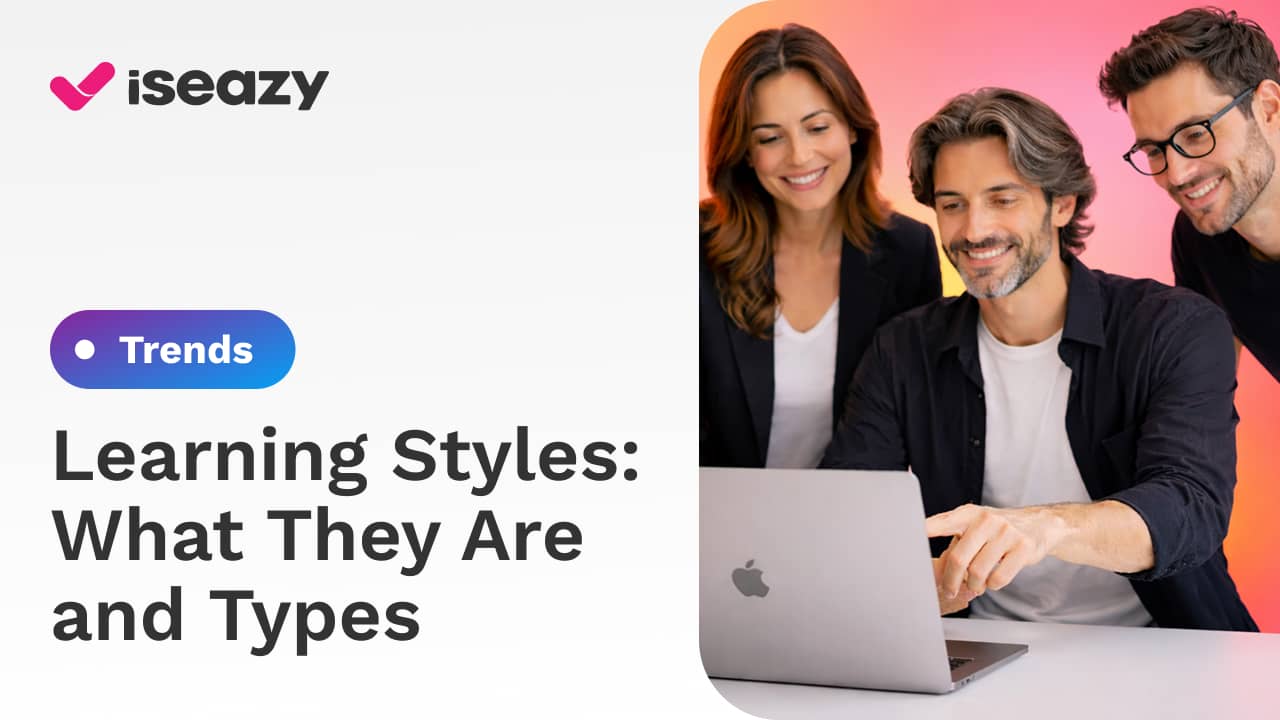
Designing an online course is not just about developing the content, but about deciding which formats will work best for the people who will take it. That is where the different learning styles become useful: they help you choose the kind of resource that best captures attention and supports retention.
WEBINAR ONDEMAND
How to create e-learning courses adapted to different types of learning with AI


The VARK model, put forward by Neil Fleming and Colleen Mills, describes four styles based on how people prefer to receive and process information. It is not about pigeonholing anyone, but about recognizing that each person may learn better by combining different styles depending on the context. In this guide we will go through all four, the alternatives to VARK, what the evidence says about all of them, and how to apply them realistically in your e-learning courses.
| Style | How they learn best | E-learning formats that fit |
|---|---|---|
| Visual | With the support of images, diagrams, mind maps and spatial relationships. | Infographics, diagrams, short videos, animations, concept maps. |
| Auditory | By listening to explanations, talking, debating and verbalizing ideas. | Podcasts/micro-audio, voice-overs, guided discussions, audio feedback. |
| Read/write | By reading, taking notes, structuring information and consulting sources. | Articles, downloadable guides, glossaries, summary and writing activities. |
| Kinesthetic | By trying, practicing, experimenting and applying in real situations. | Simulations, scenarios, interactive exercises (drag and drop), role plays. |
According to Bay Atlantic University, “every learner uses a different strategy to remember information more efficiently while studying. Some take notes, some draw diagrams, some prefer listening to lectures, and so on.”
Let’s take a closer look at the four main learning styles based on Fleming and Mills’ VARK model, bearing in mind that learners may not use just one of them, but several learning methods at once.
Learners with a visual learning style prefer to learn through observation and the graphical representation of information. This approach allows them to process content more effectively when it is presented in clear, well-organized visual forms.
To boost visual learning in an online or in-person course, you can use specific strategies:
Remember that, for visual learners, it is not about presenting attractive information, but about structuring it visually in a logical and meaningful way.
The auditory learning style is based on the ability to take in, process and retain information through active listening and spoken interaction. Auditory learners find it easier to understand concepts when they are presented through sounds, spoken words or music.
To improve learning for auditory learners, you can put the following strategies in place:
These activities not only support information retention, they also create a dynamic learning environment that encourages auditory learners to take an active part.

The kinesthetic learning style is oriented towards action and experimentation. These learners process information better through hands-on experiences, movement and activities that involve their active participation. Their learning is most effective when they can interact directly with the content instead of just watching or listening.
To boost kinesthetic learning, it is essential to include practical, dynamic activities that involve them directly:
These techniques allow kinesthetic learners to get deeply involved in the learning process, supporting not only comprehension but also long-term retention.
The read/write learning style is ideal for those learners who process and retain information most effectively through texts and notes. For these learners, words are the main tool for understanding concepts and organizing ideas.
To support learners with this learning style, it is key to provide clear, well-organized written materials:
This approach not only helps them consolidate their learning, it also allows them to develop writing and analysis skills they can apply in many contexts. Although many learners combine several styles, these methods make sure read/write learners have resources tailored to their needs.

This is the question almost no article on the subject answers, and it is worth tackling head-on before redesigning any course. Learning styles are one of the most popular ideas in training, but also one of the most poorly understood.
Two very different claims need to be told apart. The first is that people have preferences about how they receive information: this is well documented and anyone can recognize it in themselves. The second, far stronger one, is the so-called matching hypothesis: that teaching each person in their preferred format improves their results. They are different things, and only the first one is supported.
In 2008, a team of researchers made up of Harold Pashler, Mark McDaniel, Doug Rohrer and Robert Bjork reviewed the scientific literature on the subject in Psychological Science in the Public Interest. Validating the matching hypothesis required a very specific experimental design: classifying participants by style, randomly assigning them to different teaching methods and checking whether each group performs better with “its” method. When they reviewed the published studies they found very few that met that design, and those that did showed no such crossover in results.
It is worth reading the conclusion carefully, because it tends to be exaggerated in both directions. The authors did not claim that learning styles are false or that preferences do not exist. What they pointed out is that the evidence needed to justify classifying learners and tailoring instruction to them has not been produced.
If classifying people does not hold up, what do we do with all this? The practical answer is to shift the question. Instead of asking yourself how does this person learn, ask yourself what format does this content call for. A procedure is practiced, a concept is explained, a relationship between ideas is drawn, a difficult conversation is rehearsed. That is where multimodal learning comes in.
The multimodal approach does not classify anyone: it presents each idea in more than one format and lets each person lean on whichever feels most comfortable. It has a huge operational advantage for an L&D team, namely that it does not force you to produce several versions of the same course. It is also the starting point for most learning strategies that work in corporate environments.
| Approach | What it proposes | What it means for your team |
|---|---|---|
| Learning styles (classic) | Classify each person into a style and tailor the content to them. | High cost: several versions of the course. No solid empirical backing. |
| Multimodal learning | Explain each idea in more than one format within the same course. | A single, richer course. It benefits the whole workforce at once. |
| Format driven by content | Choose the format the subject matter demands, not the person. | Faster design decisions that are easier to defend to the business. |
Designing online training for diverse teams is not about labeling each person and adapting the whole course to a single style. In practice, what works best is to create multimodal experiences and give options so each employee can choose how to move forward depending on the content, the moment and their preference. These six instructional design principles are a good starting point.
Open each block with a short, clear explanation in text and pair it with visual support that genuinely adds something: a diagram, an explanatory image or a simple animation. The goal is not to decorate, but to reduce cognitive load and make comprehension easier.
After the definition, add a practical case: a customer situation, an internal procedure, a typical mistake or an everyday decision. This helps both the more text-oriented profiles and those who need context in order to understand.
Turn each idea into an action: ordering steps, matching concepts, choosing the best answer in a scenario, drag and drop, completing a mini-checklist. Keep the activity short —between 30 and 90 seconds— and with immediate feedback. If the task is complex, lean on instructional scaffolding to gradually remove the support.
You do not need to create two complete versions of the course. It is enough to add occasional alternative paths or elements: for example, a text summary for those who prefer to read, alongside a voice-over for those who prefer to listen. The key lies in how you structure your e-learning content from the start.
Finish with a downloadable reminder or a final summary to reinforce retention. You can also close the training with a short final test to check comprehension.
Review which formats drive the most completion, time on task and correct answers. If a module is always abandoned at the same point, it is not a style problem: it is usually a problem of clarity or length.
Although the VARK model is one of the best known, it is not the only approach to understanding how we learn. There are other theories that broaden our understanding of learning styles, bringing in factors such as cognitive preferences, the diversity of intelligences and practical adaptations. They are worth knowing, although the same caution about the evidence we saw earlier applies to them. Below we explore four notable models:
David Kolb proposed an experiential learning model based on how people process and apply information in their environment. This approach focuses on two main dimensions: how individuals perceive information (concrete experience or abstract conceptualization) and how they process it (active experimentation or reflection). Four learning styles emerge from these combinations:
It is the model that connects best with experiential learning in online training, because it describes a cycle —experience, reflect, conceptualize, apply— that you can translate directly into the structure of a course.
Put forward by Ned Herrmann, this model is based on the idea that the brain has four main quadrants that influence how we process information: analytical, practical, relational and experimental. Each person shows a unique combination of brain preferences.
This model helps you develop balanced activities that address multiple preferences, improving participation and performance.
Howard Gardner proposed that there is no single general intelligence, but a range of intelligences that people use to learn and solve problems. According to his theory, every individual has a unique combination of these intelligences.
The diversity of this theory makes it possible to design programs that tap into each person’s unique potential.
This model combines dimensions such as sensory perception, the way information is processed and organizational preferences to identify unique learning styles.
This approach is especially useful for personalizing educational programs and making sure every learner finds methods that fit their needs.
| Model | What it classifies | When it helps you in corporate training |
|---|---|---|
| VARK (Fleming and Mills) | The preferred sensory modality: visual, auditory, read/write or kinesthetic. | To check that a course does not always lean on the same format. |
| Kolb | The way experience is perceived and processed, in a four-stage cycle. | To structure hands-on training: experience, reflect, conceptualize, apply. |
| Herrmann | The dominant brain preference: analytical, practical, relational or experimental. | To balance activities in leadership and skills programs. |
| Gardner | Different types of intelligence, rather than a single general ability. | To justify a variety of resources for very mixed audiences. |
These are the most frequent slip-ups when a training team tries to put learning styles into practice. Spotting them early saves a lot of work.
Learning styles are neither fixed nor universal; they are shaped by a range of factors that influence how each person processes, retains and applies knowledge. These factors include personal characteristics, social influences and the impact of technology and the learning environment.
Individual factors play a crucial role, since every person has a unique way of interpreting and processing information.
The social and cultural context has a significant impact, since it shapes beliefs, values and expectations around education.
In the digital age, technology and the learning environment play an increasingly important part in how people engage with knowledge.
Choosing the right technology is vital to increase knowledge retention and motivation. There are many e-learning technologies that provide a wide variety of content formats and communication channels you can take advantage of to improve results.
For example, authoring tools such as isEazy Author let you create content with a wide variety of resources that work for all kinds of learners. You can include videos, simulations, exercises and games that work well with kinesthetic and analytical profiles, insert links to external sources such as e-books or websites, and even create charts and infographics for those who rely on the visual.
For those who prefer reading and writing or social learning, training apps such as isEazy Engage or LMS/LXP platforms such as isEazy LMS are ideal environments. Both offer communication channels where learners can interact with others —chats, forums, shared and commented content— and spaces for exchanging knowledge with articles, manuals, PDFs and much more.
When you are looking for the ideal environment, make sure it has the right tools to assess and give constructive feedback, or that it includes self-assessment features.
Giving constructive feedback is an integral part of the learning process: it helps evaluate results and, done well, improves motivation and performance.
But assessment should not be the same for everyone. Just as each person learns differently, feedback can also be adapted. In this section you will see how to give each profile the kind of feedback that works best for them:
Present information clearly, concisely and in an organized way. Emphasize the main points with visual resources such as charts, tables, diagrams or screenshots that include elements highlighted with colors, symbols and icons.
Giving feedback verbally, in a conversational and expressive way, is very useful for this profile. Use examples and stories to get your ideas across and show relevance. You can use audio to give feedback personally, while chats and forums are useful for gathering information through conversations.
For this profile, your comments should be detailed, precise and logical, with data and references to back them up. Leaning on articles or guides that support your comments is very effective. It is also essential to provide clear guidelines with instructions, recommendations or steps to follow.
Here, practical, experiential and motivating feedback works best. The ideal is to use gamification apps such as isEazy Game, which give instant feedback through interactive experiences.
Put these tips into practice and you will see how each person responds better to assessments tailored to the way they work. And remember the nuance from the section on evidence: adapting the channel of the feedback is reasonable and cheap; redesigning the whole program by style is not.

In an increasingly diverse training environment, bringing multiple learning styles together has become an essential practice. This approach aims to combine different methodologies and resources to offer a complete, inclusive and effective experience.
The key lies in flexibility and creativity when designing the experience. Some hybrid and multichannel approaches:
Holistic education does not just aim to pass on knowledge, but to develop skills, values and competencies that prepare people for real challenges. This is how a combination of styles enriches it:
Grupo Puerto de Cartagena is a good example of how all this works off paper. With a very mixed workforce —technical, operational and administrative profiles sharing the same training plan— they opted for a learning experience with varied formats instead of replicating the same course over and over. Find out how they did it →
In the digital age, learning styles are evolving as technology reshapes training. Today people engage with interactive tools, online resources, multimedia content and social networks that call for a more flexible approach. Training teams need to adapt by bringing in digital platforms, encouraging collaboration and offering personalized experiences. Blended models, such as blended learning, fit particularly well with this diversity of preferences.
Committing to adaptability and making the most of technology improves engagement, caters to different preferences and prepares teams for what lies ahead. As learning styles keep evolving, adopting digital innovations will be key to effective training.
In short: taking the diversity of preferences into account when planning content and assessments helps maximize learners’ potential, as long as it does not turn into labeling people. Choosing flexible, adaptable learning environments, with tools that support diverse formats and a holistic approach, is essential in the digital age.

Learning styles are a useful tool for thinking about training, as long as they are used in the right direction. We have seen that the VARK model helps you check whether a course always leans on the same format, that Kolb, Herrmann, Gardner and Felder bring complementary perspectives, and that the evidence advises against classifying each person and redesigning the program around them. What does work is simpler and cheaper: explaining each idea in more than one format, bringing theory down to real examples, including short practice with immediate feedback and measuring what is really happening in each module. The question that guides every decision is not how each employee learns, but what format each piece of content calls for.
Putting that into practice depends above all on what you build your courses with. isEazy Author is designed for exactly this: it lets you combine text, video, audio, infographics, simulations and interactive exercises within the same course, without duplicating versions or depending on technical profiles, so every concept can be explained in several ways at once. From there, the rest of the suite reinforces the pieces we have been looking at: isEazy Game for gamified practice with immediate feedback, isEazy LMS to distribute and measure, and isEazy Brain to adapt the pace to how each person progresses. Request a demo and see it for yourself with your own content.
Learning styles are preferences or tendencies about how a person receives and processes information (for example, with visual support, by listening or by practicing). They are usually grouped into models such as VARK.
Yes, it’s entirely possible to have more than one learning style. Many people combine the qualities of different styles, such as visual, auditory or kinesthetic, depending on the content they encounter or their learning context. Learning to adapt to various styles can also enrich the educational experience and facilitate knowledge acquisition in different situations.
Understanding learning styles allows you tor personalize teaching and make it more effective. By tailoring educational methods to individual preferences, you can enhance knowledge retention, foster engagement and facilitate skill development. Additionally, this understanding can help you to design more inclusive educational strategies that address the specific needs of each learner.
Visual and auditory styles are particularly well-suited for online education, with platforms often including materials such as videos, graphics, presentations and recordings. However, the kinesthetic style can also be integrated through interactive activities, simulations or practical projects, ensuring that all learners can benefit within a digital environment.
In order too identify different learning styles within a group, educators can use questionnaires, make direct observations, and analyze student preferences during practical activities. Digital tools, such as interactive surveys and data analytics in e-learning platforms, also make it easier to collect information on how each learner interacts with educational materials, and which methods may be most effective for them.
VAK covers three learning styles or preferences: visual, auditory and kinesthetic. VARK adds a fourth one: read/write, focused on learning through texts and notes.
Use the VARK model to vary formats: explain, show, let learners practice and reinforce with a summary. The key is that learners apply it to their job, not just consume content. That is why a multimodal strategy, which offers different options and combines formats, tends to be the most effective approach, especially for a diverse workforce.

Create personalized e-learning courses for every learning style with interactive elements like videos, exercises, games, and graphs
Try it freeRequest a demo

Turn concepts into real-world skills
Put theory into practice with isEazy Skills, the most comprehensive power skills course catalog on the market.


Turn concepts into real-world skills
Put theory into practice with isEazy Skills, the most comprehensive power skills course catalog on the market.