CASE STUDY
How Clarel reshaped their company culture through 100% online training

Brain
The first AI trained to teach

Author
The #1 AI-powered authoring tool on the market

Factory
Custom e-learning content factory

Skills
Comprehensive power skills course catalog

LMS
All-in-one LMS platform with AI

Engage
App for managing frontline teams
Product

What is Brain?
Everything you need to know about the first AI trained to teach.

Learning agent: CompanionNew
Supports learners and answers their questions right inside the course, without breaking the audit trail.

How does it work?
Adaptive, conversational, and contextual. That’s learning with Brain.
FEATURES

AINew
Unlock your full potential and speed up course creation with artificial intelligence.

Accessibility
Automatically meet accessibility guidelines—without sacrificing interactivity!

Interactivity
Boost engagement with interactive, ready-to-use activities that make learning fun.

Course Creation
Reduce the time it takes to create your e-learning courses with our authoring tool.

Distribution
We offer you different distribution options, so that nothing can stop you.

SCORM
Publish your course in SCORM format and share it on any LMS.
SERVICES

Instrucional Design
Surprise your students with multimedia and interactive content.

Custom Courses
We create e-learning courses for you—tailored to your needs and hassle-free!

Virtual Reality
Turn learning into an immersive experience.

Custom Avatars
Give your courses and videos a unique touch with personalized avatars.

Audiovisual FactoryNew
Turn training into something dynamic and visual with engaging videos.
CATALOG

Course catalog
Over 600 skills and competency courses to help you adapt to your team's needs.
Microsoft Copilot AcademyNew
Your professionals will learn how to apply Copilot AI to key processes within your organization.

Artificial Intelligence Academy
Train your teams in the practical use of AI to boost productivity and innovation in your company.

Cybersecurity Academy
Capacita a tu empresa con el catálogo más completo en seguridad digital corporativa.

Use cases
Choose the solution that best fits your needs

Industries
Solutions for all types of industries
USE CASES

Onboarding
Facilitate the onboarding process, productivity and engagement of your new employees.

Upskilling
Boost your team's skills and prepare them for the challenges of the future with upskilling.

Microlearning
Discover all the advantages of microlearning and boost your training results.

Gamification
Enjoy addictive training that will get your professionals hooked.

Internal Communication
Improve communication in your company and enjoy an aligned and committed team.

Mobile learning
Agile, flexible, and interactive learning—built for today’s digital-first workforce.
INDUSTRIES

Banking and financial services
Training in compliance, cybersecurity, customer service, and key skills development.

Pharmaceuticals and healthcare
Digital onboarding, regulatory updates, and ongoing training for healthcare staff.

Retail and consumer
Agile and scalable training for in-store, operational, and customer service teams.

Industry and manufacturing
Training in processes, safety, and corporate culture for distributed teams.

Education and training
Digital solutions for training centers, internal academies, and corporate universities.

Technology and telecommunications
Development of technical talent, digital skills, and upskilling and reskilling programs.
CLIENTS

MAPFRE
How MAPFRE turn e-learning into sales with isEazy

Pepco
A personalised learning experience for a growing team.

BBVA
Digitisation and creation of high quality e-learning content.

Shiseido
We increase the engagement of the training with a social and gamified app.

Telefónica
Large-scale reskilling for the company's digital transformation.

Vodafone
A personalised learning experience for a growing team.
More than 1,000 companies already rely on isEazy.




MEET ISEAZY

Events
Discover our upcoming events and connect with the future of e-learning.

News
Find out the latest news about isEazy: press releases, partnerships, updates...

Contact
Leave us your personal details and we will contact you as soon as possible.
About isEazyNew
Find out more about our company.

Careers
We are looking for the best talent, join our team!

Partners
Become our partner and grow your business.
INTERESTING RESOURCES

Blog
The best content on e-learning: trends, tools and key strategies.

Whitepapers
Gain valuable insights and stay ahead of industry trends.

Product releases
The latest news and releases of our e-learning products and solutions.

Glossary
Definitions of the most commonly used terms and key industry concepts.

Guides
Discover the best step-by-step tips and tricks to optimize your L&D strategy.

Webinars
Video sessions on our products, trends and more

Comparatives
Compare e-learning solutions available on the market and choose the most suitable one.


WEBINAR
Master AI in isEazy Author in under an hour.




GUIDE
Prepare your organization to comply with the new AI regulations


AUTHORING TOOL
Create courses automatically and generate interactive activities, games, translations, and multimedia resources in seconds.

Stay up to date with all our latest news
 Subscribe to our newsletter
 Stay up to date with all our latest news

August 10, 2026

CONTENT CREATED BY:

Table of contents
The design of the employee learning experience is the reason why many corporate training initiatives lose their impact within weeks of launch. If you are part of an L&D team, this guide gives you practical tools to build an employee learning experience your people will want to engage with — not just complete.
The employee learning experience is the set of perceptions, interactions, and outcomes a person goes through during their development journey within an organisation. It goes far beyond the content of a course: it includes the format, the technology used, the context in which learning takes place, the feedback received, and how learning is applied on the job.
Unlike traditional training approaches focused on information delivery, the learning experience puts the employee at the centre of the process and aims to generate lasting, meaningful impact. According to the LinkedIn Workplace Learning Report 2025, 94% of employees say they would stay longer at a company that invests in their professional development. Getting this experience right is not just a pedagogical question — it is a direct lever for talent retention and competitive advantage.
It is worth distinguishing between the employee learning experience (how employees live their training journey) and experiential learning (a specific methodology based on learning by doing, following Kolb’s model). Although related, they are not the same thing.
Learning is deeply personal. Every employee has their own pace, their own way of making sense of information, and their own motivation. That is why, rather than “building courses”, L&D teams need to design experiences that accompany people through their development. These are the seven levers that make the real difference.
The design of content is one of the factors that most influences how employees experience their learning journey. It is not just about what is taught, but how it is presented. Courses that combine different formats, include hands-on activities, or incorporate small challenges tend to generate greater interest, motivation, and retention.
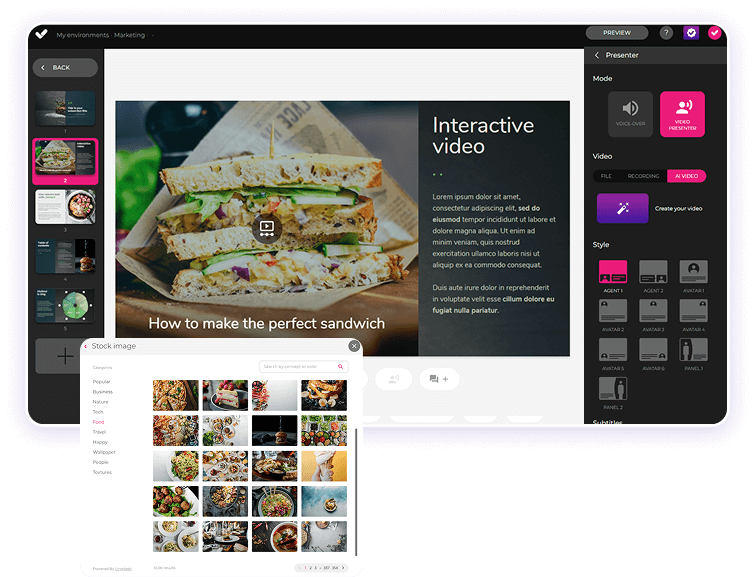
Today, authoring tools allow L&D teams to create multimodal content without advanced technical skills: interactive videos, branching scenarios, microlearning adapted to mobile devices. With isEazy Author, teams can produce this type of content quickly and at scale, without relying on external developers.
Beyond technical competencies — which tend to attract most of the attention — human skills are equally decisive for organisational progress. Communication, leadership, team management, critical thinking, and emotional intelligence are capabilities that determine how technical knowledge is actually applied day to day.
The World Economic Forum Future of Jobs Report 2025 highlights analytical thinking, creativity, and resilience among the most in-demand skills in the coming years. A complete learning experience must address both technical upskilling and the development of these cross-functional competencies. Platforms like isEazy Skills offer ready-to-use catalogues with hundreds of courses across both dimensions.

Technology should not be a barrier or an end in itself — its role is to make learning happen at the right moment and in the right format. Here, AI plays an increasingly important part: whether recommending content tailored to each employee’s needs, personalising pathways, or helping L&D teams design experiences faster.
It is useful to distinguish between two types of platforms: LMS (Learning Management Systems), focused on managing and administering training, and LXP (Learning Experience Platforms), designed to deliver more personalised, learner-centred experiences. The most complete solutions, such as isEazy LMS, bring both worlds together: training management, personalised learning experiences, AI-powered content creation, and access to a ready-to-use catalogue.
A particularly relevant trend is learning in the flow of work: integrating learning directly into the employee’s daily workflow, without disrupting their activity.
Continuous development has become essential in an environment where roles, tools, and ways of working evolve rapidly. Beyond training for today’s role, organisations need to create opportunities that allow their people to grow, specialise, or reinvent themselves when needed.
Designing structured learning pathways makes it possible to combine mandatory training with voluntary development, guiding employees progressively and coherently. For a practical framework on how to build this strategy, the isEazy guide to continuous training is an excellent starting point for L&D teams.
Not sure where to start? This table summarises the main improvement levers, their expected impact, and a first concrete action to get them moving:
| Lever | Expected impact | How to get started |
|---|---|---|
| Multimodal instructional design | High — greater retention and engagement | Audit existing content and identify what can be converted into interactive video or microlearning |
| Personalised learning pathways | High — relevant learning for each role | Define employee profiles and assign learning routes in the LMS |
| Integration of soft skills | Medium-high — impact on culture and productivity | Include at least one soft skills module in every onboarding or development pathway |
| Training measurement and analytics | High — continuous programme optimisation | Activate the LMS tracking dashboard and review completion rates monthly |
| Continuous learning culture | Very high — talent retention and adaptability | Involve managers as learning champions within their teams |
To know whether a learning experience is truly working, you need to look beyond completion rates. Training analytics help you understand how each team learns and what impact that learning has on performance and organisational goals.
The most relevant KPIs for evaluating the employee learning experience include:
Modern platforms offer dashboards that allow you to analyse progress at different levels — by individual, by department, or across the whole organisation. This visibility helps identify patterns, detect gaps, and reorient training programmes before they lose relevance.

A high-quality learning experience cannot survive without the cultural foundations to sustain it. Learning culture is the set of values, practices, and attitudes that make continuous development a norm — not an exception — within the organisation.
The manager’s role is critical. When team leaders value learning, actively recommend it, and help apply what has been learned, the impact is immediate. Training them to be development champions is one of the most cost-effective investments in L&D.
Peer learning also reinforces that culture: sharing experiences, documenting insights, and collaborating on real projects fosters curiosity and continuous knowledge exchange.
Finally, internal communication about the training programme matters more than it might seem. When employees clearly understand how training benefits them and what opportunities it opens up, they engage more and commit more deeply.
Clarel, the perfumery and drugstore chain belonging to the DIA group, is a compelling example of how a well-built learning culture can transform the way an organisation works. With isEazy, they implemented a 100% online training model that drove a real shift in their corporate culture. Find out how they did it →
Not everyone learns the same way or needs the same things. Personalising the employee learning experience means adapting content, pace, and formats to the real needs of each person or group: their role, their level of experience, their development goals, and their learning preferences.
In practice, this translates into differentiated pathways by profile, AI-recommended content based on learning history, and the freedom for each employee to explore beyond what is mandatory. The result is an experience that feels relevant and personal, not generic.
Platforms that integrate skills management capabilities also allow personalised learning to be aligned with each employee’s real skill gaps, closing the loop between training and talent development.
Measuring the learning experience goes beyond counting how many employees have completed a course. L&D teams that genuinely want to improve need data that reflects how learning happens, not just whether people reached the end. These are the most relevant indicators, organised by what they measure:
| KPI | What it measures | Benchmark guidance |
|---|---|---|
| Completion rate | Percentage of employees who finish assigned content | Sector benchmark: 70–85% for mandatory training |
| Active learning time | Real minutes of interaction, excluding pauses and abandoned sessions | Flags content that is too long or not engaging enough |
| Assessment scores | Level of comprehension and retention at the end of a module | Flag if the average drops below 70% |
| Training NPS | Employee satisfaction with the learning experience (0–10 scale) | NPS >40 indicates the experience is perceived as valuable |
| Voluntary return rate | Employees who consume content again on their own initiative | Indicates perceived relevance and quality of the content |
| Impact on business KPIs | Correlation between completed training and team performance metrics | The most strategic indicator; requires cross-referencing LMS and HR data |
A robust training analytics system makes it possible to centralise this data in a dashboard and act on it before a programme loses relevance. The key is not to measure everything — it is to measure what enables better decisions.
Knowing the most frequent pitfalls helps you avoid them before they affect the programme. These are the ones that appear most often in organisations with good intentions but that struggle to achieve the expected impact:
A well-designed employee learning experience improves motivation, agility, and the whole organisation’s capacity to adapt to change. It is not built overnight or with a single tool: it requires combining good instructional design, the right technology, data for continuous optimisation, and a culture that sustains it all.
For L&D teams, this represents a genuine opportunity to move from managing courses to designing experiences with measurable business impact. For organisations, it is one of the investments with the highest long-term return.
If you would like to see how isEazy can help you design better learning experiences for your employees, request a personalised demo.
An HR leader can improve the employee learning experience by implementing strategies focused on wellbeing, professional development, and effective communication. Designing recognition programmes, creating personalised learning pathways, and using technology to deliver accessible, engaging training all play a key role. Regular feedback loops and data-driven decisions help ensure the experience remains relevant and impactful.
To plan and design effective training activities, start by clearly defining learning objectives and understanding the needs and preferences of your team. Choosing the right methodologies — blended learning, microlearning, simulations — and adapting formats to different learner profiles makes a significant difference. Measuring results and iterating based on feedback ensures continuous improvement.
Collaborative tools enrich the training process by enabling synchronous and asynchronous communication between learners and facilitators. They promote active learning, allowing participants to share knowledge, co-create content, and solve challenges together. This social dimension increases learner engagement and strengthens knowledge retention over time.
Several tools are designed to enhance collaborative learning. Miro is a virtual whiteboard that supports mind mapping and course planning. Canva helps create engaging visual materials to improve the training experience. isEazy Author is a platform that allows L&D teams to design and create training content collaboratively, with interactive resources, branching scenarios, and multimedia elements — all without requiring technical expertise.
For a gamification strategy to succeed, several key elements must be considered: define specific objectives such as increasing participation or improving knowledge retention; analyse your audience characteristics and motivations; design an intuitive and engaging experience; and choose the right mechanics — points, badges, leaderboards, or challenges. Measuring outcomes and adjusting based on data ensures the strategy remains effective over time.
isEazy Engage boosts learner engagement through a mobile-first experience that combines microlearning, gamification, social features, and intelligent content. The result is training that is more accessible, personalised, and motivating — helping organisations achieve higher completion rates and a stronger learning culture.

Create personalized e-learning courses for every learning style with interactive elements like videos, exercises, games, and graphs
Try it freeRequest a demo


All Your Training Needs in One Powerful Tool!
Training management, content library, course creation, and progress tracking—everything in a single subscription!


All Your Training Needs in One Powerful Tool!
Training management, content library, course creation, and progress tracking—everything in a single subscription!