WHITEPAPER
How to improve the learning experience in your company with an LXP

Brain
The first AI trained to teach

Author
The #1 AI-powered authoring tool on the market

Factory
Custom e-learning content factory

Skills
Comprehensive power skills course catalog

LMS
All-in-one LMS platform with AI

Engage
App for managing frontline teams
FEATURES

AINew
Unlock your full potential and speed up course creation with artificial intelligence.

Accessibility
Automatically meet accessibility guidelines—without sacrificing interactivity!

Interactivity
Boost engagement with interactive, ready-to-use activities that make learning fun.

Course Creation
Reduce the time it takes to create your e-learning courses with our authoring tool.

Distribution
We offer you different distribution options, so that nothing can stop you.

SCORM
Publish your course in SCORM format and share it on any LMS.
SERVICES

Instrucional Design
Surprise your students with multimedia and interactive content.

Custom Courses
We create e-learning courses for you—tailored to your needs and hassle-free!

Virtual Reality
Turn learning into an immersive experience.

Custom Avatars
Give your courses and videos a unique touch with personalized avatars.

Audiovisual FactoryNew
Turn training into something dynamic and visual with engaging videos.
CATALOG

Course catalog
Over 600 skills and competency courses to help you adapt to your team's needs.
Microsoft Copilot AcademyNew
Your professionals will learn how to apply Copilot AI to key processes within your organization.

Artificial Intelligence Academy
Train your teams in the practical use of AI to boost productivity and innovation in your company.

Cybersecurity Academy
Capacita a tu empresa con el catálogo más completo en seguridad digital corporativa.

Use cases
Choose the solution that best fits your needs

Industries
Solutions for all types of industries
USE CASES

Onboarding
Facilitate the onboarding process, productivity and engagement of your new employees.

Upskilling
Boost your team's skills and prepare them for the challenges of the future with upskilling.

Microlearning
Discover all the advantages of microlearning and boost your training results.

Gamification
Enjoy addictive training that will get your professionals hooked.

Internal Communication
Improve communication in your company and enjoy an aligned and committed team.

Mobile learning
Agile, flexible, and interactive learning—built for today’s digital-first workforce.
INDUSTRIES

Banking and financial services
Training in compliance, cybersecurity, customer service, and key skills development.

Pharmaceuticals and healthcare
Digital onboarding, regulatory updates, and ongoing training for healthcare staff.

Retail and consumer
Agile and scalable training for in-store, operational, and customer service teams.

Industry and manufacturing
Training in processes, safety, and corporate culture for distributed teams.

Education and training
Digital solutions for training centers, internal academies, and corporate universities.

Technology and telecommunications
Development of technical talent, digital skills, and upskilling and reskilling programs.
CLIENTS

MAPFRE
How MAPFRE turn e-learning into sales with isEazy

Pepco
A personalised learning experience for a growing team.

BBVA
Digitisation and creation of high quality e-learning content.

Shiseido
We increase the engagement of the training with a social and gamified app.

Telefónica
Large-scale reskilling for the company's digital transformation.

Vodafone
A personalised learning experience for a growing team.
More than 1,000 companies already rely on isEazy.





MEET ISEAZY

Events
Discover our upcoming events and connect with the future of e-learning.

News
Find out the latest news about isEazy: press releases, partnerships, updates...

Contact
Leave us your personal details and we will contact you as soon as possible.
About isEazyNew
Find out more about our company.

Careers
We are looking for the best talent, join our team!

Partners
Become our partner and grow your business.
INTERESTING RESOURCES

Blog
The best content on e-learning: trends, tools and key strategies.

Whitepapers
Gain valuable insights and stay ahead of industry trends.

Product releases
The latest news and releases of our e-learning products and solutions.

Glossary
Definitions of the most commonly used terms and key industry concepts.

Guides
Discover the best step-by-step tips and tricks to optimize your L&D strategy.

Webinars
Video sessions on our products, trends and more

Comparatives
Compare e-learning solutions available on the market and choose the most suitable one.


WEBINAR
Master AI in isEazy Author in under an hour.




GUIDE
Prepare your organization to comply with the new AI regulations

Stay up to date with all our latest news
 Subscribe to our newsletter
 Stay up to date with all our latest news

February 27, 2026

CONTENT CREATED BY:

Table of contents
Corporate learning is undergoing a profound transformation. It is no longer enough to publish a course in an LMS and expect employees to complete it: organizations that lead in talent have understood that learning together, in context, and continuously is a true competitive advantage. In this scenario, social learning networks have emerged as one of the most powerful tools for HR and L&D teams.
In this post, you will find everything you need to understand what they are, how they work, how they differ from a traditional LMS, and, above all, how to implement them successfully in your organization. It includes a comparison, an implementation checklist, a governance template for moderators, and answers to the most frequently asked questions in the industry.
Social learning networks (SLNs) are digital platforms designed specifically to facilitate interaction, collaboration, and knowledge sharing among people with a shared learning goal. Unlike general-purpose networks like LinkedIn or Slack, SLNs natively integrate courses, assessments, progress tracking, and gamification mechanics within a social environment.
In the field of Human Resources and corporate learning (L&D), these platforms have gained momentum because they respond to a fundamental shift in how adults learn: according to the 70-20-10 model, 20% of professional learning happens through social interaction with peers and mentors. SLNs digitize and scale precisely that 20%.
A relevant data point: a Brandon Hall Group report notes that organizations with social learning cultures report knowledge retention rates up to 40% higher than those that rely exclusively on in-person training or passive e-learning. Meanwhile, Deloitte indicates that companies with strong learning programs are 92% more likely to innovate.

A corporate social learning network is not a single tool, but an ecosystem that integrates multiple technological and pedagogical layers. Below, we break down the functionalities that determine its real value in a business environment:
Each employee has a profile that displays their skills, learning achievements, earned badges, and contributions to the community. This creates internal transparency and makes it easier to identify internal experts—an essential asset in organizations with more than 200 employees, where knowledge is often fragmented.
Users can create or join communities focused on specific areas (sales, compliance, onboarding, leadership…). Within these spaces, they post questions, share resources, and discuss solutions. The result is a living knowledge base that grows with every interaction.
Unlike traditional LMS platforms, where the course is the central unit, in an SLN structured content coexists with user-generated content. Microlearning modules (5–10 minutes) are distributed contextually within the feed, just like a post on a social network.
Points, badges, leaderboards, and digital rewards create a motivation loop that sustains participation over time. Studies reveal that 89% of employees say they are more productive when training includes gamification elements.
SLNs support text, short videos, infographics, podcasts, and documents. UGC, for example, when a senior sales representative shares a 2-minute video with a negotiation tip, often generates higher engagement than formal corporate content, as it is perceived as more authentic and relevant.
Learning should not interrupt work; it should happen within it. SLNs send push notifications and contextual emails that deliver the right content to the right person at the right time—just before an important meeting, during onboarding, or after identifying a skills gap.

One of the most common mistakes among L&D teams is confusing a social learning network with an LMS or with an internal communication tool such as Slack or Teams. Each solution addresses different needs and, in many cases, they are complementary. Choosing the right one—or the right combination—depends on the specific use case. This table helps you compare the two most common approaches in corporate environments:
| Criteria | Social Learning Network (SLN) | Traditional LMS |
|---|---|---|
| Main objective | Collaborative and social learning | Training management and delivery |
| User profile | Yes, with achievements and skills | Yes (depending on the type of LMS) |
| Online courses | Yes (short modules) | Yes (full courses) |
| Gamification | High (badges, rankings) | Depends on the LMS |
| Tracking (analytics) | Depends on the platform | High (SCORM, xAPI) |
| Informal learning | Very high | Depends on the LMS |
| Ideal for | Deskless teams, communities of practice, social onboarding | Mandatory training, compliance, corporate training |
Beyond theoretical arguments, the value of an SLN is measured through concrete business metrics. Below, we outline the benefits with the strongest empirical backing, including client data and industry studies:
The social and interactive nature of SLNs significantly reduces the dropout rates typically associated with passive e-learning. According to internal data from isEazy clients, organizations that combined training with gamification achieved knowledge retention rates above 90%, along with increased engagement and broader reach.
Tacit knowledge—the know-how employees carry in their heads but that is never formally documented—accounts for between 60% and 80% of organizational knowledge, according to Gartner. Communities of practice within an SLN create the context and motivation for this knowledge to surface, be shared, and become institutionalized.
Social onboarding—where new hires interact with mentors, consult community FAQs, and complete collaborative challenges—can reduce time to full productivity by 30% to 50%.
By shifting part of in-person training and externally produced content toward peer-to-peer learning, SLNs can reduce the cost per training hour by 30% to 60%. The Association for Talent Development (ATD) estimates that the average training cost per employee in companies without social learning is 35% higher than in organizations with active social learning ecosystems.
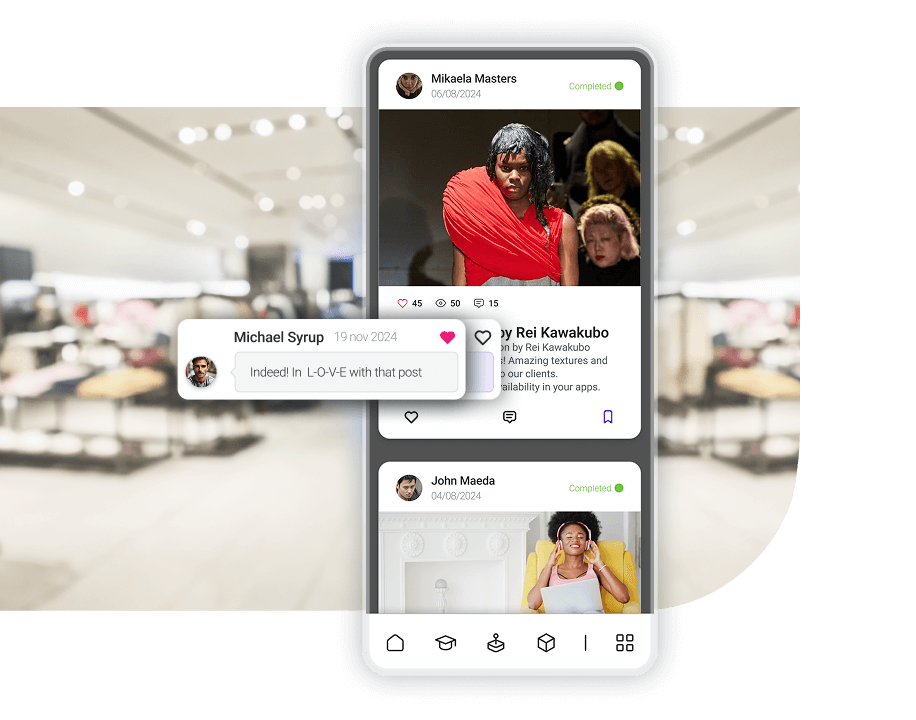
Clarel, a beauty and personal care retail chain within the DIA Group, was undergoing a major transformation of its business model, shifting from self-service to a product- and customer-focused approach. Its main challenge was to turn its entire sales team into product experts, particularly in the latest additions to its private-label catalog.
The challenge was twofold: more than 3,000 employees geographically dispersed across Spain and very limited time to implement an effective training solution. In-person training was not viable at that scale.
With isEazy Engage, Clarel implemented a strategy based on smartphone-accessible microlearning, gamification through challenges and games to assess learning, and personalized content created by the team itself, including product videos recorded by store managers, which received an overwhelmingly positive response from colleagues. Discover this success story:
CASE STUDY
How Clarel trained professionals at +1,000 points of sale with mobile learning


Implementing a social learning network is not an automatic guarantee of success. There are critical factors that can undermine the project:
Clear governance is the difference between a vibrant community and an abandoned forum. This template defines the role of the Community Manager / Moderator within a corporate SLN:
Moderator responsibilities:
Participation guidelines for members:
Beyond creating the platform, instructional design and activation strategy determine whether collaboration truly happens. These are the most effective levers:
Social learning networks have moved beyond being an emerging trend to become a critical infrastructure for organizational learning. In an environment where knowledge has an increasingly shorter lifespan and teams are more distributed and diverse than ever, the ability to learn together—continuously, contextually, and collaboratively—is what differentiates organizations that grow from those that fall behind.
The challenge is not technological: the platforms exist and are accessible. The challenge is cultural and strategic: creating the conditions for social learning to be recognized, rewarded, and measured like any other organizational asset.
isEazy’s solutions are designed precisely for this challenge: to provide environments where structured training, peer learning, and internal communication converge into an experience that teams use not only because they have to, but because they want to. Request an isEazy demo and discover how to transform learning in your organization.
An LMS (Learning Management System) is primarily designed to manage and deliver structured training, with a strong focus on compliance tracking and certification. A Social Learning Network (SLN), by contrast, prioritizes social interaction and peer-to-peer learning. In practice, more mature organizations combine both: the LMS for mandatory training and the SLN for informal learning and knowledge management. Modern solutions such as isEazy Engage integrate both functions into a single environment.
Yes, although the benefits scale with team size. In companies with fewer than 50 employees, the main challenge is reaching the critical mass of participants needed to keep communities active. A recommended strategy is to start with a single cross-functional community and grow organically. From 100–150 employees onward, SLNs tend to deliver a very clear training ROI.
Key metrics fall into three categories: engagement (weekly active users, posts, comments, likes), learning (course completion rate, assessment scores, time spent on the platform, achievements unlocked), and business impact (reduced onboarding time, internal training NPS, correlation between training completion and performance KPIs). Measuring activity alone is not enough; learning metrics must be connected to business outcomes.
Initial engagement indicators (posts, forum participation) are typically visible within the first 2–4 weeks if the launch is well designed. Business impact metrics (error reduction, faster onboarding, improved NPS) usually require 3 to 6 months. The most successful projects establish a 90-day activation plan with clear milestones before launch.
Mature SLNs offer integrations with HCM systems (SAP SuccessFactors, Workday), LMS platforms (via SCORM and xAPI/Tin Can standards), communication tools (Teams, Slack), and analytics platforms. Integration with talent management systems allows organizations to link training progress to career paths, performance evaluations, and succession planning.

Discover isEazy's powerful tools!
Request a demoTry it free
Need help?
If you are looking for a perfect e-learning tool tailored to your needs, don't hesitate to write to us!


Need help?
If you are looking for a perfect e-learning tool tailored to your needs, don't hesitate to write to us!