Brain
The first AI trained to teach

Author
The #1 AI-powered authoring tool on the market

Factory
Custom e-learning content factory

Skills
Comprehensive power skills course catalog

LMS
All-in-one LMS platform with AI

Engage
App for managing frontline teams
Product

What is Brain?
Everything you need to know about the first AI trained to teach.

How does it work?
Adaptive, conversational, and contextual. That’s learning with Brain.

Security
Why your company’s knowledge never leaves your environment or trains other models.

Comparison
Discover what sets isEazy Brain apart from other AI solutions.

Frequently Asked Questions
Want to learn more? Find answers to all your questions about isEazy Brain here.

FEATURES

AINew
Unlock your full potential and speed up course creation with artificial intelligence.

Accessibility
Automatically meet accessibility guidelines—without sacrificing interactivity!

Interactivity
Boost engagement with interactive, ready-to-use activities that make learning fun.

Course Creation
Reduce the time it takes to create your e-learning courses with our authoring tool.

Distribution
We offer you different distribution options, so that nothing can stop you.

SCORM
Publish your course in SCORM format and share it on any LMS.

SERVICES

Instrucional Design
Surprise your students with multimedia and interactive content.

Custom Courses
We create e-learning courses for you—tailored to your needs and hassle-free!

Virtual Reality
Turn learning into an immersive experience.

Custom Avatars
Give your courses and videos a unique touch with personalized avatars.

Audiovisual FactoryNew
Turn training into something dynamic and visual with engaging videos.

CATALOG

Course catalog
Over 600 skills and competency courses to help you adapt to your team's needs.
Microsoft Copilot AcademyNew
Your professionals will learn how to apply Copilot AI to key processes within your organization.

Artificial Intelligence Academy
Train your teams in the practical use of AI to boost productivity and innovation in your company.

Cybersecurity Academy
Capacita a tu empresa con el catálogo más completo en seguridad digital corporativa.
FEATURES

Learning platform
Manage all your training from one place

Analitycs
Measure the impact of your training

Learning Experience
Offer a unique learning experience to your team
Content Library
Choose from hundreds of expert-created courses
Authoring Tool
Create your own content—faster than ever


Use cases
Choose the solution that best fits your needs

Industries
Solutions for all types of industries
USE CASES

Onboarding
Facilitate the onboarding process, productivity and engagement of your new employees.

Upskilling
Boost your team's skills and prepare them for the challenges of the future with upskilling.

Microlearning
Discover all the advantages of microlearning and boost your training results.

Gamification
Enjoy addictive training that will get your professionals hooked.

Internal Communication
Improve communication in your company and enjoy an aligned and committed team.

Mobile learning
Agile, flexible, and interactive learning—built for today’s digital-first workforce.
INDUSTRIES

Banking and financial services
Training in compliance, cybersecurity, customer service, and key skills development.

Pharmaceuticals and healthcare
Digital onboarding, regulatory updates, and ongoing training for healthcare staff.

Retail and consumer
Agile and scalable training for in-store, operational, and customer service teams.

Industry and manufacturing
Training in processes, safety, and corporate culture for distributed teams.

Education and training
Digital solutions for training centers, internal academies, and corporate universities.

Technology and telecommunications
Development of technical talent, digital skills, and upskilling and reskilling programs.
CLIENTS

MAPFRE
How MAPFRE turn e-learning into sales with isEazy

Pepco
A personalised learning experience for a growing team.

BBVA
Digitisation and creation of high quality e-learning content.

Shiseido
We increase the engagement of the training with a social and gamified app.

Telefónica
Large-scale reskilling for the company's digital transformation.

Vodafone
A personalised learning experience for a growing team.
More than 1,000 companies already rely on isEazy.






MEET ISEAZY

Events
Discover our upcoming events and connect with the future of e-learning.

News
Find out the latest news about isEazy: press releases, partnerships, updates...

Contact
Leave us your personal details and we will contact you as soon as possible.
About isEazyNew
Find out more about our company.

Careers
We are looking for the best talent, join our team!

Partners
Become our partner and grow your business.

INTERESTING RESOURCES

Blog
The best content on e-learning: trends, tools and key strategies.

Whitepapers
Gain valuable insights and stay ahead of industry trends.

Product releases
The latest news and releases of our e-learning products and solutions.

Glossary
Definitions of the most commonly used terms and key industry concepts.

Guides
Discover the best step-by-step tips and tricks to optimize your L&D strategy.

Webinars
Video sessions on our products, trends and more

Comparatives
Compare e-learning solutions available on the market and choose the most suitable one.


WEBINAR
Master AI in isEazy Author in under an hour.




GUIDE
Prepare your organization to comply with the new AI regulations

Stay up to date with all our latest news
 Subscribe to our newsletter
 Stay up to date with all our latest news

April 17, 2026
On-the-Job Training: How to Effectively Develop Employee Skills

CONTENT CREATED BY:

Table of contents
On-the-job training (OJT) is the most effective method for employees to acquire real skills in the same environment where they will apply them. Unlike traditional theoretical training, OJT combines practice, context and immediate feedback to accelerate professional development.
What is on-the-job training and how does it work
On-the-job training is a practical methodology in which employees acquire skills and knowledge directly in the workplace, through experience and using the resources and tools they rely on every day to carry out their responsibilities.
Rather than depending on external or theoretical training programmes, employees learn from colleagues and managers, observe real-life situations and actively participate in them. This allows them to develop specific skills directly related to their job responsibilities.
According to LinkedIn Learning’s Workplace Learning Report 2024, 90% of organisations acknowledge that talent retention would improve with greater investment in learning and development. OJT is one of the most direct levers to achieve this.
When is this type of training most useful?
On-the-job training is ideal for learning specific processes or procedures, mastering tools or machinery, and preparing employees to fulfil their role within the company autonomously and without errors. It is also especially useful during new employee onboarding, internal promotions, or changes in work processes.
How the OJT cycle works
An effective OJT programme follows a four-phase cycle:
- Prepare: the trainer explains the task and assesses the employee’s starting level.
- Demonstrate: the trainer carries out the task while explaining each step.
- Practise: the employee performs the task under supervision and receives immediate feedback.
- Consolidate: the employee works independently; the trainer monitors and adjusts as needed.
On-the-job training vs. off-the-job training
This method has been recognised for decades and continues to grow in popularity due to its effectiveness in acquiring the skills, knowledge and competencies needed to perform specific job tasks. However, it has particular characteristics that set it apart from other methods such as off-the-job learning. Here are some key differences:
| Differences | On-the-job | Off-the-job |
|---|---|---|
| Location | In the workplace (office, factory, warehouse, etc.) | Outside the workplace (classrooms, training centres, etc.) |
| Learning methods | "Learning-by-doing", observation and hands-on experience | Theoretical learning |
| Costs | Low cost, as it typically uses existing resources, facilities and internal colleagues or supervisors as trainers | Training materials, facilities and external trainers |
| Schedules | During regular working hours | Dedicated time outside of work obligations |
| Focus | Specific learning: tasks, projects, job-related skills | Broader learning: concepts, theoretical knowledge |
Benefits of on-the-job training for organisations and employees
On-the-job training benefits both employees and organisations, providing hands-on experience and rapid learning opportunities that drive productivity and, in turn, business competitiveness. Here are the benefits for both parties:
For employees:
- Agile, real-world adaptation: employees integrate into their role quickly by facing real situations, reducing the likelihood of making mistakes.
- Building confidence and competence: training in their own work environment makes employees feel more capable and confident, improving both performance and professional self-esteem.
- Increased job satisfaction: constant contact with colleagues from day one fosters a sense of belonging and improves the overall working environment.
- Continuous professional growth: learning through daily work supports the progressive and sustainable development of new skills.
For organisations:
- Reduced ramp-up time: employees become productive faster, which translates into lower onboarding costs.
- Lower turnover rate: well-structured onboarding training improves retention, especially in the first months of employment.
- Internal knowledge transfer: OJT preserves and disseminates organisational know-how without relying on external trainers.
- Better alignment with real processes: training is directly applicable to the company’s context, with no gap between what is learned and what is needed on the job.
Types of on-the-job training
There are various on-the-job training methods that can be applied in practice, both for new employees and for teams undergoing reskilling:
- Mentoring, coaching and shadowing: the employee works alongside an experienced mentor or colleague who guides them through specific tasks, provides real-time feedback and shares best practices.
- Job rotation: employees move between different roles or departments, gaining varied skills and a broader understanding of how the organisation works.
- Practical projects: allow employees to apply learned skills in real situations, tackling challenges and developing concrete solutions.
- Learning-by-doing: employees are assigned specific tasks that require the application of new skills, promoting active learning. You can expand on this approach with the concept of learning in the flow of work, which integrates learning directly into everyday tasks.
- Simulations: recreate workplace scenarios (such as customer service or emergency situations) where employees can practice responses and improve their skills in a safe environment, either virtually or with the help of colleagues.
If you’re looking for more concrete ideas to structure these dynamics, check out our guide on employee training activities.
How to implement on-the-job training step by step
One of the main differences between an OJT programme that works and one that doesn’t is prior planning. These are the four steps we recommend at isEazy to structure an effective on-the-job training programme:
1. Training needs assessment
Before designing any programme, identify what skills or knowledge each employee or team needs to develop. This can be done through performance reviews, interviews with managers, or analysis of the most frequent errors in daily work. This assessment is the foundation for everything else.
2. OJT programme design
Define specific learning objectives, select internal trainers (mentors, supervisors or key colleagues), choose the most appropriate methodologies (mentoring, rotation, practical projects) and prepare the necessary supporting materials.
3. Implementation and follow-up
Roll out the programme while maintaining fluid communication between trainers and employees. Track progress, identify blockers and adjust the pace as needed. Using a training platform makes this follow-up significantly easier.
4. Evaluation and continuous improvement
At the end of the programme — and throughout its execution — measure results against the KPIs defined in advance. Use that data to improve future editions and justify the investment to senior management.

KPIs and metrics to measure the success of your on-the-job training
Measuring the impact of on-the-job training is one of the most common challenges for L&D teams. Without data, it is impossible to justify the investment to senior leadership or improve the programme systematically. These are the key KPIs you should monitor:
| KPI | What it measures | How to obtain it |
|---|---|---|
| Completion rate | Percentage of employees who complete the programme | LMS or training platform |
| Time to competency | Days from the start of training to the expected level of autonomous performance | Manager tracking + LMS data |
| Error reduction | Decrease in incidents or mistakes after completing the training | Quality records or team incident logs |
| Training NPS | Employee satisfaction with the learning experience | Post-training survey (0-10 scale) |
| Productivity increase | Measurable performance improvement before and after the programme | Production metrics or performance reviews |
For a deeper analysis, we recommend applying the Kirkpatrick Model, which evaluates training across four levels: reaction (did the employee enjoy it?), learning (did they acquire knowledge?), behaviour (are they applying it at work?) and business impact. This approach helps you demonstrate the return on training investment to senior management.
How to maximise the effectiveness of your on-the-job training with a corporate app
To get the most out of this learning methodology, having the right tools in place is essential. A training app can be the perfect complement to boost and maximise your employees’ on-the-job training. Here is how this combination improves the effectiveness of your training:
Improves access to training content anytime, anywhere
A training app allows employees to access content whenever they need it, without depending on in-person sessions or fixed schedules. This is especially valuable in sectors with high turnover or teams spread across multiple locations.

Facilitates progress tracking and employee development
Staying on top of employees’ progress in their daily tasks is essential to support their professional growth and ensure business success. A training app makes task management easier by enabling detailed, personalised tracking of each employee’s progress.
Offers interactive and gamification elements
Gamification is a powerful technique for motivating employees and improving their engagement in the learning process. Integrating interactive and gamification elements into training can make learning far more engaging and enjoyable, through rankings, challenges and virtual rewards.
Integrates learning into the daily workflow
One of the strongest trends in L&D is learning in the flow of work: learning directly while working, without interrupting the flow of activity. Modern training apps deliver micro-content at the precise moment employees need it — whether before a meeting, during a new task, or right after making a mistake.
Facilitates communication and collaboration
A training app also serves as a communication and collaboration platform for employees. The best ones include discussion forums, chats and spaces where employees can share experiences and knowledge, fostering peer interaction and the exchange of ideas.

Clarel is a clear example of how on-the-job training can be scaled efficiently using mobile learning. With over 1,000 stores, the company implemented a simultaneous training solution that allowed its professionals to receive training directly on their mobile devices, improving performance and alignment with the company’s objectives. Discover how they did it in our case study →
Take your training strategy to the next level with isEazy Engage
Now that you know what on-the-job training is and how a training app can multiply its results, it’s time to discover isEazy Engage.
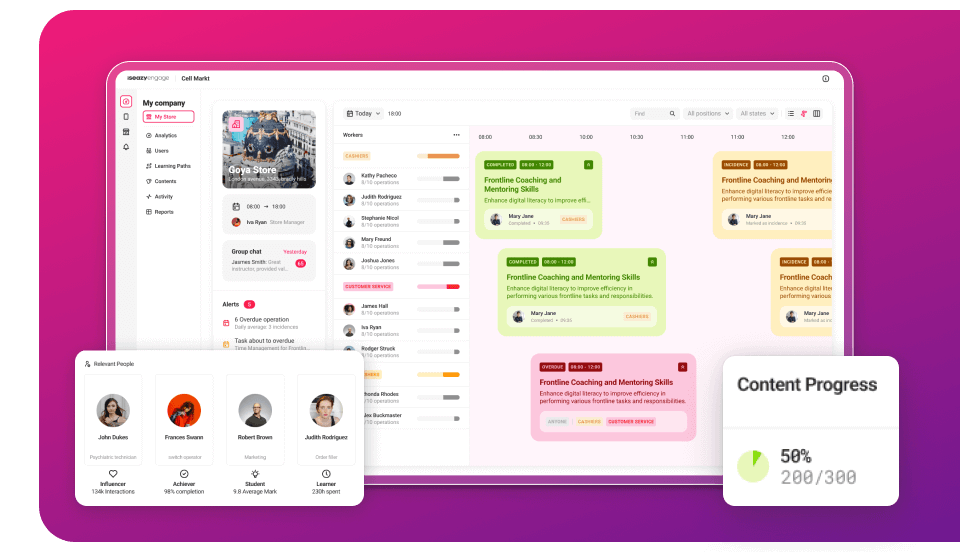
Supercharge on-the-job training with its powerful features: create personalised learning paths tailored to each employee’s needs, incorporate interactive content such as videos and quizzes to drive engagement, and keep employees motivated as they apply what they’ve learned in real situations.
Its analytics and tracking tools also allow you to monitor each employee’s performance and progress in real time, identify areas for improvement and adjust training to meet each worker’s evolving needs. If you want to extend this learning beyond the workplace, discover how to structure a continuous training plan for your organisation.
Don’t miss the opportunity to transform how your employees learn. Explore isEazy Engage and find out how we can help you achieve your goals.
Frequently asked questions about on-the-job training
What is the difference between on-the-job and off-the-job training?
The main difference lies in the environment and learning approach. In on-the-job training, employees learn in their workplace through direct experience and the use of real tools, whereas in off-the-job training, learning takes place in an external environment — such as classrooms or workshops — using theoretical examples, simulations, or exercises.
Is on-the-job training effective for new employees?
Yes, because it allows them to adapt quickly to the work environment, learn the company’s specific processes, and develop practical skills from day one.
How long does on-the-job training last?
The duration varies depending on the type of role and the skills that need to be acquired. It can last from a few days to several months, depending on the complexity of the tasks and the level of experience required.
Can on-the-job training be combined with e-learning?
Yes, on-the-job training can be combined with e-learning to offer a more comprehensive approach. E-learning allows employees to access digital training content through tools such as employee apps, which complement their hands-on learning — making it easier to access additional materials, assessments, and progress tracking.
What KPIs should I track to evaluate on-the-job training?
The main KPIs for evaluating on-the-job training are: programme completion rate, time to competency (how long it takes an employee to reach the expected level of autonomous performance), reduction in errors or incidents after training, employee satisfaction score (training NPS), and productivity increase measured before and after the programme. The ideal approach combines quantitative metrics — such as LMS data or performance records — with qualitative metrics gathered through surveys or manager assessments.
How do I know if on-the-job training is working?
The most effective way to assess whether your OJT programme is working is to cross-reference LMS data (access, completion, learning time) with business indicators such as productivity, error rate, or employee retention. The Kirkpatrick Model provides a four-level framework: reaction (did the employee enjoy it?), learning (did they acquire the knowledge?), behaviour (are they applying it?) and impact (did business results improve?). Applying this model allows you to justify the return on training investment to senior management.
Featured articles



GUIDE
Does your training plan comply with the EU AI Act?
Prepare your organization to comply with the new AI Regulations
Download guide


Did you know that only 20% of workers worldwide sit behind a desk?
Enhance their learning experience and support them in their daily lives with a tool designed specifically for them.


Did you know that only 20% of workers worldwide sit behind a desk?
Enhance their learning experience and support them in their daily lives with a tool designed specifically for them.
Related articles