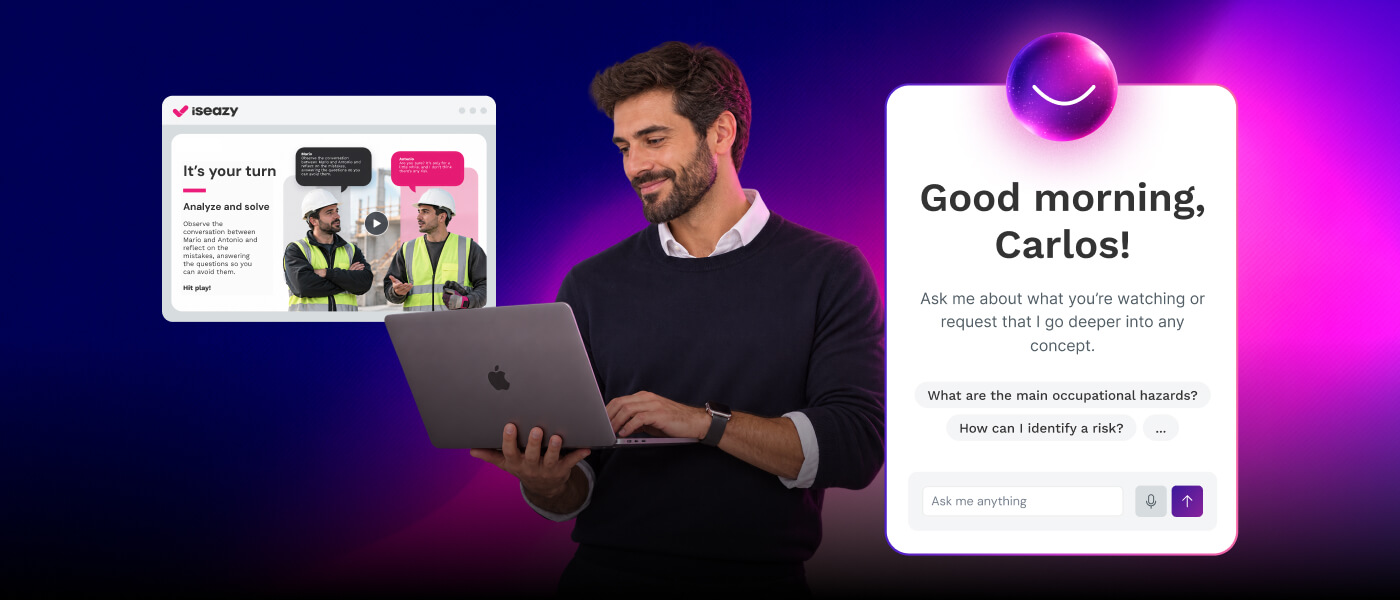
WHITEPAPER
How to adapt your in-person training to an online format with microlearning

Brain
The first AI trained to teach

Author
The #1 AI-powered authoring tool on the market

Factory
Custom e-learning content factory

Skills
Comprehensive power skills course catalog

LMS
All-in-one LMS platform with AI

Engage
App for managing frontline teams
Product

What is Brain?
Everything you need to know about the first AI trained to teach.

How does it work?
Adaptive, conversational, and contextual. That’s learning with Brain.

Security
Why your company’s knowledge never leaves your environment or trains other models.

Comparison
Discover what sets isEazy Brain apart from other AI solutions.

Frequently Asked Questions
Want to learn more? Find answers to all your questions about isEazy Brain here.
FEATURES

AINew
Unlock your full potential and speed up course creation with artificial intelligence.

Accessibility
Automatically meet accessibility guidelines—without sacrificing interactivity!

Interactivity
Boost engagement with interactive, ready-to-use activities that make learning fun.

Course Creation
Reduce the time it takes to create your e-learning courses with our authoring tool.

Distribution
We offer you different distribution options, so that nothing can stop you.

SCORM
Publish your course in SCORM format and share it on any LMS.
SERVICES

Instrucional Design
Surprise your students with multimedia and interactive content.

Custom Courses
We create e-learning courses for you—tailored to your needs and hassle-free!

Virtual Reality
Turn learning into an immersive experience.

Custom Avatars
Give your courses and videos a unique touch with personalized avatars.

Audiovisual FactoryNew
Turn training into something dynamic and visual with engaging videos.
CATALOG

Course catalog
Over 600 skills and competency courses to help you adapt to your team's needs.
Microsoft Copilot AcademyNew
Your professionals will learn how to apply Copilot AI to key processes within your organization.

Artificial Intelligence Academy
Train your teams in the practical use of AI to boost productivity and innovation in your company.

Cybersecurity Academy
Capacita a tu empresa con el catálogo más completo en seguridad digital corporativa.
FEATURES

Learning platform
Manage all your training from one place

Analitycs
Measure the impact of your training

Learning Experience
Offer a unique learning experience to your team
Content Library
Choose from hundreds of expert-created courses
Authoring Tool
Create your own content—faster than ever

Use cases
Choose the solution that best fits your needs

Industries
Solutions for all types of industries
USE CASES

Onboarding
Facilitate the onboarding process, productivity and engagement of your new employees.

Upskilling
Boost your team's skills and prepare them for the challenges of the future with upskilling.

Microlearning
Discover all the advantages of microlearning and boost your training results.

Gamification
Enjoy addictive training that will get your professionals hooked.

Internal Communication
Improve communication in your company and enjoy an aligned and committed team.

Mobile learning
Agile, flexible, and interactive learning—built for today’s digital-first workforce.
INDUSTRIES

Banking and financial services
Training in compliance, cybersecurity, customer service, and key skills development.

Pharmaceuticals and healthcare
Digital onboarding, regulatory updates, and ongoing training for healthcare staff.

Retail and consumer
Agile and scalable training for in-store, operational, and customer service teams.

Industry and manufacturing
Training in processes, safety, and corporate culture for distributed teams.

Education and training
Digital solutions for training centers, internal academies, and corporate universities.

Technology and telecommunications
Development of technical talent, digital skills, and upskilling and reskilling programs.
CLIENTS

MAPFRE
How MAPFRE turn e-learning into sales with isEazy

Pepco
A personalised learning experience for a growing team.

BBVA
Digitisation and creation of high quality e-learning content.

Shiseido
We increase the engagement of the training with a social and gamified app.

Telefónica
Large-scale reskilling for the company's digital transformation.

Vodafone
A personalised learning experience for a growing team.
More than 1,000 companies already rely on isEazy.





MEET ISEAZY

Events
Discover our upcoming events and connect with the future of e-learning.

News
Find out the latest news about isEazy: press releases, partnerships, updates...

Contact
Leave us your personal details and we will contact you as soon as possible.
About isEazyNew
Find out more about our company.

Careers
We are looking for the best talent, join our team!

Partners
Become our partner and grow your business.
INTERESTING RESOURCES

Blog
The best content on e-learning: trends, tools and key strategies.

Whitepapers
Gain valuable insights and stay ahead of industry trends.

Product releases
The latest news and releases of our e-learning products and solutions.

Glossary
Definitions of the most commonly used terms and key industry concepts.

Guides
Discover the best step-by-step tips and tricks to optimize your L&D strategy.

Webinars
Video sessions on our products, trends and more

Comparatives
Compare e-learning solutions available on the market and choose the most suitable one.


WEBINAR
Master AI in isEazy Author in under an hour.




GUIDE
Prepare your organization to comply with the new AI regulations

Stay up to date with all our latest news
 Subscribe to our newsletter
 Stay up to date with all our latest news

February 2, 2026

CONTENT CREATED BY:

Table of contents
Did you know that 70% of what your employees learn does not come from formal courses? This is the premise of the 70-20-10 model, a learning approach that has helped transform corporate training in thousands of companies worldwide.
In a business environment where change is the only constant, the traditional way of training employees has become obsolete. Companies around the world that stand out in their industries have one thing in common: they have discovered that the most effective learning does not happen in a classroom, but in day-to-day work.
The 70-20-10 model is not just an academic theory; it is a practical strategy that is helping companies reduce training costs while increasing talent retention and improving performance.
In this comprehensive guide, you will discover:
Whether you lead an HR department, manage teams, or are looking to optimize training in your company, this guide will give you the practical insights you need.
The 70-20-10 model was developed in the 1990s by Morgan McCall, Robert Eichinger, and Michael Lombardo from the Center for Creative Leadership. After interviewing nearly 200 successful executives about how they had acquired their most valuable competencies, they discovered a surprising pattern. They found that effective learning is distributed as follows:
No. And this is a crucial point that many companies misunderstand.
The creators of the model never intended these figures to be exact or prescriptive. The model does not say “spend exactly 70% of your budget on workplace experiences.” Instead, it serves as a conceptual framework that reminds us that:
In your organization, the ratio might be 60-25-15 or 80-15-5. What matters is maintaining balance and avoiding the traditional mistake of relying exclusively on classroom training.

Beyond being a theoretical distribution of learning, the 70-20-10 model has a direct impact on business outcomes. By aligning training with how people truly learn (by doing, collaborating, and solving real problems), organizations not only improve knowledge acquisition, but also on-the-job transfer, training investment efficiency, and the employee experience.
These are the main benefits that explain why so many companies are adopting this approach:
The 70-20-10 model is based on how people learn most deeply: through direct experience, practice, and interaction with others. When learning takes place in real work contexts, memory, understanding, and the ability to apply what has been learned in similar situations are strengthened, increasing transfer to daily performance compared to models focused solely on theoretical training.
By leveraging on-the-job and peer learning, companies reduce their reliance on external trainers and costly programs.
Employees apply what they learn immediately in their real work, not weeks after completing a course.
Skills such as leadership, communication, emotional intelligence, or critical thinking are truly developed through practice, not in a classroom.
Employees who feel they are constantly learning and growing are 94% more likely to stay with the company.

The context in which companies operate has changed more in the last five years than in the previous two decades. Innovation cycles are shorter, roles are constantly evolving, and technical and digital skills are transforming at high speed.
In this scenario, traditional training models, based almost exclusively on formal courses, are no longer enough to keep teams up to date. The 70-20-10 model becomes especially relevant because it offers a more realistic view of how people learn in the workplace: by combining practical experience, social learning, and structured training to respond to an increasingly dynamic and uncertain professional environment.
According to the World Economic Forum, 50% of the skills you need today will be obsolete within the next 5 years. Employees cannot wait for quarterly courses—they need to learn continuously, in the flow of their work.
According to Gallup, millennials and Generation Z, who represent the majority of today’s workforce, value continuous professional development. 87% of them consider having development opportunities at work to be important.
The rise of hybrid and remote work has democratized access to different forms of learning, but it has also fragmented informal social learning opportunities.
Applying the 70-20-10 model does not simply mean adding more courses or opening a Teams channel. It involves designing a learning ecosystem where daily experience, collaboration between people, and formal training work together to develop real competencies. These are the key actions to activate it properly within the organization.
The core of the model lies in learning by doing. This is where the most complex skills are developed and where learning naturally transfers to performance.
Some ways to drive it:
This type of learning aligns with the concept of learning in the flow of work, where development happens while working, not outside the real context.
WHITEPAPER
How to adapt your in-person training to an online format with microlearning


A large part of learning happens through conversations, observation, and shared experiences. Organizations that systematize this exchange accelerate the development of their teams.
Key actions:
Want to see a real success story? Discover how we helped Petit Palace boost their team’s talent through Mentoring.
CASE STUDY
How Petit Palace managed to enhance the talent of its team through mentoring.


Structured training does not disappear, but its role is to provide the foundation, context, and reinforcement for what is learned on the job.
Key elements here include:
This formal layer acts as the framework that organizes and reinforces experiential and social learning.
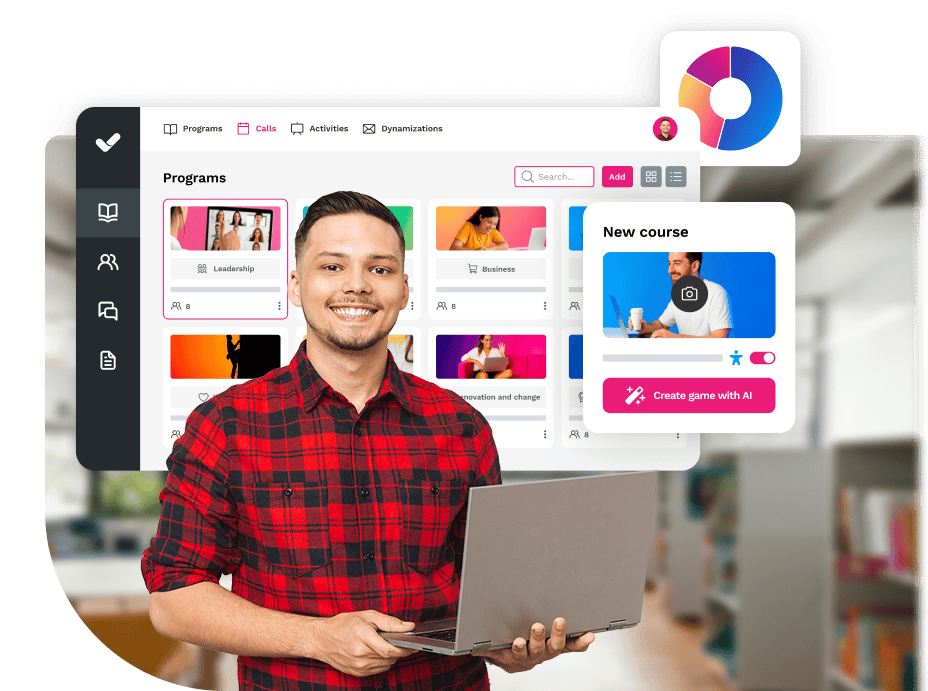
Before rolling out initiatives, it is essential to understand the starting point. Implementing 70-20-10 without this analysis often leads to isolated actions with no real impact.
It is necessary to analyze:
This diagnosis helps prioritize efforts where the impact will be greatest.
The model must be linked to results, not just training activities. That is why it is important to establish specific and measurable objectives, such as reducing onboarding time, improving skills, or increasing productivity in certain processes.
In addition to participation indicators, it is advisable to measure:
This way, learning is directly connected to organizational outcomes.
For the 70%:
For the 20%:
For the 10%:
Trying to transform the entire company at once often generates resistance. A more effective strategy is to start with a specific team or area that has a clear development need and a committed manager.
During the pilot, it is key to:
Once validated, the approach can be scaled across the rest of the organization with a higher probability of success.
Many organizations try to adopt the model but make mistakes that reduce its impact:
Implementing the 70-20-10 model does not depend only on the willingness to learn, but also on having an infrastructure that enables experience, collaboration, and structured training. Technology does not replace learning, but it makes it possible at scale.
To ensure experiential learning does not remain informal or invisible, it is important to support it with tools that structure it and connect it to performance:
These solutions help turn daily work into an intentional source of development.
Learning between people needs spaces where it can happen naturally and continuously.
Key tools here include:
These tools make collective knowledge visible and accelerate its transfer.
Formal training is still necessary, but it must be integrated into the overall ecosystem.
For this purpose, organizations use:
This layer provides coherence, traceability, and reinforcement for learning that happens outside the classroom.
| Part of the 70-20-10 model | Type of learning | Tools that enable it |
|---|---|---|
| 70% | Experiential learning on the job | Project management systems, simulation platforms and practical scenarios, performance evaluation tools, goal tracking systems |
| 20% | Social and collaborative learning | Communication and collaboration platforms (Teams, Slack), mentoring and coaching systems, digital communities of practice, internal knowledge repositories |
| 10% | Structured formal training | LMS for training management, e-learning content authoring tools, professional course catalogs, assessment and analytics systems |
So far, we have seen what applying the 70-20-10 model involves: integrating experience, collaboration, and structured training into a single ecosystem. The challenge for many organizations is not understanding the model, but having the right tools to make it work in a coordinated and scalable way.
This is where isEazy’s AI-powered e-learning tools make the difference.
With isEazy LMS, organizations can centralize training, define role-based learning paths, and measure progress with analytics that connect learning and performance. Its all-in-one approach includes an AI-powered authoring tool that makes it easy to create interactive courses, simulations, and multimedia content without requiring technical profiles. It also offers a library of professional courses that accelerates coverage of key competencies such as sustainability, AI, leadership, compliance, cybersecurity, and more—without starting from scratch.
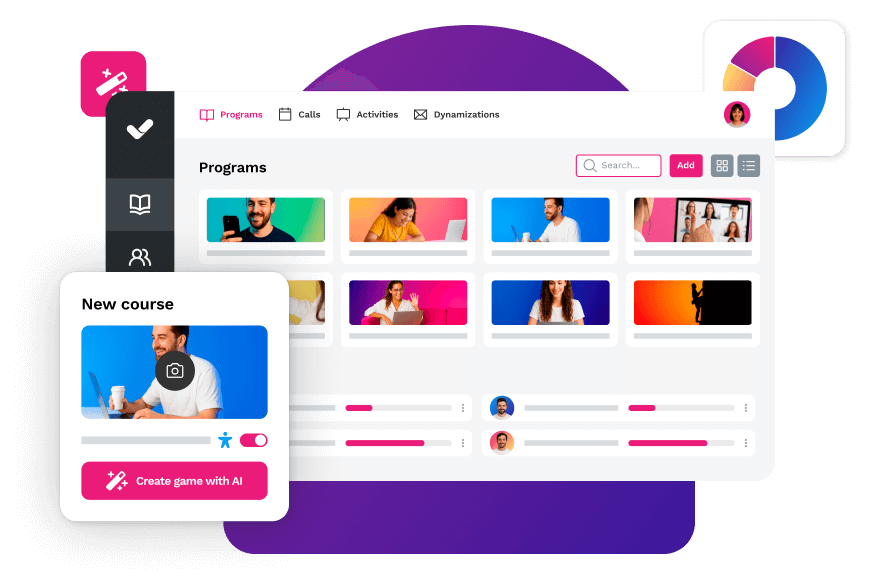
Knowledge sharing is enhanced through isEazy Engage, which combines management, internal communication, and learning in a single app specially designed for frontline teams. It enables communities of practice, experience sharing, and employee-generated content, similar to the way people interact on social networks.

The features of authoring tools such as isEazy Author for creating branching scenarios, chat simulations, and interactive videos allow learners to practice decisions and real-life situations in safe environments. This reinforces the learning that occurs in day-to-day work and facilitates the development of complex skills.

Organizations that rely exclusively on formal courses are training for the past. Today’s environment requires professionals who learn continuously, collaborate across areas, and develop competencies while working.
The 70-20-10 model offers a clear framework to achieve this, integrating experience, social learning, and structured training into a single strategy. It is not about adding more training, but about redesigning how learning happens within the organization.
Companies that adopt this approach not only develop better professionals, but also build continuous learning cultures capable of adapting to change.
If you want to see how this model can be put into practice with tools that connect formal training, social learning, and on-the-job experience, you can request a demo of our products and explore how it works in a real environment.
Yes, but it must be adapted to the context. It is not the same in an industrial company as in a technology company. What matters is balancing experience, social learning, and formal training according to the business reality.
No. Formal training remains key for providing foundations, conceptual frameworks, and certifications, but it must be complemented with on-the-job and peer learning.
If your employees learn by solving real problems, receive frequent feedback, and share knowledge across teams, you are already applying parts of the model, even if it is not formally structured.
By linking learning to business results: reduced onboarding time, improved productivity, lower turnover, or greater capacity for innovation.
Yes. Beyond completed courses, it involves measuring behavior changes, on-the-job application, and their impact on KPIs such as sales, quality, or efficiency.

GUIDE
Prepare your organization to comply with the new AI Regulations
Download guide


Discover the e-learning tools that will take your learning strategy to the next level
Amazing, intuitive, and easy-to-use software for everyone


Discover the e-learning tools that will take your learning strategy to the next level
Amazing, intuitive, and easy-to-use software for everyone