CASE STUDY
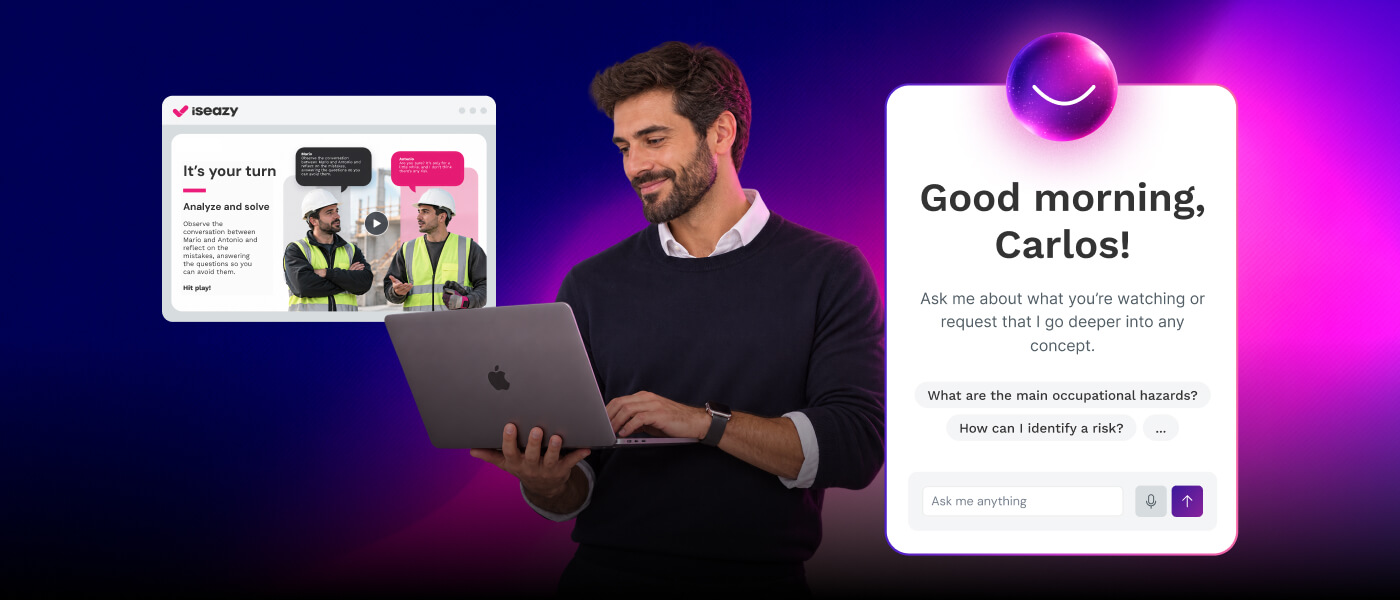
How Grupo Puerto de Cartagena optimized their training with isEazy Author’s AI.

Brain
The first AI trained to teach

Author
The #1 AI-powered authoring tool on the market

Factory
Custom e-learning content factory

Skills
Comprehensive power skills course catalog

LMS
All-in-one LMS platform with AI

Engage
App for managing frontline teams
Product

What is Brain?
Everything you need to know about the first AI trained to teach.

How does it work?
Adaptive, conversational, and contextual. That’s learning with Brain.

Security
Why your company’s knowledge never leaves your environment or trains other models.

Comparison
Discover what sets isEazy Brain apart from other AI solutions.

Frequently Asked Questions
Want to learn more? Find answers to all your questions about isEazy Brain here.
FEATURES

AINew
Unlock your full potential and speed up course creation with artificial intelligence.

Accessibility
Automatically meet accessibility guidelines—without sacrificing interactivity!

Interactivity
Boost engagement with interactive, ready-to-use activities that make learning fun.

Course Creation
Reduce the time it takes to create your e-learning courses with our authoring tool.

Distribution
We offer you different distribution options, so that nothing can stop you.

SCORM
Publish your course in SCORM format and share it on any LMS.
SERVICES

Instrucional Design
Surprise your students with multimedia and interactive content.

Custom Courses
We create e-learning courses for you—tailored to your needs and hassle-free!

Virtual Reality
Turn learning into an immersive experience.

Custom Avatars
Give your courses and videos a unique touch with personalized avatars.

Audiovisual FactoryNew
Turn training into something dynamic and visual with engaging videos.
CATALOG

Course catalog
Over 600 skills and competency courses to help you adapt to your team's needs.
Microsoft Copilot AcademyNew
Your professionals will learn how to apply Copilot AI to key processes within your organization.

Artificial Intelligence Academy
Train your teams in the practical use of AI to boost productivity and innovation in your company.

Cybersecurity Academy
Capacita a tu empresa con el catálogo más completo en seguridad digital corporativa.
FEATURES

Learning platform
Manage all your training from one place

Analitycs
Measure the impact of your training

Learning Experience
Offer a unique learning experience to your team
Content Library
Choose from hundreds of expert-created courses
Authoring Tool
Create your own content—faster than ever

Use cases
Choose the solution that best fits your needs

Industries
Solutions for all types of industries
USE CASES

Onboarding
Facilitate the onboarding process, productivity and engagement of your new employees.

Upskilling
Boost your team's skills and prepare them for the challenges of the future with upskilling.

Microlearning
Discover all the advantages of microlearning and boost your training results.

Gamification
Enjoy addictive training that will get your professionals hooked.

Internal Communication
Improve communication in your company and enjoy an aligned and committed team.

Mobile learning
Agile, flexible, and interactive learning—built for today’s digital-first workforce.
INDUSTRIES

Banking and financial services
Training in compliance, cybersecurity, customer service, and key skills development.

Pharmaceuticals and healthcare
Digital onboarding, regulatory updates, and ongoing training for healthcare staff.

Retail and consumer
Agile and scalable training for in-store, operational, and customer service teams.

Industry and manufacturing
Training in processes, safety, and corporate culture for distributed teams.

Education and training
Digital solutions for training centers, internal academies, and corporate universities.

Technology and telecommunications
Development of technical talent, digital skills, and upskilling and reskilling programs.
CLIENTS

MAPFRE
How MAPFRE turn e-learning into sales with isEazy

Pepco
A personalised learning experience for a growing team.

BBVA
Digitisation and creation of high quality e-learning content.

Shiseido
We increase the engagement of the training with a social and gamified app.

Telefónica
Large-scale reskilling for the company's digital transformation.

Vodafone
A personalised learning experience for a growing team.
More than 1,000 companies already rely on isEazy.





MEET ISEAZY

Events
Discover our upcoming events and connect with the future of e-learning.

News
Find out the latest news about isEazy: press releases, partnerships, updates...

Contact
Leave us your personal details and we will contact you as soon as possible.
About isEazyNew
Find out more about our company.

Careers
We are looking for the best talent, join our team!

Partners
Become our partner and grow your business.
INTERESTING RESOURCES

Blog
The best content on e-learning: trends, tools and key strategies.

Whitepapers
Gain valuable insights and stay ahead of industry trends.

Product releases
The latest news and releases of our e-learning products and solutions.

Glossary
Definitions of the most commonly used terms and key industry concepts.

Guides
Discover the best step-by-step tips and tricks to optimize your L&D strategy.

Webinars
Video sessions on our products, trends and more

Comparatives
Compare e-learning solutions available on the market and choose the most suitable one.


WEBINAR
Master AI in isEazy Author in under an hour.




GUIDE
Prepare your organization to comply with the new AI regulations

Stay up to date with all our latest news
 Subscribe to our newsletter
 Stay up to date with all our latest news

April 10, 2026

CONTENT CREATED BY:

Table of contents
Bloom’s Taxonomy is a classification framework for learning objectives that organises thinking into six progressive cognitive levels: from remembering basic information to creating new solutions. In corporate training, it serves to design structured programmes that develop real skills and generate measurable impact on the business.
Developed in 1956 by educational psychologist Benjamin Bloom and revised in 2001 by Anderson and Krathwohl, this model remains the gold standard for instructional design today. According to LinkedIn Learning’s Workplace Learning Report 2024, 90% of organisations that measure the impact of training acknowledge that having clear, structured learning objectives —precisely what Bloom’s Taxonomy facilitates— is the single most critical factor in achieving measurable results.
Bloom’s Taxonomy was developed in 1956 by a team of educational psychologists led by Benjamin Bloom. Its goal was to create a common system for classifying educational objectives and facilitate the design of assessments that were coherent with the expected level of learning. The original framework organised cognitive learning into six categories: knowledge, comprehension, application, analysis, synthesis and evaluation.
In 2001, Lorin Anderson and David Krathwohl revised the model with two fundamental changes: they renamed the levels using action verbs (what the learner does, not what they know) and swapped the top two levels, placing Create at the apex of the hierarchy above Evaluate. This adjustment better reflects the reality of learning: to create something genuinely new, one must first have evaluated options.
In the context of corporate training, Bloom’s Taxonomy has become the foundation of modern instructional design. It allows L&D teams to stop asking “what are we going to teach?” and start asking “what do employees need to be able to do?” —a shift in perspective that transforms training programmes into strategic investments with measurable returns.
In the cognitive domain, the six learning levels form a progressive hierarchy. Each level builds on the previous one, creating a development path that moves from the most basic to the most complex thinking. Understanding this hierarchy is the first step to designing corporate training programmes that genuinely transform employee behaviour.
Below are the six levels with their key verbs and practical application in corporate environments:

| Level | Key verbs | Corporate training example |
|---|---|---|
| Remember | Identify, list, name, define, recognise | Compliance quiz |
| Understand | Explain, summarise, classify, interpret, compare | Onboarding module with conceptual assessment |
| Apply | Solve, demonstrate, execute, use, implement | Customer service simulation |
| Analyse | Differentiate, examine, break down, infer, relate | Case study on performance data |
| Evaluate | Judge, critique, argue, justify, select | Peer review of project proposals |
| Create | Design, build, propose, plan, develop | Final project: designing an improvement plan |
The Analyse level is the inflection point in Bloom’s Taxonomy: it is where training stops being theoretical and begins to generate real value. Employees who reach this level do not merely know things; they are able to break down complex situations, identify patterns and draw actionable conclusions.
In corporate practice, the most effective analysis activities include real case studies, business data analysis projects, and exercises where employees must compare alternative approaches and argue their choice. This type of activity is particularly relevant in programmes focused on leadership, team management and strategic decision-making.
According to Gallup’s State of the Global Workplace 2023, only 23% of employees globally feel fully engaged at work. Training programmes that reach the Analyse level —by placing employees in front of real situations and challenging them to interpret and decide— have a direct impact on engagement, autonomy and professional contribution. Learn more about learning strategies to maximise this level.
Applying Bloom’s Taxonomy in instructional design does not mean working through all six levels in every programme. It means starting from a key question: what should the employee be able to do by the end of this training? The answer to that question determines the target cognitive level, and that level determines everything else: the verbs in the learning objectives, the content formats and the assessment methods.
The first step is to write learning objectives with action verbs that correspond to the desired cognitive level. An objective like “the employee will understand the privacy policy” is vague and unassessable. A well-written objective would be: “the employee will be able to identify the three scenarios where the privacy policy applies” (Remember/Understand level) or “will be able to resolve cases of possible non-compliance” (Apply level). The difference between the two is the difference between a training that stays on paper and one that drives real behaviour change.
Each cognitive level requires different formats. There is no point using an explanatory video for a Create-level objective, nor subjecting employees to a complex project for a Remember-level objective. The choice of format should follow from the level, not from production preferences.
Bloom’s Taxonomy delivers concrete, measurable advantages to corporate training initiatives, particularly when L&D teams are seeking to demonstrate the impact of training in business terms.
By creating progressive learning paths that gradually increase in complexity, Bloom’s Taxonomy keeps employees in an optimal development zone: sufficiently challenged to stay motivated, but without feeling overwhelmed. This structure promotes long-term retention compared to one-off or cumulative training without progression.
One of the most common problems in corporate training is the gap between what is learned and what is applied. When learning objectives are written with Bloom’s verbs aligned to real work behaviours —rather than just content— that gap narrows dramatically. Training stops being an event and becomes a results-oriented process.
Bloom’s Taxonomy provides the precise vocabulary to define what to measure at each level. This allows L&D teams to move beyond surface-level metrics (completion rates, quiz scores) towards indicators that genuinely reflect competency development.
Grupo Puerto de Cartagena is a real-world example of what happens when training is designed with a solid methodological foundation and a learner-centred approach (everboarding and learning taxonomies). With a structured learning strategy powered by isEazy, Puerto de Cartagena succeeded in strengthening key competency acquisition and raising engagement with learning, demonstrating that a well-defined taxonomy aligned with corporate objectives transforms training into a truly transformative experience for employees. Discover how they did it →
CASE STUDY
How Grupo Puerto de Cartagena optimized their training with isEazy Author’s AI.


Modern e-learning platforms are the most effective vehicle for implementing Bloom’s Taxonomy at scale. The key is choosing tools that allow you to design the right formats for each cognitive level and measure each employee’s real progress across the entire hierarchy.
A well-configured LMS allows you to create learning paths where access to higher-level content is conditional on completing the basics: an employee cannot access the case analysis module until they have passed the conceptual understanding module first. This progressive gating is not a restriction —it is a guarantee that learning consolidates before advancing.
With isEazy LMS, L&D teams can structure these progressive paths, configure access conditions based on results, and get detailed analytics on where each employee sits in the Bloom hierarchy.
The authoring tool is where Bloom’s principles come to life in course format. With isEazy Author, teams can create flashcards for Remember level, interactive modules with branching scenarios for Apply level, guided case studies for Analyse level, and project-based assessments using rubrics for the higher levels —all in one platform, with no technical expertise required.

Measuring the impact of training is one of the greatest challenges for L&D teams. Bloom’s Taxonomy provides the conceptual framework to define exactly what to measure at each level: not all metrics are relevant to all cognitive levels, and confusing them leads to erroneous conclusions about programme effectiveness.
Establishing clear Key Performance Indicators (KPIs) is fundamental to measuring the success of training initiatives. Metrics must be aligned with the target cognitive level of each programme: a 95% completion rate may be an excellent indicator for a basic-level (Remember) programme, but completely irrelevant for evaluating whether employees have developed the ability to Analyse or Create.
Below is a guide to KPIs by Bloom’s Taxonomy level:
| Level | Metric | KPIs |
|---|---|---|
| Remember | Retention of key information | Post-module quiz accuracy rate; 30-day retention |
| Understand | Correct conceptual understanding | Conceptual assessment results; explain-in-own-words questions |
| Apply | Correct use in real situations | Simulation results; on-the-job performance assessment (30-60-90 days) |
| Analyse | Diagnostic and reasoning capability | Quality of analysis in case studies; argumentation assessment |
| Evaluate | Soundness of judgement and criteria | Peer review; assessment of decisions made vs. actual results |
| Create | Quality and applicability of output generated | Project and proposal assessment; real implementation of what was designed |
The final step in demonstrating training impact is connecting learning metrics with business indicators: do employees who completed the data analysis programme make fewer errors? Do managers who went through the leadership programme have teams with higher retention? This cross-referencing of data transforms training into a measurable-ROI investment and positions the L&D team as a strategic actor within the organisation.
Applying Bloom’s Taxonomy systematically requires more than knowing the six levels. Here are the operational principles that distinguish an implementation that generates real impact from one that remains theoretical.
The most common mistake is starting from the content (“let’s create a course on assertive communication”) rather than from the level (“we want managers to be able to apply feedback techniques in difficult conversations”). When you start from the level, the entire instructional design —format, activities, assessment— automatically aligns.
Each module or learning unit must have at least one objective written with a specific, measurable Bloom verb. Avoid vague verbs like “understand”, “know” or “be aware of”. Use verbs that imply a verifiable action: identify, apply, analyse, propose, evaluate.
It is common to default to the cheapest or easiest-to-produce formats regardless of the target cognitive level. An explanatory video can be highly effective for Understand level, but wholly insufficient for Create level. The format should follow from the level, not from production decisions.
Bloom’s Taxonomy works best when levels are respected in sequence. This does not mean every programme must go through all six levels, but that higher-level modules should not be accessible until lower-level ones have been consolidated. Use your LMS’s sequencing tools to automate this.
Bloom’s Taxonomy is far more than a theoretical framework: it is a practical guide for designing corporate training programmes that drive real behavioural change in employees and generate measurable business impact. When applied correctly, it transforms the question “have we trained employees?” into “what are they now able to do that they couldn’t before?”.
Its greatest value in today’s L&D landscape is precisely its ability to connect training with business outcomes: not as an aspirational ideal, but as a systematic and repeatable process. With well-defined objectives, the right formats for each level and the correct metrics, any training team can demonstrate the ROI of their work with hard data.
With isEazy Author and isEazy LMS, organisations can bring Bloom’s principles to life through intuitive course creation, impactful content and progressive learning paths —all integrated in a single platform. Request a demo and discover how to transform corporate training in your organisation.
Bloom’s Taxonomy is a classification framework for learning objectives that organises thinking into six progressive cognitive levels: Remember, Understand, Apply, Analyse, Evaluate and Create. In corporate training, it is used to design structured programmes that develop real skills and generate measurable impact on the business. By clearly defining which cognitive level each module should target, L&D teams can choose the right formats, write precise learning objectives and measure results coherently.
The six levels of Bloom’s Taxonomy (revised 2001 version) are: 1) Remember: retrieving information from memory (quizzes, flashcards); 2) Understand: interpreting and explaining concepts (explanatory modules, videos); 3) Apply: using what has been learned in real situations (simulations, role-plays); 4) Analyse: breaking down information and examining relationships (case studies, data analysis); 5) Evaluate: making judgements based on criteria (debates, peer reviews); 6) Create: generating something new by combining what has been learned (projects, solution design). Each level builds on the previous one, forming a progressive hierarchy.
To apply Bloom’s Taxonomy in corporate training, always start by defining the target cognitive level before thinking about content: what should the employee be able to do by the end of the training? From that answer, write learning objectives with specific action verbs (identify, apply, analyse, create), choose the formats best suited to that level, and define coherent assessment metrics. A well-configured LMS allows you to create progressive learning paths that ensure learning consolidates before advancing to the next level.
The original Bloom’s Taxonomy (1956) classified objectives into six categories using nouns: Knowledge, Comprehension, Application, Analysis, Synthesis and Evaluation. The revised version of 2001, by Anderson and Krathwohl, made two key changes: it renamed the levels with action verbs (what the learner does, not what they know) and swapped the top two levels, placing Create at the apex of the hierarchy above Evaluate. This adjustment better reflects the reality of learning: to create something genuinely new, one must first have evaluated options. The revised version is the most widely used today in corporate instructional design.

GUIDE
Prepare your organization to comply with the new AI Regulations
Download guide


How can AI become your best ally for creating e-learning courses?
Discover isEazy Author's powerful AI features


How can AI become your best ally for creating e-learning courses?
Discover isEazy Author's powerful AI features