CASE STUDY
How Pepco was able to comprehensively manage employee training with an LMS

Brain
The first AI trained to teach

Author
The #1 AI-powered authoring tool on the market

Factory
Custom e-learning content factory

Skills
Comprehensive power skills course catalog

LMS
All-in-one LMS platform with AI

Engage
App for managing frontline teams
Product

What is Brain?
Everything you need to know about the first AI trained to teach.

Learning agent: CompanionNew
Supports learners and answers their questions right inside the course, without breaking the audit trail.

How does it work?
Adaptive, conversational, and contextual. That’s learning with Brain.
FEATURES

AINew
Unlock your full potential and speed up course creation with artificial intelligence.

Accessibility
Automatically meet accessibility guidelines—without sacrificing interactivity!

Interactivity
Boost engagement with interactive, ready-to-use activities that make learning fun.

Course Creation
Reduce the time it takes to create your e-learning courses with our authoring tool.

Distribution
We offer you different distribution options, so that nothing can stop you.

SCORM
Publish your course in SCORM format and share it on any LMS.
SERVICES

Instrucional Design
Surprise your students with multimedia and interactive content.

Custom Courses
We create e-learning courses for you—tailored to your needs and hassle-free!

Virtual Reality
Turn learning into an immersive experience.

Custom Avatars
Give your courses and videos a unique touch with personalized avatars.

Audiovisual FactoryNew
Turn training into something dynamic and visual with engaging videos.
CATALOG

Course catalog
Over 600 skills and competency courses to help you adapt to your team's needs.
Microsoft Copilot AcademyNew
Your professionals will learn how to apply Copilot AI to key processes within your organization.

Artificial Intelligence Academy
Train your teams in the practical use of AI to boost productivity and innovation in your company.

Cybersecurity Academy
Capacita a tu empresa con el catálogo más completo en seguridad digital corporativa.

Use cases
Choose the solution that best fits your needs

Industries
Solutions for all types of industries
USE CASES

Onboarding
Facilitate the onboarding process, productivity and engagement of your new employees.

Upskilling
Boost your team's skills and prepare them for the challenges of the future with upskilling.

Microlearning
Discover all the advantages of microlearning and boost your training results.

Gamification
Enjoy addictive training that will get your professionals hooked.

Internal Communication
Improve communication in your company and enjoy an aligned and committed team.

Mobile learning
Agile, flexible, and interactive learning—built for today’s digital-first workforce.
INDUSTRIES

Banking and financial services
Training in compliance, cybersecurity, customer service, and key skills development.

Pharmaceuticals and healthcare
Digital onboarding, regulatory updates, and ongoing training for healthcare staff.

Retail and consumer
Agile and scalable training for in-store, operational, and customer service teams.

Industry and manufacturing
Training in processes, safety, and corporate culture for distributed teams.

Education and training
Digital solutions for training centers, internal academies, and corporate universities.

Technology and telecommunications
Development of technical talent, digital skills, and upskilling and reskilling programs.
CLIENTS

MAPFRE
How MAPFRE turn e-learning into sales with isEazy

Pepco
A personalised learning experience for a growing team.

BBVA
Digitisation and creation of high quality e-learning content.

Shiseido
We increase the engagement of the training with a social and gamified app.

Telefónica
Large-scale reskilling for the company's digital transformation.

Vodafone
A personalised learning experience for a growing team.
More than 1,000 companies already rely on isEazy.





MEET ISEAZY

Events
Discover our upcoming events and connect with the future of e-learning.

News
Find out the latest news about isEazy: press releases, partnerships, updates...

Contact
Leave us your personal details and we will contact you as soon as possible.
About isEazyNew
Find out more about our company.

Careers
We are looking for the best talent, join our team!

Partners
Become our partner and grow your business.
INTERESTING RESOURCES

Blog
The best content on e-learning: trends, tools and key strategies.

Whitepapers
Gain valuable insights and stay ahead of industry trends.

Product releases
The latest news and releases of our e-learning products and solutions.

Glossary
Definitions of the most commonly used terms and key industry concepts.

Guides
Discover the best step-by-step tips and tricks to optimize your L&D strategy.

Webinars
Video sessions on our products, trends and more

Comparatives
Compare e-learning solutions available on the market and choose the most suitable one.


WEBINAR
Master AI in isEazy Author in under an hour.




GUIDE
Prepare your organization to comply with the new AI regulations


AUTHORING TOOL
Create courses automatically and generate interactive activities, games, translations, and multimedia resources in seconds.

Stay up to date with all our latest news
 Subscribe to our newsletter
 Stay up to date with all our latest news

April 23, 2026

CONTENT CREATED BY:

Table of contents
If your company manages certifications, compliance programmes or onboarding assessments through an online learning platform, you have likely wondered at some point how to ensure those tests are truly reliable. The answer lies in proctoring in e-learning: the technology that enables remote supervision of online assessments and guarantees their integrity without requiring physical presence.
The term proctoring comes from the verb to proctor, meaning to supervise. In the context of e-learning, it refers to the set of technologies and procedures that allow monitoring and verifying the integrity of an exam or assessment carried out in a digital environment.
Unlike the academic context —where proctoring is used mainly to prevent fraud in university certifications—, in the corporate environment its function is broader: to validate that employees who pass an assessment have genuinely acquired the required competencies, whether during an onboarding process, an upskilling programme or a mandatory compliance certification.
A proctoring system acts as a digital supervisor that, without interfering with the test-taker’s experience, monitors in real time or through recording what happens during the assessment: who is in front of the camera, whether any unauthorised materials are visible, and whether the behaviour is consistent with someone sitting an exam legitimately.
A modern proctoring system combines several technological layers that operate simultaneously during the assessment:
Not all assessment contexts require the same level of supervision. Before choosing a solution, it is worth understanding which modalities exist and which situation each one fits best:
| Type | How it works | Best for |
|---|---|---|
| Automated proctoring | AI analyses recordings and behaviour without real-time human intervention. Generates automatic alerts for later review. | High-volume onboarding assessments, compliance tests with large numbers of employees. |
| Live proctoring | A human supervisor observes the test-taker in real time via video call. Can intervene if irregularities are detected. | High-value certifications, professional accreditation exams, personnel selection. |
| Hybrid proctoring | Combination of AI for automatic analysis and human review only for cases flagged as suspicious. | Upskilling programmes, internal certifications with career progression implications. |
| Record & Review proctoring | The session is recorded and reviewed afterwards by a human specialist or AI. | When real-time supervision is not possible but evidence is required for potential auditing. |
In an environment where more and more companies manage employee training through digital platforms, the credibility of online assessments becomes a strategic asset. Without proctoring, a certification obtained in an LMS may carry far less weight than one achieved in person, both for the company and for the employee themselves.
These are the scenarios where proctoring adds the most value in the L&D context:
Integrating proctoring into your corporate training strategy requires more than just choosing a tool. Here are the five steps that ensure a successful implementation:
Not every test justifies the cost and friction of proctoring. The first step is to identify which assessments have a real impact on business decisions: mandatory compliance certifications, accreditation tests with curricular value, or assessments that determine access to roles or compensation. The rest can work perfectly well without active supervision.
Cross the risk level of each assessment with the employee volume. A high-volume compliance test with a low fraud risk is well suited to automated proctoring. A high-value certification for a small number of people may justify live proctoring.
The integration must be native or via LTI. With an isEazy LMS, proctoring activates directly within the assessment activity, without the employee needing to leave the training environment.
Explain what is being monitored, why, and how data is protected. Transparency is the single biggest factor in employee acceptance of proctoring.
Define who reviews the generated alerts, within what timeframe, and with what criteria decisions about the validity of a flagged assessment are made. A clear process prevents arbitrary decisions and ensures fairness.
Pepco, the retail chain with a presence in more than 20 European countries, needed to ensure that its thousands of store employees passed product training and compliance assessments in a verifiable and standardised way across all its locations. With isEazy LMS, it centralised all training management and assessment tracking, ensuring complete result traceability across every market. Find out how they did it →
Like any technology applied to people, proctoring has both strengths and weaknesses. Understanding both is essential for a responsible implementation.
The emergence of generative AI tools has transformed the proctoring landscape in a paradoxical way: the same technology that enables assessments to be supervised with greater precision is also the one that facilitates new forms of cheating. Understanding this duality is critical for any L&D manager planning their assessment strategy.
Computer vision and natural language processing models now make it possible to detect behavioural patterns that would be invisible to a human supervisor: micro eye movements, variations in typing rhythm, changes in ambient lighting or the use of earphones. AI also allows proctoring to be scaled to thousands of simultaneous sessions without increasing the cost of human supervision.
Generative AI tools can write complete answers, produce high-quality content in seconds and, in some cases, operate in ways that are difficult for conventional proctoring systems to detect. This is why the most advanced proctoring solutions are incorporating specific capabilities to detect the use of AI during assessments.
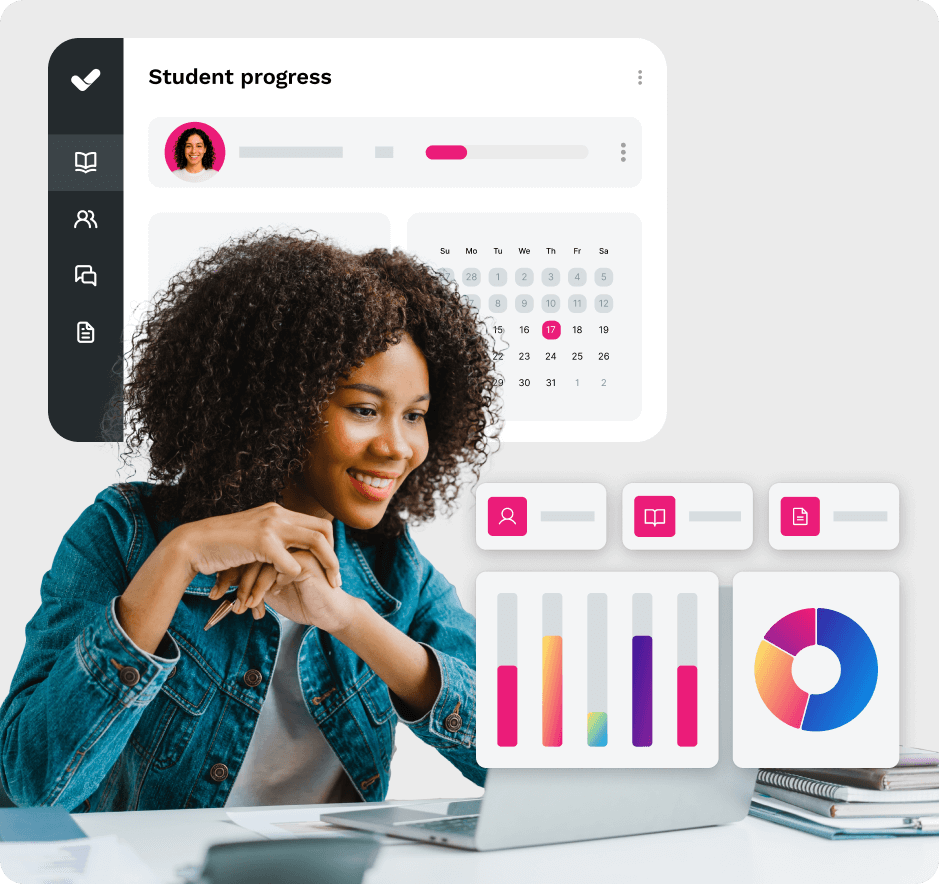
The greatest operational advantage of proctoring lies not in the supervision tool itself, but in its integration with the learning management platform. When proctoring is connected to the LMS, it enables remote monitoring to be activated for any activity within a training programme, providing complete control over the assessment process, from participant access through to results review.
This is particularly relevant for companies with employees across multiple locations —retail, logistics, pharma— where manually coordinating supervised assessments would be unmanageable. A corporate LMS like isEazy LMS acts as the operational hub of the entire training strategy, with proctoring integration as one more layer of that ecosystem.
For companies exploring platforms with advanced automation and assessment management capabilities, it may also be useful to review the AI-powered LMS options available on the market.
isEazy LMS offers native integration with leading proctoring solutions, including Smowl, allowing L&D teams to activate assessment supervision in just a few clicks, with no additional technical development required.

Proctoring in e-learning is not merely a control tool: it is the piece that allows digital assessments to carry the same strategic weight as in-person ones. In a context where companies are investing ever more in online training, assessment integrity becomes a requirement, not an afterthought.
Implementing proctoring responsibly —with transparent communication, respect for privacy, and efficient LMS integration— turns digital certifications into credentials with real value for both the company and the employee. Tools like isEazy LMS, with its open architecture and ability to integrate with specialist partners, make this goal achievable for any L&D team, regardless of size or sector.
Yes, proctoring is legal as long as it is applied in compliance with applicable data protection regulations, such as the GDPR in Europe. The key is to inform employees in advance that they will be monitored during the assessment, obtain their explicit consent, and ensure that the collected data (image, behaviour, device activity) is handled with appropriate security measures and not retained longer than necessary. It is advisable to include the use of proctoring in the company’s privacy policy and in internal training contracts or communications.
A proctoring system can detect window or screen changes, the presence of more than one person in the camera frame, the absence of the test-taker, the use of unauthorised notes or devices, unusual eye movements, and attempts to copy text. The most advanced AI-powered systems also analyse behavioural patterns throughout the exam to detect anomalies that would be difficult to perceive manually.
When implemented transparently and proportionately, proctoring has minimal impact. The key is to communicate clearly what is and is not being monitored, and that the goal is to validate learning — not to surveil the employee. Problems arise when it is introduced without prior information or with a disproportionate level of intrusiveness, which can generate distrust within the team.
Yes, most modern proctoring solutions integrate with LMS platforms using standards such as LTI or their own APIs. This allows the LMS to automatically launch the supervised environment when accessing an assessment, with results recorded directly within the LMS. An LMS like isEazy LMS centralises both training management and assessment integrity control.

Automate processes, access 600+ ready-to-use courses, or create your own content with the help of AI.
Request a demoContact us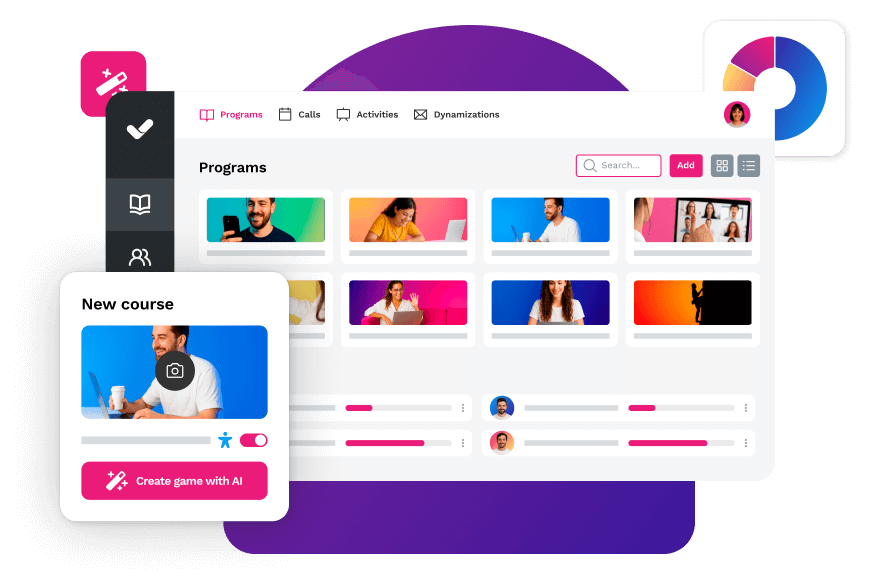


Streamline your training management
Experience the power of AI in an LMS that has it all


Streamline your training management
Experience the power of AI in an LMS that has it all