CASE STUDY
How Pepco was able to comprehensively manage employee training with an LMS

Brain
The first AI trained to teach

Author
The #1 AI-powered authoring tool on the market

Factory
Custom e-learning content factory

Skills
Comprehensive power skills course catalog

LMS
All-in-one LMS platform with AI

Engage
App for managing frontline teams
FEATURES

AINew
Unlock your full potential and speed up course creation with artificial intelligence.

Accessibility
Automatically meet accessibility guidelines—without sacrificing interactivity!

Interactivity
Boost engagement with interactive, ready-to-use activities that make learning fun.

Course Creation
Reduce the time it takes to create your e-learning courses with our authoring tool.

Distribution
We offer you different distribution options, so that nothing can stop you.

SCORM
Publish your course in SCORM format and share it on any LMS.
SERVICES

Instrucional Design
Surprise your students with multimedia and interactive content.

Custom Courses
We create e-learning courses for you—tailored to your needs and hassle-free!

Virtual Reality
Turn learning into an immersive experience.

Custom Avatars
Give your courses and videos a unique touch with personalized avatars.

Audiovisual FactoryNew
Turn training into something dynamic and visual with engaging videos.
CATALOG

Course catalog
Over 600 skills and competency courses to help you adapt to your team's needs.
Microsoft Copilot AcademyNew
Your professionals will learn how to apply Copilot AI to key processes within your organization.

Artificial Intelligence Academy
Train your teams in the practical use of AI to boost productivity and innovation in your company.

Cybersecurity Academy
Capacita a tu empresa con el catálogo más completo en seguridad digital corporativa.

Use cases
Choose the solution that best fits your needs

Industries
Solutions for all types of industries
USE CASES

Onboarding
Facilitate the onboarding process, productivity and engagement of your new employees.

Upskilling
Boost your team's skills and prepare them for the challenges of the future with upskilling.

Microlearning
Discover all the advantages of microlearning and boost your training results.

Gamification
Enjoy addictive training that will get your professionals hooked.

Internal Communication
Improve communication in your company and enjoy an aligned and committed team.

Mobile learning
Agile, flexible, and interactive learning—built for today’s digital-first workforce.
INDUSTRIES

Banking and financial services
Training in compliance, cybersecurity, customer service, and key skills development.

Pharmaceuticals and healthcare
Digital onboarding, regulatory updates, and ongoing training for healthcare staff.

Retail and consumer
Agile and scalable training for in-store, operational, and customer service teams.

Industry and manufacturing
Training in processes, safety, and corporate culture for distributed teams.

Education and training
Digital solutions for training centers, internal academies, and corporate universities.

Technology and telecommunications
Development of technical talent, digital skills, and upskilling and reskilling programs.
CLIENTS

MAPFRE
How MAPFRE turn e-learning into sales with isEazy

Pepco
A personalised learning experience for a growing team.

BBVA
Digitisation and creation of high quality e-learning content.

Shiseido
We increase the engagement of the training with a social and gamified app.

Telefónica
Large-scale reskilling for the company's digital transformation.

Vodafone
A personalised learning experience for a growing team.
More than 1,000 companies already rely on isEazy.





MEET ISEAZY

Events
Discover our upcoming events and connect with the future of e-learning.

News
Find out the latest news about isEazy: press releases, partnerships, updates...

Contact
Leave us your personal details and we will contact you as soon as possible.
About isEazyNew
Find out more about our company.

Careers
We are looking for the best talent, join our team!

Partners
Become our partner and grow your business.
INTERESTING RESOURCES

Blog
The best content on e-learning: trends, tools and key strategies.

Whitepapers
Gain valuable insights and stay ahead of industry trends.

Product releases
The latest news and releases of our e-learning products and solutions.

Glossary
Definitions of the most commonly used terms and key industry concepts.

Guides
Discover the best step-by-step tips and tricks to optimize your L&D strategy.

Webinars
Video sessions on our products, trends and more

Comparatives
Compare e-learning solutions available on the market and choose the most suitable one.


WEBINAR
Master AI in isEazy Author in under an hour.




GUIDE
Prepare your organization to comply with the new AI regulations

Stay up to date with all our latest news
 Subscribe to our newsletter
 Stay up to date with all our latest news

June 23, 2026

CONTENT CREATED BY:
Table of contents
An AI LMS is a learning management platform that incorporates artificial intelligence to personalise, automate and optimise corporate training. Unlike a conventional LMS, it adapts content and learning pathways for each employee in real time, turning training into a genuine competitive advantage for the L&D team.
In this article you will find everything you need to know: what an AI LMS actually is, how it transforms corporate training, what benefits it delivers, which features are essential, which are the best AI tools for e-learning on the market today, and how to choose the platform that best fits your organisation.
An artificial intelligence-powered learning management system (AI LMS) is a digital platform that combines the capabilities of a classic LMS — course management, enrolments, progress tracking — with AI algorithms that analyse user behaviour, detect learning patterns and dynamically adapt the training experience.
Traditional LMS platforms treat all learners the same way: the same content, the same pace, the same pathway. AI LMS platforms break that model by introducing intelligent recommendations, adaptive pathways and automation of processes that previously required manual intervention from the L&D team.
The table below summarises the most relevant differences between both models to help you make an informed decision:
Here is a direct comparison of the most relevant capabilities so you can assess which model best meets your organisation’s needs:
| Capability | Traditional LMS | AI LMS |
|---|---|---|
| Personalisation | Manual, by groups or roles | Automatic, individual and in real time |
| Content recommendations | Static catalogue or manual search | AI engine that suggests based on profile and goals |
| Learning pathways | Fixed, defined by the administrator | Adaptive, adjusted to each user's progress |
| Analytics | Basic progress and completion reports | Predictive analytics, skills gap detection |
| Administrative automation | Limited, manual processes | High: automatic assignments, certifications, reminders |
| Training needs detection | Periodic surveys or manual evaluation | Continuous, based on behaviour and performance data |
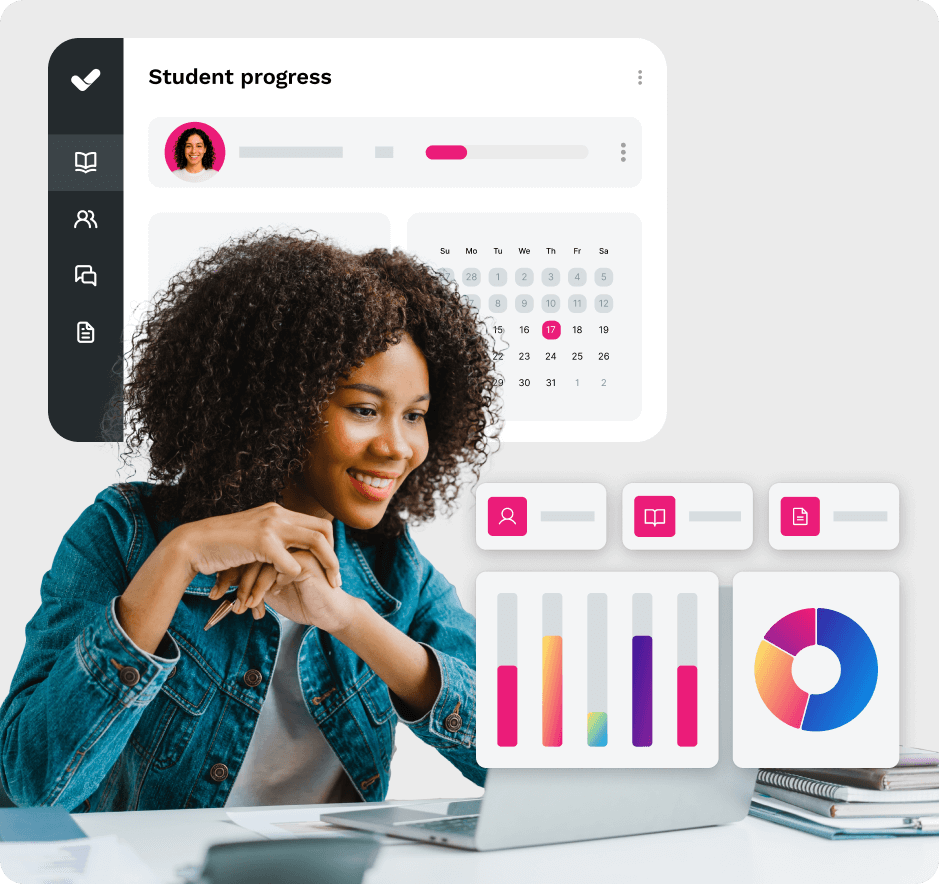
Integrating artificial intelligence into LMS systems is not a cosmetic change: it redefines the logic of how corporate learning is managed, delivered and measured. Here are the most significant transformations:

By personalising content and learning pathways to each employee’s profile, AI LMS platforms significantly improve knowledge retention. Employees learn with content that is directly aligned with their roles and goals, which increases the likelihood that they will apply what they have learned in their day-to-day work. According to the Brandon Hall Group 2023 report, organisations with personalised learning programmes report completion rates up to 40% higher than those using standard training.
An AI LMS turns training into an ongoing process rather than a one-off event. With resources always available, proactive recommendations and training adapted to immediate needs, employees develop the habit of continuous learning, driving individual and collective growth across the organisation.
By automating repetitive tasks — course assignment, completion tracking, certificate issuance, reminders — the training team can devote its time to what truly matters: designing talent development strategies aligned with business objectives.
The advanced analytics of AI LMS platforms make it possible to measure the real impact of each training programme: which content works, which gets abandoned and where knowledge gaps arise. That information turns training into a traceable investment, not an invisible cost.
An AI LMS scales with organisational growth without proportionally increasing the operational burden. Onboarding new employees, expanding the catalogue or rolling out training across multiple languages or geographies is as straightforward as configuring a new segment in the platform. Discover how isEazy LMS covers all these needs in a single environment.
Pepco, one of Europe’s fastest-growing fashion and home retail chains, used isEazy LMS to centralise and scale its training strategy across multiple countries. Thanks to the platform, the company managed to train thousands of point-of-sale employees more efficiently without growing its L&D team. Discover how they did it →
Not all AI LMS platforms offer the same level of intelligence. Here are the features that cannot be missing from the platform you choose:
A quality AI LMS provides access to a curated catalogue of ready-to-use content. With isEazy LMS, users have unlimited access to more than 600 practical microlearning courses, available in various formats and languages, covering leadership, sales, productivity, compliance and AI skills. The AI-powered recommendation engine automatically suggests the most relevant content based on each person’s profile and objectives.
Learning pathways are the backbone of any structured training strategy. In an AI LMS, these pathways are not static: they adjust based on each user’s progress, results and profile. The platform can reorder modules, suggest complementary content or skip stages that have already been mastered, ensuring every employee advances at the most efficient pace and along the most effective route for them.
The analytics capabilities of an AI LMS go far beyond simply knowing whether someone completed a course. Advanced dashboards provide data on engagement, learning times, module results and skills progression. Predictive analytics detects gaps before they become performance issues, allowing teams to act proactively.

Learning pathways are the backbone of any structured training strategy. In an AI LMS, these pathways are not static: they adjust based on each user’s progress, results and profile. The platform can reorder modules, suggest complementary content or skip stages that have already been mastered, ensuring every employee advances at the most efficient pace and along the most effective route for them.
The analytics capabilities of an AI LMS go far beyond simply knowing whether someone completed a course. Advanced dashboards provide data on engagement, learning times, module results and skills progression. Predictive analytics detects gaps before they become performance issues, allowing teams to act proactively.

The best LMS platform does not just distribute training — it also lets you create it. AI-integrated authoring tools — such as those incorporated into isEazy LMS through isEazy Author and its AI Autopilot — make it possible to transform internal documents or ideas into interactive courses in a fraction of the usual time, with automatic narration, translation, exercise generation and personalised avatars.

Your imagination has no limits. Now, your authoring tool doesn’t either
Discover the new AI Autopilot from isEazy Author


An AI LMS cannot operate in silos. The ability to integrate with HR tools, CRM systems, performance evaluation platforms or internal communication tools is essential for training to stay aligned with the organisation’s real processes.
| Criterion | Why it matters | What to look for |
|---|---|---|
| Level of AI personalisation | Determines whether the platform trains each person individually or everyone equally | Individual recommendations, adaptive pathways, role-based adjustment |
| Analytics and reporting | Without data, there are no strategic decisions | Real-time dashboard, predictive analytics, data export |
| Content catalogue | Avoids building everything from scratch | 300+ courses available, up to date and in multiple languages |
| Integrated authoring tool | Create your own content without relying on third parties | AI to generate, translate, narrate and adapt courses |
| Technical integrations | The platform must fit into your ecosystem | SCORM, xAPI, SSO, integration with HR and CRM systems |
| Support and onboarding | Adoption depends on initial guidance | 24/7 support, L&D team training, English-language documentation |
With so many options available, choosing an AI LMS can feel overwhelming. Here are the key steps to making an informed decision:
Before evaluating platforms, clarify the problem you want to solve: do you need to scale onboarding? Improve compliance? Develop digital skills? The profile of your users — age range, digital literacy, languages, geographic spread — will determine which features are priorities.
Not every organisation needs the same level of sophistication. Identify whether your priority is personalisation, content creation, administrative management or advanced analytics, and choose the platform that best addresses that dimension.
Ask the provider how the AI in their platform actually works. Is it a basic recommendation engine or is there real predictive analytics? Do they have an innovation roadmap? AI in training evolves quickly, and it pays to choose a provider committed to continuous improvement.
An AI LMS that takes months to implement or cannot integrate with your HR systems is an obstacle, not a solution. Prioritise platforms with native integrations and onboarding teams that support the go-live process.
You can review an objective comparison of the leading options on the market in our comparison of the best AI tools for e-learning, where we evaluate criteria such as features, ease of use, support and pricing.
The corporate training landscape is undergoing accelerated transformation. Organisations that continue to train everyone the same way — same courses, same pace — are losing ground to those using data and AI to make training relevant, agile and measurable. According to the LinkedIn Workplace Learning Report 2024, 91% of L&D professionals say that personalised learning is a strategic priority for their organisation over the next two years.
Artificial intelligence does not replace the training team: it amplifies it. By automating operational management and providing actionable data, it allows L&D professionals to focus on what truly makes a difference: designing meaningful learning experiences, aligning training with business strategy and developing talent proactively.
isEazy Brain represent a qualitative leap forward. Brain positions itself as a new type of learning tool—“training that thinks”—that is adaptive, conversational, and contextual. It is the first native AI applied to corporate training that adapts to each professional’s learning moment, objectives, context, difficulty level, mood, and proficiency level.

Adopting an AI LMS is one of the most strategic decisions an L&D team can make today. From learning personalisation and management automation to predictive analytics and AI-powered content creation, these platforms are not a passing trend: they are the infrastructure of the future of corporate learning.
If you are looking for an all-in-one solution that combines LMS, content catalogue and AI authoring tool in a single environment, discover isEazy LMS. Do not fall behind in the transformation of learning. Request a demo today and discover the real potential of AI-powered training.
A traditional LMS acts as a repository and course manager: it stores content, manages enrolments and tracks progress. An AI LMS goes further by incorporating artificial intelligence to personalise each employee’s experience. It analyses user behaviour, results, role and objectives to recommend relevant content, adapt difficulty levels and automate administrative tasks. The key difference is that a traditional LMS treats all learners the same way, while an AI LMS adapts training to each person in real time, boosting efficiency and engagement.
Not necessarily. Modern AI LMS platforms are designed with intuitive interfaces that make adoption straightforward even for L&D teams without a technical background. The initial setup may require support from the provider, but day-to-day use — creating learning pathways, assigning content, reviewing analytics — is designed so that any training manager can handle it independently. The most important thing is to choose a provider that offers support, onboarding assistance and clear documentation to ensure a successful implementation.
Adaptive learning is a training approach that adjusts content, pace and difficulty based on each person’s profile, progress and results. An AI LMS implements this through algorithms that analyse user behaviour data: which content they consume, where they drop off, what scores they achieve and what their professional goals are. Based on that information, the platform generates personalised recommendations, adjusts learning pathways and automatically detects knowledge gaps. The result is training that is far more relevant and effective for every employee.
isEazy Brain is isEazy’s native AI platform that converts each company’s real corporate knowledge into adaptive, contextual and conversational training agents. Unlike a conventional AI LMS, which personalises the distribution of existing content, Brain generates training directly from the organisation’s internal documentation: manuals, procedures, policies or knowledge bases. It operates under human control, with full traceability, per-client isolation and compliance with the EU AI Act. In short, it is the next layer of intelligence: it does not just manage training, it creates it, adapts it and delivers it conversationally to each professional at the exact moment they need it.
An AI LMS measures the return on training investment through advanced analytics and real-time dashboards. Key metrics include course completion rates, learning times, assessment results, engagement scores and skills progression by employee, department or role. The most advanced platforms incorporate predictive analytics that detect knowledge gaps before they impact performance. This allows L&D managers to make data-driven decisions: which programmes are working, which need improvement and where to focus training investment for maximum business impact.

Automate processes, access 600+ ready-to-use courses, or create your own content with the help of AI.
Request a demoContact us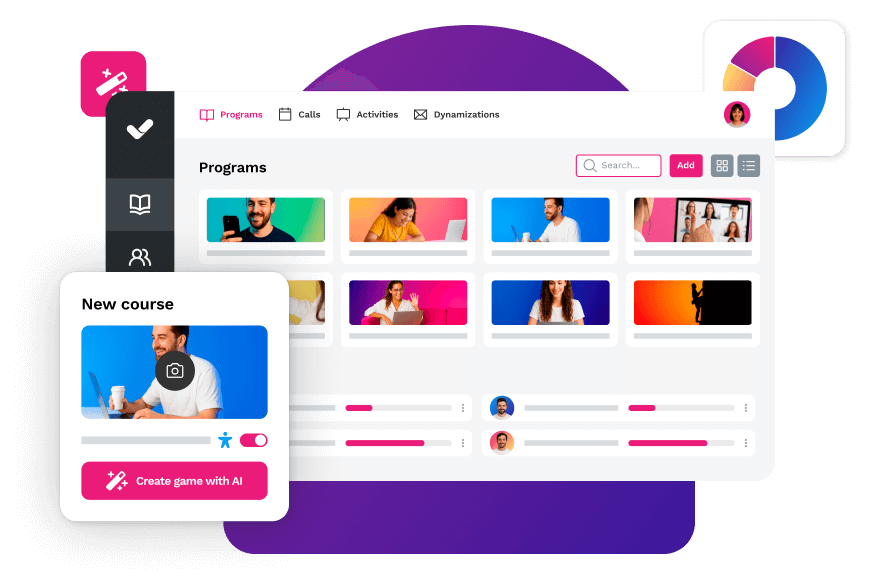


Streamline your training management
Experience the power of AI in an LMS that has it all


Streamline your training management
Experience the power of AI in an LMS that has it all