The first AI trained to teach

Brain
The first AI trained to teach

Author
The #1 AI-powered authoring tool on the market

Factory
Custom e-learning content factory

Skills
Comprehensive power skills course catalog

LMS
All-in-one LMS platform with AI

Engage
App for managing frontline teams
Discover isEazy Brain


Product
What is Brain?
Everything you need to know about the first AI trained to teach.
How does it work?
Adaptive, conversational, and contextual. That’s learning with Brain.
Security
Why your company’s knowledge never leaves your environment or trains other models.
Comparison
Discover what sets isEazy Brain apart from other AI solutions.
Frequently Asked Questions
Want to learn more? Find answers to all your questions about isEazy Brain here.
Discover isEazy Author


 See all features
FEATURES
AINew
Unlock your full potential and speed up course creation with artificial intelligence.
Accessibility
Automatically meet accessibility guidelines—without sacrificing interactivity!
Interactivity
Boost engagement with interactive, ready-to-use activities that make learning fun.
Course Creation
Reduce the time it takes to create your e-learning courses with our authoring tool.
Distribution
We offer you different distribution options, so that nothing can stop you.
SCORM
Publish your course in SCORM format and share it on any LMS.
Discover isEazy Factory


SERVICES
Instrucional Design
Surprise your students with multimedia and interactive content.
Custom Courses
We create e-learning courses for you—tailored to your needs and hassle-free!
Virtual Reality
Turn learning into an immersive experience.
Custom Avatars
Give your courses and videos a unique touch with personalized avatars.
Audiovisual FactoryNew
Turn training into something dynamic and visual with engaging videos.
Discover isEazy Skills


CATALOG
Course catalog
Over 600 skills and competency courses to help you adapt to your team's needs.
Microsoft Copilot AcademyNew
Your professionals will learn how to apply Copilot AI to key processes within your organization.
Artificial Intelligence Academy
Train your teams in the practical use of AI to boost productivity and innovation in your company.
Cybersecurity Academy
Capacita a tu empresa con el catálogo más completo en seguridad digital corporativa.
Discover isEazy LMS


FEATURES
Learning platform
Manage all your training from one place
Analitycs
Measure the impact of your training
Learning Experience
Offer a unique learning experience to your team
Content Library
Choose from hundreds of expert-created courses
Authoring Tool
Create your own content—faster than ever

Use cases
Choose the solution that best fits your needs

Industries
Solutions for all types of industries
See all solutions


 See all solutions
USE CASES
Onboarding
Facilitate the onboarding process, productivity and engagement of your new employees.
Upskilling
Boost your team's skills and prepare them for the challenges of the future with upskilling.
Microlearning
Discover all the advantages of microlearning and boost your training results.
Gamification
Enjoy addictive training that will get your professionals hooked.
Internal Communication
Improve communication in your company and enjoy an aligned and committed team.
Mobile learning
Agile, flexible, and interactive learning—built for today’s digital-first workforce.
Discover our industries


 View all industries
INDUSTRIES
Banking and financial services
Training in compliance, cybersecurity, customer service, and key skills development.
Pharmaceuticals and healthcare
Digital onboarding, regulatory updates, and ongoing training for healthcare staff.
Retail and consumer
Agile and scalable training for in-store, operational, and customer service teams.
Industry and manufacturing
Training in processes, safety, and corporate culture for distributed teams.
Education and training
Digital solutions for training centers, internal academies, and corporate universities.
Technology and telecommunications
Development of technical talent, digital skills, and upskilling and reskilling programs.
CLIENTS

MAPFRE
How MAPFRE turn e-learning into sales with isEazy

Pepco
A personalised learning experience for a growing team.

BBVA
Digitisation and creation of high quality e-learning content.

Shiseido
We increase the engagement of the training with a social and gamified app.

Telefónica
Large-scale reskilling for the company's digital transformation.

Vodafone
A personalised learning experience for a growing team.
More than 1,000 companies already rely on isEazy.





MEET ISEAZY

Events
Discover our upcoming events and connect with the future of e-learning.

News
Find out the latest news about isEazy: press releases, partnerships, updates...

Contact
Leave us your personal details and we will contact you as soon as possible.
About isEazyNew
Find out more about our company.

Careers
We are looking for the best talent, join our team!

Partners
Become our partner and grow your business.
INTERESTING RESOURCES

Blog
The best content on e-learning: trends, tools and key strategies.

Whitepapers
Gain valuable insights and stay ahead of industry trends.

Product releases
The latest news and releases of our e-learning products and solutions.

Glossary
Definitions of the most commonly used terms and key industry concepts.

Guides
Discover the best step-by-step tips and tricks to optimize your L&D strategy.

Webinars
Video sessions on our products, trends and more

Comparatives
Compare e-learning solutions available on the market and choose the most suitable one.


WEBINAR
AI-powered course creation, step by step
Master AI in isEazy Author in under an hour.

05/11/2026

11:00 AM ET



GUIDE
Does your training plan comply with the EU AI Act?
Prepare your organization to comply with the new AI regulations

Subscribe to our newsletter
Stay up to date with all our latest news
 Subscribe to our newsletter
 Stay up to date with all our latest news

August 25, 2026
AI Risks in Corporate Training (and How to Manage Them)

CONTENT CREATED BY:
Fernando González Zurita
User Acquisition Manager at isEazy

Table of contents
Artificial intelligence is transforming corporate training: it accelerates content creation, personalizes learning paths, and reduces production timelines. But it also introduces specific risks that L&D managers must understand, evaluate, and manage before scaling its use across the organization. This article breaks them down one by one and proposes a practical framework for addressing them.
AI risks in corporate training are the specific problems that arise when artificial intelligence enters a company's learning cycle: unvalidated content, data leakage, biased learning paths, or loss of curricular control. They differ from general AI risks because they directly affect learning outcomes, talent development, and regulatory compliance.
Why Does AI in Corporate Training Carry Its Own Risks?
Discussions about AI risks in the enterprise are common. But a conversation about the risks that arise specifically when AI enters the corporate learning cycle is still pending in many organizations.
Corporate training is not a neutral process: it has direct implications for talent development, compliance with internal and external regulations, and organizational culture. When AI participates in that process — generating content, personalizing learning paths, or evaluating employees — errors cease to be purely technical and begin to have real consequences for people and the business.
This is compounded by an increasingly demanding regulatory environment. The European Artificial Intelligence Regulation (EU AI Act) entered into force progressively in 2024 and, since August 2026, all organizations are required to ensure a basic level of AI literacy among their workforce. Ignoring these risks is no longer just poor practice — it can lead to legal non-compliance with economic and reputational consequences.
Below are the six most relevant risks every organization should evaluate before scaling AI use in its training strategy.
1. Training Content Generated Without Pedagogical Validation
Generative AI tools can produce training materials in a matter of seconds. That speed is a genuine advantage — but it can also become a problem when AI-generated content is published without expert review.
Language models are prone to so-called “hallucinations”: statements presented with apparent confidence that are incorrect, incomplete, or simply false. In content covering internal procedures, compliance regulations, safety protocols, or specialized technical training, an error in the learning material can have serious consequences: poorly trained employees, incorrect decisions, and legal exposure for the company.
How to manage it:
- Establish a mandatory human review workflow before publishing any AI-generated content, especially on sensitive topics (compliance, safety, critical operations).
- Define which types of content can be generated more autonomously with AI (general informational content) and which require reinforced expert validation.
- Choose authoring tools with built-in AI that embed human review as part of the workflow — not as an optional step added later.
Tools like isEazy Author with AI Autopilot are built with this logic: AI accelerates creation, but the internal expert validates and approves before content reaches the employee.
2. Data Privacy and Shadow AI in L&D Teams
The second risk is probably the most widespread — and the least visible. According to data from a 2025 report cited by Javadex, 77% of employees enter corporate data into AI tools, and 49% use applications not authorized by their organization. Only 43% of companies have an approved AI governance policy.
In training teams, this phenomenon — known as Shadow AI — manifests when instructional designers, content managers, or line managers produce materials using free external or personal tools that offer no guarantees about what happens to the data they process.
The risk does not always involve bad intent. In many cases, employees simply do not know that the terms of service of certain tools allow the data entered to be used to train models, or that those tools do not comply with GDPR requirements.
How to manage it:
- Draft and communicate a clear AI usage policy specifying which tools are approved and what types of data may be processed with each.
- Provide corporate alternatives that genuinely meet the team’s needs. If a ban is not accompanied by a functional solution, Shadow AI persists.
- Implement technical Data Loss Prevention (DLP) controls for unauthorized external tools.
To learn more about protecting your organization from these threats, read our guide on cybersecurity in businesses.
3. Algorithmic Bias in Learning Path Personalization
Personalization is one of the most appealing promises of AI applied to learning: every employee receives the training they need, at the right time and at the appropriate level of difficulty. But that personalization depends on data — and data can carry biases.
If an AI system recommends learning paths based on performance histories, employee profiles, or promotion patterns that reflect existing biases in the organization — by gender, age, background, or job type — the result will be an AI that amplifies those inequalities rather than reducing them.
According to the AI at Work report by Aenoa (2026), 80% of teams operate at a basic or intermediate level of AI use, while only 2% can be considered expert. This competence gap can also feed bias into systems that evaluate or recommend training.
How to manage it:
- Audit training data and personalization outputs periodically to detect discriminatory patterns.
- Incorporate equity and diversity criteria into the configuration of learning recommendation systems.
- Maintain human oversight over training assignment decisions that affect vulnerable groups or career development choices at all times.
4. Loss of Curricular Control and Training Dependency
When an organization progressively delegates to AI the design, updating, and delivery of its training content, it risks losing something difficult to recover: control over its own learning strategy.
This risk takes several forms. On one hand, there is the erosion of internal expert knowledge: if instructional designers and subject matter experts are replaced by automated generators without supervision, the organization loses its ability to guarantee that its content reflects its culture, real processes, and strategic vision. On the other, there is technological dependency: if the entire training architecture rests on a single AI provider, any change in service, pricing, or terms can leave the organization without the capacity to respond.
In the context of AI-powered knowledge management, the key is not choosing between technology and people — it is defining which decisions belong to each.
How to manage it:
- Keep internal L&D teams with genuine capacity for curricular design and validation, regardless of the level of automation.
- Document the organization’s pedagogical principles and training approach so that they serve as a guide for any AI tool used.
- Establish a contingency plan in case the AI tools in use are discontinued or their terms change.
5. Non-Compliance with the EU AI Act and GDPR in Training Contexts
The regulatory framework surrounding the use of AI in organizations is growing denser and more demanding. For European companies, two regulations are particularly relevant in the context of corporate training.
The GDPR establishes clear obligations around the processing of personal data, including employees’ learning data. Using AI to analyze training performance, generate competency profiles, or predict development needs involves processing sensitive data that requires a legal basis, appropriate security measures, and — in many cases — a data protection impact assessment.
The EU AI Act goes further. AI systems used in HR and training — particularly those that influence decisions on recruitment, performance evaluation, or assignment of development opportunities — may be classified as high-risk systems. This entails meeting requirements for transparency, technical documentation, activity logging, conformity assessment, and human oversight.
Furthermore, since August 2026, the obligation to ensure AI literacy for the entire workforce is directly enforceable. Failing to train employees in the responsible use of AI now constitutes a regulatory breach.
For a detailed look at the implications of the regulatory framework, see our analysis of European artificial intelligence regulation.
6. How to Manage These Risks: The 3-Layer Framework
Managing AI risks in corporate training does not require putting innovation on hold. It requires structuring it. The following framework organizes mitigation measures into three complementary layers that any organization can implement progressively.
Layer 1 — Governance
Governance is the first line of defense. Without it, the technology and training layers are insufficient on their own.
- Draft an AI usage policy defining approved tools, permitted data types, and responsibilities by department.
- Appoint an internal AI lead with authority to make decisions and manage incidents.
- Maintain an AI tool inventory — including any unauthorized tools detected (Shadow AI).
- Incorporate AI into existing data protection impact assessments.
Layer 2 — Technology
The choice of tools is itself a risk management decision. Opting for solutions with the right technical guarantees significantly reduces the exposure surface.
- Prioritize platforms with client-isolated infrastructure that ensure your organization’s data is not used to train third-party models.
- Verify that solutions are compliant with GDPR and the EU AI Act.
- Require full traceability: who learned what, when, and with what result.
- Incorporate built-in human oversight into the content creation and delivery workflow.
isEazy Brain is a concrete example of how the technology layer can be structured with the right guarantees: proprietary infrastructure, client isolation, GDPR and EU AI Act compliance, and human control over all AI-generated content before it reaches the employee. Brain does not route data to external servers and does not use organizational data to train third-party models.
Layer 3 — Training
Technology and governance are necessary — but not sufficient. The differentiating factor is the preparedness of the people who use AI.
- Design an AI literacy program tailored to the different profiles in the organization: general users, technical staff, and executives.
- Include not only the functional use of tools, but also their limitations, risks, and regulatory obligations.
- Update training regularly, especially when new tools are introduced or the regulatory landscape changes.


To explore how to build an effective AI strategy for corporate training, check out our guide to AI in e-learning as well.
This layer can also be supported by specific skills development programs. The isEazy Skills AI Academy helps teams build the skills they need to understand AI, recognize its risks, and learn how to use it more effectively and responsibly in the workplace.
Summary: Risks, Warning Signs, and Management Measures
| Risk | Warning sign | Key measure |
|---|---|---|
| Content without pedagogical validation | Factual errors in published materials; hallucinations in compliance content | Mandatory human review workflow before publishing |
| Shadow AI and data leakage | Employees using external tools with corporate data without authorization | Approved AI policy + secure corporate alternatives |
| Risk | Warning sign | Key measure |
|---|---|---|
| Algorithmic bias | Learning paths replicating existing inequalities by demographic profile | Periodic data audits + human oversight in assignments |
| Loss of curricular control | L&D team unable to validate or update content independently | Keep internal experts; document pedagogical principles |
| Regulatory non-compliance | AI systems used in HR without impact assessment or technical documentation | Map tools against the EU AI Act; review GDPR legal basis |
A Real-World Example: Managing AI-Driven Training With Confidence
Grupo Puerto de Cartagena is a clear example of how an organization can integrate artificial intelligence into its training strategy while maintaining control over the learning experience. Working with isEazy, the group has built a strategy that combines advanced technology with human oversight, delivering measurable results in satisfaction, engagement, and completion rates.
Discover how they did it →
CASE STUDY
How Grupo Puerto de Cartagena optimized their training with isEazy Author’s AI.


Conclusion: AI risks can be managed, but they cannot be ignored
Artificial intelligence is already part of corporate training, and its risks — inaccurate content, Shadow AI, bias, loss of control, lack of traceability, or regulatory non-compliance — should not be a reason to slow down adoption, but rather to approach it responsibly. A solid strategy combines governance, secure technology, and employee training, while always maintaining human oversight over the decisions and content that truly matter.
At isEazy, we address these needs across different stages of the learning cycle. isEazy Author with AI Autopilot helps accelerate course creation while keeping L&D teams in control of review and editing; isEazy Brain transforms validated corporate knowledge into contextual, conversational, and adaptive learning experiences, with traceability and human oversight; and the isEazy Skills AI Academy helps prepare teams to use AI with greater knowledge, judgment, and responsibility.
The key is not to use more AI, but to use it better and with the right safeguards in place. If you want to explore which combination of solutions best fits your organization’s AI and learning strategy, talk to our team.
Frequently Asked Questions About AI and Corporate Training
Is the use of AI in corporate training regulated by law?
Yes. The European Artificial Intelligence Regulation (EU AI Act) entered into force progressively from 2024 and establishes direct obligations for organizations deploying AI systems, including those applied to training and talent development. Since August 2026, all companies are required to ensure a basic level of AI literacy among their workforce. In addition, AI systems used in HR contexts — such as performance evaluation, skills gap detection, or learning path personalization — may be classified as high-risk, which implies additional requirements for transparency, auditing, and human oversight. Training in AI is no longer optional: it is a legal obligation and a core element of corporate due diligence.
What is Shadow AI and why is it a risk for L&D departments?
Shadow AI refers to the use of unauthorized or unsupervised artificial intelligence tools by employees in their work environment. According to 2025 data, 77% of employees enter corporate information into AI tools, and 49% use applications not approved by their organization. In L&D departments, this risk materializes when instructional designers or L&D managers generate content, assessments, or materials using free external tools that may use those inputs to train their models or that lack the isolation and confidentiality guarantees required under GDPR. The solution is not to ban AI use, but to establish a clear approved-tools policy and offer secure corporate alternatives that meet the team’s real needs without compromising organizational data.
How do I know if my AI training tool is truly secure?
An AI training tool can be considered secure when it meets at least these five criteria: (1) client-isolated infrastructure — your organization’s data is not mixed with other companies’ data; (2) the provider contractually guarantees that your data will not be used to train third-party models; (3) the solution is compliant with GDPR and the EU AI Act; (4) human oversight is built into the workflow, so AI-generated content can be reviewed before it reaches the end user; and (5) there is full traceability of who learned what, when, and with what outcome. If your current tool cannot clearly answer these five questions, it is worth reviewing it before scaling its use across the organization.
What does the EU AI Act specifically require from companies regarding training?
The EU AI Act introduces two main obligations related to corporate training. The first is AI literacy: since August 2026, companies must ensure that all staff who interact with AI systems have an adequate level of competence to understand what the technology does, what its limitations are, and how to identify and manage its risks. The second affects high-risk AI systems: if your organization uses AI to make decisions affecting employees in areas such as recruitment, performance evaluation, training assignment, or career development, you will need to meet specific requirements for transparency, documentation, impact assessment, and human oversight. Non-compliance can result in significant financial penalties, as well as the associated reputational risk.
Featured articles

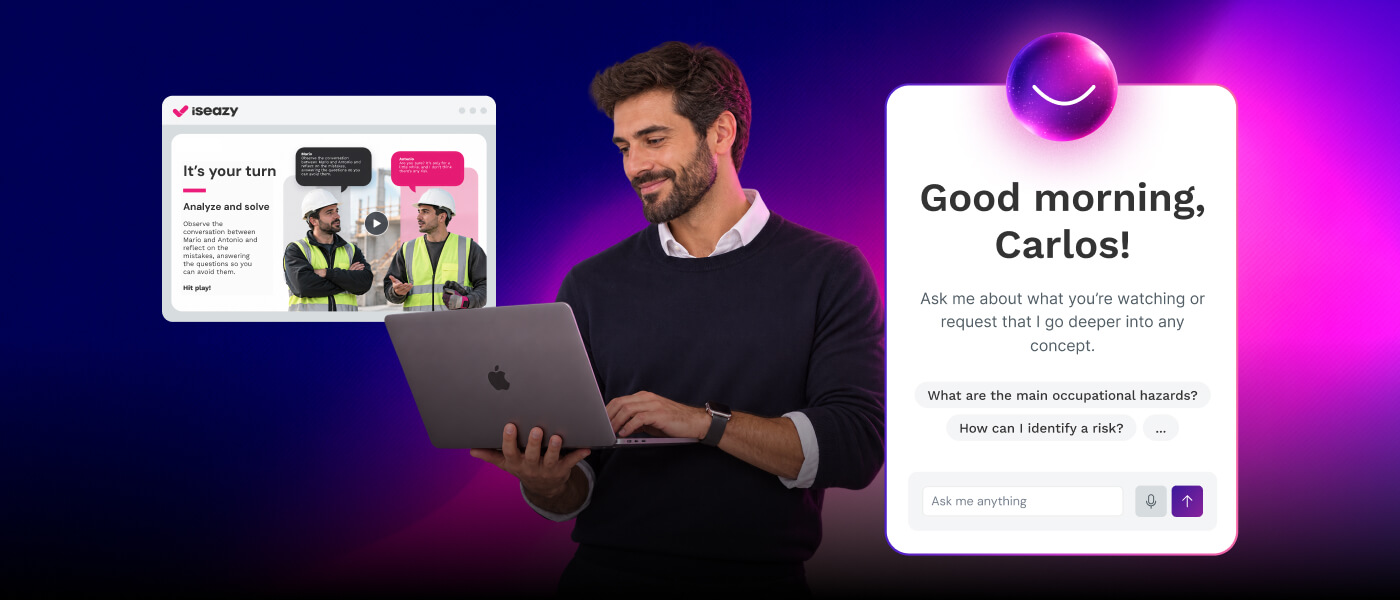


WEBINAR
AI-powered course creation, step by step
Master AI in isEazy Author in under an hour.
Register Now



Related articles
Antonio González Pozo
June 23, 2026
AI LMS: What It Is, Key Benefits, Features and How to Choose the Best One
Read more

Fernando González Zurita
June 9, 2026
Just-in-time learning: what it is and how to apply it in corporate training
Read more

Fernando González Zurita
April 6, 2026
The Unspoken Problem with AI Training in Companies
Read more