CASE STUDY
How Grupo Puerto de Cartagena optimized their training with isEazy Author’s AI.

Brain
The first AI trained to teach

Author
The #1 AI-powered authoring tool on the market

Factory
Custom e-learning content factory

Skills
Comprehensive power skills course catalog

LMS
All-in-one LMS platform with AI

Engage
App for managing frontline teams
FEATURES

AINew
Unlock your full potential and speed up course creation with artificial intelligence.

Accessibility
Automatically meet accessibility guidelines—without sacrificing interactivity!

Interactivity
Boost engagement with interactive, ready-to-use activities that make learning fun.

Course Creation
Reduce the time it takes to create your e-learning courses with our authoring tool.

Distribution
We offer you different distribution options, so that nothing can stop you.

SCORM
Publish your course in SCORM format and share it on any LMS.
SERVICES

Instrucional Design
Surprise your students with multimedia and interactive content.

Custom Courses
We create e-learning courses for you—tailored to your needs and hassle-free!

Virtual Reality
Turn learning into an immersive experience.

Custom Avatars
Give your courses and videos a unique touch with personalized avatars.

Audiovisual FactoryNew
Turn training into something dynamic and visual with engaging videos.
CATALOG

Course catalog
Over 600 skills and competency courses to help you adapt to your team's needs.
Microsoft Copilot AcademyNew
Your professionals will learn how to apply Copilot AI to key processes within your organization.

Artificial Intelligence Academy
Train your teams in the practical use of AI to boost productivity and innovation in your company.

Cybersecurity Academy
Capacita a tu empresa con el catálogo más completo en seguridad digital corporativa.

Use cases
Choose the solution that best fits your needs

Industries
Solutions for all types of industries
USE CASES

Onboarding
Facilitate the onboarding process, productivity and engagement of your new employees.

Upskilling
Boost your team's skills and prepare them for the challenges of the future with upskilling.

Microlearning
Discover all the advantages of microlearning and boost your training results.

Gamification
Enjoy addictive training that will get your professionals hooked.

Internal Communication
Improve communication in your company and enjoy an aligned and committed team.

Mobile learning
Agile, flexible, and interactive learning—built for today’s digital-first workforce.
INDUSTRIES

Banking and financial services
Training in compliance, cybersecurity, customer service, and key skills development.

Pharmaceuticals and healthcare
Digital onboarding, regulatory updates, and ongoing training for healthcare staff.

Retail and consumer
Agile and scalable training for in-store, operational, and customer service teams.

Industry and manufacturing
Training in processes, safety, and corporate culture for distributed teams.

Education and training
Digital solutions for training centers, internal academies, and corporate universities.

Technology and telecommunications
Development of technical talent, digital skills, and upskilling and reskilling programs.
CLIENTS

MAPFRE
How MAPFRE turn e-learning into sales with isEazy

Pepco
A personalised learning experience for a growing team.

BBVA
Digitisation and creation of high quality e-learning content.

Shiseido
We increase the engagement of the training with a social and gamified app.

Telefónica
Large-scale reskilling for the company's digital transformation.

Vodafone
A personalised learning experience for a growing team.
More than 1,000 companies already rely on isEazy.




MEET ISEAZY

Events
Discover our upcoming events and connect with the future of e-learning.

News
Find out the latest news about isEazy: press releases, partnerships, updates...

Contact
Leave us your personal details and we will contact you as soon as possible.
About isEazyNew
Find out more about our company.

Careers
We are looking for the best talent, join our team!

Partners
Become our partner and grow your business.
INTERESTING RESOURCES

Blog
The best content on e-learning: trends, tools and key strategies.

Whitepapers
Gain valuable insights and stay ahead of industry trends.

Product releases
The latest news and releases of our e-learning products and solutions.

Glossary
Definitions of the most commonly used terms and key industry concepts.

Guides
Discover the best step-by-step tips and tricks to optimize your L&D strategy.

Webinars
Video sessions on our products, trends and more

Comparatives
Compare e-learning solutions available on the market and choose the most suitable one.


WEBINAR
Master AI in isEazy Author in under an hour.




GUIDE
Prepare your organization to comply with the new AI regulations

Stay up to date with all our latest news
 Subscribe to our newsletter
 Stay up to date with all our latest news

July 18, 2026

CONTENT CREATED BY:

Table of contents
When an L&D manager searches for “AI training tools”, they encounter two very different types of solutions: AI LMS platforms, which incorporate artificial intelligence to improve training management and content creation, and native AI learning solutions, designed from the ground up to personalise and support learning in real time. Using the wrong one at the wrong time means solving a problem you don’t actually have. This guide explains the differences and when you need each one.
An AI LMS is a learning management platform that incorporates artificial intelligence capabilities to improve existing processes: assigning training, recording progress, ensuring traceability, and certifying competencies. AI does not replace its core architecture — it complements it with specific features.
In an LMS like isEazy’s, AI features are selectively integrated to deliver real value without adding unnecessary complexity. Some concrete examples:
These features improve operational efficiency and the user experience within the platform. However, they work in a targeted way: AI improves specific tasks but does not adapt the learning process in real time to each professional’s context, level, and specific needs.

A native AI learning solution is not a management platform. It is an intelligence layer designed from the ground up to work with an organisation’s real knowledge and transform it into adaptive, contextual, and conversational learning.
isEazy Brain is the first native AI applied to corporate training: an AI trained to teach that converts corporate knowledge into learning agents capable of adapting, in real time, to each team member.
Unlike an AI LMS, Brain does not manage learning paths or record certifications. Its purpose is different:
In the words of Miguel Valverde, CEO of isEazy: “Brain changes this dynamic by being the first trained to teach with your company’s real knowledge, adapted to each professional.”
Brain is not a chatbot or a generic content generator. It is an AI that thinks pedagogically: it guides, evaluates, adapts its tone, and selects the most appropriate resource for each moment of learning. Discover how it works →

The following table summarises the main differences between both approaches to help you identify which one better fits your current situation.
| Dimension | AI LMS | Native AI learning solution (isEazy Brain) |
|---|---|---|
| Main purpose | Manage, assign, and certify training. Create courses in minutes with Autopilot. | Convert corporate knowledge into adaptive and conversational learning |
| How it uses AI | Targeted features: course generation with Autopilot, smart search, content recommendations, task automation | AI as a core layer: learns from company knowledge and adapts the experience in real time to each person |
| What it manages | Learning paths, progress, traceability, compliance, and content production | Corporate knowledge, role and context-based personalisation, practice, and ongoing support |
| Most common user profile | L&D manager who needs to scale, create, and measure training | Professional who needs contextual answers and day-to-day support |
| isEazy example | isEazy LMS + Autopilot (AI course creation) + smart search in Skills | isEazy Brain: Companion, Adaptive, and Expert |
Knowing the differences is just the starting point. The key question is: which problem are you actually trying to solve? Below you’ll find the most common scenarios for each type of solution.
An AI LMS is the right tool when your organisation’s main challenge is organising, scaling, and measuring training. It becomes a priority when:
If the problem is that people don’t know what training is available, don’t complete courses, or it takes too long to create content, a well-implemented AI LMS resolves those friction points. It is the foundation of any scalable training strategy.
If you want to learn more about what an LMS is and how it works, this guide to LMS platforms covers everything you need to know before making a decision.

A native AI learning solution like isEazy Brain makes the most sense when the challenge is no longer managing training, but making knowledge reach each person in a relevant, personalised way at the exact moment they need it. It is especially useful when:
According to Gallup data cited by isEazy, 4 in 10 professionals already use AI to learn new things at work, and nearly half use it to consolidate information. Employee expectations have changed: they expect personalised, contextual answers — not another assigned course. isEazy Brain addresses that gap.
If you’d like to explore further how AI is transforming corporate training, this article on AI for corporate training or this one on knowledge management with AI provide additional context.

This is the key question, and the answer is clear: they are not mutually exclusive. In most organisations, combining an AI LMS with a native AI learning solution is more powerful than either one alone.
The LMS brings structure: it assigns, certifies, measures, and ensures that training reaches the right people. Autopilot dramatically reduces course production time. isEazy Brain brings adaptive intelligence: it converts the company’s real knowledge into learning agents that support each professional beyond the course.
The good news is that Brain is part of the isEazy ecosystem, which means that if you already use isEazy LMS or isEazy Author, you can incorporate this intelligence layer naturally, without replacing your existing infrastructure or changing your team’s workflows.
A pharmaceutical company uses its LMS to manage mandatory compliance training and role-based onboarding, and uses Autopilot to turn product data sheets into interactive courses in minutes. In parallel, it incorporates Brain so its sales representatives can practise customer objections, consult product documentation in real time during a visit, or receive training adapted to their level of expertise before launching a new line. The LMS organises and produces; Brain trains and accompanies.
This approach is also relevant for soft skills training with AI or for AI role play in training scenarios, where conversational practice and immediate feedback make a real difference.
Grupo Puerto de Cartagena is a good example of how an organisation can integrate AI into its training strategy to improve the learning experience and outcomes for its teams. Discover how they did it →
CASE STUDY
How Grupo Puerto de Cartagena optimized their training with isEazy Author’s AI.


Before making a decision, answer these diagnostic questions:
If you’d like to compare the main market options in detail, this comparison of the best AI learning platforms can help you put the decision in context.
An AI LMS and a native AI learning solution do not compete — they complement each other. The LMS solves the problem of management and scale. The native AI solves the problem of personalisation, scattered knowledge, and on-the-job transfer.
The question is not which is better, but which solves the problem you have today. And in many cases, the answer is that you need both: isEazy LMS to manage and measure, and isEazy Brain to teach and support.
If you want to see how this could work in your organisation, talk to our team about isEazy Brain or explore isEazy LMS.
No. Although the market often uses both terms interchangeably, they address different needs. An AI LMS is a learning management platform that incorporates specific artificial intelligence features — such as course recommendations, smart search, or administrative task automation — on top of its core architecture. A native AI learning solution, like isEazy Brain, is an intelligence layer designed from the ground up to work with an organisation’s real knowledge and transform it into adaptive, contextual, and conversational learning. The LMS manages; the native AI teaches and guides.
Yes, and in many cases it is the most recommended combination. The AI LMS manages structured training: it assigns learning paths, records progress, ensures traceability, and handles compliance. isEazy Brain acts as a complementary layer that converts corporate knowledge into adaptive, conversational learning agents available wherever the professional needs them. Brain is part of the isEazy ecosystem, which means that if you already use isEazy LMS or isEazy Author, you can incorporate this intelligence layer naturally, without replacing your existing infrastructure.
AI features in an LMS vary by provider, but the most common include automatic content recommendations based on employee profiles, smart search within the course catalogue, AI-powered content creation tools like Autopilot in isEazy Author, automated assignment and reminder workflows, and predictive analytics on training performance. These features improve operational efficiency and the user experience within the platform. However, they work in a targeted way: the AI improves specific tasks but does not adapt the learning process in real time to each person’s context, level, and specific needs.
A native AI learning solution makes the most sense when an organisation needs to go beyond training management and address challenges such as knowledge scattered across documents, experts, and systems; a lack of real personalisation by role or level; or the need for professionals to receive contextual support at the precise moment they need it — not just when they complete a course. It is also especially relevant when instructor-led training or linear course models are insufficient to transfer knowledge to the job effectively.

Automate processes, access 600+ ready-to-use courses, or create your own content with the help of AI.
Request a demoContact us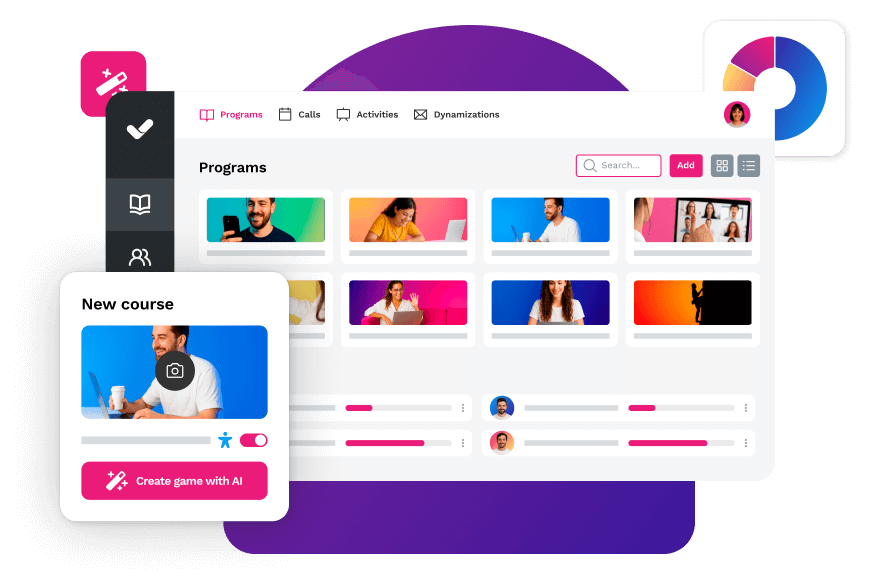


Streamline your training management
Experience the power of AI in an LMS that has it all


Streamline your training management
Experience the power of AI in an LMS that has it all