CASE STUDY
We helped PreZero improve its training strategy with attractive and quality courses.

Brain
The first AI trained to teach

Author
The #1 AI-powered authoring tool on the market

Factory
Custom e-learning content factory

Skills
Comprehensive power skills course catalog

LMS
All-in-one LMS platform with AI

Engage
App for managing frontline teams
Product

What is Brain?
Everything you need to know about the first AI trained to teach.

Learning agent: CompanionNew
Supports learners and answers their questions right inside the course, without breaking the audit trail.

How does it work?
Adaptive, conversational, and contextual. That’s learning with Brain.
FEATURES

AINew
Unlock your full potential and speed up course creation with artificial intelligence.

Accessibility
Automatically meet accessibility guidelines—without sacrificing interactivity!

Interactivity
Boost engagement with interactive, ready-to-use activities that make learning fun.

Course Creation
Reduce the time it takes to create your e-learning courses with our authoring tool.

Distribution
We offer you different distribution options, so that nothing can stop you.

SCORM
Publish your course in SCORM format and share it on any LMS.
SERVICES

Instrucional Design
Surprise your students with multimedia and interactive content.

Custom Courses
We create e-learning courses for you—tailored to your needs and hassle-free!

Virtual Reality
Turn learning into an immersive experience.

Custom Avatars
Give your courses and videos a unique touch with personalized avatars.

Audiovisual FactoryNew
Turn training into something dynamic and visual with engaging videos.
CATALOG

Course catalog
Over 600 skills and competency courses to help you adapt to your team's needs.
Microsoft Copilot AcademyNew
Your professionals will learn how to apply Copilot AI to key processes within your organization.

Artificial Intelligence Academy
Train your teams in the practical use of AI to boost productivity and innovation in your company.

Cybersecurity Academy
Capacita a tu empresa con el catálogo más completo en seguridad digital corporativa.

Use cases
Choose the solution that best fits your needs

Industries
Solutions for all types of industries
USE CASES

Onboarding
Facilitate the onboarding process, productivity and engagement of your new employees.

Upskilling
Boost your team's skills and prepare them for the challenges of the future with upskilling.

Microlearning
Discover all the advantages of microlearning and boost your training results.

Gamification
Enjoy addictive training that will get your professionals hooked.

Internal Communication
Improve communication in your company and enjoy an aligned and committed team.

Mobile learning
Agile, flexible, and interactive learning—built for today’s digital-first workforce.
INDUSTRIES

Banking and financial services
Training in compliance, cybersecurity, customer service, and key skills development.

Pharmaceuticals and healthcare
Digital onboarding, regulatory updates, and ongoing training for healthcare staff.

Retail and consumer
Agile and scalable training for in-store, operational, and customer service teams.

Industry and manufacturing
Training in processes, safety, and corporate culture for distributed teams.

Education and training
Digital solutions for training centers, internal academies, and corporate universities.

Technology and telecommunications
Development of technical talent, digital skills, and upskilling and reskilling programs.
CLIENTS

MAPFRE
How MAPFRE turn e-learning into sales with isEazy

Pepco
A personalised learning experience for a growing team.

BBVA
Digitisation and creation of high quality e-learning content.

Shiseido
We increase the engagement of the training with a social and gamified app.

Telefónica
Large-scale reskilling for the company's digital transformation.

Vodafone
A personalised learning experience for a growing team.
More than 1,000 companies already rely on isEazy.





MEET ISEAZY

Events
Discover our upcoming events and connect with the future of e-learning.

News
Find out the latest news about isEazy: press releases, partnerships, updates...

Contact
Leave us your personal details and we will contact you as soon as possible.
About isEazyNew
Find out more about our company.

Careers
We are looking for the best talent, join our team!

Partners
Become our partner and grow your business.
INTERESTING RESOURCES

Blog
The best content on e-learning: trends, tools and key strategies.

Whitepapers
Gain valuable insights and stay ahead of industry trends.

Product releases
The latest news and releases of our e-learning products and solutions.

Glossary
Definitions of the most commonly used terms and key industry concepts.

Guides
Discover the best step-by-step tips and tricks to optimize your L&D strategy.

Webinars
Video sessions on our products, trends and more

Comparatives
Compare e-learning solutions available on the market and choose the most suitable one.


WEBINAR
Master AI in isEazy Author in under an hour.




GUIDE
Prepare your organization to comply with the new AI regulations


AUTHORING TOOL
Create courses automatically and generate interactive activities, games, translations, and multimedia resources in seconds.

Stay up to date with all our latest news
 Subscribe to our newsletter
 Stay up to date with all our latest news

July 9, 2026

CONTENT CREATED BY:

Table of contents
AI-powered knowledge management is the process of capturing, organizing, structuring, and distributing an organization’s collective know-how using artificial intelligence as a processing and personalization layer. Unlike traditional document repositories — wikis, intranets, shared folders — AI-based systems do not simply store information: they interpret it, connect it, and convert it into answers, learning paths, or training content adapted to each individual.
In the context of corporate training, this represents a fundamental shift. According to McKinsey, employees spend an average of up to 1.8 hours per day searching for the internal information they need to do their jobs. That time and that dispersed knowledge represent a massive opportunity for L&D teams: if AI can process real company documentation and convert it into applicable learning, training stops depending on generic courses and becomes something contextual, accurate, and available exactly when it is needed.
Most organizations have more knowledge than they realize. Procedures, product guides, onboarding recordings, sales presentations, technical documentation, transcripts from expert meetings — the problem is not a lack of information, but the fact that this information is scattered, outdated, in incompatible formats, or simply inaccessible to the person who needs it at the right moment.
This problem has a name in the L&D world: the gap between the knowledge that exists and the training that is actually delivered. The consequences are concrete:
According to LinkedIn Learning’s Workplace Learning Report 2024, 89% of L&D leaders identify dispersed knowledge as one of their main obstacles to scaling training. It is not a question of budget or tools — it is a question of knowledge architecture.
The difference between a documentation repository and an AI-powered knowledge management system is not technological — it is functional. The first stores; the second activates. This activation process is structured in four phases:
AI processes documentation in multiple formats — PDFs, videos, presentations, audio recordings, databases — and incorporates it into a unified repository. The documents do not need to be perfectly structured beforehand: natural language processing models identify the relevant knowledge blocks regardless of the original format.
Once ingested, the information is organized by topic, role, complexity level, and context of use. This semantic tagging is what allows the system to distinguish between “technical documentation for engineers” and “usage guide for sales teams,” even if both documents cover the same product.
An AI meant for training, it won’t return the original document — it will adapt the response to the user’s profile, their learning history, their level of mastery, and the context of the query. Two employees can ask the same question and receive different answers in depth, tone, and format.
The structured knowledge is distributed where the employee needs it: inside the LMS, in the everyday work environment, at the moment of the query. Not as a course to be completed, but as an applicable answer at precisely the right moment.
The following table summarizes the key differences between a classic documentary approach and one supported by artificial intelligence — particularly relevant for L&D teams designing training strategies at scale.
| Aspect | Without AI | With AI |
|---|---|---|
| Knowledge access | Manual search in repositories | Semantic retrieval in real time |
| Content updates | Manual process, prone to obsolescence | Automatic detection of changes and discrepancies |
| Personalization | Same content for everyone | Adapted to the user's profile, role, and context |
| Conversion to training | Requires L&D team intervention | Automatic generation of pedagogical artifacts |
| Traceability | Limited to access logs | Tracking of learning and knowledge application |
| Scalability | Grows linearly with the team | Scales without proportional increase in resources |
Beyond general productivity gains, learning and development teams have specific reasons to adopt this approach. It is not a question of operational efficiency — it is a question of real training impact.
isEazy Brain is built on exactly this premise: organizations have valuable documentation that never becomes effective training. Brain acts as the AI layer that closes that gap.
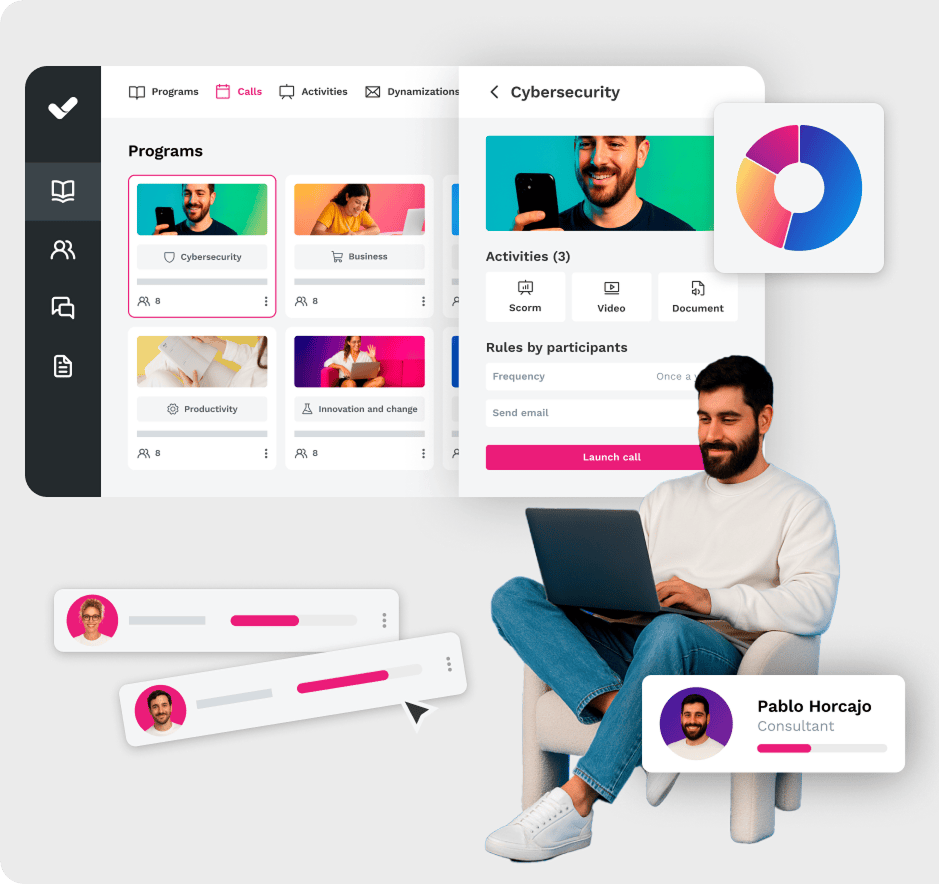
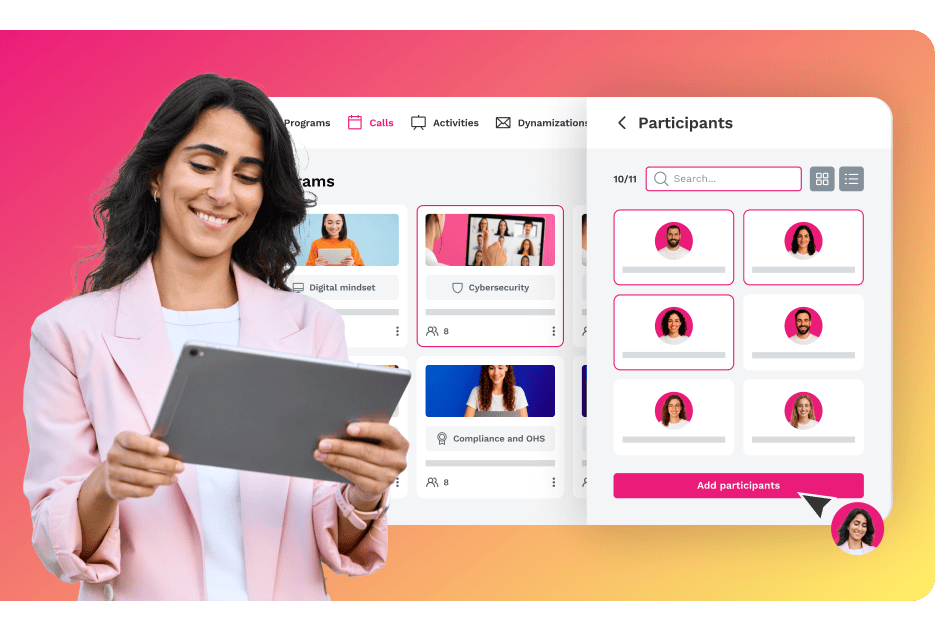
The process begins with the knowledge vault: a repository where the organization uploads its real documentation (manuals, procedures, guides, expert recordings). Brain processes that information, structures it pedagogically, and converts it into adaptive learning agents that adjust in real time to each professional. It is not a generic chatbot that responds with information from the internet — it responds exclusively with the company’s own knowledge, under human oversight and with full traceability.
All of this runs on dedicated infrastructure, with client-level isolation, full GDPR and EU AI Act compliance, and human review before any content reaches the end user. If you want to see how it works applied to your organization, you can request a demo here.

PreZero is a great example of how to systematically convert corporate knowledge into high-quality training. With isEazy, they were able to create high-impact e-learning content from their internal documentation, reducing dependency on external providers and accelerating their production cycles. Discover how they did it →
CASE STUDY
We helped PreZero improve its training strategy with attractive and quality courses.


Implementing an AI knowledge management system is not an IT project — it is an organizational change initiative. These are the five steps that structure an implementation with real impact:
Before choosing any tool, map out what knowledge exists in the organization, what format it is in, who produces it, and who consumes it. Not everything carries the same weight: prioritize knowledge that generates the most questions, the most errors, or the most dependency on specific individuals.
Do not implement a knowledge management system for the entire company on day one. Start with a specific process with measurable impact: new employee onboarding, product training for the sales team, or procedure updates in operations.
The knowledge management system must integrate with the LMS and everyday work tools. Knowledge cannot live in a separate silo — it needs to flow where employees already work.
AI generates and structures, but the human team validates. It is essential that internal experts and the L&D team understand their new role: not producing content from scratch, but supervising, enriching, and validating what AI generates from corporate knowledge.
Define concrete metrics before launch: information search time, query resolution rate without escalation, onboarding speed, errors reduced in specific processes. Without measurement, there is no organizational learning about the system itself.
AI-powered knowledge management solves real problems, but it also introduces risks that a responsible L&D team must anticipate:
AI-powered knowledge management is not a future trend — it is a practical response to a problem L&D teams have been facing for years. Organizations already have the knowledge they need to train their teams; the challenge is capturing it, structuring it, and making it accessible at the right moment. AI turns that challenge into an operational advantage: it reduces content production time, personalizes learning at scale, preserves expert knowledge, and brings training closer to the real workflow. But success does not depend solely on technology — it depends on the quality of the input knowledge, on the L&D team’s commitment to validation, and on a gradual implementation oriented toward concrete results.
If you are ready to take that step, isEazy Brain is the platform designed exactly for this: it transforms your organization’s real documentation into adaptive, contextual, and conversational learning agents, always under human oversight and with full privacy guarantees. It is not a generic chatbot or an AI layer bolted on as an afterthought — it is a new way of making your company’s knowledge teach. Request a demo and discover how it can transform your team’s learning.
They are complementary tools with different purposes. An LMS (Learning Management System) manages the distribution, tracking, and assessment of training courses. Knowledge management, on the other hand, focuses on capturing, organizing, and making the organization’s collective know-how accessible: procedures, best practices, and internal experts’ insights. AI allows both layers to converge: organizational knowledge is converted into adaptive training content that is distributed and measured through the LMS.
Data protection is a legitimate and critical concern. Platforms designed for the enterprise environment operate with client-level isolation, meaning your organization’s knowledge is not shared with other clients or used to train external models. It is essential to require that the solution comply with the GDPR and the EU AI Act, and guarantee that data does not leave to external servers without control. Before implementing any tool, review the data architecture and the provider’s privacy guarantees.
It depends on the starting point and the scope of the project. An organization with scattered documentation will need more time in the audit phase. In general, first results can be seen within a few weeks if you start with a scoped pilot: one department, one type of documentation, or one specific process. The key is not to implement everything at once — start with a use case where the impact is visible and the team can learn from the process.
No, and that should not be the goal. AI amplifies the capacity of internal experts — it does not replace them. What changes is the role: instead of the expert having to be available every time someone needs training, their knowledge is captured, structured, and accessible through adaptive learning agents that respond in real time. The trainer becomes the validator, curator, and person responsible for ensuring that the knowledge in circulation is accurate and up to date.