Corporate pedagogy is the discipline that applies the scientific principles of learning to the corporate environment to design training that genuinely impacts employee performance and business results. It is not about delivering courses: it is about learning better, more efficiently, and with strategic purpose.
According to LinkedIn’s Workplace Learning Report 2024, 90% of organisations are concerned about talent retention, and training is the primary retention factor for employees. Yet many training programmes still fail to connect learning with real practice. Corporate pedagogy is the answer to that gap.
Corporate pedagogy is the application of educational theories and learning methodologies to the corporate environment. Its goal is to design learning experiences that improve employee performance, accelerate skills acquisition, and directly contribute to the strategic objectives of the organisation.
What is corporate pedagogy?
Corporate pedagogy borrows the fundamentals of learning science — how adults learn, what makes knowledge stick, how it transfers to real work — and adapts them to the organisational context. It is a discipline that combines cognitive psychology, instructional design, talent management, and educational technology.
Unlike traditional pedagogy, oriented towards children and adolescents in academic settings, corporate pedagogy is grounded in andragogy: the adult learning model developed by Malcolm Knowles, which assumes that adults learn better when they understand the “why”, have prior experience to connect with new knowledge, and can apply what they have learnt immediately.
In practice, corporate pedagogy answers questions such as: what competencies does this team need to develop? How do we design an onboarding programme that reduces time-to-productivity? What methodology works best for training a geographically dispersed sales team?
Why corporate pedagogy is essential in today’s organisations
The workplace has changed radically. According to Deloitte’s Global Human Capital Trends 2023, 57% of business leaders consider the skills gap to be one of the main risks for their organisation over the next three years. The pace of technological change requires employees to learn, unlearn, and relearn continuously.
In this context, training can no longer be a one-off event. Corporate pedagogy proposes a continuous learning approach integrated into the workflow, evidence-based and measurable in terms of real impact. These are the factors that make it especially relevant today:
High staff turnover: companies with strong training programmes retain up to 34% more talent, according to ATD (Association for Talent Development) data.
Large-scale reskilling and upskilling: the World Economic Forum estimates that 44% of current job skills will become obsolete within the next five years.
Accelerated digitalisation: the adoption of new digital tools requires fast, contextualised training accessible from any device.
Employees without access to traditional training: deskless workers (operators, shop assistants, field staff) represent 80% of the global workforce and rarely benefit from conventional corporate training.
The 5 principles of corporate pedagogy
Every training strategy based on corporate pedagogy should rest on these five principles:
Performance orientation: learning must be directly linked to specific competencies and measurable results, not to hours of training completed.
Relevance and immediate applicability: adults learn better when they can apply what they have learnt in their real work context. Abstract or decontextualised training has minimal impact.
Personalisation: not all employees start from the same level or have the same needs. Training paths tailored to profile, role, and prior experience significantly improve retention and engagement.
Continuity: learning does not happen in a single training event. The 70-20-10 model (70% experiential learning, 20% social, 10% formal) reflects how competencies are genuinely acquired at work.
Impact measurement: Kirkpatrick’s evaluation model (reaction, learning, behaviour, results) enables measurement of whether training is generating the expected change in performance and business outcomes.
Pedagogical models applied to the corporate environment
There are different pedagogical models that can be applied in organisations depending on the type of training, the employee profile, and the learning objectives. There is no single superior model: the key is to choose the most appropriate one for each context.
Model
What it involves
Best for
Experiential learning (Kolb)
Learning by doing: cycle of concrete experience, reflection, conceptualisation, and active experimentation.
Sales training, leadership, soft skills
Mentoring and coaching
Knowledge transfer from expert to learner through continuous accompaniment and personalised feedback.
Leadership development, senior profile onboarding
Blended learning
Combines face-to-face training with e-learning, providing flexibility without losing human interaction.
Collective knowledge construction through group projects, communities of practice, and peer learning.
Distributed teams, learning culture, innovation
How to apply corporate pedagogy in your organisation: 5 steps
Implementing a corporate pedagogy strategy does not require large budgets or specialised teams from day one. These are the five fundamental steps to get started:
1. Training needs diagnosis
Before designing any course, it is essential to identify what competencies the organisation needs to develop and what the real gap is between current and desired performance. The most common tools are competency assessment surveys, manager interviews, and the analysis of performance indicators (business KPIs, error rates, onboarding times).
2. Defining learning objectives
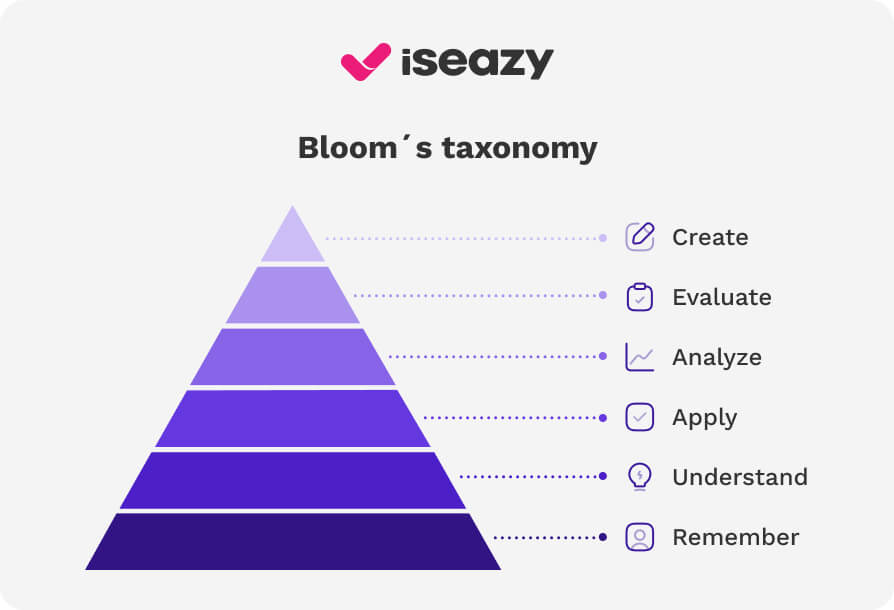
Every training action must have clear, measurable objectives connected to business results. Bloom’s taxonomy offers a useful framework for defining what level of mastery is sought: from basic knowledge through to creation and evaluation. A well-formulated objective answers: what should the employee be able to do upon completing the training?
3. Learning experience design
At this stage, the most appropriate pedagogical model is selected, the format is chosen (e-learning, face-to-face, blended, microlearning), and the content is designed. Instructional design applies principles such as cognitive load, spaced repetition, and narrative to maximise retention.
4. Implementation and rollout
Training is deployed through the right channels: an LMS centralises management and tracking, an authoring tool allows interactive content to be created without technical expertise, and microlearning platforms ensure learning reaches all profiles, including mobile workers.
5. Evaluation and continuous improvement
The final step — and the most overlooked — is measuring the real impact of training. Beyond learner satisfaction (Kirkpatrick level 1), the goal is to measure whether learning has transferred to the job (level 3) and whether it has generated business results (level 4). This information feeds the continuous improvement cycle of the training programme.
The role of the corporate pedagogue in the L&D team
The corporate pedagogue — also known as a Learning & Development Specialist or Instructional Designer — is the professional responsible for applying pedagogical principles to corporate training design. Their functions go beyond creating courses: they include needs analysis, methodology selection, impact measurement, and educational technology management.
Their main responsibilities are:
Diagnosing competency gaps and translating them into specific training needs.
Designing personalised learning paths by role, level, and business objective.
Selecting and managing training technology tools (LMS, authoring tool, engagement platforms).
Creating or overseeing the production of interactive and engaging e-learning content.
Measuring the impact of training and presenting results to management in business terms.
Fostering a culture of continuous learning across the organisation.
In many mid-sized organisations, these functions are carried out by a generalist HR profile with L&D knowledge. The good news is that current digital tools allow any professional with subject-matter expertise to create quality training without being an educational technology expert.
Clarel is a great example of how corporate pedagogy applied with the right tools can transform training across a retail network. With over 800 outlets across Spain and Portugal, Clarel needed to train its in-store teams simultaneously, with up-to-date, measurable content. With isEazy, they achieved 84% engagement in their training programmes and drastically reduced content production times. Find out how they did it →
CASE STUDY
How Clarel achieved over 84% engagement in their training with gamification.
Technology does not replace pedagogy, but it makes it scalable. These are the three categories of tools that every L&D team should know, with the leading options available on the market.
An authoring tool allows any professional — without programming knowledge — to create interactive e-learning courses with videos, quizzes, branching scenarios, and animations. Content quality is one of the primary engagement drivers in online training.
isEazy Author
The Leading AI Authoring Tool on the Market
Features
Benefits
Pricing
Accessibility
Awards
AI features: generate images, games and exercises, automatic subtitles, voiceovers, advanced interactive elements, avatars, and AI video presenters to bring your content to life.
AI Autopilot: automatic course creation from documents or ideas, with pedagogical structure, interactive resources, and applied visual identity. Transform any content into a publish-ready course in minutes.
Templates: over 25 ready-to-use interactive templates, editable and customizable with corporate colors, typography, and logo via the Smart Colors feature.
Drag-and-drop editor: visual editing to create courses with no technical, programming, or design knowledge required.
Automatic responsive design: courses adapt to any device without manual adjustments, with dual mode so each learner can access content in their preferred format.
Multi-format: export in SCORM 1.2, SCORM 2004, xAPI, and HTML5, compatible with any LMS on the market.
Automatic translation: full AI-powered course translation into over 40 languages, with no need for external translators.
Text to speech: professional voiceovers automatically generated from content, with selection of gender, language, and voice variation.
PowerPoint import: convert presentations into interactive e-learning courses in just a couple of clicks.
Real-time collaboration: simultaneous collaborative work on the same course with integrated comments, change tracking, and automatic saving with restore points.
Brand customization: styles, colors, typography, and logo to maintain corporate consistency across all content.
Gamification: points, badges, and leaderboards to motivate learners and increase engagement.
Assessments and quizzes: multiple question types and answer logic, with AI-powered automatic generation of final assessment tests based on course content.
Multimedia library: built-in bank of images, videos, icons, and graphic resources, with AI image generation adapted to your course style.
Integrations: connection with LMS platforms (SCORM, xAPI), external platforms, and management systems. A built-in learning environment is also available without leaving isEazy Author.
AI-powered: automates key creation tasks and drastically reduces production time. Over 36,000 users and 120,000 projects created in more than 90 countries speak for themselves.
Intuitive and visual interface: everything is edited intuitively with no learning curve, with pre-configured ready-to-use resources.
Real collaborative experience: distributed teams can work in parallel with real-time feedback, ideal for content factories and L&D teams.
Total flexibility: ideal for both occasional creators and large-scale production teams. Compatible with any LMS and 100% cloud-based.
Visual and professional courses: no designers or developers needed, with quality results recognized by Training Industry and eLearning Industry 2026.
Cost savings: less need for external resources and greater efficiency in content creation. Calculate your savings with the AI Autopilot ROI calculator.
Constantly evolving: new features released regularly and agile multilingual support, with real accessibility up to WCAG level AA and 80% of level AAA.
FREE plan: free forever. Ideal for exploring the tool with no commitment.
Professional: from €80/month. 1 author and up to 5 GB of storage.
Business: from €208/month. 2 authors and up to 12 GB of storage. The most popular plan.
Enterprise: custom authors and storage. Contact us for pricing.
Real standards compliance: courses compatible with level AA (100%) and up to 80% of level AAA of the Web Content Accessibility Guidelines (WCAG), and with Section 508 of the U.S. Rehabilitation Act.
Dual mode: create a single SCORM course and your learners can access it in their preferred mode, with or without accessibility adaptations, without duplicating production work.
Accessible interactive elements: all interactive resources in isEazy Author are designed to provide the same learning experience to all learners, regardless of their needs.
Contextual editor guidance: tips and guides built into the editor so any author can create quality accessible content easily, with no prior technical knowledge required.
Without sacrificing design or interactivity: accessibility in isEazy Author does not mean compromising visual impact or content richness. Accessible, attractive, and effective courses all at once.
Training Industry 2026: Top 20 AI Content Creation.
eLearning Industry 2026: Best AI-Powered Authoring Tool and Learning & Skills Development.
Training Industry 2025: Top 20 AI Content Creation.
eLearning Industry 2025: Best e-Learning Authoring Tool.
Brandon Hall 2024: Excellence Awards.
eLearning Industry 2024: Best Game Design and AI Watchlist.
G2 2024: Momentum Leader, High Performer, and High Performer Mid-Market.
Crozdesk 2024: Quality Choice, Trusted Vendor, and Happiest Users.
Software Advice 2024: FrontRunners.
Software Suggest 2024: Category Leader.
Features
AI features: generate images, games and exercises, automatic subtitles, voiceovers, advanced interactive elements, avatars, and AI video presenters to bring your content to life.
AI Autopilot: automatic course creation from documents or ideas, with pedagogical structure, interactive resources, and applied visual identity. Transform any content into a publish-ready course in minutes.
Templates: over 25 ready-to-use interactive templates, editable and customizable with corporate colors, typography, and logo via the Smart Colors feature.
Drag-and-drop editor: visual editing to create courses with no technical, programming, or design knowledge required.
Automatic responsive design: courses adapt to any device without manual adjustments, with dual mode so each learner can access content in their preferred format.
Multi-format: export in SCORM 1.2, SCORM 2004, xAPI, and HTML5, compatible with any LMS on the market.
Automatic translation: full AI-powered course translation into over 40 languages, with no need for external translators.
Text to speech: professional voiceovers automatically generated from content, with selection of gender, language, and voice variation.
PowerPoint import: convert presentations into interactive e-learning courses in just a couple of clicks.
Real-time collaboration: simultaneous collaborative work on the same course with integrated comments, change tracking, and automatic saving with restore points.
Brand customization: styles, colors, typography, and logo to maintain corporate consistency across all content.
Gamification: points, badges, and leaderboards to motivate learners and increase engagement.
Assessments and quizzes: multiple question types and answer logic, with AI-powered automatic generation of final assessment tests based on course content.
Multimedia library: built-in bank of images, videos, icons, and graphic resources, with AI image generation adapted to your course style.
Integrations: connection with LMS platforms (SCORM, xAPI), external platforms, and management systems. A built-in learning environment is also available without leaving isEazy Author.
Benefits
AI-powered: automates key creation tasks and drastically reduces production time. Over 36,000 users and 120,000 projects created in more than 90 countries speak for themselves.
Intuitive and visual interface: everything is edited intuitively with no learning curve, with pre-configured ready-to-use resources.
Real collaborative experience: distributed teams can work in parallel with real-time feedback, ideal for content factories and L&D teams.
Total flexibility: ideal for both occasional creators and large-scale production teams. Compatible with any LMS and 100% cloud-based.
Visual and professional courses: no designers or developers needed, with quality results recognized by Training Industry and eLearning Industry 2026.
Cost savings: less need for external resources and greater efficiency in content creation. Calculate your savings with the AI Autopilot ROI calculator.
Constantly evolving: new features released regularly and agile multilingual support, with real accessibility up to WCAG level AA and 80% of level AAA.
Pricing
FREE plan: free forever. Ideal for exploring the tool with no commitment.
Professional: from €80/month. 1 author and up to 5 GB of storage.
Business: from €208/month. 2 authors and up to 12 GB of storage. The most popular plan.
Enterprise: custom authors and storage. Contact us for pricing.
Accessibility
Real standards compliance: courses compatible with level AA (100%) and up to 80% of level AAA of the Web Content Accessibility Guidelines (WCAG), and with Section 508 of the U.S. Rehabilitation Act.
Dual mode: create a single SCORM course and your learners can access it in their preferred mode, with or without accessibility adaptations, without duplicating production work.
Accessible interactive elements: all interactive resources in isEazy Author are designed to provide the same learning experience to all learners, regardless of their needs.
Contextual editor guidance: tips and guides built into the editor so any author can create quality accessible content easily, with no prior technical knowledge required.
Without sacrificing design or interactivity: accessibility in isEazy Author does not mean compromising visual impact or content richness. Accessible, attractive, and effective courses all at once.
Awards
Training Industry 2026: Top 20 AI Content Creation.
eLearning Industry 2026: Best AI-Powered Authoring Tool and Learning & Skills Development.
Training Industry 2025: Top 20 AI Content Creation.
eLearning Industry 2025: Best e-Learning Authoring Tool.
Brandon Hall 2024: Excellence Awards.
eLearning Industry 2024: Best Game Design and AI Watchlist.
G2 2024: Momentum Leader, High Performer, and High Performer Mid-Market.
Crozdesk 2024: Quality Choice, Trusted Vendor, and Happiest Users.
Software Advice 2024: FrontRunners.
Software Suggest 2024: Category Leader.
Easygenerator
Funcionalidades
Ventajas
Precio
Funcionalidades de Easygenerator
Autoría en la nube: creación de cursos desde el navegador sin instalación local, con acceso desde cualquier dispositivo y actualizaciones automáticas continuas.
Plantillas listas para usar: facilita la producción de contenido a usuarios no técnicos, con elementos de arrastrar y soltar para crear cursos de forma rápida e intuitiva.
Publicación en SCORM y xAPI: exportación de cursos para LMS o publicación directa vía enlace web, con SCORM dinámico que permite actualizar el contenido sin necesidad de volver a subir el paquete al LMS.
Feedback y evaluaciones: herramientas para incorporar quizzes, encuestas y generación automática de preguntas basadas en el contenido del curso mediante IA.
Colaboración en tiempo real: varios usuarios pueden editar y revisar el contenido simultáneamente, con flujos de revisión y aprobación integrados.
Traducción automática y gestión multilingüe: traducción integrada a más de 75 idiomas mediante EasyTranslate para localización rápida sin herramientas externas.
EasyAI: convierte documentos (PDF, PowerPoint, Word) en cursos estructurados en minutos, mejora textos, genera preguntas e imágenes con IA adaptadas al contenido del curso.
Ventajas de Easygenerator
Fácil de usar: permite a cualquier empleado crear cursos sin experiencia previa en e-learning ni conocimientos técnicos. Pionera en introducir funcionalidades de IA en todas las versiones sin coste adicional.
Ideal para entornos colaborativos: fomenta la creación de contenidos desde distintos departamentos mediante el modelo de Employee-Generated Learning (EGL), con más de 2.000 empresas como Electrolux, DHL o Danone.
Velocidad de desarrollo: enfoque en la rapidez y simplicidad, con Doc-to-course para reutilizar materiales existentes y convertirlos en formación estructurada en minutos.
Publicación flexible: cursos alojados en LMS o accesibles mediante enlace web, con número ilimitado de estudiantes en todos los planes.
Precio de Easygenerator
Pro: desde 116 €/mes (facturado anualmente). 1 autor, estudiantes ilimitados.
Team: desde 582 €/mes (facturado anualmente). 5 autores, estudiantes ilimitados.
Enterprise: precios a consultar. Autores ilimitados y funcionalidades avanzadas de gestión y seguridad.
Prueba gratuita de 14 días disponible. Descuentos para centros educativos y organizaciones sin ánimo de lucro bajo consulta.
Funcionalidades
Funcionalidades de Easygenerator
Autoría en la nube: creación de cursos desde el navegador sin instalación local, con acceso desde cualquier dispositivo y actualizaciones automáticas continuas.
Plantillas listas para usar: facilita la producción de contenido a usuarios no técnicos, con elementos de arrastrar y soltar para crear cursos de forma rápida e intuitiva.
Publicación en SCORM y xAPI: exportación de cursos para LMS o publicación directa vía enlace web, con SCORM dinámico que permite actualizar el contenido sin necesidad de volver a subir el paquete al LMS.
Feedback y evaluaciones: herramientas para incorporar quizzes, encuestas y generación automática de preguntas basadas en el contenido del curso mediante IA.
Colaboración en tiempo real: varios usuarios pueden editar y revisar el contenido simultáneamente, con flujos de revisión y aprobación integrados.
Traducción automática y gestión multilingüe: traducción integrada a más de 75 idiomas mediante EasyTranslate para localización rápida sin herramientas externas.
EasyAI: convierte documentos (PDF, PowerPoint, Word) en cursos estructurados en minutos, mejora textos, genera preguntas e imágenes con IA adaptadas al contenido del curso.
Ventajas
Ventajas de Easygenerator
Fácil de usar: permite a cualquier empleado crear cursos sin experiencia previa en e-learning ni conocimientos técnicos. Pionera en introducir funcionalidades de IA en todas las versiones sin coste adicional.
Ideal para entornos colaborativos: fomenta la creación de contenidos desde distintos departamentos mediante el modelo de Employee-Generated Learning (EGL), con más de 2.000 empresas como Electrolux, DHL o Danone.
Velocidad de desarrollo: enfoque en la rapidez y simplicidad, con Doc-to-course para reutilizar materiales existentes y convertirlos en formación estructurada en minutos.
Publicación flexible: cursos alojados en LMS o accesibles mediante enlace web, con número ilimitado de estudiantes en todos los planes.
Precio
Precio de Easygenerator
Pro: desde 116 €/mes (facturado anualmente). 1 autor, estudiantes ilimitados.
Team: desde 582 €/mes (facturado anualmente). 5 autores, estudiantes ilimitados.
Enterprise: precios a consultar. Autores ilimitados y funcionalidades avanzadas de gestión y seguridad.
Prueba gratuita de 14 días disponible. Descuentos para centros educativos y organizaciones sin ánimo de lucro bajo consulta.
LMS: manage, deploy and measure training
An LMS (Learning Management System) is the central platform from which all corporate training is managed: course assignment, progress tracking, assessments, and reporting. The key is to choose an LMS that is easy to use for both administrators and employees, and that offers advanced analytics to measure the real impact of learning.
isEazy LMS
The all-in-one LMS platform powered by AI
Features
Benefits
Subscription plans
Industries
Use cases
All-in-one AI-powered LMS: combines learning management and tracking, a library of over 600 ready-to-use courses, and an AI-powered authoring tool for creating proprietary content in one solution.
Engagement and collaboration: includes gamification, mobile learning, certificates, a knowledge library, social learning, and communication channels for sharing relevant news and content.
Integrations and compatibility: connects the LMS with other business tools through SSO, APIs, and custom integrations. It supports SCORM 1.2 and SCORM 2004.
End-to-end learning management: manages learners, groups, roles, permissions, courses, programs, and learning paths from one environment. It automates training campaigns and engagement actions and supports annual learning plans with dynamic filters by audience, department, or company. It can also support administrative requirements such as FUNDAE-funded training in Spain and DC3 and DC4 records in Mexico.
Analytics and reporting: turns learning data into actionable information through visual dashboards and detailed reports. Organizations can review activity, progress, and results by learner, department, audience, subsidiary, or company.
Learning experience: provides an intuitive, customizable interface with content cards for urgent, new, recommended, or pending courses. It also includes news, announcements, and an AI-powered recommender that helps learners discover relevant content.
Content library: provides unlimited access to over 600 ready-to-use courses covering leadership, compliance, soft skills, productivity, artificial intelligence, cybersecurity, and other key areas. Content is available in 8 languages, multiple formats, and is continuously updated.
Built-in AI authoring tool: enables teams to build courses from scratch or import PowerPoint presentations and turn them into interactive content. AI supports translations, voice-overs, subtitles, images, avatar videos, exercises, and final assessments. Courses can be exported in SCORM format.
One solution for the entire learning cycle: brings management, content creation, delivery, a ready-to-use course catalog, and measurement together in one system, reducing the need for separate tools at each stage.
Proven operational capacity: provides a modern environment that helps learners find, resume, and complete assigned training. Its track record includes more than 1.5 million users, 88 million training hours, 400 learning programs, and 94,000 learning activities.
Time and resource efficiency: automates campaigns, assignments, communications, reminders, and reporting, while its AI-powered authoring tool streamlines content creation and updates. Support, consulting, outsourcing, and LMS management services are also available.
Multi-device access: provides learning access from desktop computers, phones, and tablets. Its multi-format library, available in 8 languages, supports international learning programs.
Scalable and flexible: serves both small and medium-sized businesses and large enterprises, with segmentation by department, role, company, location, or audience and plans ranging from 100 learners to enterprise deployments.
Highly customizable: allows organizations to configure colors, logos, messages, login pages, domains, structures, permissions, and learning environments according to their brand and requirements.
International recognition: isEazy LMS was included in Training Industry’s 2025 Top LMS Companies Watch List and received eLearning Industry’s “Most Effective Implementation of AI for Talent Development and Management 2026” recognition.
Professional: up to 100 users, with unlimited courses, unlimited administrators, and unlimited learning environments.
Business: up to 200 users. Includes all Professional features and adds a dedicated manager dashboard.
Enterprise: from 201 users. Includes all Business features, communication channels, a BI reporting module, a dedicated Customer Success Manager, and custom integrations.
Included capabilities: all plans include support, automation, learning management tools, customization, learning experience features, gamification, mobile learning, certificates, reporting, a training catalog, and a course recommender.
Additional services: outsourcing, consulting, custom training, and Training as a Service can be added according to project requirements.
Banking and financial services: manages compliance, cybersecurity, customer service, sales training, and skills development programs for branches, networks, and corporate teams.
Pharmaceutical and healthcare: centralizes onboarding, regulatory updates, product training, and continuous learning for healthcare, sales, and corporate employees.
Retail and consumer goods: delivers agile, segmented learning to store employees, regional managers, sales networks, operations teams, and customer service staff.
Technology and telecommunications: develops technical and digital capabilities through continuous onboarding, certification, upskilling, and reskilling programs.
Manufacturing: manages training on processes, safety, quality, technical skills, and company culture for plants, factories, and distributed teams.
Transportation and logistics: centralizes onboarding, procedural updates, operational safety, and continuous training for drivers, warehouses, and logistics networks.
Consulting and professional services: supports knowledge updates, technical learning, onboarding, and skills development for project- and client-focused teams.
Education and training: manages training providers, internal academies, certification programs, and corporate universities from a customizable environment.
Government and public sector: supports the management, segmentation, and traceability of learning programs for public employees and complex government organizations.
Insurance: keeps sales networks, agents, and back-office teams up to date on regulations, products, processes, and commercial skills.
Energy: manages safety, regulatory, sustainability, operational, and technical learning for internal teams, contractors, and external networks.
Corporate academies: centralizes programs, learning paths, resources, communications, and learning communities to build an internal academy aligned with the organization’s goals and culture.
Onboarding: creates personalized welcome journeys, automates resource assignments, and ensures each new hire receives the required training from day one.
Mandatory training: manages health and safety, equality, compliance, and regulatory programs with automated assignments, certificates, reminders, and full traceability.
Talent development: creates programs and learning paths for different roles, departments, and responsibility levels to support upskilling and reskilling.
Product training: keeps sales teams, customers, partners, and distributors up to date with practical content about products, services, and procedures.
Skills development: combines LMS management with a library of over 600 courses covering leadership, communication, productivity, digital capabilities, and other professional skills.
Features
All-in-one AI-powered LMS: combines learning management and tracking, a library of over 600 ready-to-use courses, and an AI-powered authoring tool for creating proprietary content in one solution.
Engagement and collaboration: includes gamification, mobile learning, certificates, a knowledge library, social learning, and communication channels for sharing relevant news and content.
Integrations and compatibility: connects the LMS with other business tools through SSO, APIs, and custom integrations. It supports SCORM 1.2 and SCORM 2004.
End-to-end learning management: manages learners, groups, roles, permissions, courses, programs, and learning paths from one environment. It automates training campaigns and engagement actions and supports annual learning plans with dynamic filters by audience, department, or company. It can also support administrative requirements such as FUNDAE-funded training in Spain and DC3 and DC4 records in Mexico.
Analytics and reporting: turns learning data into actionable information through visual dashboards and detailed reports. Organizations can review activity, progress, and results by learner, department, audience, subsidiary, or company.
Learning experience: provides an intuitive, customizable interface with content cards for urgent, new, recommended, or pending courses. It also includes news, announcements, and an AI-powered recommender that helps learners discover relevant content.
Content library: provides unlimited access to over 600 ready-to-use courses covering leadership, compliance, soft skills, productivity, artificial intelligence, cybersecurity, and other key areas. Content is available in 8 languages, multiple formats, and is continuously updated.
Built-in AI authoring tool: enables teams to build courses from scratch or import PowerPoint presentations and turn them into interactive content. AI supports translations, voice-overs, subtitles, images, avatar videos, exercises, and final assessments. Courses can be exported in SCORM format.
Benefits
One solution for the entire learning cycle: brings management, content creation, delivery, a ready-to-use course catalog, and measurement together in one system, reducing the need for separate tools at each stage.
Proven operational capacity: provides a modern environment that helps learners find, resume, and complete assigned training. Its track record includes more than 1.5 million users, 88 million training hours, 400 learning programs, and 94,000 learning activities.
Time and resource efficiency: automates campaigns, assignments, communications, reminders, and reporting, while its AI-powered authoring tool streamlines content creation and updates. Support, consulting, outsourcing, and LMS management services are also available.
Multi-device access: provides learning access from desktop computers, phones, and tablets. Its multi-format library, available in 8 languages, supports international learning programs.
Scalable and flexible: serves both small and medium-sized businesses and large enterprises, with segmentation by department, role, company, location, or audience and plans ranging from 100 learners to enterprise deployments.
Highly customizable: allows organizations to configure colors, logos, messages, login pages, domains, structures, permissions, and learning environments according to their brand and requirements.
International recognition: isEazy LMS was included in Training Industry’s 2025 Top LMS Companies Watch List and received eLearning Industry’s “Most Effective Implementation of AI for Talent Development and Management 2026” recognition.
Subscription plans
Professional: up to 100 users, with unlimited courses, unlimited administrators, and unlimited learning environments.
Business: up to 200 users. Includes all Professional features and adds a dedicated manager dashboard.
Enterprise: from 201 users. Includes all Business features, communication channels, a BI reporting module, a dedicated Customer Success Manager, and custom integrations.
Included capabilities: all plans include support, automation, learning management tools, customization, learning experience features, gamification, mobile learning, certificates, reporting, a training catalog, and a course recommender.
Additional services: outsourcing, consulting, custom training, and Training as a Service can be added according to project requirements.
Industries
Banking and financial services: manages compliance, cybersecurity, customer service, sales training, and skills development programs for branches, networks, and corporate teams.
Pharmaceutical and healthcare: centralizes onboarding, regulatory updates, product training, and continuous learning for healthcare, sales, and corporate employees.
Retail and consumer goods: delivers agile, segmented learning to store employees, regional managers, sales networks, operations teams, and customer service staff.
Technology and telecommunications: develops technical and digital capabilities through continuous onboarding, certification, upskilling, and reskilling programs.
Manufacturing: manages training on processes, safety, quality, technical skills, and company culture for plants, factories, and distributed teams.
Transportation and logistics: centralizes onboarding, procedural updates, operational safety, and continuous training for drivers, warehouses, and logistics networks.
Consulting and professional services: supports knowledge updates, technical learning, onboarding, and skills development for project- and client-focused teams.
Education and training: manages training providers, internal academies, certification programs, and corporate universities from a customizable environment.
Government and public sector: supports the management, segmentation, and traceability of learning programs for public employees and complex government organizations.
Insurance: keeps sales networks, agents, and back-office teams up to date on regulations, products, processes, and commercial skills.
Energy: manages safety, regulatory, sustainability, operational, and technical learning for internal teams, contractors, and external networks.
Use cases
Corporate academies: centralizes programs, learning paths, resources, communications, and learning communities to build an internal academy aligned with the organization’s goals and culture.
Onboarding: creates personalized welcome journeys, automates resource assignments, and ensures each new hire receives the required training from day one.
Mandatory training: manages health and safety, equality, compliance, and regulatory programs with automated assignments, certificates, reminders, and full traceability.
Talent development: creates programs and learning paths for different roles, departments, and responsibility levels to support upskilling and reskilling.
Product training: keeps sales teams, customers, partners, and distributors up to date with practical content about products, services, and procedures.
Skills development: combines LMS management with a library of over 600 courses covering leadership, communication, productivity, digital capabilities, and other professional skills.
360Learning
Pensada para la co-creación de contenidos entre expertos internos
Fortalezas
Casos de uso ideales
Planes
Autoría ágil y descentralizada: cualquier empleado experto puede crear cursos sin conocimientos de diseño instruccional, acelerando la producción y actualización de contenidos internos.
Colaboración entre pares: herramientas que facilitan el intercambio de conocimiento, la participación activa y la mejora continua de los contenidos por parte de los propios equipos.
Automatización para equipos de L&D: IA integrada para reducir tareas administrativas como inscripciones, seguimiento y reporting, liberando tiempo para iniciativas estratégicas.
Ecosistema de integraciones: compatible con Microsoft 365/Teams, Google Workspace, Salesforce, SAP SuccessFactors, Zoom, Slack, LinkedIn Learning, Go1 y OpenSesame, entre otros. API y webhooks disponibles para integraciones personalizadas.
Gamificación: mecánicas de motivación para impulsar el engagement y la tasa de finalización de los cursos.
Analítica y reporting: métricas de progreso y desempeño por grupos, usuarios, cursos y rutas de aprendizaje, con exportación de datos e informes automáticos semanales.
Co-creación de contenido interno: empresas que quieren escalar la creación de formación apoyándose en expertos del negocio (SMEs) para una actualización rápida y continua.
Agilidad formativa: organizaciones que priorizan lanzar y mantener formación al ritmo del negocio, con automatizaciones y autoría integrada.
Onboarding y formación operativa: aceleración del ramp-up y estandarización de prácticas, incluida la formación de equipos de primera línea.
Formación externa: academias para clientes, partners y equipos de ventas para impulsar adopción y consistencia en el mensaje.
Team: $8 por usuario registrado al mes, hasta 100 usuarios. Incluye autoría colaborativa, rutas de aprendizaje, gamificación, integraciones y soporte con sesiones colectivas de onboarding mensuales. Add-ons opcionales por $2/usuario/mes: Coaching, Live (formación presencial con Zoom/Teams) y Globalización (multiidioma automático).
Business: precio personalizado para grandes organizaciones. Incluye todas las funcionalidades del plan Team más capacidades enterprise, audiencias múltiples (empleados, clientes, partners) y servicios profesionales dedicados.
Fortalezas
Autoría ágil y descentralizada: cualquier empleado experto puede crear cursos sin conocimientos de diseño instruccional, acelerando la producción y actualización de contenidos internos.
Colaboración entre pares: herramientas que facilitan el intercambio de conocimiento, la participación activa y la mejora continua de los contenidos por parte de los propios equipos.
Automatización para equipos de L&D: IA integrada para reducir tareas administrativas como inscripciones, seguimiento y reporting, liberando tiempo para iniciativas estratégicas.
Ecosistema de integraciones: compatible con Microsoft 365/Teams, Google Workspace, Salesforce, SAP SuccessFactors, Zoom, Slack, LinkedIn Learning, Go1 y OpenSesame, entre otros. API y webhooks disponibles para integraciones personalizadas.
Gamificación: mecánicas de motivación para impulsar el engagement y la tasa de finalización de los cursos.
Analítica y reporting: métricas de progreso y desempeño por grupos, usuarios, cursos y rutas de aprendizaje, con exportación de datos e informes automáticos semanales.
Casos de uso ideales
Co-creación de contenido interno: empresas que quieren escalar la creación de formación apoyándose en expertos del negocio (SMEs) para una actualización rápida y continua.
Agilidad formativa: organizaciones que priorizan lanzar y mantener formación al ritmo del negocio, con automatizaciones y autoría integrada.
Onboarding y formación operativa: aceleración del ramp-up y estandarización de prácticas, incluida la formación de equipos de primera línea.
Formación externa: academias para clientes, partners y equipos de ventas para impulsar adopción y consistencia en el mensaje.
Planes
Team: $8 por usuario registrado al mes, hasta 100 usuarios. Incluye autoría colaborativa, rutas de aprendizaje, gamificación, integraciones y soporte con sesiones colectivas de onboarding mensuales. Add-ons opcionales por $2/usuario/mes: Coaching, Live (formación presencial con Zoom/Teams) y Globalización (multiidioma automático).
Business: precio personalizado para grandes organizaciones. Incluye todas las funcionalidades del plan Team más capacidades enterprise, audiencias múltiples (empleados, clientes, partners) y servicios profesionales dedicados.
Microlearning and engagement: learning in the flow of work
For operational, frontline, or mobile teams, microlearning and engagement platforms allow learning to be integrated into daily routines without disrupting operations. Short content, accessible from mobile and combined with communication and task management tools, represents the natural evolution of corporate training for dynamic environments.
isEazy Engage
The app to manage, connect, and train your frontline teams
Features
Benefits
Pricing
Task management: ultra-simple task creation and assignment, real-time campaign planning and deployment, progress tracking at each location, and instant validation and feedback.
Instant communication: interactive newsfeed, push notifications, chats and surveys, likes and comments. Launch your own communication channel to keep all your teams aligned with campaigns, promotions, and company news.
On-the-go training: training microbursts, knowledge library, games and challenges, and training tracking. Agile and engaging training adapted to the daily workflow of frontline teams.
Analytics: comprehensive dashboard with key metrics on tasks, communication, and training. Access detailed reports instantly or schedule them to make strategic decisions in real time.
Document manager: all documentation in one place, organized by areas, folders, or tags and available at every professional’s fingertips.
Gamification: points, rankings, and rewards every time employees review a document, interact with content, or take part in a game.
Collaborative environment: employees can create and share their own content, adding images, videos, and all types of external resources.
Roles and permissions: restrict visibility of content, announcements, and tasks through role and permission settings by department, region, or profile.
Integrated Artificial Intelligence: manage your project more easily and find any content in seconds, even within your multimedia resources.
Everything in one place: operational management, instant communication, and on-the-go training centralized in a single app, with no need for multiple tools.
Always-aligned teams: keep all your frontline professionals up to date with everything happening in your business, from campaigns and promotions to internal procedures.
Multi-location management: supervise teams and tasks across multiple stores or franchises from a single platform, with real-time visibility of all operations.
Higher engagement and knowledge retention: the combination of training and gamification has achieved over 90% knowledge retention for clients like Shiseido.
Full customization: set up the app with your corporate identity and segment content, communications, and tasks by department, region, or employee profile.
Real-time decisions: a comprehensive dashboard that lets you visualize key metrics and access detailed reports on team performance whenever you need them.
Built for frontline workers: 80% of today’s workforce are frontline workers. 78% prefer mobile to access information, and 68% consume content better through microbursts that fit their daily pace.
Flexible pricing model tailored to your company’s needs. Contact the isEazy Engage team for a personalized quote.
Features
Task management: ultra-simple task creation and assignment, real-time campaign planning and deployment, progress tracking at each location, and instant validation and feedback.
Instant communication: interactive newsfeed, push notifications, chats and surveys, likes and comments. Launch your own communication channel to keep all your teams aligned with campaigns, promotions, and company news.
On-the-go training: training microbursts, knowledge library, games and challenges, and training tracking. Agile and engaging training adapted to the daily workflow of frontline teams.
Analytics: comprehensive dashboard with key metrics on tasks, communication, and training. Access detailed reports instantly or schedule them to make strategic decisions in real time.
Document manager: all documentation in one place, organized by areas, folders, or tags and available at every professional’s fingertips.
Gamification: points, rankings, and rewards every time employees review a document, interact with content, or take part in a game.
Collaborative environment: employees can create and share their own content, adding images, videos, and all types of external resources.
Roles and permissions: restrict visibility of content, announcements, and tasks through role and permission settings by department, region, or profile.
Integrated Artificial Intelligence: manage your project more easily and find any content in seconds, even within your multimedia resources.
Benefits
Everything in one place: operational management, instant communication, and on-the-go training centralized in a single app, with no need for multiple tools.
Always-aligned teams: keep all your frontline professionals up to date with everything happening in your business, from campaigns and promotions to internal procedures.
Multi-location management: supervise teams and tasks across multiple stores or franchises from a single platform, with real-time visibility of all operations.
Higher engagement and knowledge retention: the combination of training and gamification has achieved over 90% knowledge retention for clients like Shiseido.
Full customization: set up the app with your corporate identity and segment content, communications, and tasks by department, region, or employee profile.
Real-time decisions: a comprehensive dashboard that lets you visualize key metrics and access detailed reports on team performance whenever you need them.
Built for frontline workers: 80% of today’s workforce are frontline workers. 78% prefer mobile to access information, and 68% consume content better through microbursts that fit their daily pace.
Pricing
Flexible pricing model tailored to your company’s needs. Contact the isEazy Engage team for a personalized quote.
Centrical
Features
Advantages
Pricing
Onboarding based on continuous learning and gamification: personal challenges, tiered competitions with prizes, and gamified adventure stories to make onboarding a motivating and dynamic experience.
Personalized onboarding journeys and missions: microlearning personalized by employee profile, role, and performance, adapted to the daily workflow.
Progress tracking and real-time analytics: gamified dashboard with visibility of goals, performance, and team progress, updated with real-time performance data.
Interactive elements to improve engagement: points, levels, missions, and AI-powered knowledge refresh quizzes to maintain long-term engagement.
LMS and corporate system integrations: compatible with SAP SuccessFactors, Microsoft Teams, Salesforce, and other enterprise systems to gamify existing workflows.
Pre-onboarding checklists: structured guides and checklists to ensure every new hire receives the right training from day one.
Improves motivation and engagement: advanced gamification mechanics that emotionally connect employees with their goals, team, and role within the company.
AI-powered knowledge refresh quizzes: AI-optimized microlearning to ensure knowledge retention and real-world application in daily work.
Real-time data to assess performance and engagement: advanced analytics for managers with real-time visibility of individual and team progress.
Focused on continuous development: platform specifically designed for frontline employees and contact centers, trusted by clients like Microsoft and Verizon.
Interactivity and dynamism: experience available on any device — desktop, tablet, or mobile — integrated into the systems and workflows employees already use.
Custom pricing based on each organization’s needs. A form must be completed to obtain information on plans and pricing.
Features
Onboarding based on continuous learning and gamification: personal challenges, tiered competitions with prizes, and gamified adventure stories to make onboarding a motivating and dynamic experience.
Personalized onboarding journeys and missions: microlearning personalized by employee profile, role, and performance, adapted to the daily workflow.
Progress tracking and real-time analytics: gamified dashboard with visibility of goals, performance, and team progress, updated with real-time performance data.
Interactive elements to improve engagement: points, levels, missions, and AI-powered knowledge refresh quizzes to maintain long-term engagement.
LMS and corporate system integrations: compatible with SAP SuccessFactors, Microsoft Teams, Salesforce, and other enterprise systems to gamify existing workflows.
Pre-onboarding checklists: structured guides and checklists to ensure every new hire receives the right training from day one.
Advantages
Improves motivation and engagement: advanced gamification mechanics that emotionally connect employees with their goals, team, and role within the company.
AI-powered knowledge refresh quizzes: AI-optimized microlearning to ensure knowledge retention and real-world application in daily work.
Real-time data to assess performance and engagement: advanced analytics for managers with real-time visibility of individual and team progress.
Focused on continuous development: platform specifically designed for frontline employees and contact centers, trusted by clients like Microsoft and Verizon.
Interactivity and dynamism: experience available on any device — desktop, tablet, or mobile — integrated into the systems and workflows employees already use.
Pricing
Custom pricing based on each organization’s needs. A form must be completed to obtain information on plans and pricing.
Corporate pedagogy: from training as a cost to training as a competitive advantage
Corporate pedagogy is not a trend or a concept reserved for large corporations. It is a different way of understanding training: not as a cost or an obligation, but as a strategic lever for improving performance, retaining talent, and adapting to change with agility.
Applying it does not require transforming the entire organisation overnight. The first step is as simple as asking the right question before designing any training action: What should our team be able to do after this training that they could not do before? That question changes everything.
If you want to put corporate pedagogy into practice with tools designed for L&D Managers, the isEazy ecosystem lets you create interactive content, manage training, and measure real impact from a single platform.
Frequently asked questions about corporate pedagogy
What is the difference between corporate pedagogy and traditional corporate training?
Traditional corporate training focuses on delivering standardised information, usually through generic courses or lecture-style sessions. Corporate pedagogy, by contrast, applies scientific principles of adult learning to design training experiences adapted to the real work context, employee profiles, and business objectives. While traditional training measures the number of hours completed, corporate pedagogy measures the real impact on performance and organisational results.
What qualifications does a corporate pedagogue need?
A corporate pedagogue typically combines a background in educational sciences or learning psychology with knowledge of people management and organisational development. In practice, many Learning & Development professionals take on this role with backgrounds in HR, psychology, or education, supplemented by certifications in instructional design (such as ADDIE or SAM), LMS management, and agile training methodologies. The current trend points towards increasingly digital profiles, capable of designing e-learning experiences and analysing learning data.
When should a company implement a corporate pedagogy strategy?
The ideal moment is when the company detects that existing training is not generating the expected impact on performance: high staff turnover, excessive onboarding times, recurring skills gaps, or low engagement in training programmes. It is also a priority when the organisation faces change processes (digitalisation, expansion, mergers) that require large-scale reskilling or upskilling. There is no need to wait for a consolidated L&D department: even mid-sized companies can apply corporate pedagogy principles with the right digital tools.
What role does technology play in modern corporate pedagogy?
Technology is a key enabler, but not an end in itself. An LMS allows training to be centralised and scaled; an authoring tool makes it easy to create interactive, tailored content without advanced technical knowledge; microlearning and engagement platforms allow learning to be integrated into the daily workflow. Modern corporate pedagogy uses technology to personalise learning paths, measure impact in real time, and ensure that learning reaches all profiles, including deskless workers. The key is to choose technology based on the pedagogical model, not the other way around.
Here you can assess and customize the services that we'd like to use on this website. You're in charge! Enable or disable services as you see fit. To learn more, please read our .
We have to include them in order for certain web pages to function securely. These cookies are strictly necessary, so they cannot be rejected or modified.
Cookie
Duration
Description
_ga
2 years
The _ga cookie, installed by Google Analytics, calculates visitor, session and campaign data and also keeps track of site usage for the site's analytics report. The cookie stores information anonymously and assigns a randomly generated number to recognize unique visitors.
_ga_YW3LY84JY6
2 years
This cookie is installed by Google Analytics.
_gat_gtag_UA_90425332_3
1 minute
Set by Google to distinguish users.
_gat_UA-26043609-7
1 minute
A variation of the _gat cookie set by Google Analytics and Google Tag Manager to allow website owners to track visitor behaviour and measure site performance. The pattern element in the name contains the unique identity number of the account or website it relates to.
_gat_UA-90425332-3
1 minute
A variation of the _gat cookie set by Google Analytics and Google Tag Manager to allow website owners to track visitor behaviour and measure site performance. The pattern element in the name contains the unique identity number of the account or website it relates to.
_gcl_au
3 months
Provided by Google Tag Manager to experiment advertisement efficiency of websites using their services.
_gid
1 day
Installed by Google Analytics, _gid cookie stores information on how visitors use a website, while also creating an analytics report of the website's performance. Some of the data that are collected include the number of visitors, their source, and the pages they visit anonymously.
_icl_visitor_lang_js
1 day
This cookie is stored by WPML WordPress plugin. The purpose of the cookie is to store the redirected language.
Bootstrap
11 months
Bootstrap code
cookielawinfo-checkbox-advertisement
1 year
Set by the GDPR Cookie Consent plugin, this cookie is used to record the user consent for the cookies in the "Advertisement" category .
cookielawinfo-checkbox-analytics
11 months
This cookie is set by GDPR Cookie Consent plugin. The cookie is used to store the user consent for the cookies in the category "Analytics".
cookielawinfo-checkbox-functional
11 months
The cookie is set by GDPR cookie consent to record the user consent for the cookies in the category "Functional".
cookielawinfo-checkbox-nece
1 year
Cookie law info
cookielawinfo-checkbox-necessary
11 months
This cookie is set by GDPR Cookie Consent plugin. The cookies is used to store the user consent for the cookies in the category "Necessary".
cookielawinfo-checkbox-others
11 months
This cookie is set by GDPR Cookie Consent plugin. The cookie is used to store the user consent for the cookies in the category "Other.
cookielawinfo-checkbox-performance
11 months
This cookie is set by GDPR Cookie Consent plugin. The cookie is used to store the user consent for the cookies in the category "Performance".
CookieLawInfoConsent
1 year
Records the default button state of the corresponding category & the status of CCPA. It works only in coordination with the primary cookie.
Google Font API
11 months
Google Font API
IDE
1 year 24 days
Google DoubleClick IDE cookies are used to store information about how the user uses the website to present them with relevant ads and according to the user profile.
Pardot
11 months
The pardot cookie is set while the visitor is logged in as a Pardot user. The cookie indicates an active session and is not used for tracking.
test_cookie
15 minutes
The test_cookie is set by doubleclick.net and is used to determine if the user's browser supports cookies.
viewed_cookie_policy
11 months
The cookie is set by the GDPR Cookie Consent plugin and is used to store whether or not user has consented to the use of cookies. It does not store any personal data.
wp-wpml_current_language
session
Language cookies
wpml_browser_redirect_test
session
This cookie is set by WPML WordPress plugin and is used to test if cookies are enabled on the browser.
They collect information in order to measure, evaluate performance, and improve the quality of your experience on our site.
Cookie
Duration
Description
_ga
2 years
The _ga cookie, installed by Google Analytics, calculates visitor, session and campaign data and also keeps track of site usage for the site's analytics report. The cookie stores information anonymously and assigns a randomly generated number to recognize unique visitors.
_ga_YW3LY84JY6
2 years
This cookie is installed by Google Analytics.
_gat_gtag_UA_90425332_3
1 minute
Set by Google to distinguish users.
_gat_UA-26043609-7
1 minute
A variation of the _gat cookie set by Google Analytics and Google Tag Manager to allow website owners to track visitor behaviour and measure site performance. The pattern element in the name contains the unique identity number of the account or website it relates to.
_gat_UA-90425332-3
1 minute
A variation of the _gat cookie set by Google Analytics and Google Tag Manager to allow website owners to track visitor behaviour and measure site performance. The pattern element in the name contains the unique identity number of the account or website it relates to.
_gcl_au
3 months
Provided by Google Tag Manager to experiment advertisement efficiency of websites using their services.
_gid
1 day
Installed by Google Analytics, _gid cookie stores information on how visitors use a website, while also creating an analytics report of the website's performance. Some of the data that are collected include the number of visitors, their source, and the pages they visit anonymously.
_icl_visitor_lang_js
1 day
This cookie is stored by WPML WordPress plugin. The purpose of the cookie is to store the redirected language.
wpml_browser_redirect_test
session
This cookie is set by WPML WordPress plugin and is used to test if cookies are enabled on the browser.
We use them to provide you with efficient and personalized advertisements that we believe are relevant to your interests. You may see them on other sites that you visit.
Cookie
Duration
Description
IDE
1 year 24 days
Google DoubleClick IDE cookies are used to store information about how the user uses the website to present them with relevant ads and according to the user profile.
test_cookie
15 minutes
The test_cookie is set by doubleclick.net and is used to determine if the user's browser supports cookies.













 Subscribe to our newsletter