Enjoy the most addictive storytelling courses!

Brain
The first AI trained to teach

Author
The #1 AI-powered authoring tool on the market

Factory
Custom e-learning content factory

Skills
Comprehensive power skills course catalog

LMS
All-in-one LMS platform with AI

Engage
App for managing frontline teams
Discover isEazy Brain


Product
What is Brain?
Everything you need to know about the first AI trained to teach.
How does it work?
Adaptive, conversational, and contextual. That’s learning with Brain.
Security
Why your company’s knowledge never leaves your environment or trains other models.
Comparison
Discover what sets isEazy Brain apart from other AI solutions.
Frequently Asked Questions
Want to learn more? Find answers to all your questions about isEazy Brain here.
Discover isEazy Author


 See all features
FEATURES
AINew
Unlock your full potential and speed up course creation with artificial intelligence.
Accessibility
Automatically meet accessibility guidelines—without sacrificing interactivity!
Interactivity
Boost engagement with interactive, ready-to-use activities that make learning fun.
Course Creation
Reduce the time it takes to create your e-learning courses with our authoring tool.
Distribution
We offer you different distribution options, so that nothing can stop you.
SCORM
Publish your course in SCORM format and share it on any LMS.
Discover isEazy Factory


SERVICES
Instrucional Design
Surprise your students with multimedia and interactive content.
Custom Courses
We create e-learning courses for you—tailored to your needs and hassle-free!
Virtual Reality
Turn learning into an immersive experience.
Custom Avatars
Give your courses and videos a unique touch with personalized avatars.
Audiovisual FactoryNew
Turn training into something dynamic and visual with engaging videos.
Discover isEazy Skills


CATALOG
Course catalog
Over 600 skills and competency courses to help you adapt to your team's needs.
Microsoft Copilot AcademyNew
Your professionals will learn how to apply Copilot AI to key processes within your organization.
Artificial Intelligence Academy
Train your teams in the practical use of AI to boost productivity and innovation in your company.
Cybersecurity Academy
Capacita a tu empresa con el catálogo más completo en seguridad digital corporativa.
Discover isEazy LMS


FEATURES
Learning platform
Manage all your training from one place
Analitycs
Measure the impact of your training
Learning Experience
Offer a unique learning experience to your team
Content Library
Choose from hundreds of expert-created courses
Authoring Tool
Create your own content—faster than ever

Use cases
Choose the solution that best fits your needs

Industries
Solutions for all types of industries
See all solutions


 See all solutions
USE CASES
Onboarding
Facilitate the onboarding process, productivity and engagement of your new employees.
Upskilling
Boost your team's skills and prepare them for the challenges of the future with upskilling.
Microlearning
Discover all the advantages of microlearning and boost your training results.
Gamification
Enjoy addictive training that will get your professionals hooked.
Internal Communication
Improve communication in your company and enjoy an aligned and committed team.
Mobile learning
Agile, flexible, and interactive learning—built for today’s digital-first workforce.
Discover our industries


 View all industries
INDUSTRIES
Banking and financial services
Training in compliance, cybersecurity, customer service, and key skills development.
Pharmaceuticals and healthcare
Digital onboarding, regulatory updates, and ongoing training for healthcare staff.
Retail and consumer
Agile and scalable training for in-store, operational, and customer service teams.
Industry and manufacturing
Training in processes, safety, and corporate culture for distributed teams.
Education and training
Digital solutions for training centers, internal academies, and corporate universities.
Technology and telecommunications
Development of technical talent, digital skills, and upskilling and reskilling programs.
CLIENTS

MAPFRE
How MAPFRE turn e-learning into sales with isEazy

Pepco
A personalised learning experience for a growing team.

BBVA
Digitisation and creation of high quality e-learning content.

Shiseido
We increase the engagement of the training with a social and gamified app.

Telefónica
Large-scale reskilling for the company's digital transformation.

Vodafone
A personalised learning experience for a growing team.
More than 1,000 companies already rely on isEazy.





MEET ISEAZY

Events
Discover our upcoming events and connect with the future of e-learning.

News
Find out the latest news about isEazy: press releases, partnerships, updates...

Contact
Leave us your personal details and we will contact you as soon as possible.
About isEazyNew
Find out more about our company.

Careers
We are looking for the best talent, join our team!

Partners
Become our partner and grow your business.
INTERESTING RESOURCES

Blog
The best content on e-learning: trends, tools and key strategies.

Whitepapers
Gain valuable insights and stay ahead of industry trends.

Product releases
The latest news and releases of our e-learning products and solutions.

Glossary
Definitions of the most commonly used terms and key industry concepts.

Guides
Discover the best step-by-step tips and tricks to optimize your L&D strategy.

Webinars
Video sessions on our products, trends and more

Comparatives
Compare e-learning solutions available on the market and choose the most suitable one.


WEBINAR
AI-powered course creation, step by step
Master AI in isEazy Author in under an hour.

05/11/2026

11:00 AM ET



GUIDE
Does your training plan comply with the EU AI Act?
Prepare your organization to comply with the new AI regulations

Subscribe to our newsletter
Stay up to date with all our latest news
 Subscribe to our newsletter
 Stay up to date with all our latest news

February 16, 2026
Lifelong learning. Guide for companies and professionals

CONTENT CREATED BY:
Antonio González Pozo

Table of contents
The way we learn —and work— has changed forever. In 2026, technical skills become obsolete within just a few years, professional roles evolve constantly, and technology reshapes entire industries at an accelerated pace. In this context, training once is no longer enough: continuous learning is the only way to stay relevant.
This is where lifelong learning, or continuous learning, comes into play—an approach that goes far beyond traditional education. It involves integrating learning as a permanent habit, both professionally and personally, driven by curiosity, adaptability, and ongoing improvement. The most competitive organizations no longer see training as a one-time event, but as a strategic process linked to growth, innovation, and talent retention.
In this complete guide, you will discover what lifelong learning is, its main modalities, why it has become a key factor for companies and professionals, and how to build a true culture of continuous learning supported by technology and e-learning platforms. If you want to prepare your team —and your career— for the future, this is the starting point.
What is lifelong learning and why is it essential in 2026?
Lifelong learning, or continuous learning, is the process of acquiring knowledge, skills and competencies continuously throughout life. It goes far beyond the formal education we receive in schools and universities, encompassing any learning activity carried out to improve our personal and professional capabilities.
Unlike traditional training, lifelong learning is voluntary, self-directed, and motivated by the desire for personal growth. It can take many forms: reading a specialized book, listening to an educational podcast, taking an online course, attending in-person workshops, watching tutorials on YouTube, or simply discussing new ideas and trends with colleagues.
Why is lifelong learning becoming increasingly important?
In a world where technology is advancing exponentially and knowledge quickly becomes outdated, continuous learning has become an essential necessity. As Peter Drucker, considered the father of modern management, stated:
“The only skill that will be important in the 21st century is the ability to learn new skills. Everything else will become obsolete over time.”
Peter Drucker
The labor market is in constant transformation. The professions we know today may not exist tomorrow, while new roles are emerging that require completely different competencies. Artificial intelligence, big data, automation, and other technological advances are redefining how we work and which skills we need to stay relevant.
In this context, lifelong learning emerges as the answer for both professionals seeking to remain competitive and organizations aiming to build agile, adaptable teams prepared for future challenges.
The 6 types of continuous learning you should know
Continuous learning or lifelong learning is not a single concept, but rather encompasses various modalities depending on context, structure, and objectives. Understanding these categories will help you identify development opportunities in different areas of your professional and personal life.
1. Formal lifelong learning
This type of continuous learning is characterized by structured programs with a defined schedule and consistent evaluations. It usually requires in-person or virtual attendance at specific times and is linked to recognized educational institutions.
- Examples: university diploma programs, specialization programs, executive master’s degrees, courses certified by official institutions.
- Main advantage: they provide recognized credentials and certifications that validate your competencies with employers and in the job market.
2. Self-directed lifelong learning
In this modality, the learner has full control over what to learn, when to learn it, and at what pace. It is one of the most flexible forms of continuous learning and adapts perfectly to the busy schedules of modern professionals.
- Examples: MOOC (Massive Open Online Courses), platforms such as Coursera or Udemy, specialized tutorials, and on-demand webinars.
- Main advantage: maximum flexibility and access to high-quality content from anywhere in the world.
3. Professional lifelong learning
This refers to learning that takes place directly in the workplace. It is one of the most common types of lifelong learning and can be either formal (company-organized training) or informal (learning from daily experience).
- Examples: onboarding programs, internal training, mentoring, job rotation, collaborative projects. Platforms such as isEazy Skills.
- Main advantage: immediate application of acquired knowledge in real work situations.

4. Personal lifelong learning
This type of continuous learning is driven by personal interests rather than professional needs. It takes place outside educational institutions and the workplace, and is usually motivated by passion and curiosity.
- Examples: learning a new language for pleasure, taking cooking classes, studying photography, reading about philosophy or history.
- Main advantage: increases personal satisfaction, reduces stress, and can lead to unexpected new professional opportunities.
5. Indirect lifelong learning
Also known as experiential learning, it arises naturally through everyday interactions and lived experiences. It is not planned or structured, but it is essential for developing soft skills.
- Examples: conversations with colleagues, participation in debates, networking, travel, conflict resolution, roleplay, simulations, teamwork.
- Main advantage: development of interpersonal competencies, critical thinking, and adaptability without conscious effort.
6. Informal or free lifelong learning
This is the most flexible type of lifelong learning. The learner fully decides what, how, and when to learn, without predefined structure or formal evaluations.
- Examples: watching documentaries, reading blog articles, listening to podcasts, experimenting with new tools, learning through trial and error.
- Main advantage: immediate access to knowledge without entry barriers, at zero or very low cost.
| Type of Learning | Key Characteristics | Practical Examples |
|---|---|---|
| Formal | Structured, with a defined schedule, consistent assessments, and official certifications | Diplomas, executive master’s degrees, certified programs, university specializations |
| Self-directed | Full learner control over pace and content, maximum flexibility | MOOC courses, Coursera/Udemy platforms, online tutorials, on-demand webinars |
| Professional | Takes place in the workplace, with immediate application to daily tasks | Onboarding, internal training sessions, mentoring, job rotation, collaborative projects |
| Personal | Driven by personal interests, outside the workplace and academic environments | Learning languages, cooking classes, photography, reading for pleasure, educational hobbies |
| Indirect | Arises naturally from everyday experiences, develops soft skills | Conversations, networking, travel, debates, conflict resolution, teamwork |
| Informal / Open | Maximum flexibility, no structure or assessments, immediate access | Documentaries, podcasts, blog articles, YouTube, experimentation, trial and error |
Benefits of lifelong learning for companies and employees
Implementing a culture of continuous learning generates significant advantages for both organizations and the professionals who are part of them.
Benefits for professionals
- Greater employability and competitiveness: professionals who practice lifelong learning develop more attractive and versatile profiles, increasing their opportunities for career growth and professional mobility.
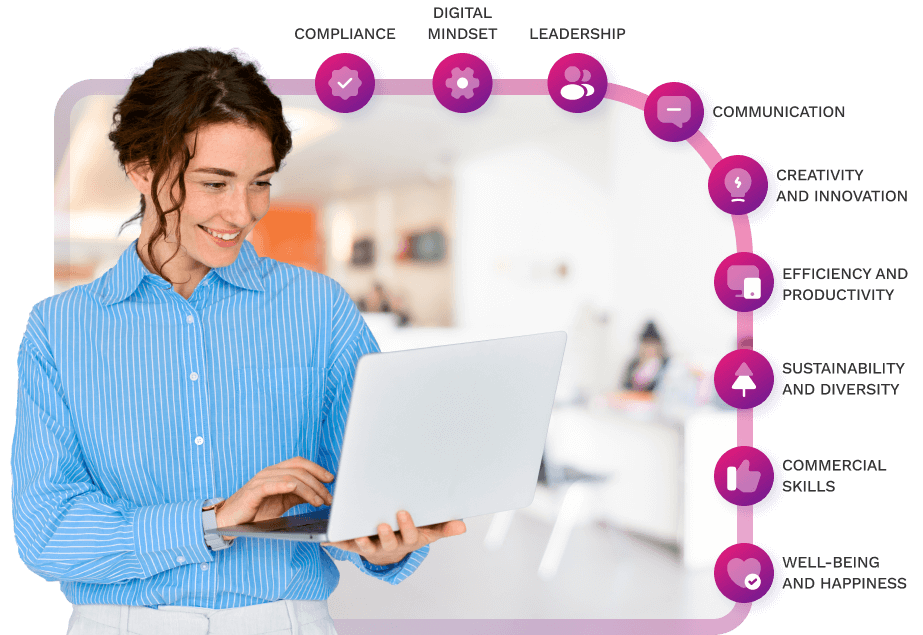
- Development of diversified skills: lifelong learning enables the acquisition of both technical competencies (hard skills) and interpersonal abilities (power skills), creating more well-rounded professionals.
- Adaptability to change: in a constantly evolving work environment, those who embrace continuous learning adapt more quickly to new technologies, methodologies, and industry trends.
- Greater satisfaction and engagement: having the opportunity to learn and grow continuously increases motivation, sense of purpose, and job satisfaction.
- Cognitive stimulation: lifelong learning keeps the mind active, improves memory, enhances creativity, and contributes to long-term mental health.
Benefits for organizations
- More productive teams: employees with up-to-date competencies work more efficiently, make better use of available tools, and deliver stronger results.
- Greater business competitiveness: companies that invest in continuous learning are better prepared to face market changes, adopt new technologies, and stay at the forefront of their industry.
- Talent retention: offering professional development opportunities is one of the factors most valued by employees. A culture of lifelong learning significantly reduces staff turnover.
- Culture of innovation: teams that learn continuously generate more ideas, experiment with new approaches, and actively contribute to organizational innovation.
- Personalized and efficient training: with modern e-learning platforms, companies can design training programs aligned with their specific needs, optimizing their investment in learning.
- Future readiness: an organization with a continuous learning mindset better anticipates environmental changes and proactively prepares for upcoming challenges.

How to implement a culture of continuous learning in your organization
Integrating lifelong learning into organizational culture requires a strategic approach and commitment from all levels of the company. Below are best practices to achieve this:
1. Foster a growth mindset
The first step in implementing continuous learning is changing the collective mindset. The organization must convey that learning does not end with hiring or initial training, but is an ongoing process.
Concrete actions:
- Regularly communicate the importance of continuous professional development.
- Recognize and publicly celebrate those who invest time in their learning.
- Remove the stigma around mistakes by promoting experimentation as a path to learning.
- Engage leaders as role models in their own development.
2. Implement a comprehensive training plan
An effective continuous learning program must be diverse, structured, and aligned with the company’s strategic objectives.
Key components:
- Role-specific technical training.
- Development of transversal skills (communication, leadership, teamwork).
- Updates on industry trends.
- Mentoring and coaching programs.
- Spaces for peer learning.
3. Personalize learning paths
Not all employees have the same needs or learn in the same way. Personalization is essential for the success of lifelong learning.
Personalization strategies:
- Conduct competency assessments to identify individual gaps.
- Offer multiple content formats (videos, readings, practice activities, simulations, storytelling).
- Allow employees to choose topics of interest within an approved catalog.
- Adapt pace and depth according to each person’s level.


4. Create interactive and dynamic content
Continuous learning is more effective when content is engaging, practical, and applicable to daily work.
Best practices:
- Use gamification to increase engagement.
- Incorporate real cases and simulations.
- Design microlearning content to make it easier to consume in short moments.
- Regularly update materials to maintain their relevance.
WHITEPAPER
Looking for the perfect tool to create interactive courses? Here's how to choose it


5. Encourage collaboration and social learning
Lifelong learning does not happen in isolation. Collaborative environments enhance the exchange of knowledge and experiences.
Recommended initiatives:
- Create communities of practice based on areas of interest.
- Organize “lunch and learn” sessions where employees share knowledge.
- Implement cross-mentoring systems.
- Facilitate internal forums or discussion platforms.
6. Allocate specific time and resources
Lifelong learning requires not only financial investment, but also time. Organizations must make it easier for employees to dedicate time to learning without it being perceived as an additional burden.
Practical actions:
- Set aside hours dedicated exclusively to training (example: 5 hours per week).
- Provide individual budgets for external courses.
- Recognize learning time as part of working hours, not as extra time.
- Provide access to subscriptions for high-quality educational platforms.
7. Implement evaluation and monitoring systems
To ensure that continuous learning generates impact, it is essential to measure and continuously track progress.
Relevant metrics:
- Participation rate in training programs.
- Average training hours per employee.
- Application of what has been learned in real projects.
- Competency development according to periodic evaluations.
- Participant satisfaction with training programs.
Tools and platforms to boost lifelong learning
Technology has democratized access to continuous learning, offering solutions tailored to different needs and budgets.
1. LMS platforms (Learning Management System)
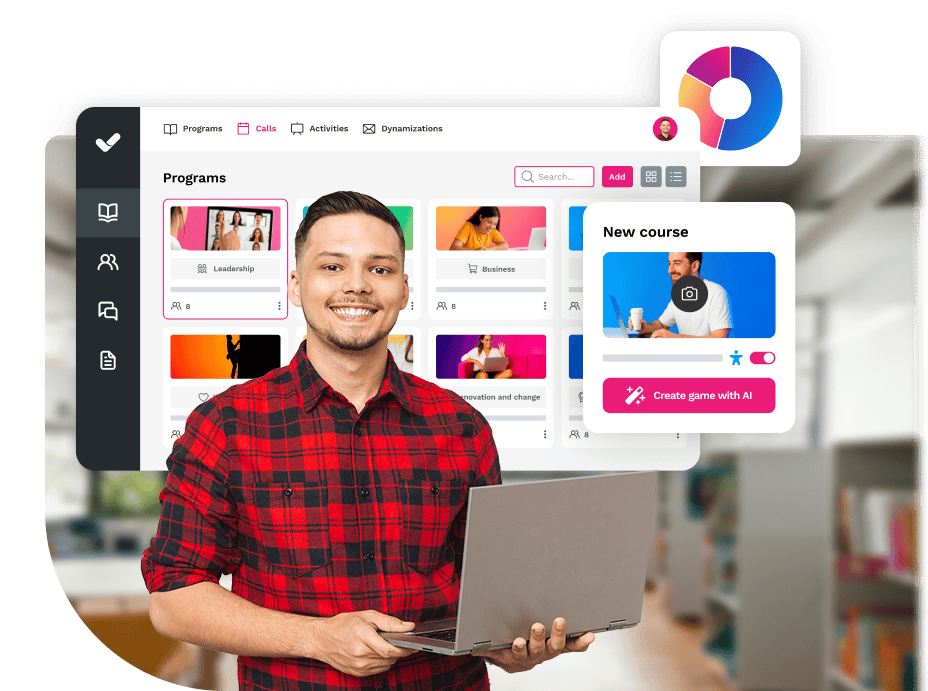
An LMS is essential for managing, delivering, and tracking training programs in an organization. isEazy LMS is an all-in-one solution that allows you to:
- Centralize all training content in one place.
- Automate course assignments and enrollments.
- Generate reports on progress and results.
- Create e-learning content with AI.
- Access a complete catalog of ready-to-use courses.
- Access content from any device, enabling flexible learning.
2. MOOC platforms
Massive Open Online Courses (MOOCs) are ideal for self-directed learning:
- Coursera: more than 175 million users, offering courses from prestigious universities
- Udacity: specialized in technology and digital skills, with more than 21 million learners
- edX: founded by Harvard and MIT, offers MicroMasters programs and professional certifications
- LinkedIn Learning: integrated with professional profiles, ideal for career development.
- isEazy Skills: the most comprehensive course catalog for professional training on the market. More than 600 courses and soft skills programs to help you adapt to your team’s needs.
Microlearning tools
Microlearning supports lifelong learning through short, specific content that can be consumed in just a few minutes.
Emerging technologies
Technological innovation is transforming continuous learning:
- Virtual Reality (VR) and Augmented Reality (AR): immersive simulations for safe practice in controlled environments.
- Artificial Intelligence: virtual tutors that personalize pace and content according to learner progress.
- Gamification: platforms that turn learning into engaging, game-based experiences.
- Micro-credentials and digital badges: fast certifications that validate specific skills in an agile way.
How to measure the impact of continuous learning in your company
Evaluating the return on investment of lifelong learning is essential to justify resources and optimize strategies.
Key performance indicators (KPIs)
- Participation rate
- Percentage of employees who complete training programs.
- Frequency of access to learning platforms.
- Average time spent on training.
- Competency assessment
- Comparison of skills before and after training.
- Results in knowledge tests and certifications.
- Progress in personalized learning paths.
- Practical application
- Projects where acquired knowledge was implemented.
- Process improvements thanks to new competencies.
- Documented success stories.
- Organizational performance indicators
- Increased productivity of trained teams.
- Reduction in errors or execution times.
- Improvement in quality indicators.
- Talent retention and satisfaction
- Turnover rate compared to the industry.
- Job satisfaction surveys.
- eNPS (Employee Net Promoter Score).
- Learning data analysis
- Content consumption patterns.
- Correlation between training and performance.
- Identification of competency gaps.
- Promotions and professional development
- Percentage of internal promotions.
- Employees taking on new roles or responsibilities.
- Cases of lateral or vertical mobility.
- Industry benchmarking
- Comparison with industry standards.
- Relative position in talent indicators.
- Evolution compared to competitors.
Data collection methods
- Surveys and questionnaires: direct feedback from participants.
- Qualitative interviews: deeper exploration of individual experiences.
- LMS data analysis: dashboards with usage metrics.
- Focus groups: group sessions to identify improvement opportunities.
- 360° evaluations: multiple perspectives on competency development.
Trends in lifelong learning for the coming years
Continuous learning is constantly evolving. These are the trends that will shape its future:
1. Hyper-personalization with AI
Artificial intelligence will enable the creation of unique lifelong learning experiences for each individual, adapting content, methodologies, and pace according to each person’s profile, preferences, and goals.

2. Immersive learning with VR/AR
Virtual and augmented reality technologies will take continuous learning to new levels of effectiveness through hyper-realistic simulations in sectors such as healthcare, engineering, and customer service.

x
3. Micro-credentials and digital badges
Traditional certificates will give way to agile credentials that quickly validate specific competencies, allowing professionals to demonstrate their skills in a granular way. In isEazy Skills, professionals who complete a course will be able to automatically share their completion certificates on LinkedIn. This is an exceptional opportunity to give visibility to internal talent development and strengthen their learning culture in the professional environment.

4. Global collaborative learning
Platforms will connect professionals from around the world to learn together, share experiences, and co-create knowledge beyond geographic and cultural boundaries.

Conclusion: lifelong learning as a competitive advantage
Lifelong learning is not a passing trend, but a strategic necessity in the 21st century. Continuous learning enriches both individuals and organizations, creating more well-rounded professionals, more agile teams, and more competitive companies.
To successfully implement lifelong learning in your company, it is essential to have the right tools. isEazy offers the best AI-powered e-learning solutions to drive continuous training, with collaborative spaces, interactive content, and detailed progress analytics. Request a demo now.
Frequently asked questions about lifelong learning
What is the difference between lifelong learning and traditional training?
Traditional training is usually one-time, structured, and focused on a specific stage of life (for example, university studies). Lifelong learning, on the other hand, is an ongoing process that extends throughout both professional and personal life. It is more flexible, self-directed, and adapted to the changing needs of the work environment, becoming part of everyday life through online courses, microlearning, work experiences, and social learning.
Why is lifelong learning key for companies in 2026?
Because the job market is evolving at high speed. Automation, AI, and digital transformation are causing skills to become outdated more quickly. Companies that promote lifelong learning build more adaptable, innovative, and productive teams. It also improves talent retention, as professionals value working for organizations that support their continuous development.
How can a company create a culture of lifelong learning?
To integrate lifelong learning into an organization, it is necessary to combine strategy, leadership, and technology. This means fostering a growth mindset, offering learning plans aligned with business goals, personalizing learning paths, and allocating time during the workday for training. Platforms like isEazy LMS help centralize content, track progress, and automate training management.
What types of activities are part of lifelong learning?
Continuous learning goes beyond formal courses. It includes structured training (master’s programs, certifications), self-directed online courses, learning on the job, mentoring, communities of practice, specialized reading, podcasts, simulations, microlearning, and even everyday experiences such as networking or solving real-world problems. This variety supports the development of both technical skills and soft skills.
How is the impact of lifelong learning measured within an organization?
It can be assessed through indicators such as participation rates in training, skills development, practical application of knowledge, productivity improvement, error reduction, and talent retention. Learning platforms like isEazy Skills provide analytics that help connect learning initiatives with real business outcomes.
Featured articles


GUIDE
Does your training plan comply with the EU AI Act?
Prepare your organization to comply with the new AI Regulations
Download guide


The best e-learning solutions for companies, all in one place
Powerful, quick-to-set-up tools that are easy to use, no matter your training needs


The best e-learning solutions for companies, all in one place
Powerful, quick-to-set-up tools that are easy to use, no matter your training needs
Related articles

Sara De la Torre
January 25, 2024
Cloud-based training: 4 advantages of learning in the cloud
Read more

Sara De la Torre
September 28, 2026
AI Skills: What They Are and How to Build Them in Your Organization
Read more

Sara De la Torre
October 18, 2018
Images as metaphors. How to convey abstract concepts with images.
Read more