CASE STUDY
How MAPFRE turned learning into sales with isEazy

Brain
The first AI trained to teach

Author
The #1 AI-powered authoring tool on the market

Factory
Custom e-learning content factory

Skills
Comprehensive power skills course catalog

LMS
All-in-one LMS platform with AI

Engage
App for managing frontline teams
FEATURES

AINew
Unlock your full potential and speed up course creation with artificial intelligence.

Accessibility
Automatically meet accessibility guidelines—without sacrificing interactivity!

Interactivity
Boost engagement with interactive, ready-to-use activities that make learning fun.

Course Creation
Reduce the time it takes to create your e-learning courses with our authoring tool.

Distribution
We offer you different distribution options, so that nothing can stop you.

SCORM
Publish your course in SCORM format and share it on any LMS.
SERVICES

Instrucional Design
Surprise your students with multimedia and interactive content.

Custom Courses
We create e-learning courses for you—tailored to your needs and hassle-free!

Virtual Reality
Turn learning into an immersive experience.

Custom Avatars
Give your courses and videos a unique touch with personalized avatars.

Audiovisual FactoryNew
Turn training into something dynamic and visual with engaging videos.
CATALOG

Course catalog
Over 600 skills and competency courses to help you adapt to your team's needs.
Microsoft Copilot AcademyNew
Your professionals will learn how to apply Copilot AI to key processes within your organization.

Artificial Intelligence Academy
Train your teams in the practical use of AI to boost productivity and innovation in your company.

Cybersecurity Academy
Capacita a tu empresa con el catálogo más completo en seguridad digital corporativa.

Use cases
Choose the solution that best fits your needs

Industries
Solutions for all types of industries
USE CASES

Onboarding
Facilitate the onboarding process, productivity and engagement of your new employees.

Upskilling
Boost your team's skills and prepare them for the challenges of the future with upskilling.

Microlearning
Discover all the advantages of microlearning and boost your training results.

Gamification
Enjoy addictive training that will get your professionals hooked.

Internal Communication
Improve communication in your company and enjoy an aligned and committed team.

Mobile learning
Agile, flexible, and interactive learning—built for today’s digital-first workforce.
INDUSTRIES

Banking and financial services
Training in compliance, cybersecurity, customer service, and key skills development.

Pharmaceuticals and healthcare
Digital onboarding, regulatory updates, and ongoing training for healthcare staff.

Retail and consumer
Agile and scalable training for in-store, operational, and customer service teams.

Industry and manufacturing
Training in processes, safety, and corporate culture for distributed teams.

Education and training
Digital solutions for training centers, internal academies, and corporate universities.

Technology and telecommunications
Development of technical talent, digital skills, and upskilling and reskilling programs.
CLIENTS

MAPFRE
How MAPFRE turn e-learning into sales with isEazy

Pepco
A personalised learning experience for a growing team.

BBVA
Digitisation and creation of high quality e-learning content.

Shiseido
We increase the engagement of the training with a social and gamified app.

Telefónica
Large-scale reskilling for the company's digital transformation.

Vodafone
A personalised learning experience for a growing team.
More than 1,000 companies already rely on isEazy.





MEET ISEAZY

Events
Discover our upcoming events and connect with the future of e-learning.

News
Find out the latest news about isEazy: press releases, partnerships, updates...

Contact
Leave us your personal details and we will contact you as soon as possible.
About isEazyNew
Find out more about our company.

Careers
We are looking for the best talent, join our team!

Partners
Become our partner and grow your business.
INTERESTING RESOURCES

Blog
The best content on e-learning: trends, tools and key strategies.

Whitepapers
Gain valuable insights and stay ahead of industry trends.

Product releases
The latest news and releases of our e-learning products and solutions.

Glossary
Definitions of the most commonly used terms and key industry concepts.

Guides
Discover the best step-by-step tips and tricks to optimize your L&D strategy.

Webinars
Video sessions on our products, trends and more

Comparatives
Compare e-learning solutions available on the market and choose the most suitable one.


WEBINAR
Master AI in isEazy Author in under an hour.




GUIDE
Prepare your organization to comply with the new AI regulations


AUTHORING TOOL
Create courses automatically and generate interactive activities, games, translations, and multimedia resources in seconds.

Stay up to date with all our latest news
 Subscribe to our newsletter
 Stay up to date with all our latest news

July 23, 2026

CONTENT CREATED BY:

Table of contents
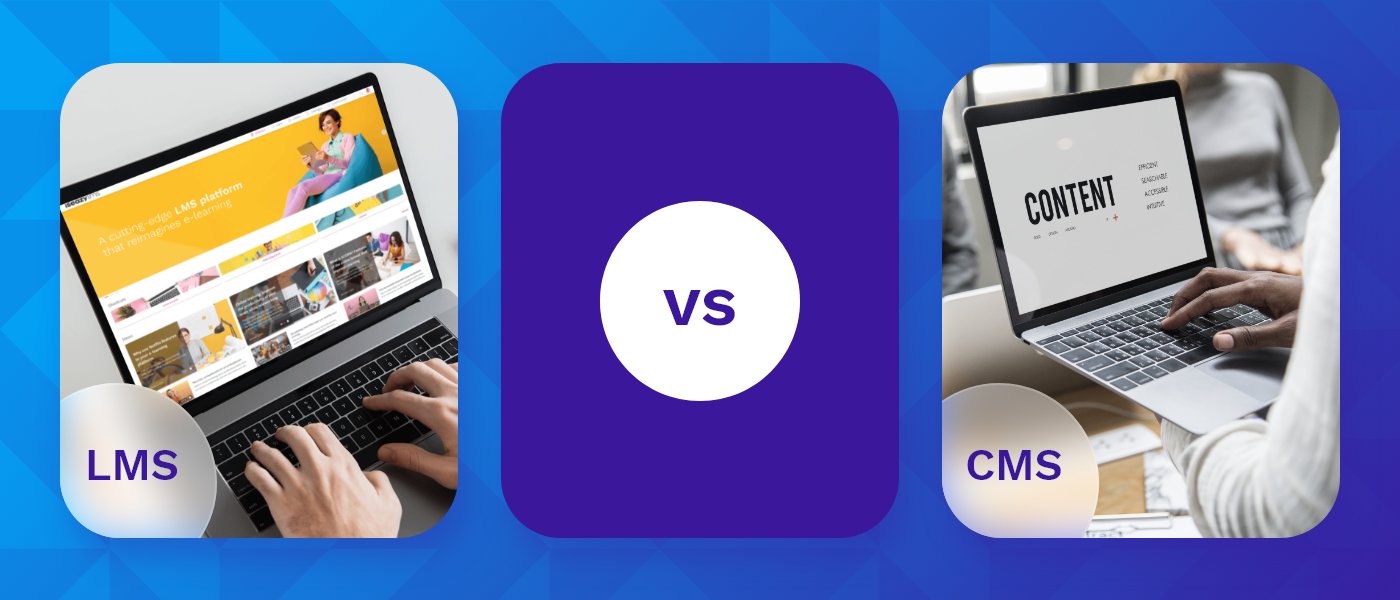
In corporate training, distinguishing between an LMS (Learning Management System) and an LRS (Learning Record Store) is essential for designing an effective learning strategy. Although both tools manage learning data, their purpose, scope, and technology are very different. In this article, we explain what each one is, what sets them apart, and when your organization actually needs one or the other.
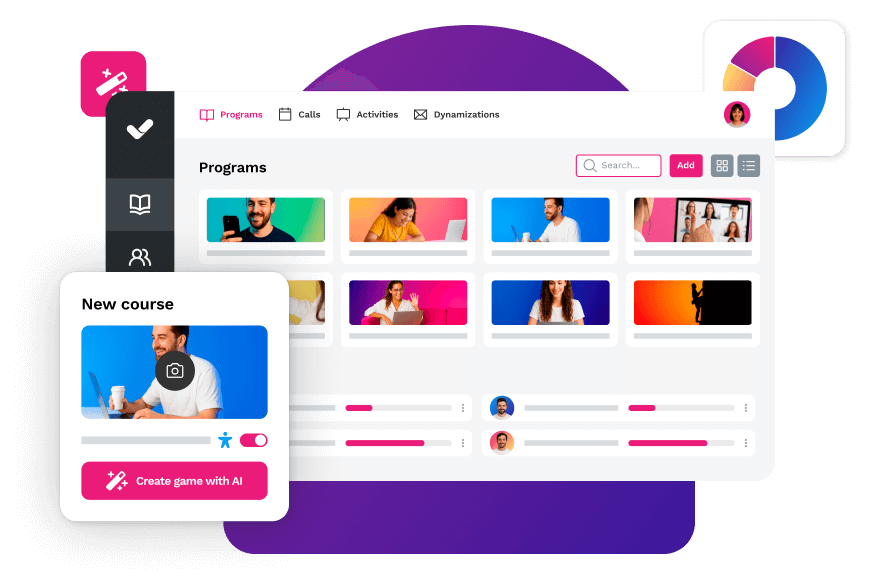
A Learning Management System (LMS) is a software platform designed to administer, document, track, and distribute corporate training programs. It provides L&D teams with the tools they need to develop, implement, and manage all their learning initiatives from a single place. If you want a more complete overview, we have a dedicated LMS guide covering everything you need to know.
The main features of an LMS include:
Using an LMS like isEazy LMS allows organizations to deliver consistent training experiences, meet compliance requirements, and identify knowledge gaps across their teams from a centralized platform.
A Learning Record Store (LRS) is a specialized data repository designed to store and manage records of learning experiences generated by multiple sources. Unlike the LMS, the LRS does not manage or deliver training: its sole function is to collect, store, and share data about any type of learning activity.
The LRS works thanks to the xAPI (Experience API) standard, also known as Tin Can API. xAPI captures detailed records of learner interactions with training materials in the form of subject-verb-object “statements”: for example, “Ana completed the sales module” or “Carlos passed the customer service simulation”. Unlike SCORM vs xAPI, the xAPI standard does not require learning to take place inside an LMS.
An LRS can collect learning data from:
Modern corporate learning does not happen exclusively inside formal LMS courses. According to the 70-20-10 model, 70% of workplace learning comes from hands-on experience and job challenges, 20% from social interactions, and just 10% from structured training. A traditional LMS with SCORM only captures that 10%.
An LRS with xAPI dramatically expands the scope of learning tracking. It can record, for example:
This capability is especially relevant for organizations with complex learning ecosystems, multiple vendors and platforms, or a strong culture of informal and social learning.
Although they are sometimes confused, LMS and LRS have completely different purposes. The table below summarizes the fundamental differences to help you identify what your organization actually needs:
| Criteria | LMS | LRS |
|---|---|---|
| Primary function | Manage and deliver training | Store learning data |
| Communication standard | SCORM (and xAPI in modern LMS) | xAPI exclusively |
| Type of learning | Formal and structured | Formal, informal, and experiential |
| Who uses it | L&D managers, employees, admins | Systems and platforms (API) |
| User management | Yes (enrollments, profiles, permissions) | No |
| Content delivery | Yes (courses, paths, assessments) | No |
| Built-in reporting | Yes (dashboards, reports) | Raw exportable data |
| Data sources | Only activities inside the LMS | Multiple platforms and systems |
The question L&D leaders ask most is not “what is an LRS?” but “do I actually need one?”. The honest answer is: most organizations do not need a standalone LRS. A modern LMS covers the tracking and analytics needs of 90% of organizations.
However, a separate LRS does make sense when any of the following conditions apply:
If none of these situations describes your organization, investing in a next-generation LMS with built-in analytics is the most efficient decision.
Between SCORM and xAPI there is a third standard that L&D professionals should know: cmi5. Defined by the Aviation Industry CBT Committee (AICC), cmi5 combines the operational simplicity of SCORM with the data power of xAPI.
What does cmi5 bring in practice? It defines exactly how an LMS launches a course and how that course reports data to an LRS using xAPI. It resolves one of xAPI’s historical challenges: its great flexibility made it difficult to implement consistently. cmi5 establishes the clear rules that make genuine LMS-to-LRS interoperability possible.
For L&D teams, this means enjoying granular xAPI tracking while keeping centralized management in the LMS — a step forward from traditional e-learning standards.
Adding an LRS to your technology stack means complexity: technical configuration, integration maintenance, team training, and additional cost. For most organizations, a modern LMS with native xAPI support and built-in advanced analytics eliminates the need for a separate LRS.
Next-generation LMS platforms like isEazy LMS already include data recording and analysis capabilities that previously required an external LRS:
MAPFRE is a great example of how an LMS with powerful analytics can transform the impact of corporate training at scale. With isEazy LMS, MAPFRE’s L&D team was able to improve the tracking and personalization of their training program, connecting learning data with business outcomes.
The industry trend points toward convergence: LMS platforms are increasingly incorporating capabilities traditionally associated with the LRS, blurring the line between the two systems. According to the LinkedIn Workplace Learning Report 2024, 89% of L&D professionals consider demonstrating the impact of training on business outcomes their top priority — which demands systems capable of correlating learning data with performance metrics.
This evolution is producing platforms that combine in a single environment:
For training teams, this means fewer tools to manage, more integrated data, and a stronger ability to demonstrate training ROI. Explore how it works in practice with LMS analytics and LMS learning reports.
LRS and LMS are not rivals — they are complementary technologies with different purposes. The LMS manages and delivers training; the LRS extends the ability to capture learning data beyond the formal environment. However, for most organizations the real question is not “LRS or LMS?” but which LMS can cover both needs without adding complexity to the technology stack.
A modern LMS with native xAPI support, advanced analytics, and solid integrations eliminates the need for a standalone LRS in most cases. Before investing in an additional solution, it is worth evaluating whether your current LMS — or a new one — already covers that ground.
If you want to see how isEazy LMS handles tracking, reporting, and integrations in practice, request a personalized demo and we will walk you through it using your specific use case.
A Learning Management System (LMS) manages training: enrollments, course delivery, progress tracking, and basic reporting. A Learning Record Store (LRS) is a data repository that stores learning records generated by multiple sources using the xAPI standard, including informal activities, simulations, and learning that takes place outside the LMS. The key difference is scope: the LMS manages structured formal learning, while the LRS captures any type of learning experience. In practice, most organizations cover their needs with a modern LMS that already includes built-in advanced analytics.
An LRS with xAPI support can record virtually any learning interaction: e-learning course completions, simulation results, video watch time, offline activities, peer-to-peer social learning, knowledge base searches, or even real-world on-the-job practice. Data is stored as “xAPI statements” in subject-verb-object format (for example: “John completed the onboarding module”). This flexibility is the main advantage of the LRS over SCORM, which only tracks formal courses inside the LMS.
It depends on the maturity and complexity of your learning ecosystem. Most mid-size and large organizations do not need a standalone LRS: a modern LMS that supports xAPI and cmi5 already includes native data storage and advanced analytics capabilities. A separate LRS makes sense when the organization uses multiple learning platforms (LMS, LXP, external apps) and needs to centralize all learning data in a single repository, or when analytics requirements are highly advanced and specialized. If you are just getting started or have a unified learning ecosystem, a good LMS is sufficient.
cmi5 is an e-learning standard that combines the best of SCORM and xAPI: it defines how a course is launched and how it communicates between an LMS and an LRS using the xAPI protocol. Unlike SCORM (which only works within the LMS) or plain xAPI (very flexible but without implementation rules), cmi5 establishes a clear set of norms for genuine interoperability between content and platforms. For L&D teams, cmi5 means courses can report granular xAPI data to the LRS while keeping centralized management in the LMS — delivering the detailed analytics of xAPI with the operational simplicity of SCORM.

Automate processes, access 600+ ready-to-use courses, or create your own content with the help of AI.
Request a demoContact us

Streamline your training management
Experience the power of AI in an LMS that has it all


Streamline your training management
Experience the power of AI in an LMS that has it all