CASE STUDY
How Pepco was able to comprehensively manage employee training with an LMS

Brain
The first AI trained to teach

Author
The #1 AI-powered authoring tool on the market

Factory
Custom e-learning content factory

Skills
Comprehensive power skills course catalog

LMS
All-in-one LMS platform with AI

Engage
App for managing frontline teams
Product

What is Brain?
Everything you need to know about the first AI trained to teach.

How does it work?
Adaptive, conversational, and contextual. That’s learning with Brain.

Security
Why your company’s knowledge never leaves your environment or trains other models.

Comparison
Discover what sets isEazy Brain apart from other AI solutions.

Frequently Asked Questions
Want to learn more? Find answers to all your questions about isEazy Brain here.
FEATURES

AINew
Unlock your full potential and speed up course creation with artificial intelligence.

Accessibility
Automatically meet accessibility guidelines—without sacrificing interactivity!

Interactivity
Boost engagement with interactive, ready-to-use activities that make learning fun.

Course Creation
Reduce the time it takes to create your e-learning courses with our authoring tool.

Distribution
We offer you different distribution options, so that nothing can stop you.

SCORM
Publish your course in SCORM format and share it on any LMS.
SERVICES

Instrucional Design
Surprise your students with multimedia and interactive content.

Custom Courses
We create e-learning courses for you—tailored to your needs and hassle-free!

Virtual Reality
Turn learning into an immersive experience.

Custom Avatars
Give your courses and videos a unique touch with personalized avatars.

Audiovisual FactoryNew
Turn training into something dynamic and visual with engaging videos.
CATALOG

Course catalog
Over 600 skills and competency courses to help you adapt to your team's needs.
Microsoft Copilot AcademyNew
Your professionals will learn how to apply Copilot AI to key processes within your organization.

Artificial Intelligence Academy
Train your teams in the practical use of AI to boost productivity and innovation in your company.

Cybersecurity Academy
Capacita a tu empresa con el catálogo más completo en seguridad digital corporativa.
FEATURES

Learning platform
Manage all your training from one place

Analitycs
Measure the impact of your training

Learning Experience
Offer a unique learning experience to your team
Content Library
Choose from hundreds of expert-created courses
Authoring Tool
Create your own content—faster than ever

Use cases
Choose the solution that best fits your needs

Industries
Solutions for all types of industries
USE CASES

Onboarding
Facilitate the onboarding process, productivity and engagement of your new employees.

Upskilling
Boost your team's skills and prepare them for the challenges of the future with upskilling.

Microlearning
Discover all the advantages of microlearning and boost your training results.

Gamification
Enjoy addictive training that will get your professionals hooked.

Internal Communication
Improve communication in your company and enjoy an aligned and committed team.

Mobile learning
Agile, flexible, and interactive learning—built for today’s digital-first workforce.
INDUSTRIES

Banking and financial services
Training in compliance, cybersecurity, customer service, and key skills development.

Pharmaceuticals and healthcare
Digital onboarding, regulatory updates, and ongoing training for healthcare staff.

Retail and consumer
Agile and scalable training for in-store, operational, and customer service teams.

Industry and manufacturing
Training in processes, safety, and corporate culture for distributed teams.

Education and training
Digital solutions for training centers, internal academies, and corporate universities.

Technology and telecommunications
Development of technical talent, digital skills, and upskilling and reskilling programs.
CLIENTS

MAPFRE
How MAPFRE turn e-learning into sales with isEazy

Pepco
A personalised learning experience for a growing team.

BBVA
Digitisation and creation of high quality e-learning content.

Shiseido
We increase the engagement of the training with a social and gamified app.

Telefónica
Large-scale reskilling for the company's digital transformation.

Vodafone
A personalised learning experience for a growing team.
More than 1,000 companies already rely on isEazy.


MEET ISEAZY

Events
Discover our upcoming events and connect with the future of e-learning.

News
Find out the latest news about isEazy: press releases, partnerships, updates...

Contact
Leave us your personal details and we will contact you as soon as possible.
About isEazyNew
Find out more about our company.

Careers
We are looking for the best talent, join our team!

Partners
Become our partner and grow your business.
INTERESTING RESOURCES

Blog
The best content on e-learning: trends, tools and key strategies.

Whitepapers
Gain valuable insights and stay ahead of industry trends.

Product releases
The latest news and releases of our e-learning products and solutions.

Glossary
Definitions of the most commonly used terms and key industry concepts.

Guides
Discover the best step-by-step tips and tricks to optimize your L&D strategy.

Webinars
Video sessions on our products, trends and more

Comparatives
Compare e-learning solutions available on the market and choose the most suitable one.


WEBINAR
Master AI in isEazy Author in under an hour.




GUIDE
Prepare your organization to comply with the new AI regulations

Stay up to date with all our latest news
 Subscribe to our newsletter
 Stay up to date with all our latest news

November 25, 2025

CONTENT CREATED BY:

Table of contents
In an increasingly digital work environment, corporate training is no longer optional — it’s a strategic necessity. Companies are looking for tools that help them train and develop talent in an agile, effective, and sustainable way. And in doing so, they often face a common decision: should they use a Human Resource Management System (HRMS) with a training module or invest in a dedicated LMS solution?
While both approaches may seem to address similar needs on the surface, the reality is that their goals, capabilities, and outcomes differ significantly. Below, we explore the key factors that will help you decide which option is best for your organization.
An HRMS (Human Resource Management System) is a platform designed to centralize and automate key HR functions such as payroll, hiring, time tracking, performance management, and regulatory compliance. Some solutions include basic training modules that help manage certain aspects of internal training.
This approach is particularly appealing for small businesses or teams with limited resources, as it combines multiple needs into a single tool, reducing operational complexity and software licensing costs.
However, when the focus is on learning, these modules often fall short. They are typically designed for mandatory or compliance training, offering limited functionality and little flexibility to customize content, learning paths, or user experience.
Many HRMS providers integrate learning modules to offer a more comprehensive solution for workforce development. These integrated LMS modules provide basic training functionalities within the same platform, allowing organizations to manage employee training alongside other HR activities. The integration usually includes features like course enrollment, progress tracking, and compliance training.
The convenience of having an HRMS that includes an LMS module is especially attractive for small and medium-sized enterprises (SMEs) looking to simplify their systems. These functionalities may include intuitive dashboards, automatic enrollment, and simplified reporting — aligning training efforts with broader HR objectives.
One of the main advantages of using an HRMS with an LMS module is its cost efficiency. Organizations can reduce software licensing fees, maintenance costs, and reliance on multiple vendors by consolidating systems. This is particularly beneficial for smaller companies with limited budgets that want to implement training solutions without major investments.
An HRMS that includes an LMS supports a centralized employee database, allowing HR teams to manage staff information, training records, and performance reviews all in one place. Simplified user management eliminates data duplication, reduces errors, and improves overall data integrity.
For smaller teams, the quick deployment of an integrated system is a major advantage. Since the training module is usually designed to be user-friendly, HR teams can roll out training programs quickly without requiring extensive technical training. This ease of use encourages immediate employee engagement and facilitates a smooth transition to digital learning.
Working with a single vendor simplifies support and system updates. Organizations using an HRMS with an integrated LMS can handle all their needs through one point of contact, ensuring cohesive functionality between HR management and employee training.
| Aspect | HRMS with LMS Module | Specialized LMS |
|---|---|---|
| Purpose | Comprehensive HR management with training as an extra feature | Training and development as the core function |
| Training Capabilities | Basic: enrollment, compliance, simple tracking | Advanced: learning paths, gamification, authoring, in-depth analytics |
| Customization | Limited: fixed templates, low flexibility | High: custom content, branding, personalized learning paths |
| User Experience | Functional, but not very engaging or appealing | Modern, dynamic, and learner-centered |
| Scalability | Limited: designed for basic training needs | High: built to grow and adapt to new challenges |
Despite their convenience, LMS solutions integrated into an HRMS often come with limitations. These systems may lack advanced features needed for more complex training scenarios. For example, if a company wants to implement gamified learning strategies, it may find that the LMS module lacks the capabilities offered by a specialized standalone LMS platform.
The user experience with an LMS integrated into an HRMS may also fall short, especially when it comes to learner engagement. Training modules might not include interactive elements that promote participation, knowledge retention, and motivation. This can lead to lower course completion rates and less effective learning outcomes.
While integrated LMS modules may offer basic reporting features, they often lack the analytical depth provided by standalone LMS platforms. Advanced tracking, custom reports, and real-time insights into learner performance are typically missing, limiting the organization’s ability to thoroughly assess training effectiveness.
An HRMS with an LMS module may not include robust content authoring tools. Organizations may be limited to pre-built courses that do not fully reflect their brand or learning goals. This lack of flexibility can hinder creativity and result in generic training experiences that fail to resonate with employees.
Finally, HRMS platforms may not prioritize continuous innovation in their LMS modules. As e-learning technologies evolve, organizations may find their integrated systems lagging behind in adopting new methodologies and features, such as microlearning or advanced learning analytics.
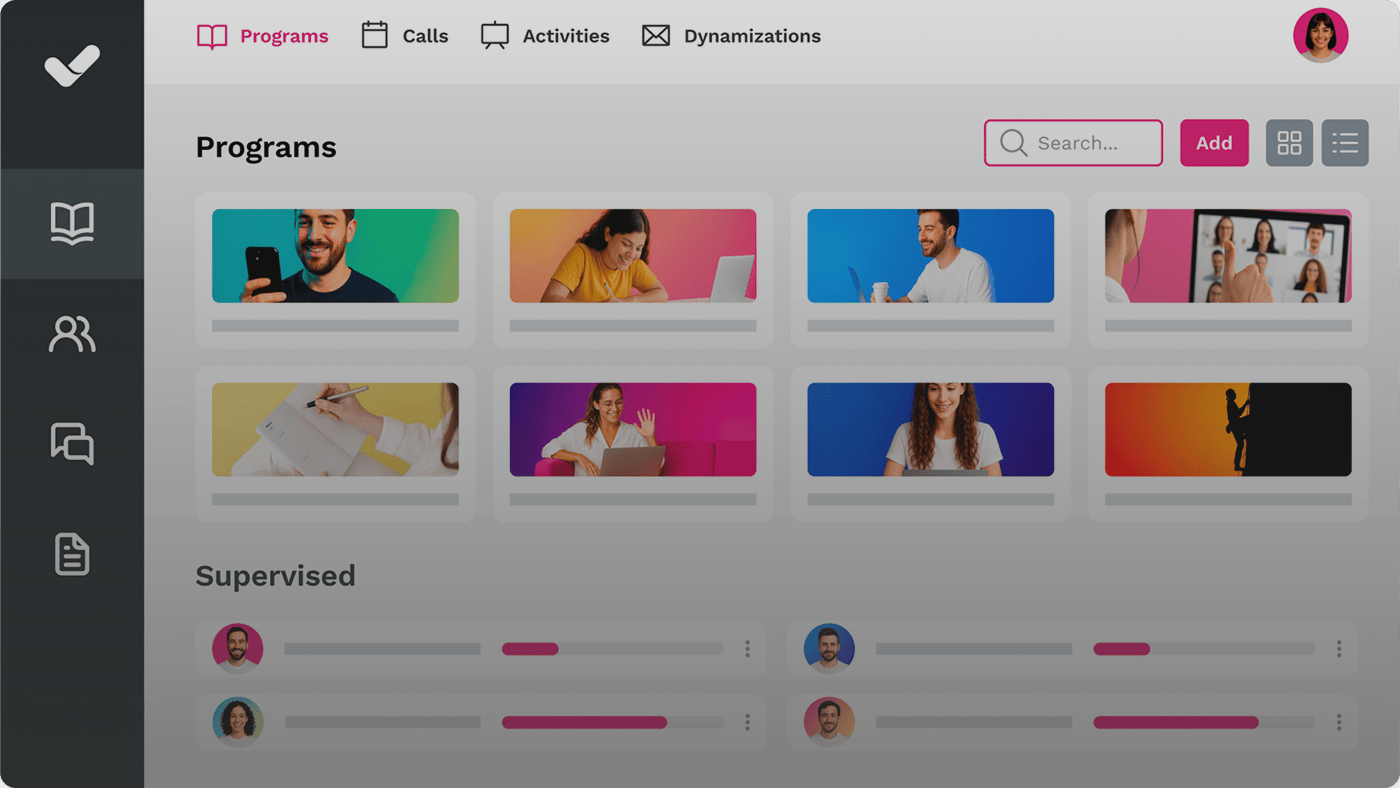
An LMS (Learning Management System) is designed with a single purpose: to support professional learning and development. These platforms allow organizations to design, deliver, manage, and analyze training programs in depth, adapting to the specific needs of both the organization and individual users.
Thanks to this specialized focus, an LMS goes far beyond simple course tracking. You can integrate gamification elements, create personalized learning paths, develop content with built-in authoring tools, automate communications, and extract real-time learning metrics — all within a user experience designed to motivate and retain employees.
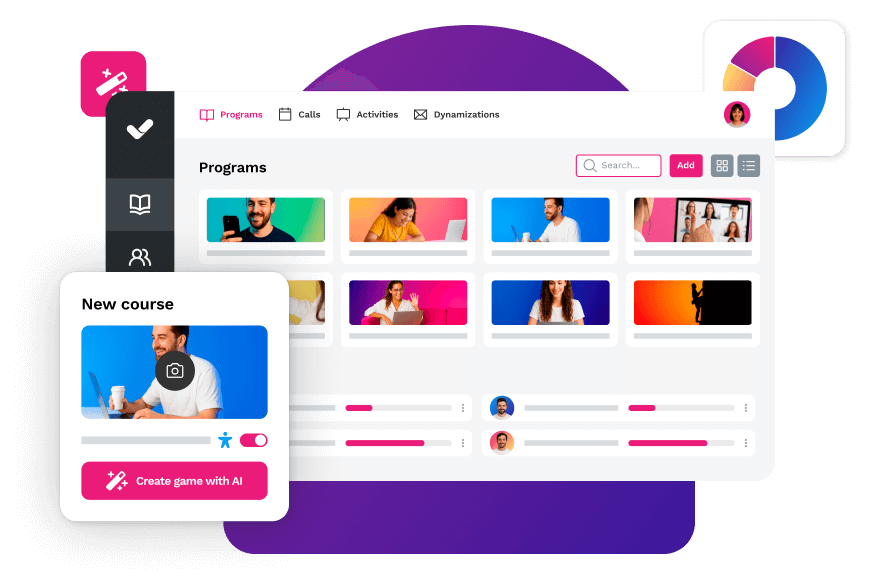
Solutions like isEazy LMS take it a step further by combining these features with an attractive, intuitive interface inspired by streaming platforms, boosting adoption and engagement from day one.
A standalone LMS is specifically designed for learning and development. It offers a wide range of features aimed at enhancing the training experience, making it a strong solution for organizations with significant training needs.
Standalone LMS platforms provide advanced features such as gamification, social learning, and interactive assessments that drive participation and enhance the learner experience. These elements help keep users engaged and motivated to complete their training.
Because they are learning-focused, standalone LMSs typically include advanced analytics that allow organizations to closely monitor learner progress, course effectiveness, and skill acquisition. This detailed data supports informed decision-making regarding training programs and return on investment (ROI).
As organizations expand, their training needs often become more complex. A standalone LMS provides the scalability required to support that growth, allowing more users, courses, and functionalities to be added without sacrificing performance. This flexibility is essential in today’s fast-changing business environment.
Standalone LMS providers are usually at the forefront of educational technology, consistently updating their platforms to include the latest learning trends and methodologies. Regular updates and new features enable organizations to deliver next-generation learning experiences to their employees.
It’s not about deciding which option is better, but about understanding which one best fits your goals.
An HRMS with a training module may be enough if:
A standalone LMS is the better choice if:
In fact, many companies choose a hybrid solution: integrating a specialized LMS with their HRMS. This allows them to centralize employee data while taking full advantage of a platform built for learning. isEazy LMS, for example, can be easily integrated with HR systems through standard connectors or APIs.
Before making a decision, it’s essential to thoroughly assess your training needs and evaluate how well each platform supports your learning strategy. To make an informed choice, consider these key questions:
1. Type of Training:
What kinds of programs do you need to manage — compliance, soft skills, technical development, onboarding, continuous learning, or a mix of several?
2. Volume and Frequency:
How many people do you need to train, and how often? Is your organization expecting growth or increasing training complexity?
3. Content and Customization:
Does your team need to create its own content, personalize learning paths, and adapt the experience to match your branding — or is it enough to use prebuilt content?
How much control do you require over content creation, editing, and customization?
4. Metrics and Analytics:
What kind of data do you need to measure the impact of learning? Do you need advanced analytics, real-time reporting, or just basic metrics?
5. Workforce Distribution:
Is your team working on-site, in a hybrid model, or fully remote? Do you need a platform that supports training for distributed teams?
6. Total Cost:
What is the total cost of ownership, including licenses, support, maintenance, admin hours, and potential integrations?
7. Vendor Relationship:
What level of support, updates, and innovation do you expect from your vendor?
Does the product’s development pace align with the future needs of your training strategy?
Choosing between an HRMS and an LMS depends on the direction you want to take your learning strategy. If your goal is to cover the basics — such as tracking attendance or certifying mandatory training — a module within your HRMS might be enough. But if you’re aiming to boost talent development, drive real engagement, and measure the business impact of learning, you need a modern, specialized LMS solution.
isEazy LMS is more than just a course management platform. It’s a next-generation tool designed to deliver a learning experience that is as engaging as it is effective — for both end users and administrators. What sets it apart?
Because training your team shouldn’t be just an administrative task — it should be a chance to accelerate their growth and the growth of your business.
Ready to transform your learning strategy? Request a demo and discover everything isEazy LMS has to offer.
An HRMS centralizes HR processes, with training as an additional module. An LMS, on the other hand, is built from the ground up to support talent development and learning management.
It depends on your needs. For basic training or compliance, it may be enough. But if you’re aiming for continuous, measurable, and engaging learning, a specialized LMS is the better option.
An LMS offers greater flexibility, allowing you to scale users, integrate new formats, or adopt innovative learning methods as your strategy evolves.

GUIDE
Prepare your organization to comply with the new AI Regulations
Download guide


Streamline your training management
Experience the power of AI in an LMS that has it all


Streamline your training management
Experience the power of AI in an LMS that has it all