CASE STUDY
Discover how fischer streamlined course creation with the perfect authoring tool.

Brain
The first AI trained to teach

Author
The #1 AI-powered authoring tool on the market

Factory
Custom e-learning content factory

Skills
Comprehensive power skills course catalog

LMS
All-in-one LMS platform with AI

Engage
App for managing frontline teams
Product

What is Brain?
Everything you need to know about the first AI trained to teach.

How does it work?
Adaptive, conversational, and contextual. That’s learning with Brain.

Security
Why your company’s knowledge never leaves your environment or trains other models.

Comparison
Discover what sets isEazy Brain apart from other AI solutions.

Frequently Asked Questions
Want to learn more? Find answers to all your questions about isEazy Brain here.
FEATURES

AINew
Unlock your full potential and speed up course creation with artificial intelligence.

Accessibility
Automatically meet accessibility guidelines—without sacrificing interactivity!

Interactivity
Boost engagement with interactive, ready-to-use activities that make learning fun.

Course Creation
Reduce the time it takes to create your e-learning courses with our authoring tool.

Distribution
We offer you different distribution options, so that nothing can stop you.

SCORM
Publish your course in SCORM format and share it on any LMS.
SERVICES

Instrucional Design
Surprise your students with multimedia and interactive content.

Custom Courses
We create e-learning courses for you—tailored to your needs and hassle-free!

Virtual Reality
Turn learning into an immersive experience.

Custom Avatars
Give your courses and videos a unique touch with personalized avatars.

Audiovisual FactoryNew
Turn training into something dynamic and visual with engaging videos.
CATALOG

Course catalog
Over 600 skills and competency courses to help you adapt to your team's needs.
Microsoft Copilot AcademyNew
Your professionals will learn how to apply Copilot AI to key processes within your organization.

Artificial Intelligence Academy
Train your teams in the practical use of AI to boost productivity and innovation in your company.

Cybersecurity Academy
Capacita a tu empresa con el catálogo más completo en seguridad digital corporativa.
FEATURES

Learning platform
Manage all your training from one place

Analitycs
Measure the impact of your training

Learning Experience
Offer a unique learning experience to your team
Content Library
Choose from hundreds of expert-created courses
Authoring Tool
Create your own content—faster than ever

Use cases
Choose the solution that best fits your needs

Industries
Solutions for all types of industries
USE CASES

Onboarding
Facilitate the onboarding process, productivity and engagement of your new employees.

Upskilling
Boost your team's skills and prepare them for the challenges of the future with upskilling.

Microlearning
Discover all the advantages of microlearning and boost your training results.

Gamification
Enjoy addictive training that will get your professionals hooked.

Internal Communication
Improve communication in your company and enjoy an aligned and committed team.

Mobile learning
Agile, flexible, and interactive learning—built for today’s digital-first workforce.
INDUSTRIES

Banking and financial services
Training in compliance, cybersecurity, customer service, and key skills development.

Pharmaceuticals and healthcare
Digital onboarding, regulatory updates, and ongoing training for healthcare staff.

Retail and consumer
Agile and scalable training for in-store, operational, and customer service teams.

Industry and manufacturing
Training in processes, safety, and corporate culture for distributed teams.

Education and training
Digital solutions for training centers, internal academies, and corporate universities.

Technology and telecommunications
Development of technical talent, digital skills, and upskilling and reskilling programs.
CLIENTS

MAPFRE
How MAPFRE turn e-learning into sales with isEazy

Pepco
A personalised learning experience for a growing team.

BBVA
Digitisation and creation of high quality e-learning content.

Shiseido
We increase the engagement of the training with a social and gamified app.

Telefónica
Large-scale reskilling for the company's digital transformation.

Vodafone
A personalised learning experience for a growing team.
More than 1,000 companies already rely on isEazy.





MEET ISEAZY

Events
Discover our upcoming events and connect with the future of e-learning.

News
Find out the latest news about isEazy: press releases, partnerships, updates...

Contact
Leave us your personal details and we will contact you as soon as possible.
About isEazyNew
Find out more about our company.

Careers
We are looking for the best talent, join our team!

Partners
Become our partner and grow your business.
INTERESTING RESOURCES

Blog
The best content on e-learning: trends, tools and key strategies.

Whitepapers
Gain valuable insights and stay ahead of industry trends.

Product releases
The latest news and releases of our e-learning products and solutions.

Glossary
Definitions of the most commonly used terms and key industry concepts.

Guides
Discover the best step-by-step tips and tricks to optimize your L&D strategy.

Webinars
Video sessions on our products, trends and more

Comparatives
Compare e-learning solutions available on the market and choose the most suitable one.


WEBINAR
Master AI in isEazy Author in under an hour.




GUIDE
Prepare your organization to comply with the new AI regulations

Stay up to date with all our latest news
 Subscribe to our newsletter
 Stay up to date with all our latest news

April 9, 2026

CONTENT CREATED BY:

Table of contents
Employee-generated learning (EGL) turns your own employees into creators of corporate knowledge. Rather than relying exclusively on external providers, organizations leverage internal expertise to train others.
According to LinkedIn Learning (2024), 87% of companies acknowledge that more than 60% of corporate knowledge lives exclusively within their employees. This reality has made EGL one of the most relevant practices in today’s training and development strategies.
Below, we explore exactly what it is, why more and more companies are adopting it, and what its eight most concrete and measurable benefits are.
Motivating employees to generate internal training content has a direct impact on three key business areas:
| Criterion | EGL (employees) | External training |
|---|---|---|
| Cost per module | Low (internal time) | High (vendor + design) |
| Content relevance | High (real context) | Medium (generic content) |
| Update speed | Immediate | Weeks or months |
| Engagement impact | High (active role) | Variable |
| Knowledge retention | High (social learning) | Medium |
Creating training content that helps colleagues do their jobs better increases employees’ intrinsic motivation. They feel valued, needed, and part of a learning community.
According to the Deloitte Global Human Capital Trends 2023 report, employees who actively contribute to organizational knowledge are 23% more likely to stay with the company long-term.
To maximize this benefit, it is essential to work on learner engagement: creating spaces in the LMS to share modules, establishing recognition mechanisms (badges, internal certificates), and measuring impact through completion rates and post-training assessments.
When creating training for others, internal experts are compelled to deepen their own understanding. The process of synthesizing and explaining consolidates learning to a far greater degree than simply receiving it.
This phenomenon, known as the Protégé Effect, shows that teaching improves one’s own comprehension by up to 90% more than passive study (Nestojko et al., 2014, Washington University). Learning by doing is especially powerful here: employees learn by creating, and develop communication and synthesis skills that go far beyond the content they produce.
As an added benefit, this voluntary expansion of knowledge reduces dependence on expensive external training and builds more well-rounded internal experts.
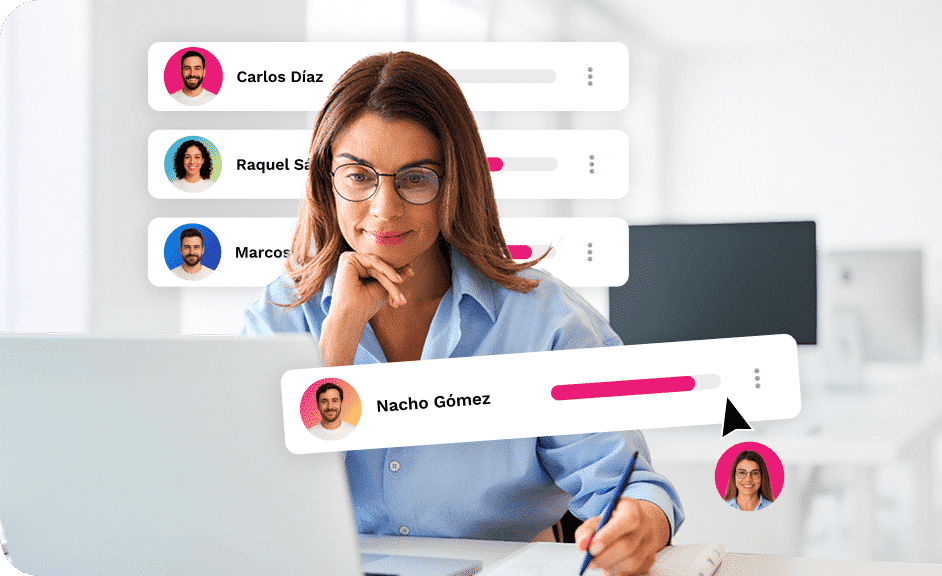
When the trainer is a colleague, the context is local and relevant: they know the real processes, the team’s language, and the day-to-day challenges. Learning becomes one-to-one, strengthening relationships and building greater trust across teams.
This is precisely the principle behind social learning: learning from and with peers is more effective than top-down, one-directional instruction. Albert Bandura demonstrated long ago that social observation and interaction are fundamental drivers of adult learning.
Furthermore, internally generated content tends to adapt better to the team’s different learning styles, because the creator knows first-hand how each person in their environment learns.
This is perhaps the most tangible benefit for L&D and HR managers. The production cost of an e-learning course with an external provider ranges from €10,000 to €40,000 per hour of training (AICC Industry Benchmark, 2023). EGL cuts that cost by 60% to 80% by leveraging internal expertise.
Beyond production savings, the time to deployment shrinks dramatically: while an external vendor may take weeks to deliver a module, an internal expert can have it ready in days using an intuitive authoring tool.
| Training model | Estimated cost/hour | Production time |
|---|---|---|
| Specialized external vendor | €10,000–€40,000 | 4–12 weeks |
| General e-learning agency | €3,000–€10,000 | 2–6 weeks |
| EGL with authoring tool | €500–€2,000 | 2–5 days |
Unlike one-off external training sessions, internally generated knowledge becomes an intangible organizational asset. It can be reused, updated, and scaled indefinitely—at no additional cost per use.
This asset grows with the company: every time a process changes, an employee updates the relevant module. The result is a living knowledge library, aligned with operational reality rather than a generic vendor catalogue.
It is one of the pillars of any successful training and development strategy: building knowledge that does not walk out the door when people change roles or leave the organization.
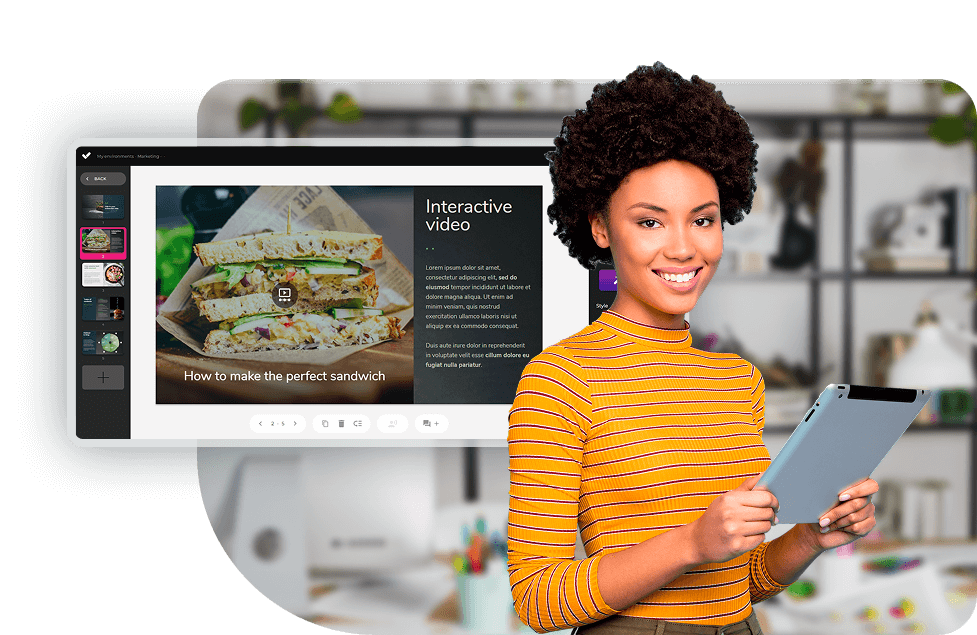
Employee-generated content is not generic: it is designed specifically for the organization’s own context—with real examples, internal case studies, and each team’s unique language. This is what sets EGL apart from any standard course catalogue.
Combined with an LMS that supports learning personalization, the result is a training experience that adapts to each person’s pace, level, and needs. Adaptive learning takes this principle even further: intelligent systems adjust content in real time based on learner performance, maximizing the efficiency of every minute of training.
When an employee creates content that others use and value, their professional confidence grows considerably. Feeling valuable, useful, and recognized as a go-to expert in their area has a direct impact on performance and commitment.
The Gallup State of the Global Workplace (2023) report concludes that peer recognition is one of the top three drivers of talent retention, ranking above financial compensation for certain profiles. EGL formalizes that recognition structurally: those who create training for others become a visible reference point within the organization.
This effect is amplified when content is well-matched to the people receiving it: the more closely it addresses their real needs, the greater the recognition the creator-trainer receives.
Internally generated knowledge does more than add training modules: it builds a connected expertise network. Every employee who creates content becomes a visible knowledge node, accessible to the rest of the organization.
From a neuroscientific perspective, brain-based learning shows that learning in social contexts with immediate practical application creates stronger and more durable neural connections. EGL combines exactly these two ingredients.
Social learning is the natural framework for this process: the corporate knowledge network is built on real interactions, not on content consumed in isolation. Organizations that systematize this model create a competitive advantage that is hard to replicate externally.
Thanks to the implementation of isEazy Author, Fischer was able to streamline its training content creation and empowered its team to develop courses internally—cutting production times and improving interaction in their training programmes. This shift allowed Fischer to offer more efficient, accessible training that is closely aligned with the specific needs of its global teams. Find out how they did it →
CASE STUDY
Discover how fischer streamlined course creation with the perfect authoring tool.


The biggest barrier to EGL is not a lack of internal knowledge—it is the lack of tools that allow subject-matter experts to create high-quality training content without being instructional designers. That is exactly where an intuitive authoring tool comes in.
isEazy Author is built precisely for this: it enables any employee, regardless of their technical background, to create e-learning courses that are interactive, engaging, and aligned with company standards. The result is modules that are actually used, kept up to date, and drive real impact.
If you want to explore how to systematize your organization’s internal knowledge and turn it into scalable training, request an isEazy Author demo and start building your corporate knowledge library.
Employee-generated learning (EGL) is the practice of enabling internal staff within an organization to create and share training content with their peers. Instead of relying exclusively on external providers, employees with expertise in a specific area develop courses, guides, or modules that others can use. The result is corporate knowledge that is contextualized, up to date, and aligned with the realities of the business.
The main advantages of employee-generated learning include: a 40–50% reduction in training time compared to traditional models (ATD, 2023), cost savings of 60–80% versus external providers, improved talent retention through peer recognition, more relevant and contextualized content, and the creation of a long-term knowledge asset that remains within the company regardless of employee turnover.
To successfully implement EGL, it is necessary to identify internal experts with valuable knowledge and a willingness to share it, provide them with an intuitive authoring tool that does not require technical skills, establish spaces within the LMS where created modules are accessible to the rest of the team, create a recognition system (badges, internal certifications) to encourage participation, and measure impact through completion rates and post-training assessments.
The key tool for EGL is an intuitive authoring tool that allows any employee—regardless of their technical background—to create high-quality, interactive e-learning courses without being an instructional designer. In addition, an LMS is needed to centralize and distribute internally generated content. isEazy Author is designed precisely for this: it enables the creation of engaging, SCORM-compatible modules.

WEBINAR
Master AI in isEazy Author in under an hour.
Register Now


Looking for an easy, agile and efficient authoring tool?
Create accessible, engaging and dynamic e-learning courses with artificial intelligence in minutes.

Looking for an easy, agile and efficient authoring tool?
Create accessible, engaging and dynamic e-learning courses with artificial intelligence in minutes.