CASE STUDY
How we helped ESADE innovate in their e-learning course creation proces

Brain
The first AI trained to teach

Author
The #1 AI-powered authoring tool on the market

Factory
Custom e-learning content factory

Skills
Comprehensive power skills course catalog

LMS
All-in-one LMS platform with AI

Engage
App for managing frontline teams
FEATURES

AINew
Unlock your full potential and speed up course creation with artificial intelligence.

Accessibility
Automatically meet accessibility guidelines—without sacrificing interactivity!

Interactivity
Boost engagement with interactive, ready-to-use activities that make learning fun.

Course Creation
Reduce the time it takes to create your e-learning courses with our authoring tool.

Distribution
We offer you different distribution options, so that nothing can stop you.

SCORM
Publish your course in SCORM format and share it on any LMS.
SERVICES

Instrucional Design
Surprise your students with multimedia and interactive content.

Custom Courses
We create e-learning courses for you—tailored to your needs and hassle-free!

Virtual Reality
Turn learning into an immersive experience.

Custom Avatars
Give your courses and videos a unique touch with personalized avatars.

Audiovisual FactoryNew
Turn training into something dynamic and visual with engaging videos.
CATALOG

Course catalog
Over 600 skills and competency courses to help you adapt to your team's needs.
Microsoft Copilot AcademyNew
Your professionals will learn how to apply Copilot AI to key processes within your organization.

Artificial Intelligence Academy
Train your teams in the practical use of AI to boost productivity and innovation in your company.

Cybersecurity Academy
Capacita a tu empresa con el catálogo más completo en seguridad digital corporativa.

Use cases
Choose the solution that best fits your needs

Industries
Solutions for all types of industries
USE CASES

Onboarding
Facilitate the onboarding process, productivity and engagement of your new employees.

Upskilling
Boost your team's skills and prepare them for the challenges of the future with upskilling.

Microlearning
Discover all the advantages of microlearning and boost your training results.

Gamification
Enjoy addictive training that will get your professionals hooked.

Internal Communication
Improve communication in your company and enjoy an aligned and committed team.

Mobile learning
Agile, flexible, and interactive learning—built for today’s digital-first workforce.
INDUSTRIES

Banking and financial services
Training in compliance, cybersecurity, customer service, and key skills development.

Pharmaceuticals and healthcare
Digital onboarding, regulatory updates, and ongoing training for healthcare staff.

Retail and consumer
Agile and scalable training for in-store, operational, and customer service teams.

Industry and manufacturing
Training in processes, safety, and corporate culture for distributed teams.

Education and training
Digital solutions for training centers, internal academies, and corporate universities.

Technology and telecommunications
Development of technical talent, digital skills, and upskilling and reskilling programs.
CLIENTS

MAPFRE
How MAPFRE turn e-learning into sales with isEazy

Pepco
A personalised learning experience for a growing team.

BBVA
Digitisation and creation of high quality e-learning content.

Shiseido
We increase the engagement of the training with a social and gamified app.

Telefónica
Large-scale reskilling for the company's digital transformation.

Vodafone
A personalised learning experience for a growing team.
More than 1,000 companies already rely on isEazy.





MEET ISEAZY

Events
Discover our upcoming events and connect with the future of e-learning.

News
Find out the latest news about isEazy: press releases, partnerships, updates...

Contact
Leave us your personal details and we will contact you as soon as possible.
About isEazyNew
Find out more about our company.

Careers
We are looking for the best talent, join our team!

Partners
Become our partner and grow your business.
INTERESTING RESOURCES

Blog
The best content on e-learning: trends, tools and key strategies.

Whitepapers
Gain valuable insights and stay ahead of industry trends.

Product releases
The latest news and releases of our e-learning products and solutions.

Glossary
Definitions of the most commonly used terms and key industry concepts.

Guides
Discover the best step-by-step tips and tricks to optimize your L&D strategy.

Webinars
Video sessions on our products, trends and more

Comparatives
Compare e-learning solutions available on the market and choose the most suitable one.


WEBINAR
Master AI in isEazy Author in under an hour.


AUTHORING TOOL
Create courses automatically and generate interactive activities, games, translations, and multimedia resources in seconds.

Stay up to date with all our latest news
 Subscribe to our newsletter
 Stay up to date with all our latest news

August 24, 2026

CONTENT CREATED BY:

Table of contents
A content factory is a digital training content production model in which a specialised, multidisciplinary external team — with its own methodology — transforms your company’s knowledge into attractive, effective, and scalable e-learning courses. Having one is, today, one of the most strategic decisions an L&D department can make.
The term content factory refers to a specialised outsourcing model for the production of digital training content. It is not a marketing agency or a one-off course provider: it is a structure with processes, technology, and professional profiles designed specifically for e-learning creation.
Its typical components include:
The result is a production flow that combines industrial efficiency with pedagogical rigour: more courses, in less time, and with higher quality than if created in-house from scratch. A content factory can be external (a provider you hire) or internal, although most organisations opt for the external model to access capabilities that make no sense to maintain in-house.
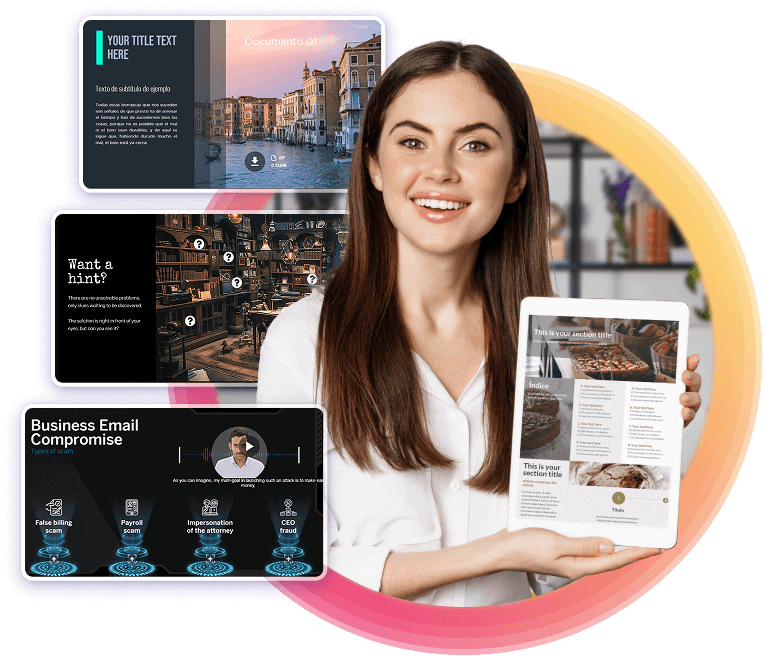
Outsourcing training content production can make a significant difference to the quality and impact of your learning programme. What makes e-learning content truly high quality? The accuracy and currency of information, solid instructional design, well-calibrated interactive elements, and an attractive visual experience are the four pillars that underpin any effective course.
According to LinkedIn Learning’s 2024 Workplace Learning Report, 90% of organisations that improved their training outcomes over the past two years also increased their investment in quality content. Working with a specialist content factory is the most efficient way to access that level of quality without assuming the costs of building an internal team.
Key benefits:
Content factories also tend to offer competitive pricing and scalable solutions that adapt to each company’s needs, responding quickly when training requirements evolve.

A corporate e-learning content factory can produce virtually any type of training content. The most common project types are:
With isEazy Factory you have access to all these production types under one provider, with dedicated teams for each speciality and a methodology that ensures consistency across projects.
Choosing your e-learning content provider well is a decision that directly impacts your training programme’s results for years to come. These are the key criteria to evaluate:
Every industry has its own content requirements, pedagogical style, and regulatory context. A provider experienced in retail knows that training must be consumed on mobile devices and in short intervals. One specialising in financial services understands the importance of traceability and certification. Ask for case studies and references in your sector before making any decision.
A good portfolio doesn’t just show attractive courses — it shows measurable results. Look for providers who can discuss completion rates, assessment outcomes, or business performance indicators. You can also review how to curate e-learning content to understand what quality criteria to apply. Design matters, but pedagogical effectiveness matters more.
Content produced must be compatible with your LMS. Confirm the provider works with SCORM 1.2, SCORM 2004, or xAPI according to your platform’s requirements. If you don’t yet have an LMS, ask whether they can offer an integrated solution.
Course delivery is not the end of the process. Content needs to stay up to date and may require corrections after launch. A good provider offers clear review cycles, post-delivery technical support, and periodic update options.
If you need 10 courses a year today but expect 50 in two years, your provider must be able to scale with you. Ask about simultaneous production capacity and how they handle peak demand.
| Evaluation criterion | Quality signal | Red flag |
|---|---|---|
| Sector experience | Case studies in your sector with measurable results | Only show design samples with no impact data |
| Pedagogical team | In-house instructional designers and pedagogists | All instructional design is subcontracted |
| Technical integration | SCORM/xAPI certified, LMS integration track record | No mention of technical standards |
| Intellectual property | All produced content is yours from delivery | They retain rights or charge for future modifications |
| Scalability | Demonstrated parallel production capacity | Only operate sequentially without a dedicated team |
Outsourcing to a content factory is not the right answer in every case. Knowing the limits of this model is a sign of maturity in corporate L&D management.
It makes more sense to outsource when:
It may make more sense to keep it internal when:
In many cases, the optimal solution is a hybrid model: the content factory produces high-impact strategic courses, while the internal team manages updates and more operational content using their own content virtualisation tools.
Outsourcing e-learning content creation can be an effective solution for many organisations. However, it also presents important challenges worth knowing about in advance:
One of the most common problems is content that doesn’t reflect the organisation’s strategic objectives or tone. This happens when the initial brief is insufficient or when there are no intermediate reviews before final production.
How to avoid it: establish measurable objectives from the outset (pedagogical KPIs), define the learner profiles clearly, and validate content prototypes before scaling to full production.
The quality of outsourced content may not meet expectations if clear acceptance criteria aren’t defined upfront. Design can be attractive but the pedagogy superficial, or vice versa.
How to avoid it: define quality criteria before signing: number of review cycles, accessibility standards, expected interactivity levels, and client acceptance metrics. Include these in the contract.
Some providers retain rights over produced materials or charge for future modifications, creating a costly long-term dependency.
How to avoid it: ensure the contract includes full transfer of intellectual property to the client upon delivery.
Training content ages: regulations change, processes evolve, products update. Without a maintenance agreement you can end up with outdated courses nobody reviews.
How to avoid it: negotiate a periodic maintenance model, or choose a provider that delivers source files so you can make minor edits internally with your own e-learning resource tools.
Esade is a great example of how a leading institution can elevate the quality of its e-learning with the support of a specialist content factory. With isEazy Factory and isEazy Author, Esade developed e-learning courses with a level of design and interactivity that reinforces its positioning as a world-class business school. Discover how they did it →
If you’re looking for a content factory capable of creating effective, attractive e-learning courses that genuinely engage your audience, isEazy Factory is your best option. With over 20 years of experience and hundreds of projects across retail, banking, legal, energy, and technology, isEazy Factory brings three major capabilities together under one provider:
All you need to do is provide us with the information you want to include in your courses — we handle everything else. The result: spectacular courses, enriched with interactive and multimedia elements, ready to drive real results in your training programme.
Want to see how it works? Request an isEazy Factory demo and discover what a real content factory can do for you.

A content factory is a specialized structure that designs, develops, and produces digital training content in a systematic and professional way. Unlike an occasional provider, it has its own methodology, technology, and multidisciplinary team — including instructional designers, graphic designers, e-learning developers, audiovisual specialists, and project managers — that transforms your company’s internal knowledge into digital learning experiences aligned with your strategic objectives. The result is a production flow that combines industrial efficiency with pedagogical rigour: more courses, in less time, and with higher quality than if created in-house from scratch.
Outsourcing to a content factory provides several key advantages for L&D teams. First, you gain access to specialists in instructional design and pedagogy who know how to structure knowledge so it is retained and applied, not just consumed. Second, production capacity scales flexibly without depending on internal team availability. Third, costs become predictable: you eliminate investment in software, staff training, and licences that internal production requires. Fourth, a specialist provider handles technical standards — SCORM, xAPI, LMS compatibility, WCAG accessibility — as a baseline. Finally, a content factory can manage the full lifecycle of your courses, updating them when processes, regulations, or products change.
A corporate e-learning content factory can produce virtually any type of training content. The most common projects include: onboarding and induction (welcome courses, corporate culture, procedures); technical and product training (manuals, operational processes, regulatory compliance); compliance and regulatory training (GDPR, workplace safety, ethics); soft skills development (leadership, communication, emotional intelligence); microlearning modules (short 3–10 minute bursts for knowledge reinforcement); and audiovisual production (corporate videos, animations, motion graphics, voiceovers). The best providers, like isEazy Factory, bring all these capabilities under one roof, with dedicated teams for each speciality.
Choosing the right provider requires evaluating five key criteria. First, check their sector experience: each industry has its own content requirements, regulatory context, and learning style — ask for case studies in your sector. Second, review their portfolio for measurable outcomes, not just aesthetic quality. Third, verify technical compatibility with your LMS (SCORM 1.2, SCORM 2004, xAPI). Fourth, assess the level of post-delivery support: updates, corrections, and maintenance should be clearly defined in the contract. Fifth, consider scalability: if your training needs grow, your provider must be able to grow with you without compromising quality or delivery times.
The cost of a content factory varies depending on the volume of projects, content complexity, and services included. Specialist providers typically work with hourly rates, per-module pricing, or monthly retainer contracts. A rough estimate for a standard 30-minute SCORM e-learning course can range from €3,000 to €15,000, depending on the level of interactivity, audiovisual production, and instructional design included. The most relevant metric when evaluating cost is not the per-course price, but the total cost of ownership: internal time saved, production speed, and the quality of the final result. isEazy Factory, for example, reduces production time and costs by up to 5x compared to developing content in-house, thanks to its combination of methodology, technology, and specialist team.
Yes, and it should be a non-negotiable condition when choosing any content factory. A mature provider will have brand alignment processes from the briefing phase: validation of colour palettes, typography, tone of voice, and reference examples. Externally produced content goes through review cycles where the client has full visibility and can request corrections before final delivery. The best factories don’t just replicate your brand manual — they add pedagogical consistency, ensuring content not only sounds like your company but also reinforces your culture and strategic messages. To guarantee this control, include a validated prototype process in the contract before scaling to full production, and ensure intellectual property clauses confirm that all materials produced belong entirely to your organisation.
Although the terms sound similar, there are important differences. A content agency typically works on one-off projects or campaigns, with flexible teams and processes adapted to each brief. A content factory, by contrast, is a specialised and permanent structure designed to produce training content systematically, scalably, and with its own methodology. It has standardised processes, fixed multidisciplinary teams, and integrated technology to accelerate production without sacrificing quality. In the context of corporate e-learning, the difference is especially relevant: a content factory understands learning objectives, the organisation’s competency framework, and technical industry standards (SCORM, xAPI, LMS compatibility), while a generalist agency may produce attractive content but without the pedagogical rigour needed for training to be truly effective.

Now it's possible, with isEazy Factory
Request a demoContact us


Do you need customized e-learning courses?
Rely on the only content factory capable of creating spectacular e-learning courses in record time


Do you need customized e-learning courses?
Rely on the only content factory capable of creating spectacular e-learning courses in record time