WHITEPAPER
How to adapt your in-person training to an online format with microlearning

Brain
The first AI trained to teach

Author
The #1 AI-powered authoring tool on the market

Factory
Custom e-learning content factory

Skills
Comprehensive power skills course catalog

LMS
All-in-one LMS platform with AI

Engage
App for managing frontline teams
Product

What is Brain?
Everything you need to know about the first AI trained to teach.

Learning agent: CompanionNew
Supports learners and answers their questions right inside the course, without breaking the audit trail.

How does it work?
Adaptive, conversational, and contextual. That’s learning with Brain.
FEATURES

AINew
Unlock your full potential and speed up course creation with artificial intelligence.

Accessibility
Automatically meet accessibility guidelines—without sacrificing interactivity!

Interactivity
Boost engagement with interactive, ready-to-use activities that make learning fun.

Course Creation
Reduce the time it takes to create your e-learning courses with our authoring tool.

Distribution
We offer you different distribution options, so that nothing can stop you.

SCORM
Publish your course in SCORM format and share it on any LMS.
SERVICES

Instrucional Design
Surprise your students with multimedia and interactive content.

Custom Courses
We create e-learning courses for you—tailored to your needs and hassle-free!

Virtual Reality
Turn learning into an immersive experience.

Custom Avatars
Give your courses and videos a unique touch with personalized avatars.

Audiovisual FactoryNew
Turn training into something dynamic and visual with engaging videos.
CATALOG

Course catalog
Over 600 skills and competency courses to help you adapt to your team's needs.
Microsoft Copilot AcademyNew
Your professionals will learn how to apply Copilot AI to key processes within your organization.

Artificial Intelligence Academy
Train your teams in the practical use of AI to boost productivity and innovation in your company.

Cybersecurity Academy
Capacita a tu empresa con el catálogo más completo en seguridad digital corporativa.

Use cases
Choose the solution that best fits your needs

Industries
Solutions for all types of industries
USE CASES

Onboarding
Facilitate the onboarding process, productivity and engagement of your new employees.

Upskilling
Boost your team's skills and prepare them for the challenges of the future with upskilling.

Microlearning
Discover all the advantages of microlearning and boost your training results.

Gamification
Enjoy addictive training that will get your professionals hooked.

Internal Communication
Improve communication in your company and enjoy an aligned and committed team.

Mobile learning
Agile, flexible, and interactive learning—built for today’s digital-first workforce.
INDUSTRIES

Banking and financial services
Training in compliance, cybersecurity, customer service, and key skills development.

Pharmaceuticals and healthcare
Digital onboarding, regulatory updates, and ongoing training for healthcare staff.

Retail and consumer
Agile and scalable training for in-store, operational, and customer service teams.

Industry and manufacturing
Training in processes, safety, and corporate culture for distributed teams.

Education and training
Digital solutions for training centers, internal academies, and corporate universities.

Technology and telecommunications
Development of technical talent, digital skills, and upskilling and reskilling programs.
CLIENTS

MAPFRE
How MAPFRE turn e-learning into sales with isEazy

Pepco
A personalised learning experience for a growing team.

BBVA
Digitisation and creation of high quality e-learning content.

Shiseido
We increase the engagement of the training with a social and gamified app.

Telefónica
Large-scale reskilling for the company's digital transformation.

Vodafone
A personalised learning experience for a growing team.
More than 1,000 companies already rely on isEazy.





MEET ISEAZY

Events
Discover our upcoming events and connect with the future of e-learning.

News
Find out the latest news about isEazy: press releases, partnerships, updates...

Contact
Leave us your personal details and we will contact you as soon as possible.
About isEazyNew
Find out more about our company.

Careers
We are looking for the best talent, join our team!

Partners
Become our partner and grow your business.
INTERESTING RESOURCES

Blog
The best content on e-learning: trends, tools and key strategies.

Whitepapers
Gain valuable insights and stay ahead of industry trends.

Product releases
The latest news and releases of our e-learning products and solutions.

Glossary
Definitions of the most commonly used terms and key industry concepts.

Guides
Discover the best step-by-step tips and tricks to optimize your L&D strategy.

Webinars
Video sessions on our products, trends and more

Comparatives
Compare e-learning solutions available on the market and choose the most suitable one.


WEBINAR
Master AI in isEazy Author in under an hour.




GUIDE
Prepare your organization to comply with the new AI regulations


AUTHORING TOOL
Create courses automatically and generate interactive activities, games, translations, and multimedia resources in seconds.

Stay up to date with all our latest news
 Subscribe to our newsletter
 Stay up to date with all our latest news

September 22, 2026

CONTENT CREATED BY:

Table of contents
In an era of constant connectivity and competing priorities, capturing professionals’ attention is a real challenge. Between meetings, emails, and pending tasks, employees increasingly demand learning that is brief, accessible, and to the point. In this context, snackable content has become a key tool for fostering continuous, dynamic, and genuinely effective learning within organizations. In this guide, you’ll discover what it is, which types exist, and how to apply it in your corporate e-learning strategy.
The term snackable content comes from a food analogy: content that is quick, appealing, and easy to consume. In corporate training, it refers to learning materials of short duration — typically between 1 and 5 minutes — focused on a single learning objective. Unlike traditional e-learning courses, snackable content does not require a long block of uninterrupted time or a dedicated learning environment.
A frequent question is whether snackable content and microlearning are the same thing. The short answer is no, though they are closely related:
In other words: every microlearning piece can be snackable content, but not all snackable content is part of a microlearning path. Both strategies are complementary. Learn more in our learning pill glossary entry.
WHITEPAPER
How to adapt your in-person training to an online format with microlearning


There is no single type of snackable content. The right format depends on the learning objective, the employee’s profile, and the device they typically use. These are the most effective formats in corporate settings:
| Format | Ideal use case | Optimal duration |
|---|---|---|
| Short video | Explain a process, introduce a concept, or communicate an internal change | 1–3 min |
| Infographic | Summarize data, process steps, or differences between options | 60–90 sec read |
| Quiz / microtest | Reinforce knowledge after training or assess retention | 3–5 questions |
| Short podcast | Reflective or update content for commutes or downtime | 3–7 min |
| Flashcard | Quick review of terminology, regulations, or key concepts | 30–60 sec per card |
| Animated GIF | Illustrate technical procedures or repeatable steps visually | 10–30 sec |
The rise of snackable content is not a passing trend — it is rooted in evidence about how adults learn in workplace environments. According to the Journal of Applied Psychology, distributing learning across short, spaced sessions can improve knowledge transfer by up to 17% compared to long, concentrated sessions. Here are the key advantages:
Short visual formats activate multiple cognitive channels simultaneously, which strengthens retention. Combining image, concise text, and interaction — such as a quiz — creates a more durable learning impression than passively reading a manual.
The brief format removes the “I don’t have time to learn” barrier. A 2-minute piece fits into any break, commute, or transition between tasks. On platforms like isEazy Engage, the use of gamified and collaborative micro-content has pushed engagement above 98% in real training projects.
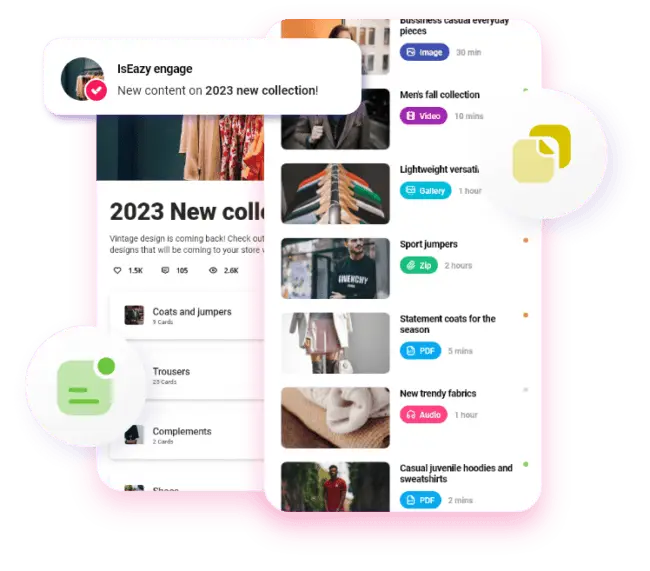
Snackable content lets employees access exactly the information they need at the moment they need it — before a call, during an installation process, or when attending a customer. This makes it the ideal solution for just-in-time training and for field or remote teams. Mobile learning and snackable content are, in fact, naturally complementary strategies.
Rather than intensive multi-hour sessions, snackable content distributes learning in small doses over time. This approach — spaced learning — reduces cognitive fatigue and improves long-term knowledge consolidation.
A short, modular piece is far easier to update than a full course. When a regulation changes or a product launches, you only need to edit the affected piece — without reviewing hours of content. This is especially valuable in regulated sectors or high-change environments.
Snackable content is not suitable for every type of learning, but it can effectively address a wide range of common training needs within organizations:
During their first few days, employees are exposed to a large amount of information. Breaking the onboarding experience into small pieces — company culture, job-specific tools, and key procedures — helps them absorb information progressively without feeling overwhelmed. Interactive learning in a snackable format can help accelerate the onboarding process.
Organizations in regulated industries need to ensure that all employees are familiar with current rules and requirements. Snackable content makes it possible to reinforce policies and procedures through regular reminders and short explanatory learning bites, helping reduce the risk of non-compliance.
Product tutorials, objection-handling simulations, or negotiation tips in micro formats allow sales teams to review exactly the information they need before a customer meeting, without having to open and complete an entire course.
Developing skills such as communication, empathy, or team management requires continuous practice. Snackable content makes it possible to create short, recurring learning activities that help professionals develop these skills consistently over time.
After a longer training session — whether in person or through e-learning — snackable content is ideal for keeping knowledge fresh. Regular reminders, review quizzes, or short practical scenarios reinforce what employees have learned and encourage real-world application on the job.
Clarel, a retail company with more than 1,000 points of sale across Spain, implemented a micro-content and gamification strategy with isEazy that achieved an 84% engagement rate among its store teams. Thanks to a snackable, mobile-first format, they were able to train geographically dispersed employees simultaneously without disrupting daily operations. Find out how they did it →
CASE STUDY
We helped Clarel transform its knowledge into interactive and effective microcontents

Having a clear strategy is the first step. The second is having the right tools to create high-quality pieces and distribute them effectively. isEazy’s solutions are purpose-built for exactly this.
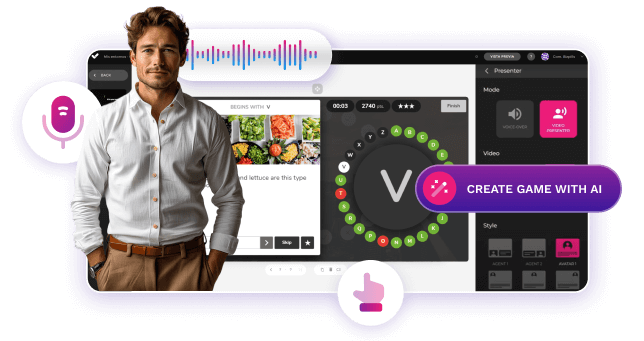
With isEazy Author, anyone can design engaging pieces in minutes — no technical skills required. Built-in templates, integrated multimedia resources, automatic accessibility compliance, and AI-powered features let you generate text, exercises, and quizzes at speed. The interactive course creation capability turns any content into a dynamic learning experience. The result: high-quality snackable pieces ready to export as SCORM, publish directly to your LMS, or distribute via isEazy Engage.
Creating snackable pieces is only half the job. The other half is making sure they reach the right employee at the right time, at the right cadence. isEazy Engage lets you group micro-content into personalized, automated learning paths — scheduling daily knowledge doses aligned with your organization’s strategic objectives. Its gamified, social format naturally drives engagement.
If you’re looking for an all-in-one solution to manage and distribute your snackable content, the isEazy microlearning platform lets you centralize creation, distribution, and progress tracking in a single environment. And if you want bespoke content, isEazy Factory’s microlearning courses for companies offer expert-designed content tailored to your organization’s specific needs.
Creating short pieces does not automatically guarantee that snackable content works. Behind every effective learning pill, there are deliberate instructional design decisions. These are the key principles that separate a piece that gets consumed and forgotten from one that drives real learning:
| Principle | What to do | Common mistake |
|---|---|---|
| One objective, one piece | Define a single learning outcome per piece. If you need to cover three concepts, create three pieces. | Trying to explain too much in one format: the learner gets lost and retains nothing. |
| Start with the problem | Open with a question, a data point, or a real-life scenario that activates the need to learn. Context hooks better than a definition. | Starting with "In this module you will learn…": the fastest way to lose attention. |
| Format serves the content | Choose the format based on what needs to be taught: video for processes, infographic for comparisons, quiz for assessment, podcast for reflection. | Always using the same format out of convenience, even when it's not the best fit for that objective. |
| Mobile-first by default | Design for small screens and silent consumption. Subtitles, icons, and legible typography are essential. | Shrinking desktop content to mobile size: the result is unreadable. |
| Always close with an action | Include a quiz, a reflection prompt, or a concrete next step at the end. Learning without application is forgotten within 24 hours. | Ending the piece with no call to action or comprehension check. |
| Measure and improve | Track completion rates, quiz results, and consumption time. That data reveals which pieces work and which need revision. | Publishing without tracking: without data, you cannot know whether the content is generating real learning. |
Snackable content is not an alternative to high-quality training, but rather a more agile way to bring learning into employees’ daily workflow. When each piece addresses a specific objective and is integrated into a broader training strategy, it can reinforce knowledge, support continuous learning, and deliver easy-to-consume content exactly when employees need it.
With isEazy Author, you can create short, visual, and interactive content without technical skills, incorporating multimedia resources, activities, and assessments to turn each piece into a more engaging learning experience.
And if you need to deliver that content to frontline teams, isEazy Engage lets you distribute mobile training and microlearning directly within their daily workflow, making knowledge easier to access wherever they are.
If you want to explore other solutions for developing your strategy, check out our comparison of the best microlearning apps and find out which option best fits your organization’s needs.
Snackable content refers to short, visual, and easily consumable learning materials designed to deliver impact in seconds. Microlearning, by contrast, is structured as a sequence of short pieces that build a complete competency over time. The two are complementary strategies: snackable content works as a reinforcement tool or entry point, while microlearning constructs progressive learning. You can combine both by creating microlearning paths that integrate snackable pieces as reminders or prior-knowledge activators.
The most effective snackable content formats for corporate training include: short videos (1–3 minutes) to explain processes or key concepts; infographics that summarize data or steps visually; short podcasts for commuting or downtime; quizzes and microtests to reinforce knowledge; animated GIFs to illustrate technical procedures; and flashcards for quick reviews. Format selection should match the employee’s usual device and the learning objective — whether that’s reinforcement, just-in-time learning, onboarding, or internal communication.
The main benefits of snackable content in corporate environments are: higher knowledge retention, since short visual formats activate more cognitive channels than long texts; better engagement — especially for time-pressed employees — thanks to the dynamic format; just-in-time learning that gives people access to exactly the information they need at the moment they need it; compatibility with mobile learning, which is essential for deskless or field-based workers; and reduced cognitive overload, since content is delivered in small doses over time rather than in intensive sessions.
To implement a snackable content strategy in your organization, follow these steps: first, identify learning needs and the key moments in the employee journey where snackable content adds the most value — onboarding, post-training reinforcement, compliance updates. Second, choose the right format based on the employee profile and their most-used device. Third, create the pieces using an authoring tool like isEazy Author, which lets you design visual, interactive content without technical expertise. Fourth, distribute them through a platform that supports automated learning paths, like isEazy Engage, to ensure proper sequencing and learning progress tracking.
Snackable content works particularly well in industries with mobile or deskless employees who have limited access to training during working hours: retail, logistics, hospitality, banking, healthcare, and manufacturing. It is also highly effective for recurring regulatory or compliance updates, onboarding programs for high-turnover roles, and soft skills development that requires sustained practice over time. In short, any organization that needs to train dispersed, time-poor, or remote teams can benefit from a snackable content strategy.

Train your team with brief and engaging content that facilitates understanding and guarantees learning
Request a demo
Need fast, effective, and easy-to-digest content?
Reinforce learning and boost knowledge retention with the most engaging multimedia and interactive micro-content

Need fast, effective, and easy-to-digest content?
Reinforce learning and boost knowledge retention with the most engaging multimedia and interactive micro-content