Brain
The first AI trained to teach

Author
The #1 AI-powered authoring tool on the market

Factory
Custom e-learning content factory

Skills
Comprehensive power skills course catalog

LMS
All-in-one LMS platform with AI

Engage
App for managing frontline teams
Product

What is Brain?
Everything you need to know about the first AI trained to teach.

Learning agent: CompanionNew
Supports learners and answers their questions right inside the course, without breaking the audit trail.

How does it work?
Adaptive, conversational, and contextual. That’s learning with Brain.

FEATURES

AINew
Unlock your full potential and speed up course creation with artificial intelligence.

Accessibility
Automatically meet accessibility guidelines—without sacrificing interactivity!

Interactivity
Boost engagement with interactive, ready-to-use activities that make learning fun.

Course Creation
Reduce the time it takes to create your e-learning courses with our authoring tool.

Distribution
We offer you different distribution options, so that nothing can stop you.

SCORM
Publish your course in SCORM format and share it on any LMS.

SERVICES

Instrucional Design
Surprise your students with multimedia and interactive content.

Custom Courses
We create e-learning courses for you—tailored to your needs and hassle-free!

Virtual Reality
Turn learning into an immersive experience.

Custom Avatars
Give your courses and videos a unique touch with personalized avatars.

Audiovisual FactoryNew
Turn training into something dynamic and visual with engaging videos.

CATALOG

Course catalog
Over 600 skills and competency courses to help you adapt to your team's needs.
Microsoft Copilot AcademyNew
Your professionals will learn how to apply Copilot AI to key processes within your organization.

Artificial Intelligence Academy
Train your teams in the practical use of AI to boost productivity and innovation in your company.

Cybersecurity Academy
Capacita a tu empresa con el catálogo más completo en seguridad digital corporativa.


Use cases
Choose the solution that best fits your needs

Industries
Solutions for all types of industries
USE CASES

Onboarding
Facilitate the onboarding process, productivity and engagement of your new employees.

Upskilling
Boost your team's skills and prepare them for the challenges of the future with upskilling.

Microlearning
Discover all the advantages of microlearning and boost your training results.

Gamification
Enjoy addictive training that will get your professionals hooked.

Internal Communication
Improve communication in your company and enjoy an aligned and committed team.

Mobile learning
Agile, flexible, and interactive learning—built for today’s digital-first workforce.
INDUSTRIES

Banking and financial services
Training in compliance, cybersecurity, customer service, and key skills development.

Pharmaceuticals and healthcare
Digital onboarding, regulatory updates, and ongoing training for healthcare staff.

Retail and consumer
Agile and scalable training for in-store, operational, and customer service teams.

Industry and manufacturing
Training in processes, safety, and corporate culture for distributed teams.

Education and training
Digital solutions for training centers, internal academies, and corporate universities.

Technology and telecommunications
Development of technical talent, digital skills, and upskilling and reskilling programs.
CLIENTS

MAPFRE
How MAPFRE turn e-learning into sales with isEazy

Pepco
A personalised learning experience for a growing team.

BBVA
Digitisation and creation of high quality e-learning content.

Shiseido
We increase the engagement of the training with a social and gamified app.

Telefónica
Large-scale reskilling for the company's digital transformation.

Vodafone
A personalised learning experience for a growing team.
More than 1,000 companies already rely on isEazy.






MEET ISEAZY

Events
Discover our upcoming events and connect with the future of e-learning.

News
Find out the latest news about isEazy: press releases, partnerships, updates...

Contact
Leave us your personal details and we will contact you as soon as possible.
About isEazyNew
Find out more about our company.

Careers
We are looking for the best talent, join our team!

Partners
Become our partner and grow your business.
INTERESTING RESOURCES

Blog
The best content on e-learning: trends, tools and key strategies.

Whitepapers
Gain valuable insights and stay ahead of industry trends.

Product releases
The latest news and releases of our e-learning products and solutions.

Glossary
Definitions of the most commonly used terms and key industry concepts.

Guides
Discover the best step-by-step tips and tricks to optimize your L&D strategy.

Webinars
Video sessions on our products, trends and more

Comparatives
Compare e-learning solutions available on the market and choose the most suitable one.


WEBINAR
Master AI in isEazy Author in under an hour.




GUIDE
Prepare your organization to comply with the new AI regulations

Stay up to date with all our latest news
 Subscribe to our newsletter
 Stay up to date with all our latest news

July 10, 2026
Generative AI in E-Learning: What It Is, What It Can Do, and How to Use It

CONTENT CREATED BY:

Table of contents
Corporate training teams have been navigating the same tension for years: the need for more up-to-date content, shorter production cycles, and greater personalization, all with the same resources and the same processes. Generative AI in e-learning is the most compelling answer to emerge so far for resolving that imbalance.
We’re not talking about using ChatGPT to draft a script faster. We’re talking about a new generation of tools trained specifically to create complete learning experiences — with pedagogical structure, interactivity, multimedia resources, and visual consistency, from a document or an idea. Technology that not only accelerates production, but changes the role of L&D professionals and what an organization can expect from its training.
This article explains what generative AI applied to e-learning is, how it differs from general-purpose AI, what it can do today, what its real limitations are, and how to identify the tools that are actually ready for corporate training.
How AI has evolved in e-learning: from text generation to intelligent learning
To understand where we are, it helps to briefly trace the journey. Generative AI did not burst into e-learning all at once, but in three successive phases that have progressively expanded what the technology can do within a training process.
First phase: the content era
It all began with the explosion of large language models. For the first time, anyone could produce fluent text at high speed. L&D teams began using these tools to draft scripts, generate exercises, or translate materials. The result was useful but limited: it created fragments of content, not structured training.
Second phase: the multimodal era
The next wave extended capabilities beyond text. Image generation, avatar-driven videos, automatic voiceovers, and storyboards became accessible without relying on large-scale production. Teams gained resources that used to require entire departments. But integration was still manual, fragmented, and inconsistent.
Third phase: the intelligent learning era
This is where we are now. According to Fosway Group, more than 60% of L&D teams plan to increase their use of AI tools in 2025. The key shift is that AI is no longer just helping create content — it is starting to orchestrate the entire training process: from structuring a course to adapting it to each learner in real time. Brandon Hall Group data points in the same direction: organizations using AI in their training processes reduce production time by up to 60% while improving engagement and completion rates.
What generative AI in e-learning can do today
The most important leap is not in speed, but in scope. Before this generation of tools, AI could assist with specific, isolated tasks. Now it can handle the entire course creation process. The difference with general-purpose AI is fundamental and worth seeing clearly:
| Capability | General-purpose AI (ChatGPT, etc.) | AI for e-learning (AI Autopilot) |
|---|---|---|
| Generate fluent text | ✓ Yes | ✓ Yes |
| Pedagogical structure by modules | ✗ No | ✓ Yes |
| Connect objectives with activities | ✗ No | ✓ Yes |
| Interactivity (role play, assessments…) | ✗ No | ✓ Yes |
| Apply branding and visual style | ✗ No | ✓ Yes |
| Generate voiceovers and avatar videos | Limited | ✓ Yes |
| Course ready to validate from the first proposal | ✗ No | ✓ Yes |
Specifically, tools like isEazy Author with AI Autopilot enable you to:
- Convert a document or idea into a complete course structured by modules and lessons.
- Design specific interactive resources: role play activities, assessments, infographics, games.
- Produce resources that previously required entire teams: images, voiceovers, avatar videos, subtitles.
- Apply corporate branding — colors, typography, narrative style — automatically and consistently across all training.
- Update existing content in record time when a process, regulation, or business strategy changes.
The result is not a draft that needs rewriting. It’s a solid first version, pedagogically coherent, ready to review and publish. Request a demo of isEazy Author and see what AI Autopilot can do with your content.

The real impact on L&D teams: speed, scale, and new roles
Generative AI does not only change how long it takes a team to produce a course. It changes what that team can do with its time. What used to take weeks — from the script to the final layout — now becomes a complete first version in minutes, ready to review, adjust, and publish. That frees up capacity for what truly matters: learning strategy, curriculum design, and alignment with the business.
For organizations, the consequences are concrete:
- More courses, with the same team: scalability no longer depends on multiplying human resources.
- Always up-to-date catalogs: if a process or regulation changes, training can be updated immediately.
- Guaranteed visual consistency: AI applies corporate identity automatically, regardless of who created the content.
- Reduced production cost: less time spent on format and execution means more budget for design and strategy.
The transformation also affects roles. L&D professionals are shifting from content producers to curators, architects, and strategists. AI handles the execution; the professional drives the direction.
Limits and risks no L&D team should ignore
Adopting generative AI in corporate training without clear criteria carries real risks. The most frequent is confusing speed with quality: a general-purpose AI can generate apparently correct content that is pedagogically inconsistent — with objectives lacking aligned activities, assessments disconnected from content, or a visual style that does not respect the company’s identity.
Other common risks worth keeping in mind:
- Lack of human validation: publishing AI-generated content without expert review introduces errors that are difficult to detect at scale. AI proposes; the professional validates. That step is not optional.
- Privacy and regulatory compliance: some tools send the data you process to external servers, which may compromise the confidentiality of corporate information and conflict with regulations such as GDPR.
- Hallucinations and inaccuracies: AI can generate plausible but incorrect information, especially on technical, regulatory, or highly specific topics. Without review, that content reaches employees as if it were verified.
- Overreliance without strategy: implementing AI without a clear learning strategy produces more content faster, but not necessarily better training. Volume is not impact.
How to choose an AI tool for e-learning: key criteria
Not all AI tools for corporate training are equal. Before adopting a solution, every L&D team should be able to answer these five questions:
- Is it trained for e-learning or is it a general-purpose AI adapted to it? A tool designed specifically for training understands the pedagogical structure of a course: modules, objectives, activities, assessment. A general-purpose AI does not.
- Does it maintain human control in the process? AI should propose; the professional should be able to review, adjust, and validate before content reaches employees. Without that step, errors scale just as fast as production does.
- How does it handle data privacy? If the tool processes internal company documentation, it is essential to know where that data goes, whether it leaves for external servers, and whether it complies with applicable regulations (GDPR, sector-specific regulations).
- Does it integrate with your existing ecosystem? An AI tool that does not connect with your LMS, your HRIS, or your content library adds complexity instead of reducing it.
- Can it be measured? Any tool you deploy should allow you to measure its actual impact: time saved, cost per course, completion rate, learner satisfaction. Without metrics, there is no optimization.
Beyond creation: when training also adapts
Generative AI has solved the production problem. But a deeper challenge remains: ensuring that knowledge reaches each person in the moment and format they need, adapting to their level, context, and real objectives. Creating the course is just the first part of the cycle.
That is what isEazy Brain is for: the first AI natively trained to teach. Built on pedagogical and behavioral models, isEazy Brain turns your company’s real knowledge into training agents that adapt, in real time, to each member of your team. The result is training that thinks: contextual, conversational, and adaptive for each employee. Discover how isEazy Brain can transform the way your organization learns.

Where to start with generative AI in your organization
The barrier to entry is lower than it seems. You don’t need a months-long digital transformation project or a dedicated technical team. These three steps are a concrete, realistic starting point for any L&D department:
- Identify the most costly bottleneck in your current training process. Is it the initial production? Updating existing content? Adapting to different languages or markets? AI solves specific problems better than generic “implement AI” projects.
- Start with a bounded pilot project. Choose a course or a family of content where the impact is measurable: production time, cost per course, completion rate. A well-documented pilot is the best argument for scaling.
- Choose tools with integrated human review. Don’t look for total automation. Look for tools that accelerate the team’s work without eliminating professional judgment. The goal is not to replace the L&D professional, but to multiply their capacity. isEazy Author with AI Autopilot is designed exactly for that: professional judgment at the center, AI handling the execution. See it in action →
Frequently asked questions about generative AI in e-learning
What is generative AI in e-learning?
Generative AI in e-learning is the application of artificial intelligence models capable of creating original content to build complete learning experiences. Unlike general-purpose AI, pedagogical AI is trained to respect instructional design structures, connect learning objectives with activities, and produce courses ready to validate.
How does generative AI for e-learning differ from a general-purpose AI like ChatGPT?
General-purpose AI like ChatGPT generates fluent text but lacks pedagogical structure: it cannot connect learning objectives with activities, apply corporate branding, or produce a complete course ready to publish. Generative AI designed specifically for e-learning — like the AI Autopilot in isEazy Author — is trained to build full courses with modules, interactions, assessments, avatars, and voiceovers, starting from a document or an idea. The difference is not just speed, but scope: one creates fragments; the other creates structured training.
What is isEazy Brain and how does it complement AI Autopilot?
isEazy Brain is the first AI natively trained to teach. While AI Autopilot solves the content production problem — turning documents and ideas into complete courses quickly — isEazy Brain solves the delivery problem: ensuring that knowledge reaches each employee in the right format, at the right moment, and adapted to their level and context. Both work together: Autopilot creates the content, Brain makes it adaptive and conversational for each learner.
What are the risks of using generative AI in corporate training?
The main risk is confusing speed with quality. A general-purpose AI can generate apparently correct content that is pedagogically inconsistent, with outdated data or no alignment with the organization’s objectives. Other common risks include losing visual brand consistency, publishing without human review, and using tools that do not comply with privacy regulations such as GDPR. To minimize them, it is essential to use solutions designed specifically for e-learning, that integrate human review into the process, and that work with each company’s real, controlled knowledge.
Featured articles




Activate autopilot and create courses at AI speed
Transform your ideas or documents into spectacular courses automatically, with the #1 AI authoring tool on the market.
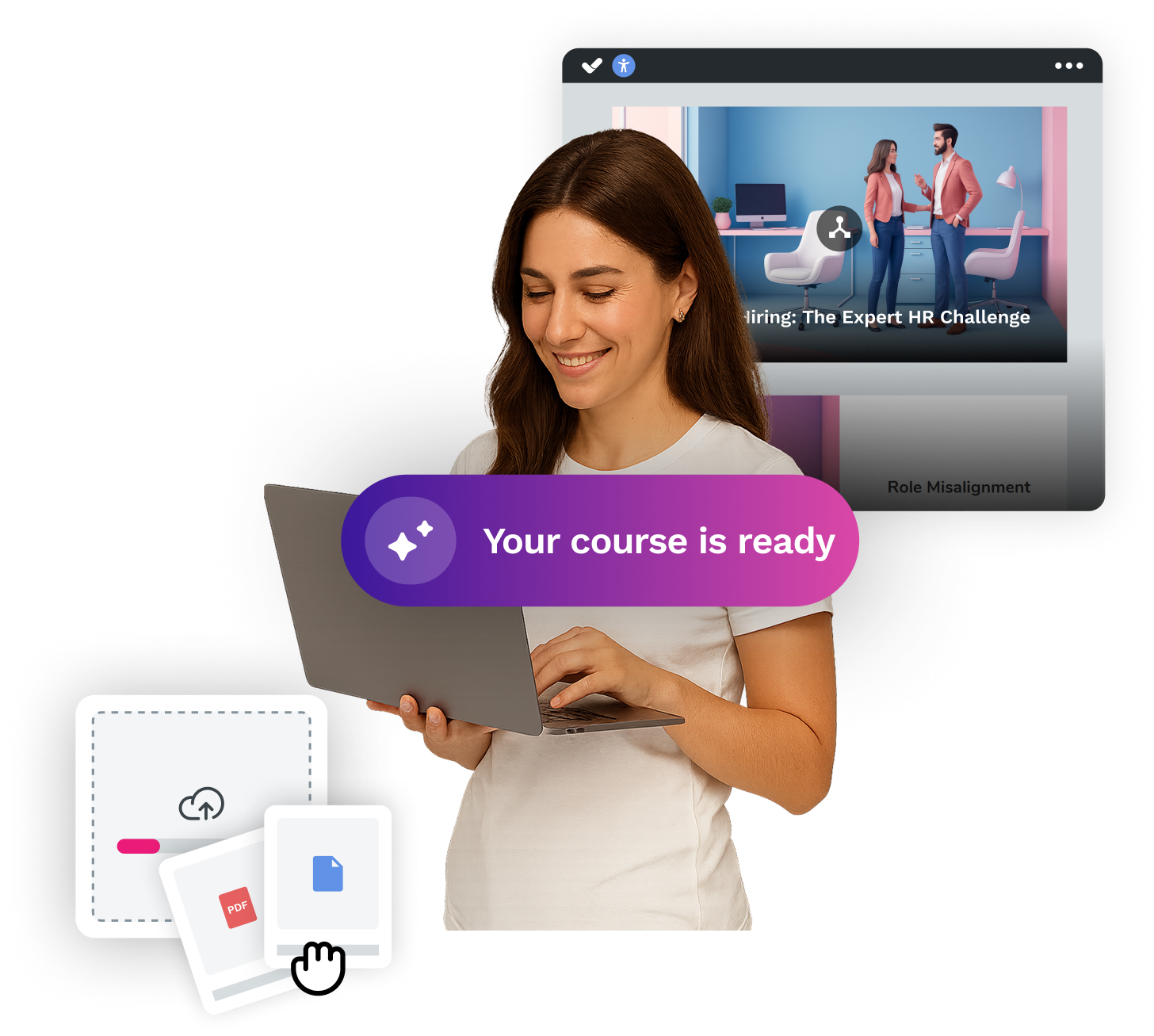


Activate autopilot and create courses at AI speed
Transform your ideas or documents into spectacular courses automatically, with the #1 AI authoring tool on the market.
Related articles