CASE STUDY
How Telefónica trained its employees in new skills with a large-scale reskilling plan

Brain
The first AI trained to teach

Author
The #1 AI-powered authoring tool on the market

Factory
Custom e-learning content factory

Skills
Comprehensive power skills course catalog

LMS
All-in-one LMS platform with AI

Engage
App for managing frontline teams
Product

What is Brain?
Everything you need to know about the first AI trained to teach.

How does it work?
Adaptive, conversational, and contextual. That’s learning with Brain.

Security
Why your company’s knowledge never leaves your environment or trains other models.

Comparison
Discover what sets isEazy Brain apart from other AI solutions.

Frequently Asked Questions
Want to learn more? Find answers to all your questions about isEazy Brain here.
FEATURES

AINew
Unlock your full potential and speed up course creation with artificial intelligence.

Accessibility
Automatically meet accessibility guidelines—without sacrificing interactivity!

Interactivity
Boost engagement with interactive, ready-to-use activities that make learning fun.

Course Creation
Reduce the time it takes to create your e-learning courses with our authoring tool.

Distribution
We offer you different distribution options, so that nothing can stop you.

SCORM
Publish your course in SCORM format and share it on any LMS.
SERVICES

Instrucional Design
Surprise your students with multimedia and interactive content.

Custom Courses
We create e-learning courses for you—tailored to your needs and hassle-free!

Virtual Reality
Turn learning into an immersive experience.

Custom Avatars
Give your courses and videos a unique touch with personalized avatars.

Audiovisual FactoryNew
Turn training into something dynamic and visual with engaging videos.
CATALOG

Course catalog
Over 600 skills and competency courses to help you adapt to your team's needs.
Microsoft Copilot AcademyNew
Your professionals will learn how to apply Copilot AI to key processes within your organization.

Artificial Intelligence Academy
Train your teams in the practical use of AI to boost productivity and innovation in your company.

Cybersecurity Academy
Capacita a tu empresa con el catálogo más completo en seguridad digital corporativa.
FEATURES

Learning platform
Manage all your training from one place

Analitycs
Measure the impact of your training

Learning Experience
Offer a unique learning experience to your team
Content Library
Choose from hundreds of expert-created courses
Authoring Tool
Create your own content—faster than ever

Use cases
Choose the solution that best fits your needs

Industries
Solutions for all types of industries
USE CASES

Onboarding
Facilitate the onboarding process, productivity and engagement of your new employees.

Upskilling
Boost your team's skills and prepare them for the challenges of the future with upskilling.

Microlearning
Discover all the advantages of microlearning and boost your training results.

Gamification
Enjoy addictive training that will get your professionals hooked.

Internal Communication
Improve communication in your company and enjoy an aligned and committed team.

Mobile learning
Agile, flexible, and interactive learning—built for today’s digital-first workforce.
INDUSTRIES

Banking and financial services
Training in compliance, cybersecurity, customer service, and key skills development.

Pharmaceuticals and healthcare
Digital onboarding, regulatory updates, and ongoing training for healthcare staff.

Retail and consumer
Agile and scalable training for in-store, operational, and customer service teams.

Industry and manufacturing
Training in processes, safety, and corporate culture for distributed teams.

Education and training
Digital solutions for training centers, internal academies, and corporate universities.

Technology and telecommunications
Development of technical talent, digital skills, and upskilling and reskilling programs.
CLIENTS

MAPFRE
How MAPFRE turn e-learning into sales with isEazy

Pepco
A personalised learning experience for a growing team.

BBVA
Digitisation and creation of high quality e-learning content.

Shiseido
We increase the engagement of the training with a social and gamified app.

Telefónica
Large-scale reskilling for the company's digital transformation.

Vodafone
A personalised learning experience for a growing team.
More than 1,000 companies already rely on isEazy.





MEET ISEAZY

Events
Discover our upcoming events and connect with the future of e-learning.

News
Find out the latest news about isEazy: press releases, partnerships, updates...

Contact
Leave us your personal details and we will contact you as soon as possible.
About isEazyNew
Find out more about our company.

Careers
We are looking for the best talent, join our team!

Partners
Become our partner and grow your business.
INTERESTING RESOURCES

Blog
The best content on e-learning: trends, tools and key strategies.

Whitepapers
Gain valuable insights and stay ahead of industry trends.

Product releases
The latest news and releases of our e-learning products and solutions.

Glossary
Definitions of the most commonly used terms and key industry concepts.

Guides
Discover the best step-by-step tips and tricks to optimize your L&D strategy.

Webinars
Video sessions on our products, trends and more

Comparatives
Compare e-learning solutions available on the market and choose the most suitable one.


WEBINAR
Master AI in isEazy Author in under an hour.




GUIDE
Prepare your organization to comply with the new AI regulations

Stay up to date with all our latest news
 Subscribe to our newsletter
 Stay up to date with all our latest news

October 8, 2026

CONTENT CREATED BY:

Table of contents
The Chief Learning Officer (CLO) is the executive ultimately responsible for an organization’s learning and development (L&D) strategy. Their role is to design, lead and measure every corporate training program so that human capital evolves at the pace the business needs.
In a context where 94% of employees would stay longer at a company that invested in their professional development (LinkedIn Learning, 2024 Report), the CLO has stopped being a technical training profile and become a strategic change agent with a seat on the executive committee.
The term Chief Learning Officer was coined by Jack Welch at General Electric in 1990, when he appointed Steve Kerr as the first CLO in modern corporate history. Since then, the role has changed radically: it has gone from managing training catalogs to orchestrating continuous learning ecosystems that have a direct impact on the bottom line.
The CLO reports to the CEO or the CHRO (Chief Human Resources Officer) and works at the intersection of business strategy, talent management and learning technology. Unlike the Training Manager or the L&D Manager —far more operational profiles—, the CLO has executive vision and decision-making power over investment, culture and organizational transformation.
Some organizations also use the titles Chief People Development Officer, VP of Learning or Head of Talent & Learning for equivalent roles, although the scope varies depending on company size and industry.
Although they work in the same field, the CLO and the L&D Manager operate at very different levels of the organization:
| Dimension | L&D Manager | Chief Learning Officer |
|---|---|---|
| Organizational level | Middle management | C-suite / Executive committee |
| Main focus | Program execution | Long-term strategy and vision |
| Counterparts | HR, department heads | CEO, CHRO, CFO, Board |
| Metrics | Completion, satisfaction | ROI, business impact, retention |
| Budget | Manages within set limits | Defines and justifies the total investment |
| Technology | Administers the LMS | Decides the technology ecosystem |
The CLO has a multidimensional role. Their responsibilities can be grouped into five broad areas:
The CLO translates business goals into a coherent learning and development strategy. This means identifying current and future skills gaps, defining investment priorities and designing the corporate learning roadmap for the next 1-3 years.
Before launching any program, the CLO leads the process of identifying training needs: performance analysis, interviews with business leaders, skills assessment and a review of previous training results. Without that diagnosis, any training plan is pure spending.
The CLO decides which platforms and tools make up the L&D technology stack: LMS, authoring tools, content catalogs, skills platforms. It is not a technical decision: it is a strategic one that shapes the learning experience of the entire workforce.
The CLO is responsible for proving the value of L&D to the executive committee. That includes defining the L&D metrics that really matter —beyond completion rates—, calculating training ROI and turning data into business decisions.
Perhaps the most strategic and least visible function: the CLO works to make learning part of the organizational DNA. This goes far beyond mandatory courses: it means designing environments where informal learning, peer-to-peer and self-directed learning have a real place in everyday work.
An effective CLO combines competencies that traditionally belonged to very different profiles:
One of the CLO’s most visible responsibilities is building and overseeing the company training plan. This document is not a course catalog: it is the roadmap that connects people’s development needs with the strategic goals of the business over a given period.
A training plan properly designed by the CLO should include:
According to Deloitte’s Global Human Capital Trends 2024 report, 89% of executives consider building an organization able to learn fast important or very important for future success —but only 10% feel their organization is ready for it. That gap is exactly the CLO’s territory.
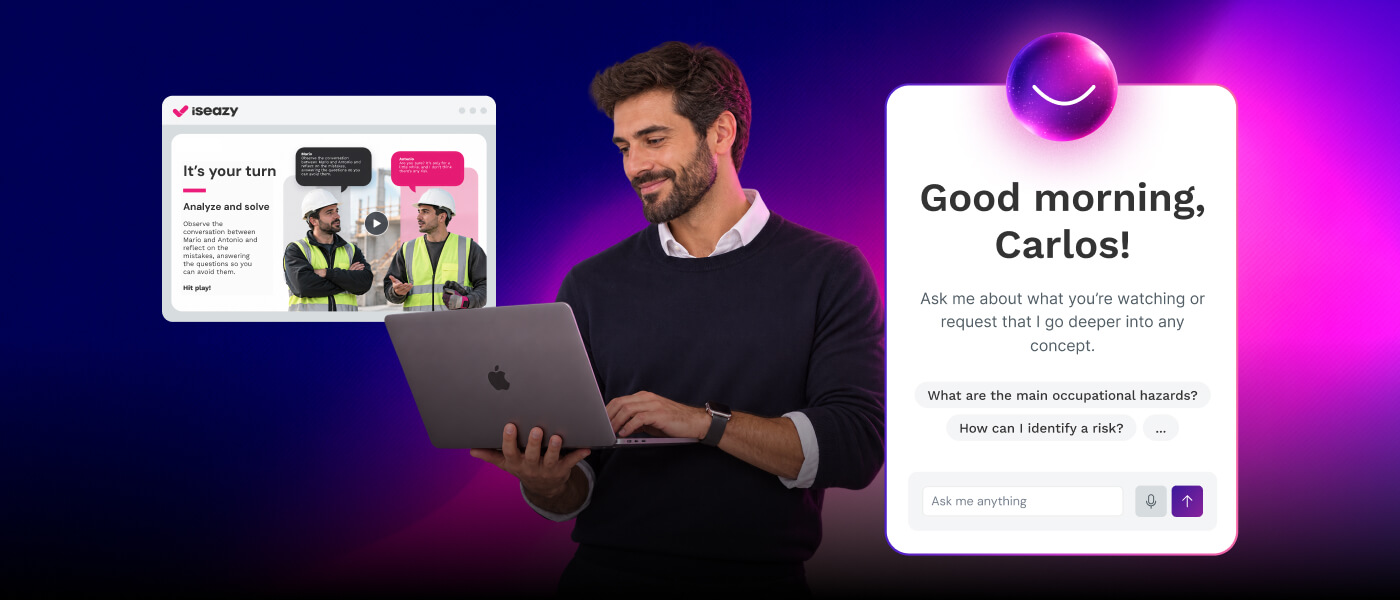
Telefónica Spain needed to scale its reskilling strategy to respond to the digital transformation of its teams. With isEazy LMS as the backbone of its learning ecosystem, the L&D team was able to manage large-scale upskilling programs, with individual progress tracking and real-time impact analytics. The CLO had the data needed to make investment decisions with sound judgment. Discover how Telefónica leads reskilling with isEazy →
CASE STUDY
How Telefónica trained its employees in new skills with a large-scale reskilling plan


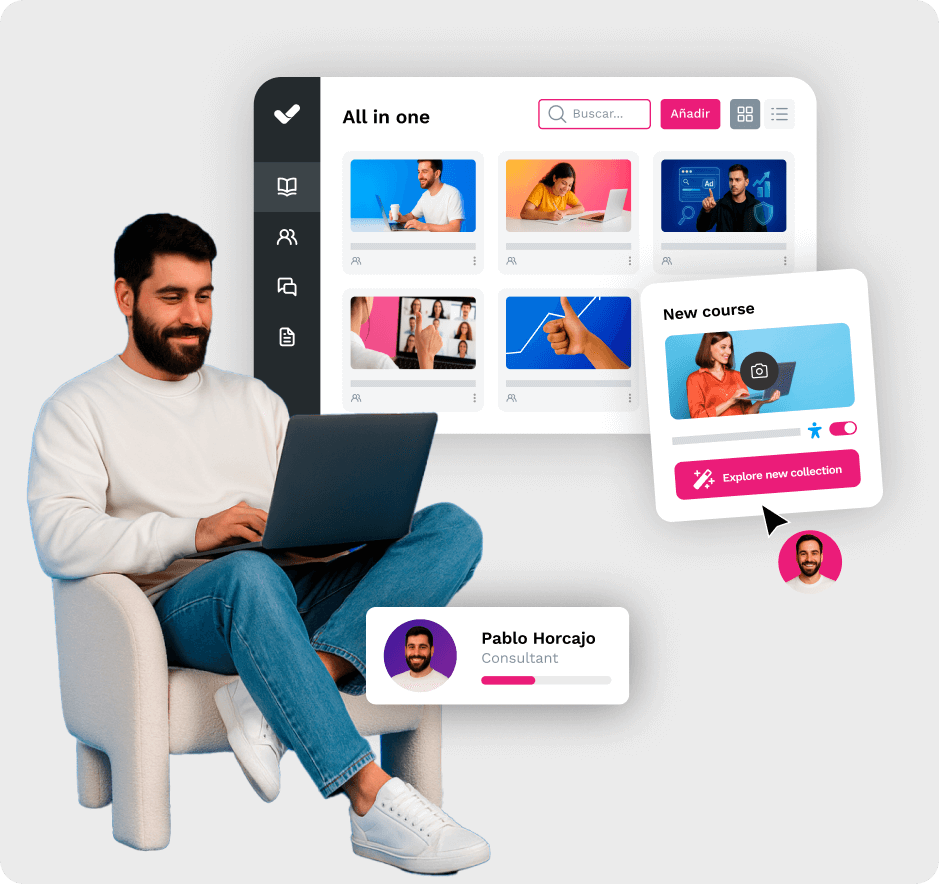
A modern CLO does not work with a single tool: they build an integrated ecosystem where each piece serves a specific purpose. isEazy’s all-in-one solution answers exactly that need: it lets the CLO manage everything from content creation to impact measurement on a single platform.
The most common tools in the L&D ecosystem led by the CLO are:
| Tool | Main function | Strategic impact |
|---|---|---|
| LMS | Distribution and tracking | Visibility over learning progress |
| Authoring tool | Internal content creation | Agility and lower external costs |
| Skills platform | Competency catalog | Scalable, accessible upskilling |
| L&D analytics | Impact measurement | Justifying ROI to management |
The CLO role has a less visible side worth knowing before taking on —or hiring for— this profile:
There is no single path to the CLO role, but there is a career trajectory that repeats itself in organizations that have matured their L&D function. According to LinkedIn Talent Insights data (2024), 68% of current CLOs come from L&D Manager, Training Director or HRBP positions with development responsibility.
The CLO has no single reference qualification. The most frequent profiles combine:
The most common route has four stages:
Beyond years of experience, there are specific competencies that mark the difference between a Training Director and a CLO:
The CLO’s salary varies significantly depending on organization size, industry and level of responsibility. Below are indicative ranges for Spain in 2024, based on data from Glassdoor, LinkedIn Salary and Infojobs Salary Trends:
| Profile / Company size | Gross annual salary (Spain) | Typical bonus |
|---|---|---|
| L&D Manager (mid-sized company, 200-500 employees) | €45,000 – €65,000 | 5-10% |
| Training Director (large company, 500+ employees) | €65,000 – €90,000 | 10-15% |
| CLO (large company / multinational) | €90,000 – €130,000 | 15-25% |
| CLO (major corporation / IBEX 35) | €130,000 – €200,000+ | 25-40% |
These ranges are indicative of the Spanish market. In multinationals headquartered in Spain but reporting globally, compensation can sit in the upper band or even above it. The bonus is usually tied to KPIs for talent retention, learning engagement and business impact metrics agreed with the CEO or CHRO.
One of the most useful tools the CLO uses to diagnose an organization’s starting point is the L&D maturity model. This framework makes it possible to identify what stage the learning function is at and which levers to pull to move up to the next level.
| Level | Characteristics | CLO's role |
|---|---|---|
| 1. Reactive | Ad-hoc training with no plan. Compliance only. | Does not exist, or is a training specialist |
| 2. Structured | Annual training plan. Basic LMS. Completion KPIs. | L&D Manager with little budget |
| 3. Aligned | L&D connected to business goals. Post-training behavior measurement. | Training Director with a voice in HR |
| 4. Predictive | Advanced analytics. Individual development plans. Proactive upskilling. | CLO with a seat on the executive committee |
| 5. Transformative | L&D as a competitive advantage. Continuous learning culture. AI applied to development. | CLO with a strategic mandate and own budget |
Most mid-sized organizations in Spain sit between levels 2 and 3. Moving up to level 4 almost always requires bringing in or empowering a CLO with real executive capacity and the right technology to close the loop between training and business results.
Organizations that invest in a CLO with real executive power do not do it to tick an HR box: they do it because they have understood that the ability to learn faster than the competition is the only sustainable long-term advantage.
An effective CLO does not manage courses: they manage the future of the organization. And to do it well, they need three things that are often in short supply: reliable data, the right technology and management backing to make evidence-based decisions.
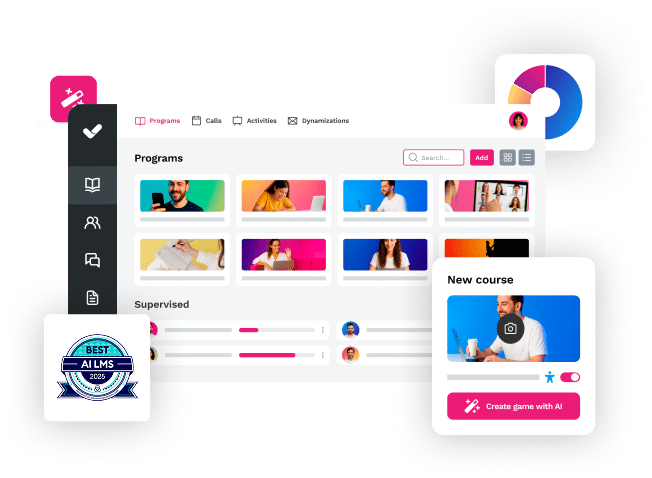
Technology is the enabler that turns the CLO’s strategy into measurable results. With isEazy’s all-in-one solution, the CLO can centralize content creation, distribution, tracking and analytics in a single ecosystem: from the LMS that gives full visibility over learning progress to isEazy Skills, a catalog of more than 600 courses ready to roll out from day one.
If your organization is defining or strengthening its L&D function, the difference between training that simply runs and training that transforms starts with giving the CLO the tools they need to prove it.
The HR Director (CHRO) has a broader role covering all human capital management: recruitment, compensation, labor relations, wellbeing and development. The CLO specializes exclusively in organizational learning and development. In many companies the CLO reports to the CHRO, although in organizations where L&D is especially strategic they may report directly to the CEO. The key difference is focus: the CHRO manages people as a resource; the CLO develops them as a strategic asset.
The CLO works with metrics at several levels. At the learning level: completion rates, assessment scores, time invested. At the behavior level: application of what was learned on the job, changes in post-training performance. At the business level: reduced time to productivity for new hires, fewer operational errors, talent retention, increased sales in commercial programs. The Kirkpatrick model (four levels) and Jack Phillips’ training ROI are the frameworks most commonly used to structure this measurement.
Not every company needs the formal CLO title, but every company needs someone performing its functions. In small organizations, this role may fall to the CHRO or a senior L&D Manager. Beyond a certain size —generally organizations with more than 500 employees or facing intense transformation—, having a dedicated CLO with executive capacity makes a real difference. The clearest sign that a company needs a CLO: when training exists but has no measurable impact on the business.
The CLO is the main decision-maker on L&D technology: which LMS to use, which authoring tools, which content catalogs, how to integrate systems with the corporate HCM. It is not a technical role in the IT sense, but it does require enough digital literacy to evaluate solutions, understand their implications for the user experience and justify investments to the CFO. Choosing the technology stack is probably the highest-impact long-term decision a CLO makes.

GUIDE
Prepare your organization to comply with the new AI Regulations
Download guide


All Your Training Needs in One Powerful Tool!
Training management, content library, course creation, and progress tracking—everything in a single subscription!


All Your Training Needs in One Powerful Tool!
Training management, content library, course creation, and progress tracking—everything in a single subscription!