CASE STUDY
Learn how we helped AKRON Group promote upskilling and reskilling of their workforce

Brain
The first AI trained to teach

Author
The #1 AI-powered authoring tool on the market

Factory
Custom e-learning content factory

Skills
Comprehensive power skills course catalog

LMS
All-in-one LMS platform with AI

Engage
App for managing frontline teams
Product

What is Brain?
Everything you need to know about the first AI trained to teach.

How does it work?
Adaptive, conversational, and contextual. That’s learning with Brain.

Security
Why your company’s knowledge never leaves your environment or trains other models.

Comparison
Discover what sets isEazy Brain apart from other AI solutions.

Frequently Asked Questions
Want to learn more? Find answers to all your questions about isEazy Brain here.
FEATURES

AINew
Unlock your full potential and speed up course creation with artificial intelligence.

Accessibility
Automatically meet accessibility guidelines—without sacrificing interactivity!

Interactivity
Boost engagement with interactive, ready-to-use activities that make learning fun.

Course Creation
Reduce the time it takes to create your e-learning courses with our authoring tool.

Distribution
We offer you different distribution options, so that nothing can stop you.

SCORM
Publish your course in SCORM format and share it on any LMS.
SERVICES

Instrucional Design
Surprise your students with multimedia and interactive content.

Custom Courses
We create e-learning courses for you—tailored to your needs and hassle-free!

Virtual Reality
Turn learning into an immersive experience.

Custom Avatars
Give your courses and videos a unique touch with personalized avatars.

Audiovisual FactoryNew
Turn training into something dynamic and visual with engaging videos.
CATALOG

Course catalog
Over 600 skills and competency courses to help you adapt to your team's needs.
Microsoft Copilot AcademyNew
Your professionals will learn how to apply Copilot AI to key processes within your organization.

Artificial Intelligence Academy
Train your teams in the practical use of AI to boost productivity and innovation in your company.

Cybersecurity Academy
Capacita a tu empresa con el catálogo más completo en seguridad digital corporativa.
FEATURES

Learning platform
Manage all your training from one place

Analitycs
Measure the impact of your training

Learning Experience
Offer a unique learning experience to your team
Content Library
Choose from hundreds of expert-created courses
Authoring Tool
Create your own content—faster than ever

Use cases
Choose the solution that best fits your needs

Industries
Solutions for all types of industries
USE CASES

Onboarding
Facilitate the onboarding process, productivity and engagement of your new employees.

Upskilling
Boost your team's skills and prepare them for the challenges of the future with upskilling.

Microlearning
Discover all the advantages of microlearning and boost your training results.

Gamification
Enjoy addictive training that will get your professionals hooked.

Internal Communication
Improve communication in your company and enjoy an aligned and committed team.

Mobile learning
Agile, flexible, and interactive learning—built for today’s digital-first workforce.
INDUSTRIES

Banking and financial services
Training in compliance, cybersecurity, customer service, and key skills development.

Pharmaceuticals and healthcare
Digital onboarding, regulatory updates, and ongoing training for healthcare staff.

Retail and consumer
Agile and scalable training for in-store, operational, and customer service teams.

Industry and manufacturing
Training in processes, safety, and corporate culture for distributed teams.

Education and training
Digital solutions for training centers, internal academies, and corporate universities.

Technology and telecommunications
Development of technical talent, digital skills, and upskilling and reskilling programs.
CLIENTS

MAPFRE
How MAPFRE turn e-learning into sales with isEazy

Pepco
A personalised learning experience for a growing team.

BBVA
Digitisation and creation of high quality e-learning content.

Shiseido
We increase the engagement of the training with a social and gamified app.

Telefónica
Large-scale reskilling for the company's digital transformation.

Vodafone
A personalised learning experience for a growing team.
More than 1,000 companies already rely on isEazy.





MEET ISEAZY

Events
Discover our upcoming events and connect with the future of e-learning.

News
Find out the latest news about isEazy: press releases, partnerships, updates...

Contact
Leave us your personal details and we will contact you as soon as possible.
About isEazyNew
Find out more about our company.

Careers
We are looking for the best talent, join our team!

Partners
Become our partner and grow your business.
INTERESTING RESOURCES

Blog
The best content on e-learning: trends, tools and key strategies.

Whitepapers
Gain valuable insights and stay ahead of industry trends.

Product releases
The latest news and releases of our e-learning products and solutions.

Glossary
Definitions of the most commonly used terms and key industry concepts.

Guides
Discover the best step-by-step tips and tricks to optimize your L&D strategy.

Webinars
Video sessions on our products, trends and more

Comparatives
Compare e-learning solutions available on the market and choose the most suitable one.


WEBINAR
Master AI in isEazy Author in under an hour.




GUIDE
Prepare your organization to comply with the new AI regulations

Stay up to date with all our latest news
 Subscribe to our newsletter
 Stay up to date with all our latest news

May 20, 2026

CONTENT CREATED BY:

Table of contents
The 180-degree evaluation is a performance appraisal method in which the employee receives feedback from their direct manager and team peers, and also conducts a self-assessment of their own performance. It is more agile than the 360° evaluation, more objective than the 90° evaluation, and particularly effective for identifying competency gaps and designing personalized development plans.
The 180-degree evaluation is a performance appraisal system that brings together three perspectives: the direct manager or supervisor, team peers, and the employee themselves through a self-assessment. Unlike more one-directional models, this approach recognizes that job performance cannot be measured from the top alone.
The name refers to the fact that the evaluation perspective covers “half a circle”: it does not reach 360° because it does not incorporate feedback from direct reports or, in general, external clients. It is, however, the most balanced model between breadth of information and ease of implementation.
The goal is not only to measure, but to activate: the results of a 180° evaluation should translate into concrete action plans, development conversations, and, where appropriate, learning pathways that close the identified gaps.
According to a study by the Integral e-Learning institute, organizations that implement structured performance evaluation systems with multi-source feedback improve the accuracy of their talent development decisions by up to 40%. The 180° model offers a practical starting point to achieve this without the complexity of a full 360° process.
Performance evaluation models differ mainly in the number and type of sources that provide feedback. Each has its own moment and purpose. This table compares the four main models:
| Model | Who evaluates | Includes self-assessment |
|---|---|---|
| 90° | Direct manager only | No |
| 180° | Manager + team peers | Yes |
| 270° | Manager + peers + direct reports | Yes |
| 360° | Manager + peers + direct reports + clients/external | Yes |
| Model | Implementation complexity | Best for |
|---|---|---|
| 90° | Very low | Quick objective reviews |
| 180° | Medium | Competency development and bidirectional feedback |
| 270° | Medium-high | Organizations with a clear hierarchical structure |
| 360° | High | Leaders, managers, and high-visibility roles |
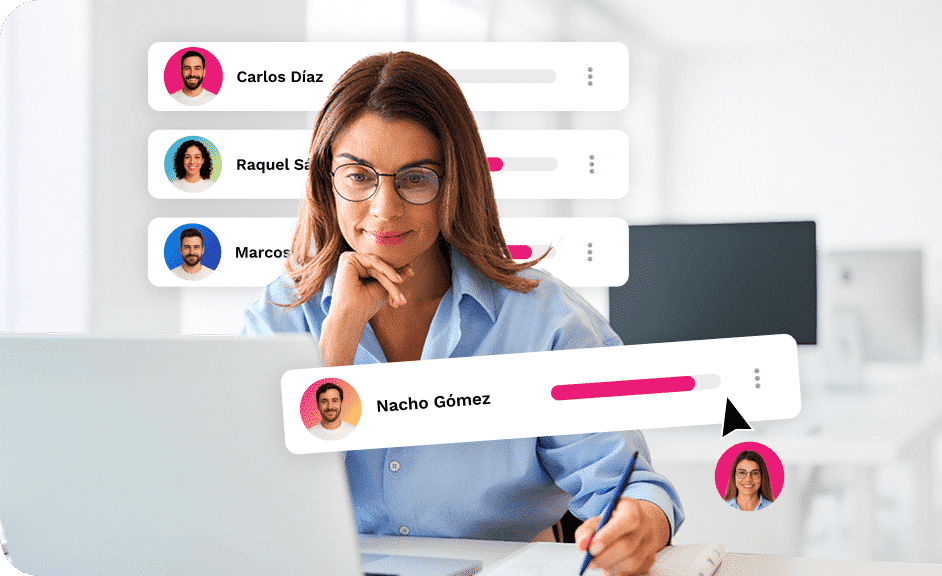
Correctly implementing a 180° evaluation requires planning, communication, and above all, a clear commitment that the results will be used for development, not as a control mechanism.
The 180° evaluation can become an empty process if it is not managed rigorously. These are the five most common mistakes in organizations and how to avoid them:

The greatest value of a 180-degree evaluation does not lie in the results report: it lies in what the organization does with that information. When evaluation data is integrated with the training strategy, the professional development cycle is truly closed.
The process has a clear logic:
AKRON Group is an example of how a company can systematize the training cycle at scale. With an ambitious upskilling and reskilling program, the company used isEazy to design learning pathways aligned with the competencies identified as critical to its transformation. The result was a more structured, scalable, and measurable talent development process. Discover how they did it →
CASE STUDY
Learn how we helped AKRON Group promote upskilling and reskilling of their workforce


The 180-degree evaluation is one of the most balanced methods for measuring job performance: more objective than the 90° evaluation, simpler to implement than the 360°, and comprehensive enough for most organizational contexts. Its true potential, however, is only activated when the results do not remain in a report, but are transformed into concrete development plans and learning actions that close the identified gaps.
Implementing it well requires defining clear objectives, selecting appropriate evaluators, guaranteeing anonymity, communicating the process transparently, and — above all — connecting each cycle of evaluation with the training and talent development strategy.
The main difference lies in the feedback sources. In a 180-degree evaluation, the direct manager, team peers, and the employee themselves (through self-assessment) participate. In a 360-degree evaluation, direct reports are also included, and in some cases external clients or suppliers. The 180° evaluation is more agile and less costly to implement, making it especially suitable for organizations that are just starting to structure their performance evaluation system, or that have teams without complex hierarchical structures.
The recommended frequency is semi-annual or annual, although it depends on business cycles and the organization’s rate of change. Some companies opt for quarterly evaluations in high-turnover environments or during periods of organizational transformation. What matters most is not the frequency itself, but ensuring that each evaluation cycle leads to a concrete action plan: without follow-through, the evaluation loses all its value as a development tool.
The most common competencies include communication and teamwork, results orientation, problem-solving ability, leadership (where applicable), adaptability, and time management. The list should always be aligned with the organization’s values and competency model: an evaluation with generic criteria produces information that is difficult to apply. It is also important to evaluate observable behaviors rather than subjective traits, so that the feedback is concrete and actionable for both the employee and their manager.
The most common biases are the halo effect (rating everything based on one positive or negative quality), recency bias (only remembering recent behaviors), and central tendency (always scoring in the middle to avoid conflict). To reduce them: use observable behavioral scales rather than subjective ratings, train evaluators before the process begins, ensure peer anonymity, and establish clear and measurable evaluation criteria. Talent management software greatly facilitates this task by standardizing the process.

GUIDE
Prepare your organization to comply with the new AI Regulations
Download guide


An LMS to manage and track learning across your entire team
Measure its impact by individual, department, region, or company-wide. Everything you need to power up your training strategy.


An LMS to manage and track learning across your entire team
Measure its impact by individual, department, region, or company-wide. Everything you need to power up your training strategy.