CASE STUDY
We helped Clarel transform its knowledge into interactive and effective microcontents

Brain
The first AI trained to teach

Author
The #1 AI-powered authoring tool on the market

Factory
Custom e-learning content factory

Skills
Comprehensive power skills course catalog

LMS
All-in-one LMS platform with AI

Engage
App for managing frontline teams
Product

What is Brain?
Everything you need to know about the first AI trained to teach.

How does it work?
Adaptive, conversational, and contextual. That’s learning with Brain.

Security
Why your company’s knowledge never leaves your environment or trains other models.

Comparison
Discover what sets isEazy Brain apart from other AI solutions.

Frequently Asked Questions
Want to learn more? Find answers to all your questions about isEazy Brain here.
FEATURES

AINew
Unlock your full potential and speed up course creation with artificial intelligence.

Accessibility
Automatically meet accessibility guidelines—without sacrificing interactivity!

Interactivity
Boost engagement with interactive, ready-to-use activities that make learning fun.

Course Creation
Reduce the time it takes to create your e-learning courses with our authoring tool.

Distribution
We offer you different distribution options, so that nothing can stop you.

SCORM
Publish your course in SCORM format and share it on any LMS.
SERVICES

Instrucional Design
Surprise your students with multimedia and interactive content.

Custom Courses
We create e-learning courses for you—tailored to your needs and hassle-free!

Virtual Reality
Turn learning into an immersive experience.

Custom Avatars
Give your courses and videos a unique touch with personalized avatars.

Audiovisual FactoryNew
Turn training into something dynamic and visual with engaging videos.
CATALOG

Course catalog
Over 600 skills and competency courses to help you adapt to your team's needs.
Microsoft Copilot AcademyNew
Your professionals will learn how to apply Copilot AI to key processes within your organization.

Artificial Intelligence Academy
Train your teams in the practical use of AI to boost productivity and innovation in your company.

Cybersecurity Academy
Capacita a tu empresa con el catálogo más completo en seguridad digital corporativa.
FEATURES

Learning platform
Manage all your training from one place

Analitycs
Measure the impact of your training

Learning Experience
Offer a unique learning experience to your team
Content Library
Choose from hundreds of expert-created courses
Authoring Tool
Create your own content—faster than ever

Use cases
Choose the solution that best fits your needs

Industries
Solutions for all types of industries
USE CASES

Onboarding
Facilitate the onboarding process, productivity and engagement of your new employees.

Upskilling
Boost your team's skills and prepare them for the challenges of the future with upskilling.

Microlearning
Discover all the advantages of microlearning and boost your training results.

Gamification
Enjoy addictive training that will get your professionals hooked.

Internal Communication
Improve communication in your company and enjoy an aligned and committed team.

Mobile learning
Agile, flexible, and interactive learning—built for today’s digital-first workforce.
INDUSTRIES

Banking and financial services
Training in compliance, cybersecurity, customer service, and key skills development.

Pharmaceuticals and healthcare
Digital onboarding, regulatory updates, and ongoing training for healthcare staff.

Retail and consumer
Agile and scalable training for in-store, operational, and customer service teams.

Industry and manufacturing
Training in processes, safety, and corporate culture for distributed teams.

Education and training
Digital solutions for training centers, internal academies, and corporate universities.

Technology and telecommunications
Development of technical talent, digital skills, and upskilling and reskilling programs.
CLIENTS

MAPFRE
How MAPFRE turn e-learning into sales with isEazy

Pepco
A personalised learning experience for a growing team.

BBVA
Digitisation and creation of high quality e-learning content.

Shiseido
We increase the engagement of the training with a social and gamified app.

Telefónica
Large-scale reskilling for the company's digital transformation.

Vodafone
A personalised learning experience for a growing team.
More than 1,000 companies already rely on isEazy.





MEET ISEAZY

Events
Discover our upcoming events and connect with the future of e-learning.

News
Find out the latest news about isEazy: press releases, partnerships, updates...

Contact
Leave us your personal details and we will contact you as soon as possible.
About isEazyNew
Find out more about our company.

Careers
We are looking for the best talent, join our team!

Partners
Become our partner and grow your business.
INTERESTING RESOURCES

Blog
The best content on e-learning: trends, tools and key strategies.

Whitepapers
Gain valuable insights and stay ahead of industry trends.

Product releases
The latest news and releases of our e-learning products and solutions.

Glossary
Definitions of the most commonly used terms and key industry concepts.

Guides
Discover the best step-by-step tips and tricks to optimize your L&D strategy.

Webinars
Video sessions on our products, trends and more

Comparatives
Compare e-learning solutions available on the market and choose the most suitable one.



September 14, 2026

CONTENT CREATED BY:

Table of contents
“Drop-off” in e-learning is the abandonment of a course or training program before completion. It happens when an employee stops accessing the content, closes it halfway through, or simply never comes back to finish it after a first session. In corporate training, “drop-off” is one of the most relevant indicators for evaluating a program’s effectiveness: a high abandonment rate signals that something isn’t working, whether in content design, perceived relevance, or the overall learning experience.
Unlike open educational environments — where abandonment can reach as high as 90% on MOOC platforms —, corporate training is expected to have higher completion rates. However, 62% of online learners abandon their training, even in contexts where training is part of a professional development plan. Understanding why this happens is the first step to reducing it.
In the e-learning ecosystem these terms are often used interchangeably, but they have important nuances:
Distinguishing between the two is key to making the right decisions: a high “drop-off” in a specific module can be solved by redesigning that content. A widespread “dropout” may require rethinking the entire training strategy.
Not all abandonment is the same, nor does it have the same cause. Identifying at what point in the course the “drop-off” happens is essential for applying the right solution:
| Type | When it happens | Typical signal in the LMS |
|---|---|---|
| Initial "drop-off" | The employee logs in but closes the course within the first few minutes | Very low session time, 0% progress |
| Mid-course "drop-off" | Abandons the course halfway through, usually in the longest or most complex module | Progress stalled at 30-60%, no return |
| Final "drop-off" | Completes almost the entire course but doesn't access the assessment or the last module | Progress >80% but no certification |
| Inactivity "drop-off" | Logs in sporadically, with growing gaps between sessions until permanent abandonment | Irregular access pattern that spaces out and stops |
Abandonment rarely has a single cause. The most common ones in corporate training environments are:
Measuring “drop-off” requires going beyond the overall completion rate. LMS analytics let you drill down to the module level and pinpoint exactly where each employee is being lost. The most useful L&D metrics for analyzing “drop-off” are:
Reviewing these metrics periodically — not just at the end of the program — lets you detect “drop-off” while the course is still active and apply improvements before it spreads.
The most effective strategies target the causes, not the symptoms. Reducing abandonment isn’t about sending more reminders: it’s about designing an experience employees actually want to complete:
| Strategy | How it reduces "drop-off" |
|---|---|
| Microlearning | Breaking content into short units (5-10 min) reduces friction and allows progress in small windows of time. |
| Gamification | Adding points, challenges and visible progress boosts intrinsic motivation and makes completing the course immediately rewarding. |
| Learning personalization | Adapting the pathway to the employee's role and level removes irrelevant content that causes abandonment from lack of connection. |
| Reinforcement activities | Including small exercises between modules keeps attention active and consolidates learning before moving on. |
| Notifications and tracking | Automated reminders and progress visibility re-engage employees who are falling behind, with no need for manual intervention. |
Most “drop-off” problems have their root in decisions made before the employee even accesses the course. Good instructional design anticipates friction points: it structures content into digestible chunks, alternates formats (video, exercise, reading, case study), sets clear objectives at the start of each module, and designs assessment as part of the learning, not as an obstacle at the end.
In addition, a good learner marketing strategy prepares the employee before the course even starts: it communicates the value of the training, manages expectations and builds motivation up front. Programs that work on the “before” have significantly lower abandonment rates than those that simply notify people of a course assignment.
Other design levers that have been shown to reduce “drop-off”:
Clarel is a good example of how “drop-off” can become a critical problem when you need to train more than 1,000 points of sale simultaneously, with very different profiles. The company used isEazy to roll out training in microformats adapted to the real time constraints of store employees, managing to keep engagement rates high across a geographically dispersed workforce. Discover how they did it →
CASE STUDY
We helped Clarel transform its knowledge into interactive and effective microcontents


Reducing “drop-off” requires both good content and a platform that lets you detect it and act on it. isEazy LMS offers an analytics dashboard that lets you see the completion rate module by module, identify employees who’ve stalled halfway through, and set up automatic re-engagement notifications. This way, the L&D team doesn’t need to manually review every single user: the platform points out where the problems are and who needs follow-up.
Combined with courses built in isEazy Author — with microformats, interactivity and integrated assessments — the result is a training experience designed for employees to make it to the end. Discover isEazy LMS and find out how your completion metrics can improve from the very first program.
WHITEPAPER
How to take your in-person training online with the right authoring tool


There’s no universal threshold, but as a rough benchmark, a completion rate above 70-80% is considered good for well-designed mandatory corporate training. In voluntary or development programs, values between 50-65% are common. What matters most isn’t the absolute number, but the trend: a drop-off rate that increases from one edition to the next, or that concentrates at the same point in the course, signals a structural problem that needs to be addressed. The real benchmark always depends on the type of training, the course length, whether it’s mandatory, and the employee profile.
The most precise way is to review the LMS activity reports at the module or slide level. Most modern platforms let you see the completion rate per unit, which makes it possible to detect exactly which screen or section has the highest abandonment. If the LMS supports SCORM-based courses, per-screen progress data is available automatically. It’s also useful to cross-reference that data with session times: if employees spend very little time in a module before closing it, that’s a sign the content isn’t engaging. Complementing this analysis with short satisfaction surveys after each module helps you understand the reasons behind the data.
Both factors matter, but content carries more weight. A poorly designed course — too long, not relevant, or with low interactivity — will generate abandonment regardless of the platform it’s hosted on. Technology acts as an amplifier: a good platform with detailed analytics, automated notifications and mobile access makes it easier to keep going, but it can’t make up for content that doesn’t connect with the employee. The most effective strategy combines both: content designed with engagement criteria (microformats, practical scenarios, short assessments) delivered on an LMS that lets you track progress and re-engage those who fall behind.

Automate processes, access 600+ ready-to-use courses, or create your own content with the help of AI.
Request a demoContact us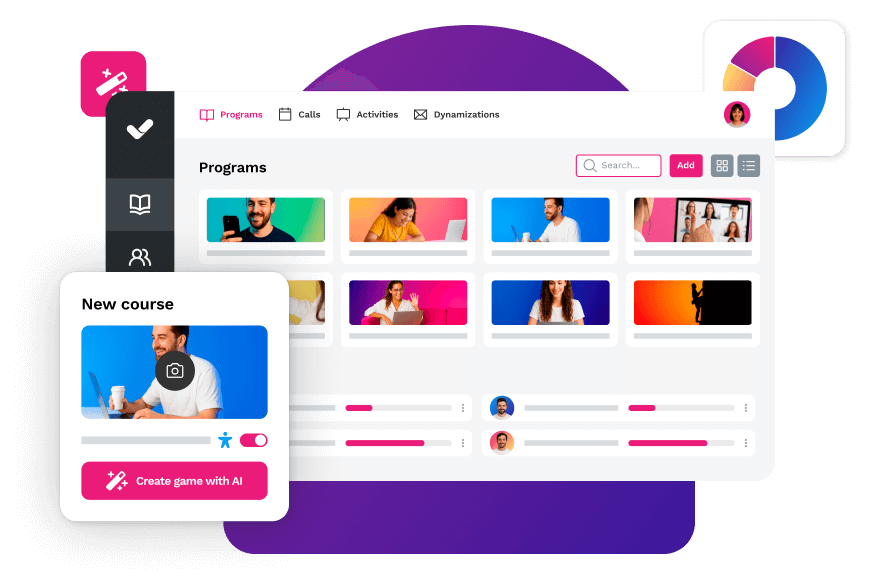

An LMS to manage and track learning across your entire team
Measure its impact by individual, department, region, or company-wide. Everything you need to power up your training strategy.