CASE STUDY
How World Kinect created interactive courses that captivated their entire team

Brain
The first AI trained to teach

Author
The #1 AI-powered authoring tool on the market

Factory
Custom e-learning content factory

Skills
Comprehensive power skills course catalog

LMS
All-in-one LMS platform with AI

Engage
App for managing frontline teams
Product

What is Brain?
Everything you need to know about the first AI trained to teach.

How does it work?
Adaptive, conversational, and contextual. That’s learning with Brain.

Security
Why your company’s knowledge never leaves your environment or trains other models.

Comparison
Discover what sets isEazy Brain apart from other AI solutions.

Frequently Asked Questions
Want to learn more? Find answers to all your questions about isEazy Brain here.
FEATURES

AINew
Unlock your full potential and speed up course creation with artificial intelligence.

Accessibility
Automatically meet accessibility guidelines—without sacrificing interactivity!

Interactivity
Boost engagement with interactive, ready-to-use activities that make learning fun.

Course Creation
Reduce the time it takes to create your e-learning courses with our authoring tool.

Distribution
We offer you different distribution options, so that nothing can stop you.

SCORM
Publish your course in SCORM format and share it on any LMS.
SERVICES

Instrucional Design
Surprise your students with multimedia and interactive content.

Custom Courses
We create e-learning courses for you—tailored to your needs and hassle-free!

Virtual Reality
Turn learning into an immersive experience.

Custom Avatars
Give your courses and videos a unique touch with personalized avatars.

Audiovisual FactoryNew
Turn training into something dynamic and visual with engaging videos.
CATALOG

Course catalog
Over 600 skills and competency courses to help you adapt to your team's needs.
Microsoft Copilot AcademyNew
Your professionals will learn how to apply Copilot AI to key processes within your organization.

Artificial Intelligence Academy
Train your teams in the practical use of AI to boost productivity and innovation in your company.

Cybersecurity Academy
Capacita a tu empresa con el catálogo más completo en seguridad digital corporativa.
FEATURES

Learning platform
Manage all your training from one place

Analitycs
Measure the impact of your training

Learning Experience
Offer a unique learning experience to your team
Content Library
Choose from hundreds of expert-created courses
Authoring Tool
Create your own content—faster than ever

Use cases
Choose the solution that best fits your needs

Industries
Solutions for all types of industries
USE CASES

Onboarding
Facilitate the onboarding process, productivity and engagement of your new employees.

Upskilling
Boost your team's skills and prepare them for the challenges of the future with upskilling.

Microlearning
Discover all the advantages of microlearning and boost your training results.

Gamification
Enjoy addictive training that will get your professionals hooked.

Internal Communication
Improve communication in your company and enjoy an aligned and committed team.

Mobile learning
Agile, flexible, and interactive learning—built for today’s digital-first workforce.
INDUSTRIES

Banking and financial services
Training in compliance, cybersecurity, customer service, and key skills development.

Pharmaceuticals and healthcare
Digital onboarding, regulatory updates, and ongoing training for healthcare staff.

Retail and consumer
Agile and scalable training for in-store, operational, and customer service teams.

Industry and manufacturing
Training in processes, safety, and corporate culture for distributed teams.

Education and training
Digital solutions for training centers, internal academies, and corporate universities.

Technology and telecommunications
Development of technical talent, digital skills, and upskilling and reskilling programs.
CLIENTS

MAPFRE
How MAPFRE turn e-learning into sales with isEazy

Pepco
A personalised learning experience for a growing team.

BBVA
Digitisation and creation of high quality e-learning content.

Shiseido
We increase the engagement of the training with a social and gamified app.

Telefónica
Large-scale reskilling for the company's digital transformation.

Vodafone
A personalised learning experience for a growing team.
More than 1,000 companies already rely on isEazy.





MEET ISEAZY

Events
Discover our upcoming events and connect with the future of e-learning.

News
Find out the latest news about isEazy: press releases, partnerships, updates...

Contact
Leave us your personal details and we will contact you as soon as possible.
About isEazyNew
Find out more about our company.

Careers
We are looking for the best talent, join our team!

Partners
Become our partner and grow your business.
INTERESTING RESOURCES

Blog
The best content on e-learning: trends, tools and key strategies.

Whitepapers
Gain valuable insights and stay ahead of industry trends.

Product releases
The latest news and releases of our e-learning products and solutions.

Glossary
Definitions of the most commonly used terms and key industry concepts.

Guides
Discover the best step-by-step tips and tricks to optimize your L&D strategy.

Webinars
Video sessions on our products, trends and more

Comparatives
Compare e-learning solutions available on the market and choose the most suitable one.


WEBINAR
Master AI in isEazy Author in under an hour.




GUIDE
Prepare your organization to comply with the new AI regulations

Stay up to date with all our latest news
 Subscribe to our newsletter
 Stay up to date with all our latest news

December 26, 2024

CONTENT CREATED BY:

Table of contents
When people talk about e-learning assessment, many still think of a final test that simply determines whether someone has passed or failed a course. However, in the context of corporate training, assessment goes far beyond a grade. It is the mechanism that makes it possible to verify whether learning is actually taking place and, above all, whether it is having an impact on job performance.
Because the key question is not whether the learner has finished the course, but whether the training is changing something within the organization.
In this guide, you will find out what e-learning assessment is, what types exist, practical examples applied to companies, which instruments to use depending on the objective, and which mistakes should be avoided so that it truly adds value.
E-learning assessment is the process of measuring learning within a digital environment in order to verify knowledge acquisition, identify training gaps, and improve the learning experience.
However, limiting assessment to checking whether someone remembers specific information only scratches the surface. Donald Kirkpatrick’s training evaluation model already stated that measuring learning alone is not enough. The most mature organizations connect assessment with behavior changes and real business outcomes.

In addition, research from the Association for Talent Development shows that companies that systematically measure the effectiveness of their training achieve better organizational results than those that do not.
These tools have three main objectives:
Therefore, e-learning assessment is not only a pedagogical tool. It is a strategic tool that enables organizations to make informed decisions about their training investment.

Not all assessments serve the same purpose within a course. In fact, one of the most common mistakes is using the same type of assessment every time without considering the stage of the learning process or the objective being pursued.
Diagnostic assessment takes place before the course begins and helps determine the participants’ starting point. In corporate environments where employees have different levels of experience, this type of assessment is especially useful for avoiding unnecessary repetition of content and personalizing the learning path from the very beginning.
Formative assessments or self-assessments, on the other hand, are integrated throughout the course. Their main purpose is not grading, but reinforcing learning through small exercises, quizzes, or simulations that allow learners to check their progress. This approach improves retention because it requires learners to retrieve information and apply it in context.
Finally, summative assessment or final test is applied at the end of the course and aims to validate whether the expected learning outcomes have been achieved. In many cases, it serves as the basis for internal certifications or regulatory compliance.
In practice, the most effective strategies combine all three types, as each provides a different kind of insight.

One of the most common searches related to e-learning assessment focuses on practical examples. And it makes sense: understanding how assessment is applied in real contexts helps design it more effectively.
These examples show that assessment in online courses can—and should—be adapted to the professional context in order to be truly effective.
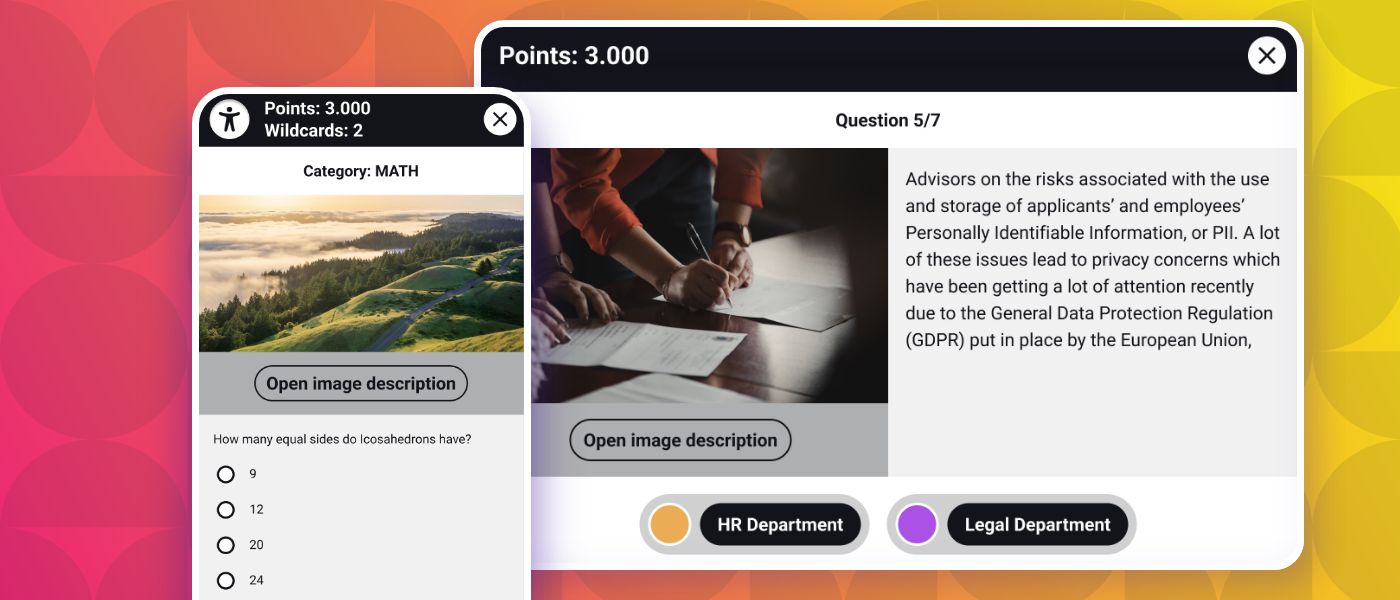
CASE STUDY
How World Kinect created interactive courses that captivated their entire team


Choosing the right instrument is just as important as clearly defining the objective of the assessment. Not all formats are designed to measure the same outcomes, and selecting the wrong one may result in evaluating memory when the real goal is to measure competence.
Below are some recommendations on which instrument to use depending on the training objective:
The key is to ask what evidence will demonstrate that learning has actually taken place.
Assessments are an essential part of any successful e-learning course. They not only help measure results, but also enrich the learning experience in several ways. By integrating assessments into your courses, you can take advantage of the following benefits:
One of the major advantages of assessments in e-learning is the ability to provide immediate feedback to learners. This allows them to quickly identify their successes and mistakes, better understand the concepts, and adjust their learning approach.
| Why is it important? | Practical example |
|---|---|
| Instant feedback helps correct misunderstandings before they turn into gaps in knowledge. In addition, it motivates learners to keep progressing because they know exactly where they need to improve. | A quiz at the end of each module that immediately shows which answers were correct and provides additional explanations for the incorrect ones. |
Assessments, especially when combined with interactive elements or gamification, make learning more engaging and dynamic. Challenges, leaderboards, and rewards can create healthy competition and keep learners interested in the course.
| Why is it important? | Practical example |
|---|---|
| Motivation is one of the main factors that drives learners to complete online courses. Well-structured assessments create a sense of progress and achievement that encourages learners to keep moving forward. | Using rewards in gamification to reinforce success in your training programs. |
If you want to learn how to use rewards in gamification, take a look at this post.
Las evaluaciones proporcionan datos concretos sobre el rendimiento de los alumnos, lo que le permite medir el impacto del curso e identificar las áreas que necesitan atención. Además de beneficiar a los alumnos, este análisis también es valioso para los instructores y gerentes.
| Why is it important? | Practical example |
|---|---|
| With a clear view of progress, it is possible to adapt course content, reinforce challenging topics, and continuously improve the learning experience. | Automatically generated reports showing the most difficult topics, completion rates, and the average performance of participants. |
With isEazy Author, you can include self-assessments throughout the course using games and interactive exercises, and activate a final assessment to verify whether the learner has acquired the key knowledge.
To create it, the first step is to activate the assessment from the project editor. Once activated, you will be able to access its settings panel and define the main elements that will determine how the test works.
The most important parameters include:
In addition, isEazy Author allows you to use a question pool, which displays a specific number of questions selected randomly from all the available ones. This helps prevent learners from sharing answers and improves the reliability of the assessment.
Once the general structure has been configured, the only thing left to do is create and edit the questions. The editor allows you to add questions, answers, associated images, and positive or negative feedback depending on the selected answer. It is also possible to easily reorganize the questions by dragging them within the panel.
After publishing the course, analyzing the assessment results — if it is distributed through an LMS — makes it possible to detect questions that are too easy, too difficult, or poorly understood. This continuous analysis is what ensures that the assessment provides real value to the learning process.

Today, tools such as isEazy Author allow you to automatically generate assessment test questions from the course content itself using artificial intelligence.
This represents a major improvement in terms of efficiency, as it makes it possible to create a complete quiz in just seconds without having to write each question manually. Since the questions are generated based on the course content, their relevance is maintained.
However, it is always recommended to review the generated questions to make sure that:
AI accelerates the creation process, but the final validation still remains the responsibility of the training team. By using isEazy Author, you can combine automatic question generation with manual editing, creating high-quality self-assessments and final tests in much less time.
With isEazy Author, you can create a final assessment test for your courses and automatically generate questions using AI based on the project content. Follow these steps:

Source of the questions: you can choose whether the AI should use the content from the entire project or only from specific sections or subsections.
If your course includes introductory or less relevant content, it is recommended to deselect those sections to improve the quality of the generated questions.
Number of questions: select how many questions you want to generate. You can create up to 99 questions for your assessment or question bank.
4. Click “Add questions with AI” and the system will automatically generate the quiz.

Once the questions have been generated, you can:
Before publishing your assessment, keep these best practices in mind:
By following these steps, you will be able to create faster, more reliable assessment tests aligned with the learning objectives of your e-learning courses.
There are common mistakes that reduce the effectiveness of assessment, often without us even realizing it. The most frequent ones include:
Avoiding these mistakes not only improves the quality of the course, but also the way participants perceive the training and its real usefulness in their day-to-day work. Ultimately, e-learning assessment should not be seen as a final formality, but as the system that allows training to become a measurable, optimizable process aligned with the organization’s objectives.
When assessments are designed with intention, the right instruments are chosen, and the results are analyzed with the proper criteria, evaluation stops being a simple questionnaire and becomes a strategic tool that drives continuous improvement.
isEazy Author is the easiest tool on the market for designing and sharing interactive and accessible e-learning courses without the need for technical knowledge. With its powerful features, you can create personalized courses quickly and easily, motivate your learners with engaging interactive and multimedia content, and build your own training environment or export your courses to upload them to your LMS. What are you waiting for to request your free trial?
E-learning assessment is the process used to measure learning within a digital training environment. It can include diagnostic tests, self-assessment exercises throughout the course, and final exams. Its purpose is to verify whether the expected knowledge or competencies have been acquired and to generate useful insights to improve training and align it with business objectives.
There is no universal number of questions, as it depends on the complexity of the content and the depth of evaluation required. In corporate training, between 8 and 15 well-designed questions are usually enough to validate a standard module, as long as they are aligned with the learning objectives. What really matters is not the number of questions, but whether the assessment reliably measures what it intends to evaluate and whether the results can be analyzed to draw meaningful conclusions.
There are different assessment instruments that can be used in e-learning, and the choice should depend on the training objective. Multiple-choice tests are suitable for verifying theoretical knowledge, while simulations or practical cases are more effective for assessing applied skills. In more strategic programs, projects or open-ended questions can help evaluate critical thinking and analytical capabilities. The key is to select the instrument that best reflects the competency you want to observe.
For an e-learning assessment to be reliable, it must be clearly aligned with the course objectives, include unambiguous questions, and be followed by proper analysis of the results. Reviewing which questions have the highest error rates, identifying items that may be too easy, or checking whether the assessment correctly differentiates between performance levels are recommended practices. It is also important that the evaluation goes beyond testing memory and includes situations where learners can apply knowledge in realistic contexts.
Using artificial intelligence can significantly speed up the creation of questions based on course content, especially in authoring tools such as isEazy Author. However, it is essential to verify that the generated questions are aligned with the training objectives, that the distractors are coherent, and that the level of difficulty is appropriate. AI should be seen as a support tool that optimizes the process, not as a replacement for expert judgment.
Measuring impact means going beyond test results and analyzing how the data relates to performance indicators. Integrating assessments with the LMS or with standards such as xAPI makes it possible to connect learning data with operational metrics, such as error reduction, improved sales performance, or compliance with processes. In this way, assessment becomes more than an isolated metric and turns into a key element for demonstrating the return on investment in training.

WEBINAR
Master AI in isEazy Author in under an hour.
Register Now


Turn your ideas into reality with the most agile resources for creating e-learning courses
Enjoy more productivity, autonomy, and speed with isEazy Author, the easiest authoring tool on the market


Turn your ideas into reality with the most agile resources for creating e-learning courses
Enjoy more productivity, autonomy, and speed with isEazy Author, the easiest authoring tool on the market