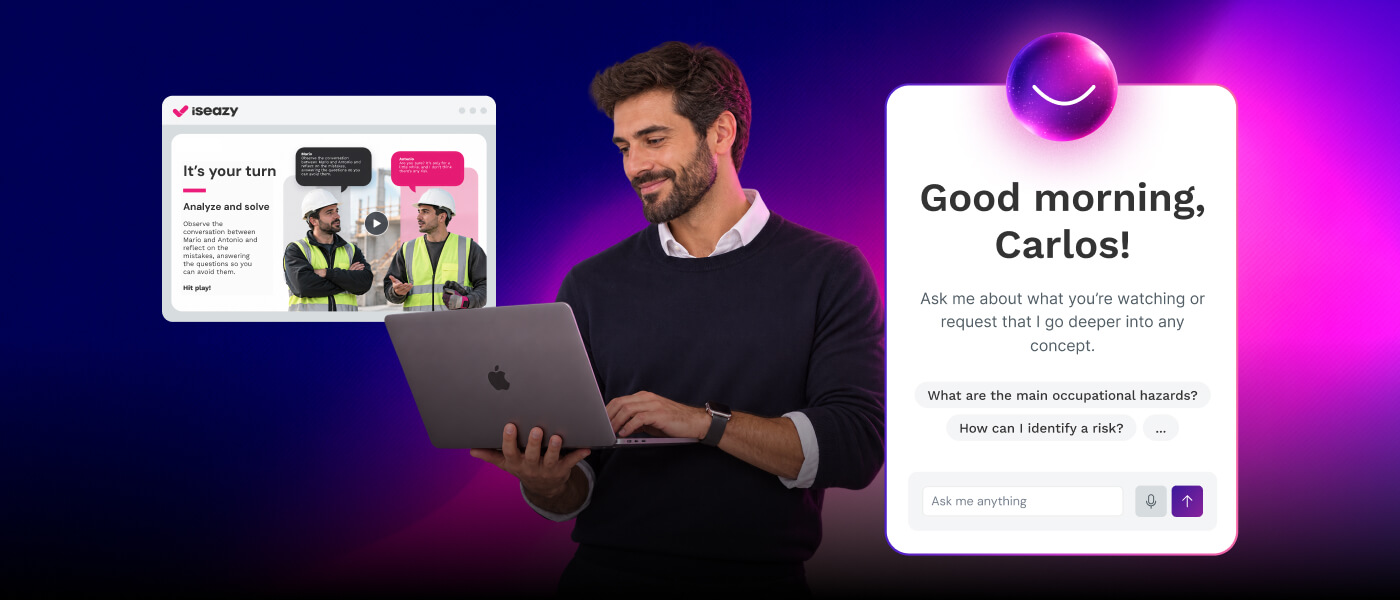
STUDY
Use of AI in HR and Corporate Training

Brain
The first AI trained to teach

Author
The #1 AI-powered authoring tool on the market

Factory
Custom e-learning content factory

Skills
Comprehensive power skills course catalog

LMS
All-in-one LMS platform with AI

Engage
App for managing frontline teams
Product

What is Brain?
Everything you need to know about the first AI trained to teach.

How does it work?
Adaptive, conversational, and contextual. That’s learning with Brain.

Security
Why your company’s knowledge never leaves your environment or trains other models.

Comparison
Discover what sets isEazy Brain apart from other AI solutions.

Frequently Asked Questions
Want to learn more? Find answers to all your questions about isEazy Brain here.
FEATURES

AINew
Unlock your full potential and speed up course creation with artificial intelligence.

Accessibility
Automatically meet accessibility guidelines—without sacrificing interactivity!

Interactivity
Boost engagement with interactive, ready-to-use activities that make learning fun.

Course Creation
Reduce the time it takes to create your e-learning courses with our authoring tool.

Distribution
We offer you different distribution options, so that nothing can stop you.

SCORM
Publish your course in SCORM format and share it on any LMS.
SERVICES

Instrucional Design
Surprise your students with multimedia and interactive content.

Custom Courses
We create e-learning courses for you—tailored to your needs and hassle-free!

Virtual Reality
Turn learning into an immersive experience.

Custom Avatars
Give your courses and videos a unique touch with personalized avatars.

Audiovisual FactoryNew
Turn training into something dynamic and visual with engaging videos.
CATALOG

Course catalog
Over 600 skills and competency courses to help you adapt to your team's needs.
Microsoft Copilot AcademyNew
Your professionals will learn how to apply Copilot AI to key processes within your organization.

Artificial Intelligence Academy
Train your teams in the practical use of AI to boost productivity and innovation in your company.

Cybersecurity Academy
Capacita a tu empresa con el catálogo más completo en seguridad digital corporativa.
FEATURES

Learning platform
Manage all your training from one place

Analitycs
Measure the impact of your training

Learning Experience
Offer a unique learning experience to your team
Content Library
Choose from hundreds of expert-created courses
Authoring Tool
Create your own content—faster than ever

Use cases
Choose the solution that best fits your needs

Industries
Solutions for all types of industries
USE CASES

Onboarding
Facilitate the onboarding process, productivity and engagement of your new employees.

Upskilling
Boost your team's skills and prepare them for the challenges of the future with upskilling.

Microlearning
Discover all the advantages of microlearning and boost your training results.

Gamification
Enjoy addictive training that will get your professionals hooked.

Internal Communication
Improve communication in your company and enjoy an aligned and committed team.

Mobile learning
Agile, flexible, and interactive learning—built for today’s digital-first workforce.
INDUSTRIES

Banking and financial services
Training in compliance, cybersecurity, customer service, and key skills development.

Pharmaceuticals and healthcare
Digital onboarding, regulatory updates, and ongoing training for healthcare staff.

Retail and consumer
Agile and scalable training for in-store, operational, and customer service teams.

Industry and manufacturing
Training in processes, safety, and corporate culture for distributed teams.

Education and training
Digital solutions for training centers, internal academies, and corporate universities.

Technology and telecommunications
Development of technical talent, digital skills, and upskilling and reskilling programs.
CLIENTS

MAPFRE
How MAPFRE turn e-learning into sales with isEazy

Pepco
A personalised learning experience for a growing team.

BBVA
Digitisation and creation of high quality e-learning content.

Shiseido
We increase the engagement of the training with a social and gamified app.

Telefónica
Large-scale reskilling for the company's digital transformation.

Vodafone
A personalised learning experience for a growing team.
More than 1,000 companies already rely on isEazy.





MEET ISEAZY

Events
Discover our upcoming events and connect with the future of e-learning.

News
Find out the latest news about isEazy: press releases, partnerships, updates...

Contact
Leave us your personal details and we will contact you as soon as possible.
About isEazyNew
Find out more about our company.

Careers
We are looking for the best talent, join our team!

Partners
Become our partner and grow your business.
INTERESTING RESOURCES

Blog
The best content on e-learning: trends, tools and key strategies.

Whitepapers
Gain valuable insights and stay ahead of industry trends.

Product releases
The latest news and releases of our e-learning products and solutions.

Glossary
Definitions of the most commonly used terms and key industry concepts.

Guides
Discover the best step-by-step tips and tricks to optimize your L&D strategy.

Webinars
Video sessions on our products, trends and more

Comparatives
Compare e-learning solutions available on the market and choose the most suitable one.


WEBINAR
Master AI in isEazy Author in under an hour.




GUIDE
Prepare your organization to comply with the new AI regulations

Stay up to date with all our latest news
 Subscribe to our newsletter
 Stay up to date with all our latest news

May 8, 2026

CONTENT CREATED BY:

Table of contents
When L&D teams calculate the training budget, they usually think about platform licences, instructor fees and, at best, instructional design time. What almost nobody adds up is the real cost of producing the content itself: the hours spent structuring, the review cycles, the coordination with subject matter experts, the tools that don’t talk to each other. Those are the hidden costs of eLearning. And their impact on training ROI is greater than any budget line captures.
Most organisations calculate the cost of training by adding three visible items: the cost of the platform or LMS, the fees of external instructors or vendors, and the learners’ time during training sessions. It is an understandable calculation, but an incomplete one.
What that budget doesn’t capture is everything that happens before a course is available to employees:
Each of those phases has a cost in real working hours. And those hours belong to profiles with a non-trivial hourly rate: instructional designers, content managers, reviewers, coordinators. None of that appears on any invoice, but it is real cost.
To understand the real cost of eLearning, you need to break it down into layers. Some are visible and appear on any invoice. Others are invisible but just as real.

These hidden costs are not a hypothesis. They are a reality that industry data confirms clearly. The study AI Use in HR and Training, produced by isEazy together with Microsoft with more than 300 professionals surveyed, provides a precise picture of the problem:
But that’s not all. The three most time-consuming tasks within course creation are: structuring content from scratch (59%), designing activities and assessments (41%) and writing the learning texts (40%). What makes these figures significant is that they describe the situation in 2025, with artificial intelligence already available and widely adopted. AI is helping, but the structural problem — the process — remains largely unresolved.
STUDY
Use of AI in HR and Corporate Training
How AI is being used, what’s working, and what’s really holding back its adoption.
Download the study


If artificial intelligence has been promising to transform training content production for years, why do 61% of teams still take more than two weeks to create a course? The answer lies in a distinction the industry has yet to fully internalise: using AI for specific tasks is different from redesigning the entire process with AI.
What happens in most L&D teams is that AI has entered as an accelerator for individual steps: drafting text faster, adjusting the tone of a paragraph, finding images more easily. But the full production workflow — from the initial content analysis to final publishing — remains just as heavy, just as fragmented, just as dependent on manual coordination between profiles.
The result is that time is saved at some points in the process, but the real bottlenecks — structuring from scratch, SME coordination, review cycles — remain exactly where they always were. The efficiency gains of AI-assisted steps are absorbed by the structural inefficiency of the process as a whole.
Putting a number on the production cost of eLearning courses does not require a complex accounting system. It requires measuring the right variables. Here is the five-step framework:
Not just the instructional designer. Also the content manager who organises the materials, the SME who reviews and validates, the designer who lays out the course, the coordinator who manages the project, and the approver. Each has an hourly cost.
Break down production into phases: analysis, structuring, writing, activity design, production, internal review, SME review, corrections, publishing. Estimate how many hours each profile dedicates to each phase in a typical course.
Use the total gross cost of the employee (salary + employer contributions + pro-rated benefits). For external profiles, use the actual invoiced amount per hour or project.
Every interaction with a vendor, agency or freelancer has an internal cost: briefing them, reviewing deliverables, requesting corrections, managing approvals. Estimate the hours your team spends on external coordination per course.
With all these figures, you can calculate what it actually costs to produce one course. Multiply by the number of courses produced per year to obtain the annual production cost — the metric that makes any improvement decision meaningful.
Find out how much you can save by creating courses compared to other tools

Once you have the number — how much it really costs to produce training in your organisation — the strategic question changes. It is no longer “can we afford a new tool?”. It is “how much does it cost us not to change anything?”.
Improving production ROI in eLearning does not necessarily mean buying cheaper tools. It means reducing the time the process consumes without losing quality in the result. There are three main levers:
All three levers can be activated independently, but their combined effect is multiplied when a tool supports them simultaneously — reducing individual task time, enabling internal production and providing structure to the process.
Even when L&D teams set out to measure, there are recurring errors that distort the result and lead to flawed strategic decisions.
The LMS or authoring tool is only a fraction of the real cost. Reducing the licence from €10,000 to €8,000 a year may have less impact on ROI than reducing production time per course by three days.
The subject matter experts who validate content have a high hourly rate and participate in multiple review cycles. Their time is production cost, even if it doesn’t appear on any training invoice.
A course that goes through four rounds of corrections between the L&D team, SMEs and management can double its production time compared to the initial estimate. This is the bottleneck that most tools don’t address directly.
Many teams calculate training ROI by comparing the cost of the platform against the number of completions or hours of training delivered. This metric omits the entire production side — which is often the most significant cost driver in the entire training equation. For a more complete picture, consult resources on [LINK:L&D metrics] that consider both the production and delivery dimensions.
As we have seen, the hidden costs of eLearning can have a significant impact on training ROI, and without precise measurement, improvement is difficult. Recognising these costs is the first step towards optimising the process and achieving more efficient, profitable results.
By understanding the true cost of creating training content, organisations can make informed decisions about where to invest and how to improve their processes. It is not just about cheaper tools — it is about improving efficiency and reducing production time without sacrificing quality.
Discover how isEazy Author can help you reduce these costs and accelerate eLearning content creation, optimising your resources and improving your training ROI. Request a demo and start transforming your training process today.
Although it depends on complexity and length, a mid-complexity course can require between 40 and 200 hours of real work: content analysis, instructional design, production, reviews and publishing. If you calculate that time using the hourly cost of each profile involved — instructional designers, reviewers, graphic designers, coordinators — the real cost of a single course can easily range from €3,000 to €25,000, before factoring in tool licences or outsourcing. The problem is that almost no L&D team adds up these figures in that level of detail.
The hidden costs of eLearning are all the expenses that don’t appear in the standard training budget but consume real time and money. The most common ones: the time of subject matter experts (SMEs) who validate the content, iterative review cycles between teams, coordination with external designers or vendors, the time spent structuring content from scratch, and the cost of managing tools that don’t integrate with each other. None of these appear on a platform invoice, but together they can exceed the visible cost of training.
To calculate the real time, you need to add up all the phases: content analysis and structuring, writing or adapting texts, designing activities and assessments, multimedia production if applicable, internal reviews, expert validation, corrections and publishing. According to data from the isEazy study with Microsoft, 61% of L&D teams take more than two weeks to produce a single course. Multiplying that time by the hourly cost of each profile involved gives the real production cost per course — the baseline for calculating the ROI of any process improvement.
It makes sense when the production volume is high enough that the time savings outweigh the cost of the tool. As a general rule, if a team produces more than 5–6 courses per year and the current production time exceeds two weeks per course, the return on a tool that reduces that time by 50% or more tends to pay for itself in under 6 months. In the isEazy study with Microsoft, 88% of surveyed professionals said they would try such a tool without hesitation — reflecting the real operational pressure that L&D teams are under.

GUIDE
Prepare your organization to comply with the new AI Regulations
Download guide

Your courses, created at AI speed
Transform your ideas or documents into spectacular courses automatically, with the #1 AI authoring tool on the market.



Your courses, created at AI speed
Transform your ideas or documents into spectacular courses automatically, with the #1 AI authoring tool on the market.