CASE STUDY
We helped Clarel transform its knowledge into interactive and effective microcontents

Brain
The first AI trained to teach

Author
The #1 AI-powered authoring tool on the market

Factory
Custom e-learning content factory

Skills
Comprehensive power skills course catalog

LMS
All-in-one LMS platform with AI

Engage
App for managing frontline teams
Product

What is Brain?
Everything you need to know about the first AI trained to teach.

How does it work?
Adaptive, conversational, and contextual. That’s learning with Brain.

Security
Why your company’s knowledge never leaves your environment or trains other models.

Comparison
Discover what sets isEazy Brain apart from other AI solutions.

Frequently Asked Questions
Want to learn more? Find answers to all your questions about isEazy Brain here.
FEATURES

AINew
Unlock your full potential and speed up course creation with artificial intelligence.

Accessibility
Automatically meet accessibility guidelines—without sacrificing interactivity!

Interactivity
Boost engagement with interactive, ready-to-use activities that make learning fun.

Course Creation
Reduce the time it takes to create your e-learning courses with our authoring tool.

Distribution
We offer you different distribution options, so that nothing can stop you.

SCORM
Publish your course in SCORM format and share it on any LMS.
SERVICES

Instrucional Design
Surprise your students with multimedia and interactive content.

Custom Courses
We create e-learning courses for you—tailored to your needs and hassle-free!

Virtual Reality
Turn learning into an immersive experience.

Custom Avatars
Give your courses and videos a unique touch with personalized avatars.

Audiovisual FactoryNew
Turn training into something dynamic and visual with engaging videos.
CATALOG

Course catalog
Over 600 skills and competency courses to help you adapt to your team's needs.
Microsoft Copilot AcademyNew
Your professionals will learn how to apply Copilot AI to key processes within your organization.

Artificial Intelligence Academy
Train your teams in the practical use of AI to boost productivity and innovation in your company.

Cybersecurity Academy
Capacita a tu empresa con el catálogo más completo en seguridad digital corporativa.
FEATURES

Learning platform
Manage all your training from one place

Analitycs
Measure the impact of your training

Learning Experience
Offer a unique learning experience to your team
Content Library
Choose from hundreds of expert-created courses
Authoring Tool
Create your own content—faster than ever

Use cases
Choose the solution that best fits your needs

Industries
Solutions for all types of industries
USE CASES

Onboarding
Facilitate the onboarding process, productivity and engagement of your new employees.

Upskilling
Boost your team's skills and prepare them for the challenges of the future with upskilling.

Microlearning
Discover all the advantages of microlearning and boost your training results.

Gamification
Enjoy addictive training that will get your professionals hooked.

Internal Communication
Improve communication in your company and enjoy an aligned and committed team.

Mobile learning
Agile, flexible, and interactive learning—built for today’s digital-first workforce.
INDUSTRIES

Banking and financial services
Training in compliance, cybersecurity, customer service, and key skills development.

Pharmaceuticals and healthcare
Digital onboarding, regulatory updates, and ongoing training for healthcare staff.

Retail and consumer
Agile and scalable training for in-store, operational, and customer service teams.

Industry and manufacturing
Training in processes, safety, and corporate culture for distributed teams.

Education and training
Digital solutions for training centers, internal academies, and corporate universities.

Technology and telecommunications
Development of technical talent, digital skills, and upskilling and reskilling programs.
CLIENTS

MAPFRE
How MAPFRE turn e-learning into sales with isEazy

Pepco
A personalised learning experience for a growing team.

BBVA
Digitisation and creation of high quality e-learning content.

Shiseido
We increase the engagement of the training with a social and gamified app.

Telefónica
Large-scale reskilling for the company's digital transformation.

Vodafone
A personalised learning experience for a growing team.
More than 1,000 companies already rely on isEazy.





MEET ISEAZY

Events
Discover our upcoming events and connect with the future of e-learning.

News
Find out the latest news about isEazy: press releases, partnerships, updates...

Contact
Leave us your personal details and we will contact you as soon as possible.
About isEazyNew
Find out more about our company.

Careers
We are looking for the best talent, join our team!

Partners
Become our partner and grow your business.
INTERESTING RESOURCES

Blog
The best content on e-learning: trends, tools and key strategies.

Whitepapers
Gain valuable insights and stay ahead of industry trends.

Product releases
The latest news and releases of our e-learning products and solutions.

Glossary
Definitions of the most commonly used terms and key industry concepts.

Guides
Discover the best step-by-step tips and tricks to optimize your L&D strategy.

Webinars
Video sessions on our products, trends and more

Comparatives
Compare e-learning solutions available on the market and choose the most suitable one.


WEBINAR
Master AI in isEazy Author in under an hour.




GUIDE
Prepare your organization to comply with the new AI regulations

Stay up to date with all our latest news
 Subscribe to our newsletter
 Stay up to date with all our latest news

April 8, 2026

CONTENT CREATED BY:

Table of contents
Atomic habits are small, specific and consistent micro-habits that, accumulated over time, generate profound transformations. The concept was popularised by James Clear in his book of the same name: the central idea is that a 1% improvement every day translates into 37% progress over the course of a year.
In the corporate environment, this principle has a direct application in training and people development. Rather than relying on large, one-off training events, atomic habits propose integrating learning as part of the natural flow of work: small doses of knowledge, repeated consistently, that build solid competencies without generating resistance or cognitive overload.
Continuous learning is today a strategic imperative. According to LinkedIn Learning’s 2024 Workplace Learning Report, 94% of employees say they would stay longer at a company that invests in their professional development. Yet most corporate training programmes fail not because of a lack of budget, but because of a lack of habit.
This is where atomic habits make the difference. When learning becomes an atomic habit — a small, predictable action tied to a specific moment of the day — it no longer depends on motivation or the training calendar. Employees don’t need to find time to learn: learning is already part of their routine.
From a cognitive standpoint, the spaced repetition inherent in habitual micro-learning directly combats Ebbinghaus’s forgetting curve: without reinforcement, we forget 70% of what we learned in less than 24 hours. Atomic habits applied to training ensure that reinforcement happens naturally and sustainably.
An effective modern learning experience is built precisely on this principle: not one big annual course, but an ecosystem of small learning moments that accumulate over time.
James Clear describes four laws for creating a lasting habit: make it obvious, make it attractive, make it easy, and make it satisfying. Applied to corporate training design, these four laws offer a practical framework for L&D teams to build programmes that employees actually complete and remember.
| Principle | Application in corporate training | Practical example |
|---|---|---|
| Make it obvious (cue) | Schedule automatic reminders or integrate content access into daily work tools | Push notification in the LMS every Monday at 9am with a 5-minute module |
| Make it attractive (craving) | Design visually dynamic, gamified content tied to real on-the-job challenges | Sales micro-course with a customer objection simulator |
| Make it easy (response) | Reduce friction: short modules, mobile-accessible, no complex login required | 3–5 minute microlearning accessible from any device |
| Make it satisfying (reward) | Celebrate progress: badges, leaderboards, congratulatory messages from managers | Digital badge awarded upon completing 4 consecutive modules |
Microlearning and atomic habits share the same DNA: both are built on the idea that less, done consistently, produces more than a lot done all at once. Building a continuous learning culture based on micro-habits requires a training format that is flexible, customisable, and doesn’t compete with the working day.
Unlike long, intensive training, microlearning allows content to be absorbed in short intervals, avoiding cognitive overload and mental fatigue. It is also highly adaptable: it can be personalised by role, department or experience level, which increases perceived relevance for each employee.
This methodology also fits the preferences of new generations of workers. Millennials and Generation Z prefer to learn quickly, interactively and digitally, from any device. By adopting microlearning as an organisational habit, companies not only improve training outcomes but also reinforce the team’s commitment to their own development.
Microlearning also enhances knowledge reinforcement: if your teams already do online training, discover how to complement it with the best reinforcement activities for e-learning courses that consolidate knowledge over the long term.
Clarel is a great example of how to embed microlearning as a habit across a retail store network. With isEazy, the company transformed its training into agile, interactive microcontents, achieving 84% engagement among its store employees. Find out how they did it →
CASE STUDY
We helped Clarel transform its knowledge into interactive and effective microcontents


Knowing that atomic habits work is not enough. The hard part is implementing them systematically across an organisation, especially when working with distributed teams, field staff or employees without a fixed desk. These five principles will help you build a continuous learning culture that truly stands the test of time.
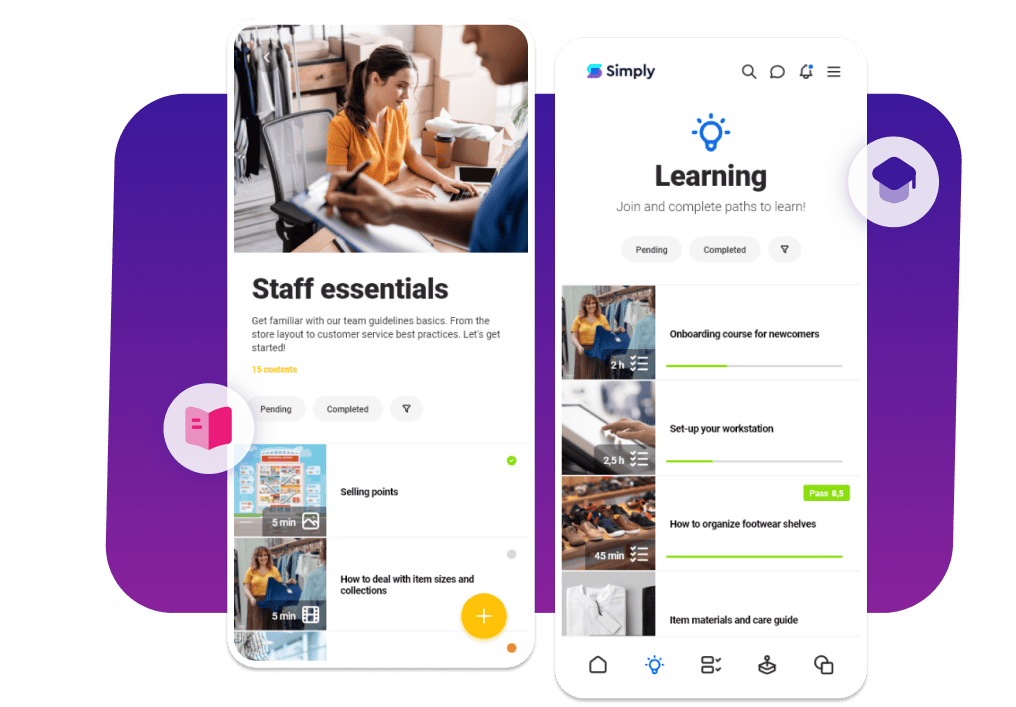
Atomic habits applied to corporate training are not a passing trend: they are the most coherent response to a labour market that evolves faster than any annual training programme can absorb. When learning becomes a habit, it stops being an extraordinary event and becomes a sustained organisational capability.
The key lies in design: small content pieces, accessible from any device, linked to daily routines and reinforced with mechanics that make progress visible and satisfying. That is exactly what isEazy Engage enables: a solution that unifies training, communication and operations in a single app for frontline teams, making habitual micro-learning a natural part of every employee’s day. Request your demo today and start watching your team grow.
Atomic habits are small, specific behavioral changes that are repeated daily until they become automatic. By incorporating these habits into the workplace, continuous learning becomes part of employees’ daily routine, facilitating the constant absorption of new knowledge and skills. This creates a cycle of continuous improvement that keeps the team motivated and committed to personal and professional development.
The main difference is that atomic habits focus on incremental and sustainable changes, while many traditional training methods rely on intensive, one-off sessions. Atomic habits promote learning as a gradual process, with small and consistent actions that can easily be incorporated into the work routine, rather than large, long-term transformations.
To motivate the team, it is essential to clearly communicate the benefits of incorporating continuous learning habits. Offering incentives, such as rewards for reaching goals, and providing a supportive environment where learning is valued can help keep everyone engaged. In addition, leaders can lead by example by demonstrating how they are applying these habits on a daily basis.
Atomic habits can be applied to both small tasks and broader goals. They help break down larger goals into smaller, more manageable actions, enabling gradual and steady progress. Over time, these small habits accumulate, leading to the achievement of more significant and complex objectives.
The success of atomic habits can be measured by tracking indicators such as improvements in individual performance, increased frequency of participation in learning activities, and positive employee feedback about their own progress. Productivity and engagement tracking tools can also be useful for monitoring the impact of these habits on the team’s routine.

Need fast, effective, and easy-to-digest content?
Reinforce learning and boost knowledge retention with the most engaging multimedia and interactive micro-content

Need fast, effective, and easy-to-digest content?
Reinforce learning and boost knowledge retention with the most engaging multimedia and interactive micro-content