CASE STUDY
How ING revolutionized onboarding and redefined talent management

Brain
The first AI trained to teach

Author
The #1 AI-powered authoring tool on the market

Factory
Custom e-learning content factory

Skills
Comprehensive power skills course catalog

LMS
All-in-one LMS platform with AI

Engage
App for managing frontline teams
Product

What is Brain?
Everything you need to know about the first AI trained to teach.

How does it work?
Adaptive, conversational, and contextual. That’s learning with Brain.

Security
Why your company’s knowledge never leaves your environment or trains other models.

Comparison
Discover what sets isEazy Brain apart from other AI solutions.

Frequently Asked Questions
Want to learn more? Find answers to all your questions about isEazy Brain here.
FEATURES

AINew
Unlock your full potential and speed up course creation with artificial intelligence.

Accessibility
Automatically meet accessibility guidelines—without sacrificing interactivity!

Interactivity
Boost engagement with interactive, ready-to-use activities that make learning fun.

Course Creation
Reduce the time it takes to create your e-learning courses with our authoring tool.

Distribution
We offer you different distribution options, so that nothing can stop you.

SCORM
Publish your course in SCORM format and share it on any LMS.
SERVICES

Instrucional Design
Surprise your students with multimedia and interactive content.

Custom Courses
We create e-learning courses for you—tailored to your needs and hassle-free!

Virtual Reality
Turn learning into an immersive experience.

Custom Avatars
Give your courses and videos a unique touch with personalized avatars.

Audiovisual FactoryNew
Turn training into something dynamic and visual with engaging videos.
CATALOG

Course catalog
Over 600 skills and competency courses to help you adapt to your team's needs.
Microsoft Copilot AcademyNew
Your professionals will learn how to apply Copilot AI to key processes within your organization.

Artificial Intelligence Academy
Train your teams in the practical use of AI to boost productivity and innovation in your company.

Cybersecurity Academy
Capacita a tu empresa con el catálogo más completo en seguridad digital corporativa.
FEATURES

Learning platform
Manage all your training from one place

Analitycs
Measure the impact of your training

Learning Experience
Offer a unique learning experience to your team
Content Library
Choose from hundreds of expert-created courses
Authoring Tool
Create your own content—faster than ever

Use cases
Choose the solution that best fits your needs

Industries
Solutions for all types of industries
USE CASES

Onboarding
Facilitate the onboarding process, productivity and engagement of your new employees.

Upskilling
Boost your team's skills and prepare them for the challenges of the future with upskilling.

Microlearning
Discover all the advantages of microlearning and boost your training results.

Gamification
Enjoy addictive training that will get your professionals hooked.

Internal Communication
Improve communication in your company and enjoy an aligned and committed team.

Mobile learning
Agile, flexible, and interactive learning—built for today’s digital-first workforce.
INDUSTRIES

Banking and financial services
Training in compliance, cybersecurity, customer service, and key skills development.

Pharmaceuticals and healthcare
Digital onboarding, regulatory updates, and ongoing training for healthcare staff.

Retail and consumer
Agile and scalable training for in-store, operational, and customer service teams.

Industry and manufacturing
Training in processes, safety, and corporate culture for distributed teams.

Education and training
Digital solutions for training centers, internal academies, and corporate universities.

Technology and telecommunications
Development of technical talent, digital skills, and upskilling and reskilling programs.
CLIENTS

MAPFRE
How MAPFRE turn e-learning into sales with isEazy

Pepco
A personalised learning experience for a growing team.

BBVA
Digitisation and creation of high quality e-learning content.

Shiseido
We increase the engagement of the training with a social and gamified app.

Telefónica
Large-scale reskilling for the company's digital transformation.

Vodafone
A personalised learning experience for a growing team.
More than 1,000 companies already rely on isEazy.





MEET ISEAZY

Events
Discover our upcoming events and connect with the future of e-learning.

News
Find out the latest news about isEazy: press releases, partnerships, updates...

Contact
Leave us your personal details and we will contact you as soon as possible.
About isEazyNew
Find out more about our company.

Careers
We are looking for the best talent, join our team!

Partners
Become our partner and grow your business.
INTERESTING RESOURCES

Blog
The best content on e-learning: trends, tools and key strategies.

Whitepapers
Gain valuable insights and stay ahead of industry trends.

Product releases
The latest news and releases of our e-learning products and solutions.

Glossary
Definitions of the most commonly used terms and key industry concepts.

Guides
Discover the best step-by-step tips and tricks to optimize your L&D strategy.

Webinars
Video sessions on our products, trends and more

Comparatives
Compare e-learning solutions available on the market and choose the most suitable one.


WEBINAR
Master AI in isEazy Author in under an hour.




GUIDE
Prepare your organization to comply with the new AI regulations

Stay up to date with all our latest news
 Subscribe to our newsletter
 Stay up to date with all our latest news

January 20, 2026

CONTENT CREATED BY:

Table of contents
Virtual learning has moved beyond being a trend to become the gold standard of corporate training. If your team hasn’t made the leap yet, you’re missing the opportunity to develop professionals who are better prepared, more engaged, and up to date.
In this article, you’ll discover everything you need to know about virtual learning: what it really is, how to implement it in your company, and why the most innovative organizations are already leveraging its potential to transform their training strategies.
Virtual learning is a training method that uses digital platforms to deliver knowledge without the need to be physically in the same place. Unlike traditional training, it breaks the limitations of time and location, allowing your employees to learn when and where they need to.
What’s interesting is that we’re not just talking about watching videos or reading PDFs. Modern virtual learning combines multiple formats: live sessions, interactive content, gamification, simulations, and microlearning. All of this is designed to create learning experiences that actually work.
Although many people use them interchangeably, there is a subtle but important difference. Virtual learning is a complete educational approach that can include both synchronous (real-time) and asynchronous training. E-learning, on the other hand, is the broader concept that encompasses all forms of digital learning.
Think of it this way: all virtual learning is e-learning, but not all e-learning is necessarily structured virtual learning. To better understand this, let’s look at the key differences between the two concepts.
| Virtual Learning | E-learning |
|---|---|
| Structured training modality with defined objectives, methodology, and tracking | Umbrella concept that covers any type of digital learning |
| Can be synchronous (live classes) and asynchronous (on-demand content) | Mainly asynchronous, based on digital content |
| Replicates a complete educational experience in digital environments | May be limited to the consumption of individual pieces of content |
| Usually supported by tutors, facilitation, and continuous assessment | Variable; tracking and follow-up may or may not exist |
| Widely used in corporate training, internal programs, and development plans | Online training in a broad sense, standalone courses, or self-paced learning |
Let’s be clear: implementing virtual learning in your organization isn’t just about following a trend—it’s making a strategic decision that directly impacts your business results. But what benefits does it really bring?
Your employees can access training from any device, at any time. Do you have teams spread across different countries? Staff working in shifts? Virtual learning adapts to their schedules—not the other way around.
Forget about renting rooms, booking physical spaces, or managing travel. Virtual learning drastically reduces logistical costs while maintaining (and even improving) training quality.
Training 10 people or 10,000 requires virtually the same cost and effort. Virtual learning allows you to scale your training programs without limits, while maintaining consistency in both message and learning experience.
Everyone learns at their own pace and has different needs. With virtual learning, you can create personalized learning paths, tailor content to different profiles, and offer additional resources to those who need them.
Unlike in-person training, virtual learning allows you to measure everything: completion rates, time spent, drop-off points, assessment results… These insights enable you to continuously optimize your training strategy.
It’s not all sunshine and rainbows, and it’s important to be honest. Virtual learning comes with certain challenges that you need to understand in order to manage them effectively.
Without an instructor physically present, some employees may lose motivation. The solution lies in creating engaging content, using gamification, setting clear goals, and maintaining ongoing communication with participants.

Your team needs access to devices and a stable connection. Make sure everyone has the necessary tools and offer alternatives if you identify technological barriers. In addition, it’s also essential to provide the right channels so they can access knowledge from wherever they are—especially when working with distributed teams or deskless employees.

Learning also happens through informal conversations. Include discussion forums, collaborative sessions, and virtual networking spaces to keep the learning community alive.
For your virtual learning initiative to succeed, you need the right tools. This is where a complete ecosystem of solutions comes into play.
A learning management system (LMS) is essential. It allows you to organize content, manage users, track progress, and analyze results. Look for an intuitive solution that doesn’t require weeks of training to use.
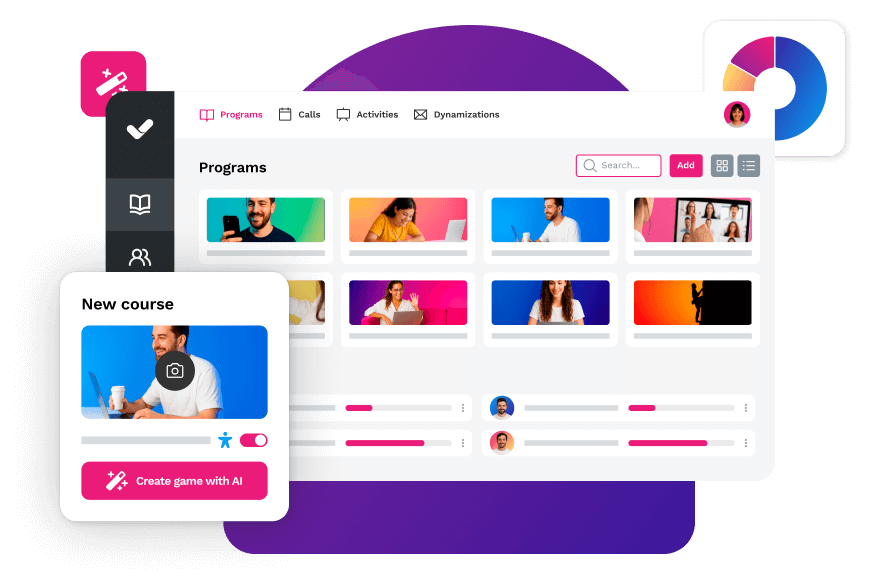
You don’t always need to hire external providers to create your courses. Modern authoring tools, especially those powered by AI, allow you to create professional content in a fraction of the time it would take using traditional methods.

Complement your custom content with courses created by experts. Soft skills course catalogs cover the most in-demand competencies and can save you months of development time.

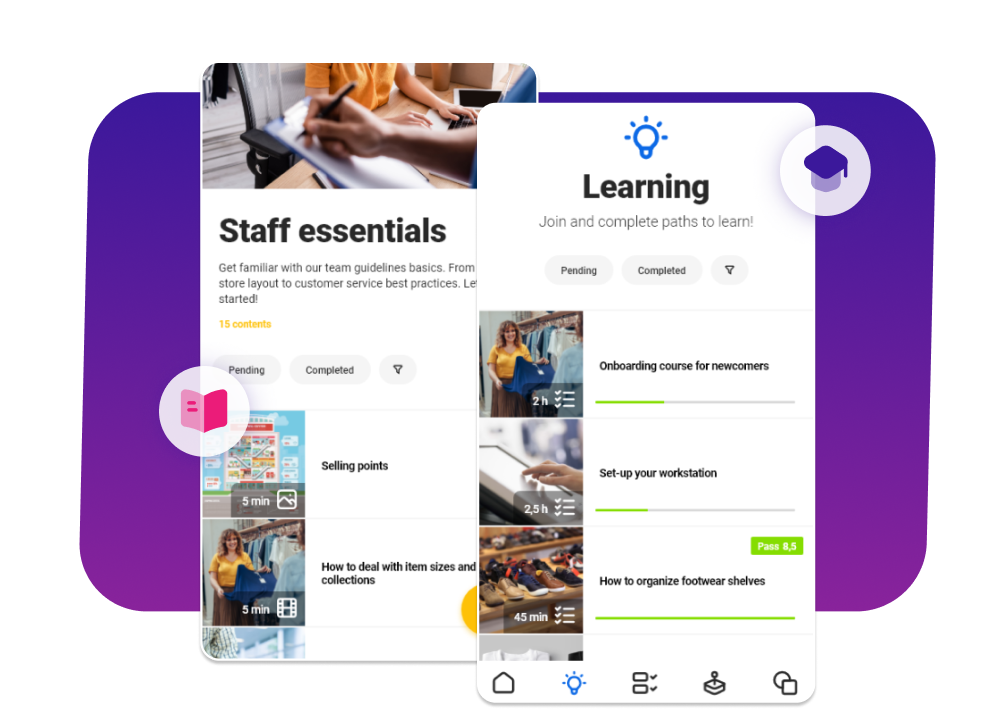
For deskless or frontline employees, you can rely on training apps that cover both learning, task management, and communication. And if these apps also support formats like gamification, the results are even better.

Implementing technology is only the first step. Real success comes from applying the right strategies.
Break content into 5–10 minute learning bites. They’re easier to consume, improve retention, and fit perfectly into your employees’ busy schedules.
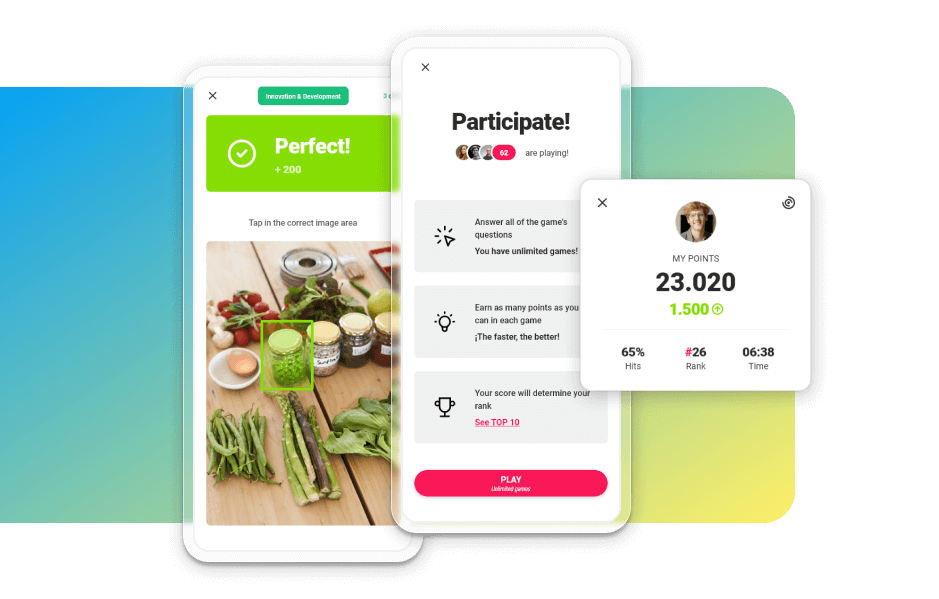
Add game elements such as points, levels, leaderboards, and challenges. Not only does this make training more engaging, but it also significantly increases completion rates.
Create spaces where your employees can share knowledge, ask questions, and learn from one another. Peer-to-peer learning is one of the most effective methods.

Combine videos, infographics, simulations, and hands-on exercises. Variety helps maintain attention and adapts to different learning styles.

Don’t wait until the end of the course to assess learning. Include quizzes and practical exercises throughout the content, with instant feedback to reinforce learning.

Let’s take a look at how different organizations are leveraging virtual learning to address their specific challenges.
Companies with high turnover or rapid growth use virtual learning to onboard new employees in a consistent and scalable way, reducing time to productivity from weeks to days. Companies like ING have already digitized their onboarding processes through an app, which has also become a key platform for multiple HR and internal communication processes.
Highly regulated sectors such as banking, insurance, or pharmaceuticals use virtual learning to ensure that all employees complete mandatory training, with full traceability for audits. But it’s not just these industries—companies like C&A in the retail sector have also managed to ensure compliance with their administrative processes for store employees and administrative staff, thanks to the virtual training solutions offered by isEazy.
Organizations that need to adapt their workforce’s skills to new technologies or business models rely on virtual learning to reskill professionals without interrupting daily operations. The success story of Grupo AKRON is one of the best examples. To maintain its leadership in the sector, the company needed to transform its corporate training processes into an online model that would guarantee the upskilling and reskilling of more than 700 employees across its different locations. Discover how they achieved this with isEazy.
Companies with store, warehouse, or field staff use mobile apps to deliver training directly to where their teams are, exactly when they need it. This is the case of Shiseido, a company that wanted to invest in training that could support its professionals in their day-to-day work, improving the customer experience. However, due to its extensive and diverse network of collaborators, it needed a digital solution that would facilitate access to training and keep the entire team connected. Learn more in the success story.
CASE STUDY
We boosted Shiseido’s training engagement with a social, gamified learning app.


Companies with extensive catalogs or frequent product launches train their sales teams in record time, ensuring everyone has up-to-date product knowledge. One example is the Clarel success story, where the company needed to turn its entire sales team into product experts—especially when it came to new launches from its private label.
CASE STUDY
We helped Clarel transform its knowledge into interactive and effective microcontents

Investing in training is strategic, but you need to prove its impact. These are the key KPIs you should track.
Compare the costs of your virtual learning program (platform, content, time invested) with tangible benefits: savings from in-person training, productivity gains, and reduced turnover.
Virtual learning continues to evolve. These are the trends shaping the path forward:

Ready to take the next step? Here’s a practical roadmap to implement virtual learning in your organization.
Before choosing tools, define what you want to achieve. Reduce onboarding time? Improve specific skills? Ensure regulatory compliance? Your goals will shape your strategy.
Look for solutions that help you achieve results, boost productivity, and are intuitive to use. You can choose from the wide range of training tools available on the market, such as authoring tools, learning management systems, microlearning apps, and even course catalogs.
Even the best training program will fail if no one knows about it. Build anticipation, clearly communicate the benefits, and make access easy.
Your leaders and training managers need to understand the tools and methodologies in order to properly support their teams.
Start with a small group, collect feedback, optimize, and then scale. Small adjustments early on can make a big difference.
Virtual learning provides real-time data. Use it to identify what’s working and what isn’t, and continuously refine your strategy.
Organizations that lead their industries have already understood that virtual learning is not an alternative to traditional training—it is its natural evolution. It offers greater flexibility, scalability, personalization, and measurability than any other method.
The question is not whether you should implement virtual learning in your company, but when you will start. Every day you wait is a missed opportunity to make your team more skilled, more agile, and better prepared for market challenges.
Need help taking the leap? At isEazy, we provide everything you need:

All designed to make implementing virtual learning as easy as it is effective. It’s time to transform the way your company learns. Request a demo.
Virtual learning goes beyond simply offering digital content. It is a structured training model with clear objectives, a defined methodology, progress tracking, and in many cases, support from tutors or facilitators. Unlike traditional online training, it is not limited to content consumption, but aims to create continuous and measurable learning.
Any company, regardless of size or industry, can benefit from virtual learning. It is especially useful for organizations with distributed teams, high turnover, ongoing training needs, compliance requirements, or frequent onboarding processes, as well as for companies with frontline staff or employees without a fixed workplace.
Yes, as long as the program is well designed. The use of microlearning, gamification, interactive content, social learning, and continuous feedback helps maintain engagement. In addition, when training is aligned with the job role and provides real value, motivation increases naturally.
Typically, companies use an LMS platform to manage users, content, and metrics, authoring tools to create custom courses, ready-to-use content catalogs, and in many cases, mobile apps to enable access to training from anywhere. The key is to choose intuitive and scalable tools.
Success is measured by combining participation metrics (completion rates, time spent), learning indicators (results, skills acquisition), and business impact, such as reduced onboarding time, improved performance, or fewer errors. These insights make it possible to calculate ROI and continuously optimize the strategy.

GUIDE
Prepare your organization to comply with the new AI Regulations
Download guide


Discover the e-learning tools that will take your learning strategy to the next level
Amazing, intuitive, and easy-to-use software for everyone


Discover the e-learning tools that will take your learning strategy to the next level
Amazing, intuitive, and easy-to-use software for everyone