WEBINAR ONDEMAND
How to create e-learning courses adapted to different types of learning with AI

Brain
The first AI trained to teach

Author
The #1 AI-powered authoring tool on the market

Factory
Custom e-learning content factory

Skills
Comprehensive power skills course catalog

LMS
All-in-one LMS platform with AI

Engage
App for managing frontline teams
FEATURES

AINew
Unlock your full potential and speed up course creation with artificial intelligence.

Accessibility
Automatically meet accessibility guidelines—without sacrificing interactivity!

Interactivity
Boost engagement with interactive, ready-to-use activities that make learning fun.

Course Creation
Reduce the time it takes to create your e-learning courses with our authoring tool.

Distribution
We offer you different distribution options, so that nothing can stop you.

SCORM
Publish your course in SCORM format and share it on any LMS.
SERVICES

Instrucional Design
Surprise your students with multimedia and interactive content.

Custom Courses
We create e-learning courses for you—tailored to your needs and hassle-free!

Virtual Reality
Turn learning into an immersive experience.

Custom Avatars
Give your courses and videos a unique touch with personalized avatars.

Audiovisual FactoryNew
Turn training into something dynamic and visual with engaging videos.
CATALOG

Course catalog
Over 600 skills and competency courses to help you adapt to your team's needs.
Microsoft Copilot AcademyNew
Your professionals will learn how to apply Copilot AI to key processes within your organization.

Artificial Intelligence Academy
Train your teams in the practical use of AI to boost productivity and innovation in your company.

Cybersecurity Academy
Capacita a tu empresa con el catálogo más completo en seguridad digital corporativa.

Use cases
Choose the solution that best fits your needs

Industries
Solutions for all types of industries
USE CASES

Onboarding
Facilitate the onboarding process, productivity and engagement of your new employees.

Upskilling
Boost your team's skills and prepare them for the challenges of the future with upskilling.

Microlearning
Discover all the advantages of microlearning and boost your training results.

Gamification
Enjoy addictive training that will get your professionals hooked.

Internal Communication
Improve communication in your company and enjoy an aligned and committed team.

Mobile learning
Agile, flexible, and interactive learning—built for today’s digital-first workforce.
INDUSTRIES

Banking and financial services
Training in compliance, cybersecurity, customer service, and key skills development.

Pharmaceuticals and healthcare
Digital onboarding, regulatory updates, and ongoing training for healthcare staff.

Retail and consumer
Agile and scalable training for in-store, operational, and customer service teams.

Industry and manufacturing
Training in processes, safety, and corporate culture for distributed teams.

Education and training
Digital solutions for training centers, internal academies, and corporate universities.

Technology and telecommunications
Development of technical talent, digital skills, and upskilling and reskilling programs.
CLIENTS

MAPFRE
How MAPFRE turn e-learning into sales with isEazy

Pepco
A personalised learning experience for a growing team.

BBVA
Digitisation and creation of high quality e-learning content.

Shiseido
We increase the engagement of the training with a social and gamified app.

Telefónica
Large-scale reskilling for the company's digital transformation.

Vodafone
A personalised learning experience for a growing team.
More than 1,000 companies already rely on isEazy.


MEET ISEAZY

Events
Discover our upcoming events and connect with the future of e-learning.

News
Find out the latest news about isEazy: press releases, partnerships, updates...

Contact
Leave us your personal details and we will contact you as soon as possible.
About isEazyNew
Find out more about our company.

Careers
We are looking for the best talent, join our team!

Partners
Become our partner and grow your business.
INTERESTING RESOURCES

Blog
The best content on e-learning: trends, tools and key strategies.

Whitepapers
Gain valuable insights and stay ahead of industry trends.

Product releases
The latest news and releases of our e-learning products and solutions.

Glossary
Definitions of the most commonly used terms and key industry concepts.

Guides
Discover the best step-by-step tips and tricks to optimize your L&D strategy.

Webinars
Video sessions on our products, trends and more

Comparatives
Compare e-learning solutions available on the market and choose the most suitable one.


WEBINAR
Master AI in isEazy Author in under an hour.


AUTHORING TOOL
Create courses automatically and generate interactive activities, games, translations, and multimedia resources in seconds.

Stay up to date with all our latest news
 Subscribe to our newsletter
Stay up to date with all our latest news

October 16, 2026

CONTENT CREATED BY:

Table of contents
Multimodal learning is a training approach that combines multiple channels and formats —visual, auditory, textual, interactive and experiential— to improve comprehension and knowledge retention. Unlike traditional training, which usually leans on a single dominant format, it integrates different cognitive inputs intentionally and in a structured way. The key word is intentional: it doesn’t mean “using lots of formats”, it means orchestrating them with instructional coherence.
Its foundation is Richard Mayer’s dual-processing theory: people process information through two main channels, the visual and the auditory, and when both are combined correctly, cognitive load drops and consolidation in memory improves. The word correctly deserves emphasis, because combining the channels badly is not neutral: it makes learning worse, and further down you’ll see the effect size.
In a corporate context where teams are hybrid, diverse and short on attention, designing effective training stops being a question of format and becomes a question of instructional architecture. In this guide you’ll find:
Before going any further, it’s worth clearing up something that shows up in almost every article on this topic and that the research does not support. The idea that each person has a learning style —visual, auditory, kinesthetic— and that teaching them in “their” style improves their results is known as the meshing hypothesis, and it is the part that doesn’t hold up.
The important distinction is this: preferences do exist —some people find a video more comfortable and others prefer to read— but preference does not predict which method produces better learning. And there’s an added risk these papers point out: labeling someone a “visual learner” boxes them in and diverts resources away from practices that are actually supported.
So why does multimodal learning work? For a different and better-founded reason: not because of the differences between people, but because of how working memory functions in all of them. Mayer’s two channels and Sweller’s cognitive load theory explain that splitting information between the visual and the auditory avoids saturating a single pathway. In other words, multimodal learning doesn’t adapt content to each individual: it takes advantage of a cognitive architecture we all share. This difference is not an academic nuance, because it completely changes how you design: it’s not about offering the same lesson in four versions for four types of learner, it’s about choosing, for each piece of content, the combination of channels that explains it best.
The VARK model, developed by Neil Fleming, sorts learning preferences into four categories:
Seen through the evidence from the previous section, VARK still has one concrete use and one equally concrete limitation. What it contributes is a useful reminder for whoever is designing: if all your training is text, there are ways of explaining the same thing that you aren’t using. In corporate environments, where technical, operational and strategic profiles sit side by side, that diversification raises the odds of comprehension across the board.
What you shouldn’t do with it is use it to label people or to build learning paths around each employee’s “style”. There is no evidence that this improves results, and it does consume budget. Put briefly: VARK works as an inventory of formats for the designer, not as a diagnosis of the learner.
If effectiveness depends on how the formats are combined and not on how many there are, the practical question is how to combine them. That’s where Mayer’s research on multimedia learning does give concrete, tested answers, and some of them are counterintuitive. These are the principles with the biggest consequences for corporate training.
| Principle | What the research says | What it means when designing |
|---|---|---|
| Multimedia | People learn better from words and pictures than from words alone | The image has to explain the concept. A decorative illustration adds nothing: it competes for attention |
| Modality | Graphics with narration work better than graphics with on-screen text | If there is something to look at, voice the explanation instead of writing it on top |
| Redundancy | Adding on screen the same text the voice is narrating makes learning worse: it held in all 16 tests collected in the Cambridge Handbook, with a median effect size of 0.86 | Don't burn the voice-over into the video as text. Subtitles yes, but switchable by whoever needs them |
| Coherence | Removing what doesn’t add value —background music, decoration, side facts— improves results | Every element you add has to justify its attention cost. When in doubt, cut it |
| Segmenting | Breaking content into user-paced units improves comprehension compared with a continuous format | It's the real foundation of microlearning: it's not that it's short, it's that the learner sets the pace |
While the blended or hybrid model combines in-person and online environments, the multimodal model explores different formats and channels for presenting content, offering the learner different ways of taking the knowledge in. They are two different, compatible axes: a program can be blended and not multimodal, or multimodal and entirely online.
| Blended learning | Multimodal learning |
|---|---|
| Combines in-person and online | Combines multiple formats and channels |
| Focuses on the place: in-person + digital | Focuses on the experience: video, text, podcast, simulations, games |
| Can stick to a fixed scheme | Flexible and adaptable to the learning objective |
In short, blended learning answers where learning happens and multimodal learning answers how it is structured cognitively.
The multimodal approach rests on three pillars:
A number of corporate learning reports published by Deloitte, among them Learning for a Skills-Based Future, agree that organizations moving toward more active, personalized, skills-centered learning models get better results in adaptability, performance and alignment with the business. Instead of focusing solely on delivering content, these strategies prioritize hands-on experience, contextual application and continuous skills development. Multimodal learning makes exactly that experiential approach possible by integrating formats that encourage active participation.
WEBINAR ONDEMAND
How to create e-learning courses adapted to different types of learning with AI


The variety of formats and interactive experiences breaks the monotony of traditional training. Giving employees some latitude over how they consume the content —watching a video, listening to a podcast or interacting with a game— makes learning more appealing and translates into greater commitment. The nuance matters: choice improves motivation, not instructional effectiveness in itself, which depends on the design.
Well-orchestrated combined use of channels increases retention because the content is reinforced in several ways and retrieved more often, which makes it easier to internalize and apply on the job.
By including diverse, accessible formats —videos with subtitles, audio transcripts, images with alt text and navigable interactive elements— multimodal learning lets every employee, whatever their abilities or specific needs, learn with equity and autonomy.

Multimodal learning makes content accessible smoothly on any device —phone, tablet or computer— and at whatever moments fit best into the daily routine. That flexibility is key in a fast-moving corporate context, especially among remote and frontline workers.
Why do it? Because multimodal learning is not a goal, it’s a means. If it doesn’t start from a specific gap —operational errors, low conversion, slow onboarding, formal compliance with no real application— it becomes a pile of formats with no impact.
Before designing anything, answer this: what behavior or outcome do I need to change? The starting point is always a measurable need.
The criterion for choosing a format is the type of skill and the level of interaction it demands, never the learner’s supposed style. This matrix resolves most cases:
| Objective | Recommended modality | Level of interaction |
|---|---|---|
| Technical procedure | Interactive simulation | High |
| Awareness | Video + infographic | Medium |
| Compliance training | Microlearning + quiz | Medium |
| Soft skills | Role play + feedback | High |
Why do it? Because understanding is not the same as knowing how to apply. If the training includes no practice, the impact on performance will be minimal. A simple structure that works:
If employees only consume content and never act on it, transfer to the job will be limited.
If part of your team can’t access the content properly, the training loses impact and creates legal risk. To guarantee accessibility, it’s important to:
That way you make sure the vast majority of your workforce can complete the training without friction and without compromising compliance.
Plenty of training programs get completed but don’t change results. If you don’t define from the outset which KPI should improve, you won’t be able to prove return. The usual objectives are:
Multimodal learning isn’t implemented “because it sounds good”. It makes sense when there is a clear reality: what we teach doesn’t always translate into what happens on the job. If your training is already producing results and being applied day to day, you probably don’t need to change anything. But if you spot a distance between what is learned and what is actually done, that’s where the multimodal approach makes the difference: it stops being one more methodology and becomes a tool for closing that gap.
Avoid limiting yourself to the completion rate: it tells you someone reached the end, not that they learned. These are the metrics that do tell you something, with a rough threshold to start reading them against.
| Metric | What it reveals | Warning sign |
|---|---|---|
| Completion rate | Whether the program gets finished, not whether it works. It's the floor, not the goal | <60% → review length, format or perceived relevance |
| Time to competence | How long it takes someone to do the task without help. The most honest indicator | No change versus the previous method → the format change contributed nothing |
| Average attempts per assessment | Whether the content genuinely prepares people for what is assessed | >2 attempts on average → mismatch between what is taught and what is asked |
| Interactions per resource | Which resources get used and which get opened and abandoned | Resources with almost no interaction → they are redundant or badly placed in the path |
| Engagement by format | Which modality retains each group best. The metric that belongs to the multimodal approach | A format consistently below the rest → review its design before producing more |
| Transfer to the job (30-60 day survey) | What has actually been applied once the immediate effect wears off | <30% report applying something → the problem is in the design, not the learner |
| Reduction in operational errors | The business impact, which is what defends the budget | No movement after two cycles → the training wasn’t aimed at the right behavior |
A multimodal strategy requires the platform to support heterogeneous formats and to be able to measure behavior by resource, not just by course. These are the requirements and what each one solves.
| Requirement | Why it is needed | How isEazy LMS solves it |
|---|---|---|
| SCORM and xAPI integration | SCORM measures what happens inside the course; xAPI, the learning that happens outside it | It supports both standards, so you can start with SCORM and add xAPI when the learning path moves beyond the course |
| Handling multiple formats | So that video, podcast, simulation and assessment coexist in the same path without workarounds | Combines video, podcast, SCORM, simulations and assessments in the same path |
| Building personalized paths | Adapting the journey to the starting level, not to the learner's supposed style | Lets you configure adaptive paths by group and level |
| Analytics by resource type | Without this you can’t know which format works, which is the central decision of the approach | Monitors engagement by resource type and lets you analyze the data in real time |
| WCAG compliance | An accessibility requirement, not an optional improvement: without it part of the workforce is left out | Supports subtitles, transcripts, alt text and accessible navigation |
Implementation takes planning and the use of various tools and resources. These are some effective strategies:
Use videos, podcasts, infographics, animations and text to present the content. The format is chosen according to what has to be taught and the level of practice it demands, not according to a supposed learner style: a procedure is learned by performing it and a concept is learned by seeing it explained.
Build in quizzes, discussion forums, simulators and educational games. Their value isn’t that they “liven things up”, it’s that they force people to retrieve what they learned, which is what consolidates memory.
Provide regular, personalized feedback so learners can track their progress and identify areas for improvement. Feedback that only says “incorrect” produces no learning: it has to point out what went wrong and what to do next.
Use platforms such as isEazy LMS to manage multimodal content efficiently, integrating different formats into a single learning experience.
Behavioral skills are more effective when they are developed in real, varied contexts. Through interactive content, videos with experts and self-assessment exercises, the multimodal model helps professionals internalize behaviors and apply them day to day.
AKRON Group is an example of how far that effect goes. With more than 700 employees spread across Mexico, Central America, South America and the United States, it supported its skills development with a catalog of over 600 courses and with the creation of its own content. The result: 50% less production time, 35% higher completion in its internal courses thanks to interactive elements, games and tests, and a training offering multiplied by four. See the case study →
The first days at a new company are decisive. Welcome videos, interactive infographics, podcasts and gamification elements create an engaging experience that speeds up onboarding and strengthens the bond with the organizational culture. With frontline workforces, the channel matters as much as the format: if the content doesn’t work on mobile, it doesn’t exist.
Clarel took it to scale: more than 1,000 points of sale and over 3,000 employees aligned on culture and operations almost in real time, with 84% participation in training and a 90% increase in product accuracy rates. See the case study →
CASE STUDY
How Clarel trained professionals at +1,000 points of sale with mobile learning


Putting an effective multimodal model into practice demands a platform that supports heterogeneous formats and measures what happens with each one. With isEazy LMS you can:
All of it on a platform designed to work on any device. Discover how to transform your training strategy.
Multimodal learning isn’t simply an appealing methodology, it’s an instructional architecture that demands design, measurement and continuous improvement. And the two ideas holding it up are worth keeping in mind: it works because of how any brain processes information, not because of each employee’s individual style, and its effectiveness depends on how the formats are combined, to the point that combining them badly makes the result worse.
If you’re weighing up whether to implement it, ask yourself these three questions:
Without those three variables defined, multimodal learning becomes a pile of formats with no real impact. With a platform like isEazy LMS you can structure multimodal paths, integrate SCORM or xAPI, measure behavior by resource and decide with data. The difference between training that gets consumed and training that transforms lies in how you design the experience and how you measure its impact.
Yes, but not for the reason usually given. It doesn’t work because each employee has a “preferred channel” —that hypothesis has no empirical support— but because working memory processes information through two pathways, the visual and the auditory, and splitting the load between them reduces saturation. That is Sweller’s and Mayer’s contribution, and it is what holds the approach up. That said, the effect depends entirely on how the formats are combined: an image that explains the concept helps, a decorative one detracts, and putting on screen the same text the voice is narrating makes the result worse. In business terms, the impact shows up where there is distance between what is taught and what happens on the job: operational errors, slow onboarding, or compliance training that gets completed but never applied.
The criterion is the type of content and the objective, not the learner’s profile. For a technical procedure, where a sequence has to be executed, interactive simulation is what transfers best. For awareness, where understanding and remembering a message is enough, a video with visual support does more than a long course. For compliance, microlearning with short checks, because the goal is retention over time. And for soft skills, role play with feedback, because behavior is only trained by practicing it. A practical rule: if the skill involves doing something, the format has to include doing it; if it only involves knowing something, explaining it well and checking it is enough.
No. You can perfectly well start with SCORM, which is what most organizations already have, and with the LMS’s native analytics. The difference is what you can measure. SCORM records what happens inside a course package: completion, score, time. xAPI records learning activities that happen outside it —watching a video, consulting a document, completing an external simulation, learning in the flow of work— and lets you reconstruct the full journey. So if your multimodal strategy lives inside courses, SCORM is enough; if it spreads learning across standalone resources and you want to know which format works best, xAPI stops being optional. It’s a measurement decision, not a content one.
The completion rate won’t do: it says someone reached the end, not that they learned. There are four signals that do work. The first, engagement by format: if you segment consumption by resource type you find out which one people abandon and which one they come back to. The second, time to competence, meaning how long it takes someone to do the task without help. The third, transfer to the job, measured with a short survey at 30 or 60 days asking what they have actually applied. And the fourth, the associated business indicator: operational errors, process times or conversion rate. If the program improves the first three but doesn’t move the fourth, the problem isn’t the formats, it’s that the training wasn’t aimed at the right behavior.
At the start, yes, and it’s worth saying so plainly: producing a simulation costs more than writing a document. But there are three qualifications that change the arithmetic. The first is that not everything has to be multimodal: the decision matrix exists precisely so you invest the effort where it pays off and not across the whole catalog. The second is that several formats derive from the same source material —one recorded session yields video, podcast, transcript and comprehension questions— and the marginal cost of the second format is far lower than that of the first. And the third is the cost of not doing it: training that gets completed but never applied has already been paid for and has produced nothing. The useful question isn’t how much it costs to produce, but how much the error it’s meant to prevent costs.
With four measures that cover most cases: subtitles and transcripts on all audio and video, alt text on images that carry information, full keyboard navigation, and correct contrast and heading structure. The reference standard is WCAG, and in the European context it’s best treated as a requirement rather than an optional improvement. One point usually raises doubts: Mayer’s redundancy principle says that putting on screen the same text the voice narrates harms learning, while accessibility demands subtitles. It isn’t a real contradiction. The solution is for subtitles to be switchable by the user, not text burned into the video: whoever needs them has them, and whoever doesn’t isn’t stuck with the cognitive cost of reading and hearing the same thing at once.

Automate processes, access 600+ ready-to-use courses, or create your own content with the help of AI.
Request a demoContact us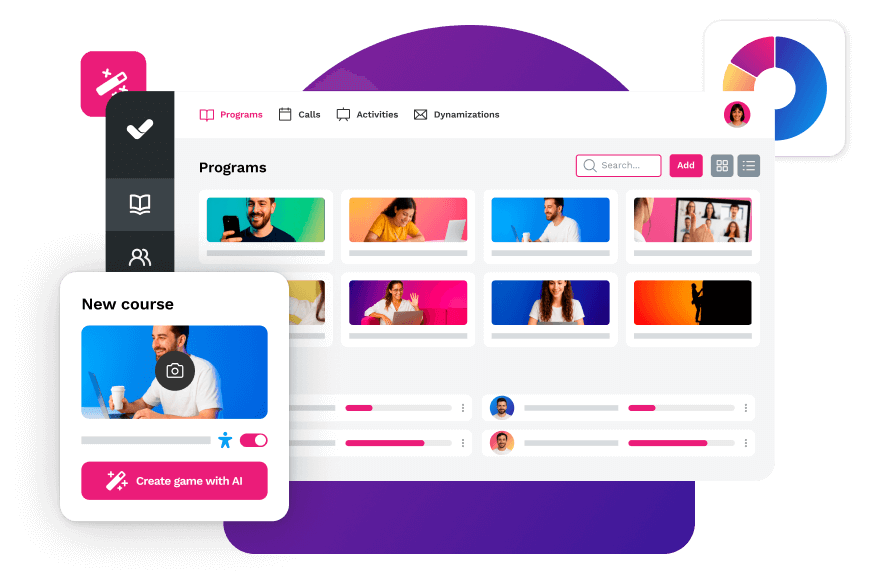


Streamline your training management
Experience the power of AI in an LMS that has it all


Streamline your training management
Experience the power of AI in an LMS that has it all