CASE STUDY
How Petit Palace managed to enhance the talent of its team through mentoring.

Brain
The first AI trained to teach

Author
The #1 AI-powered authoring tool on the market

Factory
Custom e-learning content factory

Skills
Comprehensive power skills course catalog

LMS
All-in-one LMS platform with AI

Engage
App for managing frontline teams
FEATURES

AINew
Unlock your full potential and speed up course creation with artificial intelligence.

Accessibility
Automatically meet accessibility guidelines—without sacrificing interactivity!

Interactivity
Boost engagement with interactive, ready-to-use activities that make learning fun.

Course Creation
Reduce the time it takes to create your e-learning courses with our authoring tool.

Distribution
We offer you different distribution options, so that nothing can stop you.

SCORM
Publish your course in SCORM format and share it on any LMS.
SERVICES

Instrucional Design
Surprise your students with multimedia and interactive content.

Custom Courses
We create e-learning courses for you—tailored to your needs and hassle-free!

Virtual Reality
Turn learning into an immersive experience.

Custom Avatars
Give your courses and videos a unique touch with personalized avatars.

Audiovisual FactoryNew
Turn training into something dynamic and visual with engaging videos.
CATALOG

Course catalog
Over 600 skills and competency courses to help you adapt to your team's needs.
Microsoft Copilot AcademyNew
Your professionals will learn how to apply Copilot AI to key processes within your organization.

Artificial Intelligence Academy
Train your teams in the practical use of AI to boost productivity and innovation in your company.

Cybersecurity Academy
Capacita a tu empresa con el catálogo más completo en seguridad digital corporativa.

Use cases
Choose the solution that best fits your needs

Industries
Solutions for all types of industries
USE CASES

Onboarding
Facilitate the onboarding process, productivity and engagement of your new employees.

Upskilling
Boost your team's skills and prepare them for the challenges of the future with upskilling.

Microlearning
Discover all the advantages of microlearning and boost your training results.

Gamification
Enjoy addictive training that will get your professionals hooked.

Internal Communication
Improve communication in your company and enjoy an aligned and committed team.

Mobile learning
Agile, flexible, and interactive learning—built for today’s digital-first workforce.
INDUSTRIES

Banking and financial services
Training in compliance, cybersecurity, customer service, and key skills development.

Pharmaceuticals and healthcare
Digital onboarding, regulatory updates, and ongoing training for healthcare staff.

Retail and consumer
Agile and scalable training for in-store, operational, and customer service teams.

Industry and manufacturing
Training in processes, safety, and corporate culture for distributed teams.

Education and training
Digital solutions for training centers, internal academies, and corporate universities.

Technology and telecommunications
Development of technical talent, digital skills, and upskilling and reskilling programs.
CLIENTS

MAPFRE
How MAPFRE turn e-learning into sales with isEazy

Pepco
A personalised learning experience for a growing team.

BBVA
Digitisation and creation of high quality e-learning content.

Shiseido
We increase the engagement of the training with a social and gamified app.

Telefónica
Large-scale reskilling for the company's digital transformation.

Vodafone
A personalised learning experience for a growing team.
More than 1,000 companies already rely on isEazy.


MEET ISEAZY

Events
Discover our upcoming events and connect with the future of e-learning.

News
Find out the latest news about isEazy: press releases, partnerships, updates...

Contact
Leave us your personal details and we will contact you as soon as possible.
About isEazyNew
Find out more about our company.

Careers
We are looking for the best talent, join our team!

Partners
Become our partner and grow your business.
INTERESTING RESOURCES

Blog
The best content on e-learning: trends, tools and key strategies.

Whitepapers
Gain valuable insights and stay ahead of industry trends.

Product releases
The latest news and releases of our e-learning products and solutions.

Glossary
Definitions of the most commonly used terms and key industry concepts.

Guides
Discover the best step-by-step tips and tricks to optimize your L&D strategy.

Webinars
Video sessions on our products, trends and more

Comparatives
Compare e-learning solutions available on the market and choose the most suitable one.



November 6, 2026

CONTENT CREATED BY:

Table of contents
Education 3.0 emerged in response to digital transformation and the shift in how people access, share, and apply knowledge. While the term isn’t new, it’s still essential for understanding how learning models have evolved—and why personalization, collaboration, and technology are now core pillars of any training strategy.
In a context shaped by digitization, hybrid work, and the need for continuous learning, Education 3.0 becomes especially relevant in e-learning and corporate training environments, where the goal is no longer just to deliver information, but to build real, measurable skills.
Education 3.0 is a learning model that puts the learner at the center of the learning process and uses digital technology as the foundation for creating training experiences that are more personalized, collaborative, and practical.
Unlike traditional models—where learning was based on one-way knowledge transfer—Education 3.0 promotes an active, participatory approach in which learners interact with content, collaborate with others, and apply what they learn in real-world situations.
In this model, technology stops being an add-on and becomes part of the learning infrastructure, making it easier to access knowledge, adapt content, and connect people, contexts, and experiences.
The concept wasn’t born in the corporate world or in an ed-tech marketing campaign. It was coined by Derek Keats and J. Philipp Schmidt in an article published in the journal First Monday in March 2007, titled “The genesis and emergence of Education 3.0 in higher education and its potential for Africa”.
And their original definition is considerably more radical than the one that usually circulates. For Keats and Schmidt, Education 3.0 wasn’t about adding more technology to the classroom—it was about the collapse of almost every boundary imposed within education: between disciplines, between those who teach and those who learn, between the institution and the outside world, and between formal and informal learning. Technology was the enabler, not the goal.
That nuance is worth keeping in mind, because it explains why so many “3.0” projects stall halfway: they digitize the content while leaving intact the very boundaries the model set out to tear down.
To better understand what Education 3.0 means, it helps to place it within the broader evolution of learning models.
This is the traditional education model. The instructor is the primary source of knowledge and the learner plays a passive role. Content is closed, standardized, and not easily adaptable, and learning focuses on memorization.
This model worked in stable contexts where knowledge changed slowly and training was more occasional.
This model introduces learner participation and the early use of digital tools. More collaborative methods emerge, interaction is encouraged, and learners begin to take a more active role.
However, in many cases technology is mostly used to digitize content without truly changing the pedagogical approach: the same old syllabus, now as a PDF.
Education 3.0 goes a step further and responds to a changing, digital, connected world. Learning becomes:
Education 3.0 doesn’t eliminate earlier models, but it reframes the approach to meet today’s needs—especially in digital and professional environments. Side by side, the three models differ like this:
| Education 1.0 | Education 2.0 | Education 3.0 |
|---|---|---|
| Learner: passive recipient | Learner: participant | Learner: protagonist and creator |
| Instructor: source of knowledge | Instructor: facilitator of activity | Instructor: enabler and curator |
| Technology: occasional support | Technology: content channel | Technology: learning infrastructure |
| Content: closed and standardized | Content: digitized and interactive | Content: open, modular, and reusable |
| Where it happens: in the classroom | Where it happens: classroom and platform | Where it happens: anywhere, anytime |
| Assessment: final exam | Assessment: online tests | Assessment: continuous feedback and performance |
| Goal: memorize | Goal: understand | Goal: apply and transfer |
Yes—especially in corporate training and e-learning. In fact, many of today’s digital learning approaches are built directly on the principles of Education 3.0.
Organizations now need to train their teams in a continuous, flexible, and scalable way. Education 3.0 fits challenges such as:
In this context, Education 3.0 isn’t a theoretical concept—it’s a practical foundation for designing effective learning experiences.
It’s common to wonder about the difference between Education 3.0 and Education 4.0.
Education 3.0 establishes the pedagogical foundations: learner-centered learning, personalization, collaboration, and practical application.
Education 4.0, on the other hand, adds an extra layer of advanced technology—such as artificial intelligence, automation, and large-scale data analytics.
Rather than opposing models, they’re complementary approaches. Education 3.0 defines the “how” of learning, while Education 4.0 expands the “with what,” leveraging more sophisticated technologies. Put another way: applying artificial intelligence on top of a model that’s still 1.0 doesn’t produce Education 4.0—it produces an automated exam.
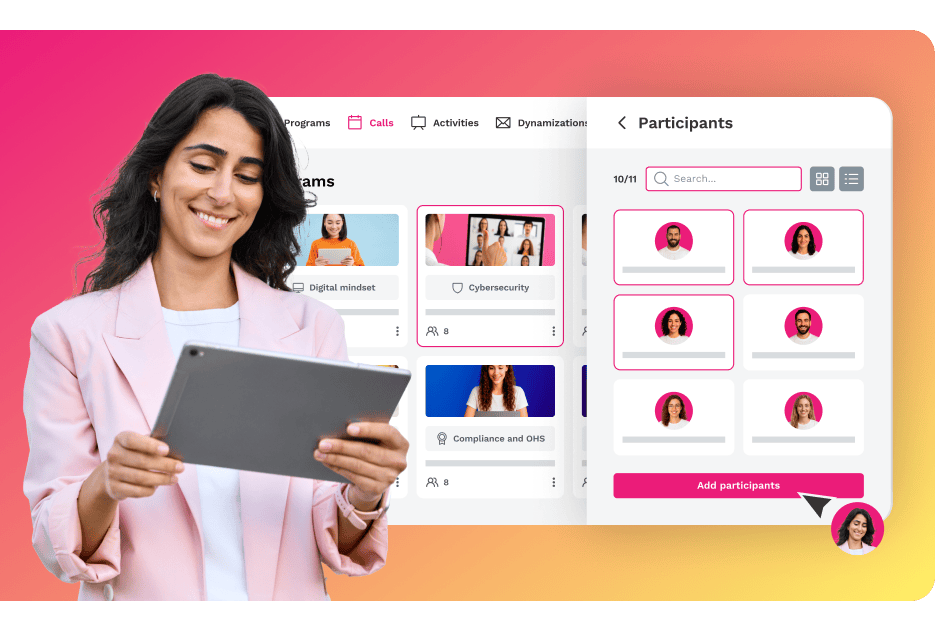
Education 3.0 recognizes that everyone learns at a different pace and in different ways. That’s why it focuses on adaptable content, flexible learning paths, and formats tailored to each learner’s context.
In digital environments, this personalized learning translates into learning paths, microcontent, and experiences adapted to specific roles, levels, and needs.
Learning stops being an individual process and becomes a shared experience. Education 3.0 encourages collaboration, knowledge sharing, and peer learning.
In corporate training, this takes shape through learning communities, collaborative projects, and spaces to share experiences and best practices. It’s in fact the trait that separates an LMS from an LXP in many comparisons.
Technology isn’t used just to digitize content, but to enhance the learning experience. Digital platforms, interactive content, and learning analytics make it possible to create more effective and measurable learning experiences.
The key isn’t the technology itself, but how it’s integrated into instructional design.
One of the core pillars of Education 3.0 is learning by doing. Learners apply concepts to real-world situations and receive continuous feedback.
This is especially relevant in corporate environments, where the ultimate goal is to improve on-the-job performance.
CASE STUDY
How Petit Palace managed to enhance the talent of its team through mentoring.


Implementing an Education 3.0 approach doesn’t mean changing everything overnight—it’s about progressively adapting methodologies and tools to today’s context.
Training programs should allow learners to explore, experiment, and apply what they’ve learned. Methodologies such as learning by doing or challenge-based learning fit especially well within this model.
Choose tools that truly add value to learning: authoring tools that let you create interactive content, measure outcomes, and adapt training to different profiles.
Technology should simplify the process, not complicate it.
Incorporate collaborative dynamics that facilitate knowledge sharing. Forums, chats, group activities, or shared projects strengthen social learning and the development of cross-functional skills.
Education 3.0 relies on approaches that promote participation, reflection, and practical application. Content should invite interaction—not just passive consumption. Simulation training is probably its most complete expression.
Beyond one-off courses, Education 3.0 fosters a learning culture in which training is part of everyday work. This means updating content, gathering feedback, and continuously improving learning experiences.

WEBINAR ONDEMAND
How to create e-learning courses adapted to different types of learning with AI


In the business world, Education 3.0 takes shape across multiple scenarios:
| Training scenario | How Education 3.0 is applied | Key benefit |
|---|---|---|
| Digital onboarding | Short, interactive modules tailored to the employee’s role | Faster onboarding and contextual learning |
| Compliance | Clear content, practical cases, and measurable assessments | Better understanding and regulatory compliance |
| Sales and customer service | Simulations and role plays with immediate feedback | Improved performance in real-life situations |
| Leadership development | Collaborative experiences and social learning | Development of cross-functional skills |
| Product training | Updatable microcontent accessible on demand | Continuous updates without rebuilding courses |
Almost all digital training presents itself today as personalized, collaborative, and performance-oriented. In practice, it’s often a 1.0 model served through a modern platform. These are the signs that give it away, and what to do about each one.
| Warning sign | What’s really going on | Where to start |
|---|---|---|
| Everyone takes the same full course | There’s no personalization: there’s a single mandatory path | Segment by role and let people skip what they already know |
| The platform’s forum is empty | Social learning is switched on, but no one is driving it | Assign owners and start with real questions from the job |
| The headline metric is the completion rate | You’re measuring consumption, not learning or performance | Add on-the-job application indicators at 30 and 90 days |
| Content is reviewed once a year | Content is a closed deliverable, not a living resource | Break it into reusable modules and update piece by piece |
| Training only happens in scheduled sessions | There’s no on-demand or point-of-need learning | Publish short, searchable resources available on mobile |
| The only feedback is the final test score | Assessment is summative, not formative | Add practice with immediate correction and a second attempt |
Education 3.0 has been on the table for almost two decades—long enough to know where it gets stuck. Knowing its limits is what keeps it from being rolled out as a label.
None of these limits invalidate the model. What they show is that Education 3.0 is above all a design and resourcing decision, not a software purchase.
Some formats that are especially well aligned with this model include:
These formats support personalization, active participation, and effective transfer to the job. And they fit an online onboarding just as well as a multi-year development plan.
E-learning is one of Education 3.0’s strongest allies. Through digital content, learning platforms, and authoring tools, it’s possible to create personalized, interactive, and scalable learning experiences.
In this context, having solutions that make it easy to create, update, and measure content allows organizations to apply the principles of Education 3.0 sustainably over time—and not just during the project’s first quarter.
Education 3.0 is the model Keats and Schmidt described in 2007 as the collapse of the boundaries within education: between disciplines, between those who teach and those who learn, between the formal and the informal. Almost twenty years on it still holds, because it describes precisely what an organization that trains continuously needs: personalized paths, peer learning, applied practice, and performance measurement. What has changed isn’t the model, but the fact that the tools to sustain it without it falling apart after six months finally exist.
And that’s where the real bottleneck is. Personalizing paths, facilitating communities, updating content piece by piece, and measuring what happens after the course is unworkable if each of those lives in a different tool. isEazy LMS brings learning paths, interactive content, social learning, and analytics together in one environment, so the model holds up day to day and not just in the project kickoff deck. Want to see it applied to your organization? Request a demo.
It’s a learner-centered educational model that uses technology to personalize learning, foster collaboration, and enable the practical application of knowledge.
Education 2.0 introduces interactivity. Education 3.0 adds personalization, social learning, and a clear performance-oriented focus.
Yes. Its principles are present in many modern e-learning and corporate training models.
Through personalized digital content, active learning methodologies, collaboration, and platforms that enable continuous measurement and improvement of training.
E-learning acts as an enabler, allowing learning to scale, be personalized, and be measured efficiently.
No. It has direct and highly relevant applications in corporate training and professional development.

Automate processes, access 600+ ready-to-use courses, or create your own content with the help of AI.
Request a demoContact us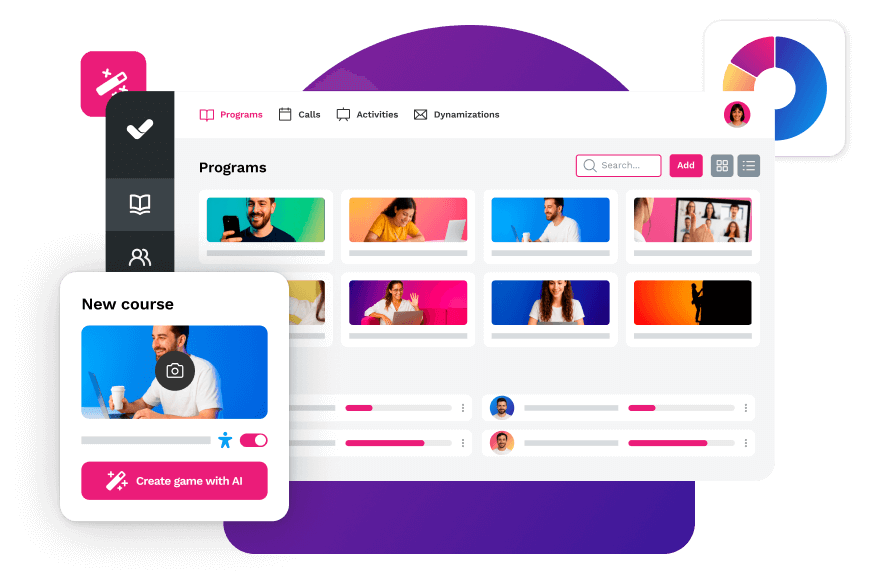

Streamline your training management
Experience the power of AI in an LMS that has it all