Video e-learning is one of the most impactful methodologies in corporate training today: video content generates a retention rate of 95%, compared to just 10% for written text. In this article, you’ll find out exactly what it is, the different types of training videos available, their benefits for organisations, and how to implement them successfully in your company.
Video e-learning is a training methodology that uses video as its primary teaching resource. It combines visual and auditory elements to aid comprehension and knowledge retention, allowing employees to learn at their own pace, from anywhere, at any time.
What is video e-learning: definition and origins
The use of video in learning is nothing new. What started with a television and a VHS player in the classroom has transformed today into a global phenomenon. Currently, 92% of internet users watch some form of online video every week, with tutorials, explainer videos and educational content among the most popular formats for Generation Z, according to Statista data.
In the context of corporate training, video e-learning is a methodology that uses video as its primary teaching tool. This approach combines visual and auditory stimuli to create a dynamic learning environment that facilitates understanding and information retention.
Unlike traditional training videos — recordings of in-person classes or corporate documentaries — video e-learning is designed specifically for digital learning: it is interactive, modular, accessible from any device, and measurable through an LMS or training platform.
Through videos, employees can access tutorials, practical demonstrations, simulations, micro-content or lectures, adapting the learning pace to their own needs.
Why video-based learning is effective: the science behind it
One of the key questions for L&D managers is how to capture employees’ attention in an environment saturated with stimuli. The answer lies in the data. YouTube is the second most visited website in the world, with over 2.5 billion active users. This is no coincidence: the human brain processes moving images 60,000 times faster than text.
Research suggests that video content has a retention rate of 95% compared to 10% for text-based content — a figure widely cited in the sector regarding the impact of video on learning, referenced by sources such as Wharton School and LinkedIn Learning. This difference is especially relevant in compliance training, operational processes or technical skills development, where precise retention makes a real difference.
Video e-learning also offers other cognitive advantages: it helps explain abstract concepts through visualisations, allows learners to pause and replay specific sections, and adapts to different learning styles — visual, auditory, and, in the case of interactive videos, kinaesthetic.
For Generation Z, video is not just a preferred format: it is the native channel for consuming information. Integrating video into training is not a design choice — it is a necessity for connecting with the youngest talent.
Benefits of video-based learning in corporate training
Video e-learning has not only transformed how companies train their teams — it offers a series of concrete advantages that justify its strategic adoption.
Reach and flexibility: Videos are accessible at any time and from any device. This flexibility is especially valuable for global companies and for non-desk workers — operators, sales teams, field staff — who don’t have constant access to a computer. Employees set their own pace, skipping ahead or replaying the sections they need to reinforce.
Training consistency: Video ensures that all employees, regardless of location or shift, receive exactly the same information. This consistency is critical for product training, compliance, or safety procedures.
Cost reduction: Although producing videos involves an initial cost, scalability quickly offsets it. A single video can train hundreds or thousands of employees at no additional cost, eliminating travel, room hire and in-person instructors.
Engagement and retention: The audiovisual format activates more areas of the brain than text or audio alone, resulting in greater attention and better knowledge retention. This is especially relevant for talent attraction and retention: companies that invest in quality training have higher employee retention rates.
Agile updates: A video can be updated or replaced without having to redesign an entire course. In sectors where procedures or regulations change frequently, this agility is a real competitive advantage.
Learning measurement: Integrated into an LMS, videos allow you to track views, viewing times, replays and results from associated assessments, providing accurate data on training effectiveness.
How to choose the right type of video for your training objective
Not all training videos are the same, nor do they serve the same purposes. Before producing any content, the first step is to define what you want employees to know or be able to do by the end of the video. The following table will help you make that decision with objective criteria:
Types of training videos: features and best practices
Now that you know which type of video best suits each objective, let’s look in detail at the characteristics of each format and how to get the most out of them in a corporate training context.
Talking-Head videos
This format features an expert speaking directly to camera about a topic. The focus is on the presenter, although many complement the recording with images, graphics or visual resources to support the content. TED talks, corporate conferences and webinars are common examples of this type. They are particularly effective for conveying leadership messages, company values or training that requires credibility and authority.
Screencasts
Unlike the previous format, the focus is on the instructor’s computer screen. They allow you to show in real time how to complete a process or perform a digital task — the effect is similar to looking over a colleague’s shoulder while they work. They are ideal for training on software tools, CRMs, ERPs or any process that takes place on a screen. They can be complemented with a partial webcam recording of the presenter, and it’s always advisable to include audio narration.
Animated videos
Animated videos are especially effective for illustrating abstract concepts or processes that are difficult to show in reality: workflows, financial concepts, supply chains, safety protocols. Through animations and avatars, it’s possible to take employees to any scenario and show them exactly what they need to do. They are also the preferred format for onboarding new employees, as they allow the company, its culture and processes to be presented in a visually engaging and memorable way. They connect particularly well with different learning styles, combining visual, narrative and kinaesthetic stimuli.
Micro-videos
Micro-videos are one of the most popular formats for training employees in high-turnover or mobile working environments. With a duration of between 1 and 3 minutes, they deliver valuable information in a concise, focused way. This format responds to a clear reality: sustained attention spans are increasingly short, and dividing a topic into small learning pills generates more effective learning with higher completion rates. They can be used in multi-module skills training, operational tutorials, procedure reminders or as reinforcement before assessments.
Interactive videos
Interactive videos are the most advanced format and the one with the greatest potential for corporate training. Unlike linear videos, these allow employees to make decisions during playback: explore alternative paths, answer questions, access additional information or assess their own performance in real time. They are especially powerful for role-plays, customer service simulations, high-stakes decision-making, or compliance training where active practice makes the real difference.
x
How to implement video e-learning in your company: a step-by-step guide
Incorporating video into your training strategy is not simply a matter of recording content and uploading it to a platform. For it to have a real impact on learning, you need to follow a structured process.
1. Define the learning objective
Before producing any video, determine what you want employees to know or be able to do by the end of it. A concrete, measurable objective is the foundation of any effective training video. Avoid generic informational videos: the more specific the objective, the more useful the video will be.
2. Choose the right format
Use the video type table in this article as a reference. The format must match the objective: if you need to teach a process in software, a screencast is your best option; if you want to assess decision-making, interactive video is irreplaceable.
3. Write a script before filming
The biggest mistake in training video production is improvising. A structured script saves editing time, improves message clarity and reduces retakes. The script should include: an opening hook (why this matters), development of the key content, and a close with a concrete action.
4. Keep videos short and focused
The optimal length for a training video is no more than 6–8 minutes. If the content requires more time, break it into independent modules. Micro-videos of 1–3 minutes have significantly higher completion rates than longer videos, according to industry data.
5. Integrate them into your LMS and measure the results
A training video without measurement is a shot in the dark. Integrate it into your training platform to track views, viewing time, drop-off points and results from associated assessments. This data will allow you to iterate and continuously improve your content library.
6. Update your library regularly
Video e-learning has one advantage over in-person training: it’s easy to update. Set a content review schedule — at least once a year for compliance training, and whenever a process or product changes — to ensure your training library is always up to date.
Best authoring tools for implementing video e-learning strategies in your company
isEazy Author
The Leading AI Authoring Tool on the Market
Features
Benefits
Pricing
Accessibility
Awards
AI features: generate images, games and exercises, automatic subtitles, voiceovers, advanced interactive elements, avatars, and AI video presenters to bring your content to life.
AI Autopilot: automatic course creation from documents or ideas, with pedagogical structure, interactive resources, and applied visual identity. Transform any content into a publish-ready course in minutes.
Templates: over 25 ready-to-use interactive templates, editable and customizable with corporate colors, typography, and logo via the Smart Colors feature.
Drag-and-drop editor: visual editing to create courses with no technical, programming, or design knowledge required.
Automatic responsive design: courses adapt to any device without manual adjustments, with dual mode so each learner can access content in their preferred format.
Multi-format: export in SCORM 1.2, SCORM 2004, xAPI, and HTML5, compatible with any LMS on the market.
Automatic translation: full AI-powered course translation into over 40 languages, with no need for external translators.
Text to speech: professional voiceovers automatically generated from content, with selection of gender, language, and voice variation.
PowerPoint import: convert presentations into interactive e-learning courses in just a couple of clicks.
Real-time collaboration: simultaneous collaborative work on the same course with integrated comments, change tracking, and automatic saving with restore points.
Brand customization: styles, colors, typography, and logo to maintain corporate consistency across all content.
Gamification: points, badges, and leaderboards to motivate learners and increase engagement.
Assessments and quizzes: multiple question types and answer logic, with AI-powered automatic generation of final assessment tests based on course content.
Multimedia library: built-in bank of images, videos, icons, and graphic resources, with AI image generation adapted to your course style.
Integrations: connection with LMS platforms (SCORM, xAPI), external platforms, and management systems. A built-in learning environment is also available without leaving isEazy Author.
AI-powered: automates key creation tasks and drastically reduces production time. Over 36,000 users and 120,000 projects created in more than 90 countries speak for themselves.
Intuitive and visual interface: everything is edited intuitively with no learning curve, with pre-configured ready-to-use resources.
Real collaborative experience: distributed teams can work in parallel with real-time feedback, ideal for content factories and L&D teams.
Total flexibility: ideal for both occasional creators and large-scale production teams. Compatible with any LMS and 100% cloud-based.
Visual and professional courses: no designers or developers needed, with quality results recognized by Training Industry and eLearning Industry 2026.
Cost savings: less need for external resources and greater efficiency in content creation. Calculate your savings with the AI Autopilot ROI calculator.
Constantly evolving: new features released regularly and agile multilingual support, with real accessibility up to WCAG level AA and 80% of level AAA.
FREE plan: free forever. Ideal for exploring the tool with no commitment.
Professional: from €80/month. 1 author and up to 5 GB of storage.
Business: from €208/month. 2 authors and up to 12 GB of storage. The most popular plan.
Enterprise: custom authors and storage. Contact us for pricing.
Real standards compliance: courses compatible with level AA (100%) and up to 80% of level AAA of the Web Content Accessibility Guidelines (WCAG), and with Section 508 of the U.S. Rehabilitation Act.
Dual mode: create a single SCORM course and your learners can access it in their preferred mode, with or without accessibility adaptations, without duplicating production work.
Accessible interactive elements: all interactive resources in isEazy Author are designed to provide the same learning experience to all learners, regardless of their needs.
Contextual editor guidance: tips and guides built into the editor so any author can create quality accessible content easily, with no prior technical knowledge required.
Without sacrificing design or interactivity: accessibility in isEazy Author does not mean compromising visual impact or content richness. Accessible, attractive, and effective courses all at once.
Training Industry 2026: Top 20 AI Content Creation.
eLearning Industry 2026: Best AI-Powered Authoring Tool and Learning & Skills Development.
Training Industry 2025: Top 20 AI Content Creation.
eLearning Industry 2025: Best e-Learning Authoring Tool.
Brandon Hall 2024: Excellence Awards.
eLearning Industry 2024: Best Game Design and AI Watchlist.
G2 2024: Momentum Leader, High Performer, and High Performer Mid-Market.
Crozdesk 2024: Quality Choice, Trusted Vendor, and Happiest Users.
Software Advice 2024: FrontRunners.
Software Suggest 2024: Category Leader.
Features
AI features: generate images, games and exercises, automatic subtitles, voiceovers, advanced interactive elements, avatars, and AI video presenters to bring your content to life.
AI Autopilot: automatic course creation from documents or ideas, with pedagogical structure, interactive resources, and applied visual identity. Transform any content into a publish-ready course in minutes.
Templates: over 25 ready-to-use interactive templates, editable and customizable with corporate colors, typography, and logo via the Smart Colors feature.
Drag-and-drop editor: visual editing to create courses with no technical, programming, or design knowledge required.
Automatic responsive design: courses adapt to any device without manual adjustments, with dual mode so each learner can access content in their preferred format.
Multi-format: export in SCORM 1.2, SCORM 2004, xAPI, and HTML5, compatible with any LMS on the market.
Automatic translation: full AI-powered course translation into over 40 languages, with no need for external translators.
Text to speech: professional voiceovers automatically generated from content, with selection of gender, language, and voice variation.
PowerPoint import: convert presentations into interactive e-learning courses in just a couple of clicks.
Real-time collaboration: simultaneous collaborative work on the same course with integrated comments, change tracking, and automatic saving with restore points.
Brand customization: styles, colors, typography, and logo to maintain corporate consistency across all content.
Gamification: points, badges, and leaderboards to motivate learners and increase engagement.
Assessments and quizzes: multiple question types and answer logic, with AI-powered automatic generation of final assessment tests based on course content.
Multimedia library: built-in bank of images, videos, icons, and graphic resources, with AI image generation adapted to your course style.
Integrations: connection with LMS platforms (SCORM, xAPI), external platforms, and management systems. A built-in learning environment is also available without leaving isEazy Author.
Benefits
AI-powered: automates key creation tasks and drastically reduces production time. Over 36,000 users and 120,000 projects created in more than 90 countries speak for themselves.
Intuitive and visual interface: everything is edited intuitively with no learning curve, with pre-configured ready-to-use resources.
Real collaborative experience: distributed teams can work in parallel with real-time feedback, ideal for content factories and L&D teams.
Total flexibility: ideal for both occasional creators and large-scale production teams. Compatible with any LMS and 100% cloud-based.
Visual and professional courses: no designers or developers needed, with quality results recognized by Training Industry and eLearning Industry 2026.
Cost savings: less need for external resources and greater efficiency in content creation. Calculate your savings with the AI Autopilot ROI calculator.
Constantly evolving: new features released regularly and agile multilingual support, with real accessibility up to WCAG level AA and 80% of level AAA.
Pricing
FREE plan: free forever. Ideal for exploring the tool with no commitment.
Professional: from €80/month. 1 author and up to 5 GB of storage.
Business: from €208/month. 2 authors and up to 12 GB of storage. The most popular plan.
Enterprise: custom authors and storage. Contact us for pricing.
Accessibility
Real standards compliance: courses compatible with level AA (100%) and up to 80% of level AAA of the Web Content Accessibility Guidelines (WCAG), and with Section 508 of the U.S. Rehabilitation Act.
Dual mode: create a single SCORM course and your learners can access it in their preferred mode, with or without accessibility adaptations, without duplicating production work.
Accessible interactive elements: all interactive resources in isEazy Author are designed to provide the same learning experience to all learners, regardless of their needs.
Contextual editor guidance: tips and guides built into the editor so any author can create quality accessible content easily, with no prior technical knowledge required.
Without sacrificing design or interactivity: accessibility in isEazy Author does not mean compromising visual impact or content richness. Accessible, attractive, and effective courses all at once.
Awards
Training Industry 2026: Top 20 AI Content Creation.
eLearning Industry 2026: Best AI-Powered Authoring Tool and Learning & Skills Development.
Training Industry 2025: Top 20 AI Content Creation.
eLearning Industry 2025: Best e-Learning Authoring Tool.
Brandon Hall 2024: Excellence Awards.
eLearning Industry 2024: Best Game Design and AI Watchlist.
G2 2024: Momentum Leader, High Performer, and High Performer Mid-Market.
Crozdesk 2024: Quality Choice, Trusted Vendor, and Happiest Users.
Software Advice 2024: FrontRunners.
Software Suggest 2024: Category Leader.
Articulate 360
Key Features
Benefits
Pricing
Storyline 360: authoring tool for creating custom courses with advanced interactions, complex branching logic, and tailored simulations.
Rise 360: web-based editor for creating responsive courses visually and quickly, with no software installation or prior technical knowledge required.
AI features: transform documents, videos, or presentations into interactive courses in minutes. Includes automatic translation into 80+ languages and AI-powered content generation.
Content Library: access to a library of templates, characters, backgrounds, and graphic resources ready to use in any course.
Review 360: collaborative platform for course review and feedback, with requests, reviews, and comment resolution all in one place throughout the creation process.
Screen recording and editing: tools to record videos and screencasts directly from the platform.
SCORM, AICC, xAPI, and cmi5 compatibility: export in standard formats for integration with any LMS, with web distribution also available without complex configurations.
Two authoring approaches: choose between a visual and fast environment (Rise 360) or a more technical and customizable one (Storyline 360) depending on project needs.
Creative potential: ideal for courses with advanced logic, complex interactions, and gamification, with full design freedom in Storyline 360.
Seamless collaboration: Review 360 makes it easy to share progress and gather team or stakeholder feedback in real time throughout the entire process.
Responsive courses: Rise 360 ensures a great experience on any device without manual adjustments.
Articulate 360 Standard: from $1,499 USD/year per user. Includes access to all tools in the package and continuous updates.
Articulate 360 AI: from $1,749 USD/year per user. Includes all Standard plan features plus advanced AI capabilities.
Free trial available. Team discounts available on request.
Key Features
Storyline 360: authoring tool for creating custom courses with advanced interactions, complex branching logic, and tailored simulations.
Rise 360: web-based editor for creating responsive courses visually and quickly, with no software installation or prior technical knowledge required.
AI features: transform documents, videos, or presentations into interactive courses in minutes. Includes automatic translation into 80+ languages and AI-powered content generation.
Content Library: access to a library of templates, characters, backgrounds, and graphic resources ready to use in any course.
Review 360: collaborative platform for course review and feedback, with requests, reviews, and comment resolution all in one place throughout the creation process.
Screen recording and editing: tools to record videos and screencasts directly from the platform.
SCORM, AICC, xAPI, and cmi5 compatibility: export in standard formats for integration with any LMS, with web distribution also available without complex configurations.
Benefits
Two authoring approaches: choose between a visual and fast environment (Rise 360) or a more technical and customizable one (Storyline 360) depending on project needs.
Creative potential: ideal for courses with advanced logic, complex interactions, and gamification, with full design freedom in Storyline 360.
Seamless collaboration: Review 360 makes it easy to share progress and gather team or stakeholder feedback in real time throughout the entire process.
Responsive courses: Rise 360 ensures a great experience on any device without manual adjustments.
Pricing
Articulate 360 Standard: from $1,499 USD/year per user. Includes access to all tools in the package and continuous updates.
Articulate 360 AI: from $1,749 USD/year per user. Includes all Standard plan features plus advanced AI capabilities.
Free trial available. Team discounts available on request.
iSpring Suite
Key Features
Benefits
Pricing
PowerPoint integration: convert existing presentations into interactive e-learning courses in just a few clicks, without leaving the familiar PowerPoint environment.
Screen recording and simulations: tools for recording screens with automatic click and keystroke detection, adding voiceovers, and creating interactive simulations and role-plays.
Quizzes and assessments: tests with multiple question types, branching logic, and answer flows to assess learner knowledge.
Video lessons: create presentations synchronized with a presenter video for a more engaging and personal learning experience.
SCORM, xAPI, and cmi5 compatibility: export courses in standard formats for integration with any LMS on the market.
Content library: over 2,500 locations, 3,600+ icons, templates, characters, backgrounds, and reusable graphic resources to enrich course design.
AI features: text generation, automatic translation into 70+ languages, text-to-speech with natural ElevenLabs voices, and AI image generation.
Low learning curve: ideal for users already familiar with PowerPoint. No technical knowledge or prior training required.
Fast course production: transform existing presentations into interactive training content quickly, with video publishing up to 1.5x faster.
LMS compatibility: ensures progress and results tracking across multiple platforms via clean, standards-compliant SCORM packages compatible with any LMS.
All tools in one suite: quizzes, video, simulations, screen recordings, AI features, and a content library all in a single environment.
iSpring Suite: from $970 USD/year per author. Includes PowerPoint authoring tool, quizzes, video lessons, simulations, and technical support.
iSpring Suite AI: from $1,290 USD/year per author. Includes all iSpring Suite features plus AI capabilities, iSpring Cloud AI, advanced content library, and updates included.
14-day free trial available. Discounts for freelancers and academics available on request.
Key Features
PowerPoint integration: convert existing presentations into interactive e-learning courses in just a few clicks, without leaving the familiar PowerPoint environment.
Screen recording and simulations: tools for recording screens with automatic click and keystroke detection, adding voiceovers, and creating interactive simulations and role-plays.
Quizzes and assessments: tests with multiple question types, branching logic, and answer flows to assess learner knowledge.
Video lessons: create presentations synchronized with a presenter video for a more engaging and personal learning experience.
SCORM, xAPI, and cmi5 compatibility: export courses in standard formats for integration with any LMS on the market.
Content library: over 2,500 locations, 3,600+ icons, templates, characters, backgrounds, and reusable graphic resources to enrich course design.
AI features: text generation, automatic translation into 70+ languages, text-to-speech with natural ElevenLabs voices, and AI image generation.
Benefits
Low learning curve: ideal for users already familiar with PowerPoint. No technical knowledge or prior training required.
Fast course production: transform existing presentations into interactive training content quickly, with video publishing up to 1.5x faster.
LMS compatibility: ensures progress and results tracking across multiple platforms via clean, standards-compliant SCORM packages compatible with any LMS.
All tools in one suite: quizzes, video, simulations, screen recordings, AI features, and a content library all in a single environment.
Pricing
iSpring Suite: from $970 USD/year per author. Includes PowerPoint authoring tool, quizzes, video lessons, simulations, and technical support.
iSpring Suite AI: from $1,290 USD/year per author. Includes all iSpring Suite features plus AI capabilities, iSpring Cloud AI, advanced content library, and updates included.
14-day free trial available. Discounts for freelancers and academics available on request.
Easygenerator
Key Features
Benefits
Pricing
Easygenerator's features
Cloud-based authoring: create courses from the browser with no local installation, accessible from any device with continuous automatic updates.
Ready-to-use templates: enables non-technical users to produce content quickly, with drag-and-drop elements for fast and intuitive course creation.
SCORM and xAPI publishing: export courses to an LMS or publish directly via a web link, with dynamic SCORM that allows content updates without re-uploading the package to the LMS.
Feedback and assessments: tools to add quizzes, surveys, and AI-powered automatic question generation based on course content.
Real-time collaboration: multiple users can edit and review content simultaneously, with integrated review and approval workflows.
Automatic translation and multilingual management: built-in translation into 75+ languages via EasyTranslate for fast localization without external tools.
EasyAI: convert documents (PDF, PowerPoint, Word) into structured courses in minutes, improve text, generate questions, and create AI-powered images tailored to course content.
Why choose Easygenerator
Easy to use: enables any employee to create courses with no prior e-learning or technical experience. A pioneer in introducing AI features across all plans at no extra cost.
Ideal for collaborative environments: fosters content creation across departments through the Employee-Generated Learning (EGL) model, trusted by 2,000+ companies including Electrolux, DHL, and Danone.
Development speed: focused on speed and simplicity, with Doc-to-course to reuse existing materials and convert them into structured training in minutes.
Flexible publishing: courses hosted in an LMS or accessible via web link, with unlimited learners on all plans.
Easygenerator Pricing
Pro: from €116/month (billed annually). 1 author, unlimited learners.
Team: from €582/month (billed annually). 5 authors, unlimited learners.
Enterprise: pricing on request. Unlimited authors and advanced management and security features.
14-day free trial available. Discounts for educational institutions and non-profit organizations available on request.
Key Features
Easygenerator's features
Cloud-based authoring: create courses from the browser with no local installation, accessible from any device with continuous automatic updates.
Ready-to-use templates: enables non-technical users to produce content quickly, with drag-and-drop elements for fast and intuitive course creation.
SCORM and xAPI publishing: export courses to an LMS or publish directly via a web link, with dynamic SCORM that allows content updates without re-uploading the package to the LMS.
Feedback and assessments: tools to add quizzes, surveys, and AI-powered automatic question generation based on course content.
Real-time collaboration: multiple users can edit and review content simultaneously, with integrated review and approval workflows.
Automatic translation and multilingual management: built-in translation into 75+ languages via EasyTranslate for fast localization without external tools.
EasyAI: convert documents (PDF, PowerPoint, Word) into structured courses in minutes, improve text, generate questions, and create AI-powered images tailored to course content.
Benefits
Why choose Easygenerator
Easy to use: enables any employee to create courses with no prior e-learning or technical experience. A pioneer in introducing AI features across all plans at no extra cost.
Ideal for collaborative environments: fosters content creation across departments through the Employee-Generated Learning (EGL) model, trusted by 2,000+ companies including Electrolux, DHL, and Danone.
Development speed: focused on speed and simplicity, with Doc-to-course to reuse existing materials and convert them into structured training in minutes.
Flexible publishing: courses hosted in an LMS or accessible via web link, with unlimited learners on all plans.
Pricing
Easygenerator Pricing
Pro: from €116/month (billed annually). 1 author, unlimited learners.
Team: from €582/month (billed annually). 5 authors, unlimited learners.
Enterprise: pricing on request. Unlimited authors and advanced management and security features.
14-day free trial available. Discounts for educational institutions and non-profit organizations available on request.
Video e-learning has moved beyond being a trend to become a standard of quality corporate training. Its ability to improve knowledge retention, adapt to any employee profile and scale at no additional cost makes it one of the most cost-effective resources an L&D team can adopt.
Although interactive videos are an extraordinarily powerful training resource, editing them and integrating them into your courses can considerably complicate your content creation processes. With isEazy Author you can create interactive videos in just a few steps, taking your training to a whole new dimension:
Carry out interactive role-plays.
Create simulations to assess your learners.
Unlock new possibilities in your onboarding courses.
Make the most of your content through storytelling.
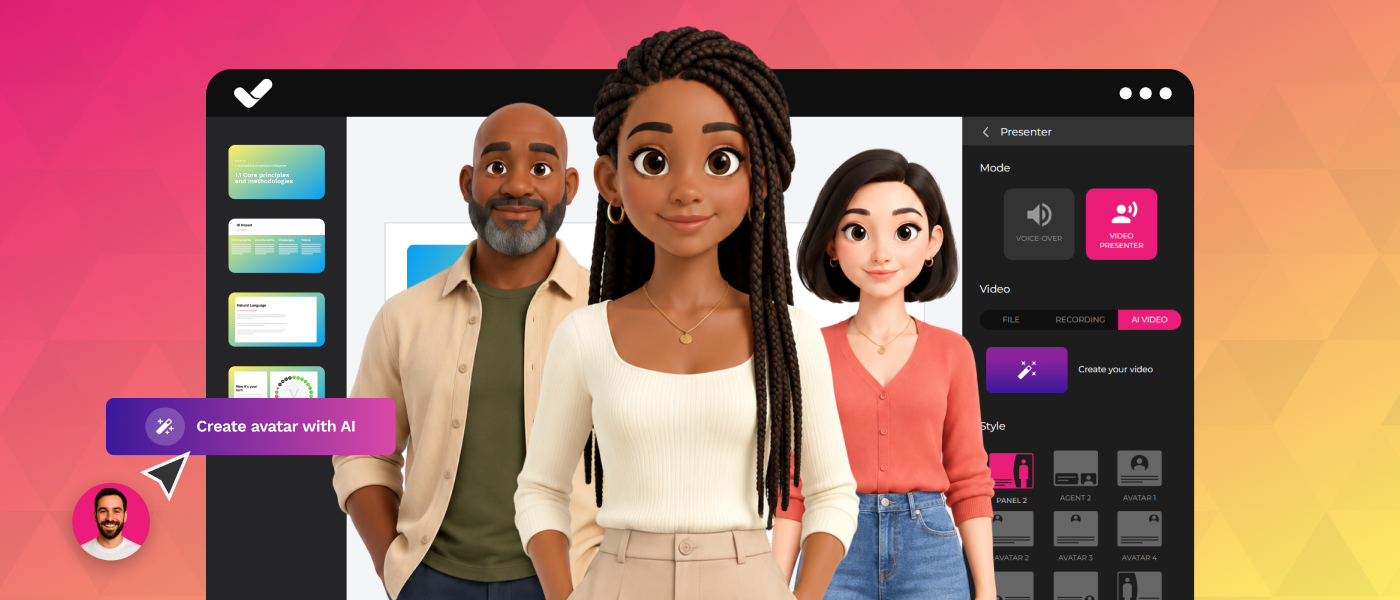
Create videos with an AI-generated avatar.
The options offered by interactive video allow you to add emotion to your courses and the human factor that contributes so much to learning. With the active participation of your audience, learning becomes an immersive and memorable experience. If you want to start making the most of video in your training, discover everything isEazy Author can do for you.
Vodafone is a clear example of how investing in advanced content creation tools transforms training productivity. With isEazy Author, Vodafone tripled its productivity in e-learning content creation, significantly reducing production times and improving the quality of their training materials. Find out how they did it →
CASE STUDY
We multiplied x3 the productivity in the creation of e-learning courses at Vodafone
How does video e-learning boost engagement and improve knowledge retention among learners?
Video e-learning combines visual and auditory elements that capture learners’ attention, resulting in a more engaging and effective learning experience. This improves knowledge retention, as learners remember visual content much better than plain text.
Why are corporate e-learning videos the ideal format for learning?
Engaging your audience through online training requires more than quality content — it’s about presenting it in a way that attracts and connects with people. This is where video outperforms virtually any other format. Videos allow you to deliver more information in a more condensed way, improving concept retention. You can explain complex topics more simply, directly and visually. They also add real dynamism and boost engagement.
How is the effectiveness and impact of video-based learning initiatives measured?
Effectiveness is measured through data analysis such as viewing time, participation in interactive activities and quiz results. Learner feedback can also be collected to adjust and improve the content.
What tools and resources are available to create high-quality video learning content?
There are various tools for creating high-quality content, such as isEazy Author, which lets you integrate different types of multimedia and interactive resources, including videos and interactive videos. You can also outsource the creation of training content with isEazy Factory — you just need to provide your knowledge and they’ll take care of the rest.
Are there best practices for designing and delivering engaging video-based learning experiences?
Yes, it’s critical to create detailed scripts, include interactive elements, and customize content to make it relevant and engaging for learners.
What considerations should be taken into account for accessibility and inclusion in video learning?
It’s important to add subtitles, offer translations, and ensure that videos can be accessed on different devices and platforms. Accessibility guidelines for people with visual and hearing impairments should also be followed. Fortunately, you don’t need to be an expert to achieve this — the interactive resources in isEazy Author automatically adapt to their accessible version, offering an interactive learning experience adjusted to everyone’s needs.
Here you can assess and customize the services that we'd like to use on this website. You're in charge! Enable or disable services as you see fit. To learn more, please read our .
We have to include them in order for certain web pages to function securely. These cookies are strictly necessary, so they cannot be rejected or modified.
Cookie
Duration
Description
_ga
2 years
The _ga cookie, installed by Google Analytics, calculates visitor, session and campaign data and also keeps track of site usage for the site's analytics report. The cookie stores information anonymously and assigns a randomly generated number to recognize unique visitors.
_ga_YW3LY84JY6
2 years
This cookie is installed by Google Analytics.
_gat_gtag_UA_90425332_3
1 minute
Set by Google to distinguish users.
_gat_UA-26043609-7
1 minute
A variation of the _gat cookie set by Google Analytics and Google Tag Manager to allow website owners to track visitor behaviour and measure site performance. The pattern element in the name contains the unique identity number of the account or website it relates to.
_gat_UA-90425332-3
1 minute
A variation of the _gat cookie set by Google Analytics and Google Tag Manager to allow website owners to track visitor behaviour and measure site performance. The pattern element in the name contains the unique identity number of the account or website it relates to.
_gcl_au
3 months
Provided by Google Tag Manager to experiment advertisement efficiency of websites using their services.
_gid
1 day
Installed by Google Analytics, _gid cookie stores information on how visitors use a website, while also creating an analytics report of the website's performance. Some of the data that are collected include the number of visitors, their source, and the pages they visit anonymously.
_icl_visitor_lang_js
1 day
This cookie is stored by WPML WordPress plugin. The purpose of the cookie is to store the redirected language.
Bootstrap
11 months
Bootstrap code
cookielawinfo-checkbox-advertisement
1 year
Set by the GDPR Cookie Consent plugin, this cookie is used to record the user consent for the cookies in the "Advertisement" category .
cookielawinfo-checkbox-analytics
11 months
This cookie is set by GDPR Cookie Consent plugin. The cookie is used to store the user consent for the cookies in the category "Analytics".
cookielawinfo-checkbox-functional
11 months
The cookie is set by GDPR cookie consent to record the user consent for the cookies in the category "Functional".
cookielawinfo-checkbox-nece
1 year
Cookie law info
cookielawinfo-checkbox-necessary
11 months
This cookie is set by GDPR Cookie Consent plugin. The cookies is used to store the user consent for the cookies in the category "Necessary".
cookielawinfo-checkbox-others
11 months
This cookie is set by GDPR Cookie Consent plugin. The cookie is used to store the user consent for the cookies in the category "Other.
cookielawinfo-checkbox-performance
11 months
This cookie is set by GDPR Cookie Consent plugin. The cookie is used to store the user consent for the cookies in the category "Performance".
CookieLawInfoConsent
1 year
Records the default button state of the corresponding category & the status of CCPA. It works only in coordination with the primary cookie.
Google Font API
11 months
Google Font API
IDE
1 year 24 days
Google DoubleClick IDE cookies are used to store information about how the user uses the website to present them with relevant ads and according to the user profile.
Pardot
11 months
The pardot cookie is set while the visitor is logged in as a Pardot user. The cookie indicates an active session and is not used for tracking.
test_cookie
15 minutes
The test_cookie is set by doubleclick.net and is used to determine if the user's browser supports cookies.
viewed_cookie_policy
11 months
The cookie is set by the GDPR Cookie Consent plugin and is used to store whether or not user has consented to the use of cookies. It does not store any personal data.
wp-wpml_current_language
session
Language cookies
wpml_browser_redirect_test
session
This cookie is set by WPML WordPress plugin and is used to test if cookies are enabled on the browser.
They collect information in order to measure, evaluate performance, and improve the quality of your experience on our site.
Cookie
Duration
Description
_ga
2 years
The _ga cookie, installed by Google Analytics, calculates visitor, session and campaign data and also keeps track of site usage for the site's analytics report. The cookie stores information anonymously and assigns a randomly generated number to recognize unique visitors.
_ga_YW3LY84JY6
2 years
This cookie is installed by Google Analytics.
_gat_gtag_UA_90425332_3
1 minute
Set by Google to distinguish users.
_gat_UA-26043609-7
1 minute
A variation of the _gat cookie set by Google Analytics and Google Tag Manager to allow website owners to track visitor behaviour and measure site performance. The pattern element in the name contains the unique identity number of the account or website it relates to.
_gat_UA-90425332-3
1 minute
A variation of the _gat cookie set by Google Analytics and Google Tag Manager to allow website owners to track visitor behaviour and measure site performance. The pattern element in the name contains the unique identity number of the account or website it relates to.
_gcl_au
3 months
Provided by Google Tag Manager to experiment advertisement efficiency of websites using their services.
_gid
1 day
Installed by Google Analytics, _gid cookie stores information on how visitors use a website, while also creating an analytics report of the website's performance. Some of the data that are collected include the number of visitors, their source, and the pages they visit anonymously.
_icl_visitor_lang_js
1 day
This cookie is stored by WPML WordPress plugin. The purpose of the cookie is to store the redirected language.
wpml_browser_redirect_test
session
This cookie is set by WPML WordPress plugin and is used to test if cookies are enabled on the browser.
We use them to provide you with efficient and personalized advertisements that we believe are relevant to your interests. You may see them on other sites that you visit.
Cookie
Duration
Description
IDE
1 year 24 days
Google DoubleClick IDE cookies are used to store information about how the user uses the website to present them with relevant ads and according to the user profile.
test_cookie
15 minutes
The test_cookie is set by doubleclick.net and is used to determine if the user's browser supports cookies.