Descubre cuánto puedes ahorrar al crear cursos frente a otras herramientas

Brain
The first AI trained to teach

Author
The #1 AI-powered authoring tool on the market

Factory
Custom e-learning content factory

Skills
Comprehensive power skills course catalog

LMS
All-in-one LMS platform with AI

Engage
App for managing frontline teams
Discover isEazy Brain


Product
What is Brain?
Everything you need to know about the first AI trained to teach.
Learning agent: CompanionNew
Supports learners and answers their questions right inside the course, without breaking the audit trail.
How does it work?
Adaptive, conversational, and contextual. That’s learning with Brain.
Discover isEazy Author


 See all features
FEATURES
AINew
Unlock your full potential and speed up course creation with artificial intelligence.
Accessibility
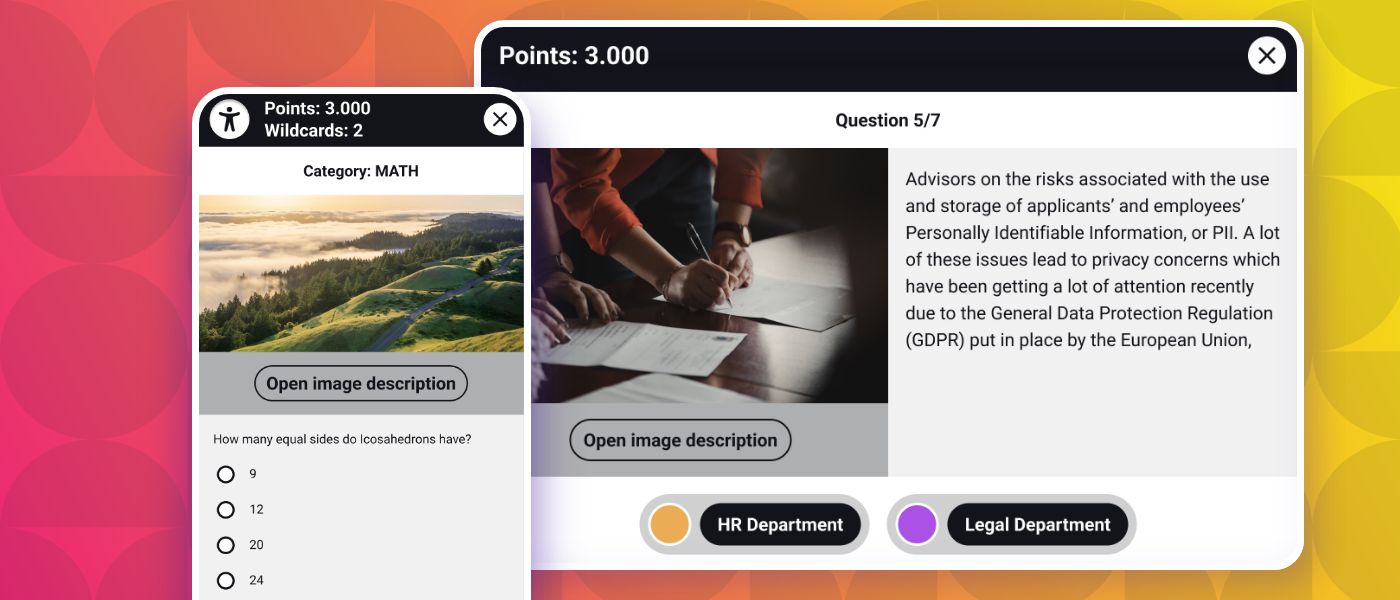
Automatically meet accessibility guidelines—without sacrificing interactivity!
Interactivity
Boost engagement with interactive, ready-to-use activities that make learning fun.
Course Creation
Reduce the time it takes to create your e-learning courses with our authoring tool.
Distribution
We offer you different distribution options, so that nothing can stop you.
SCORM
Publish your course in SCORM format and share it on any LMS.
Discover isEazy Factory


SERVICES
Instrucional Design
Surprise your students with multimedia and interactive content.
Custom Courses
We create e-learning courses for you—tailored to your needs and hassle-free!
Virtual Reality
Turn learning into an immersive experience.
Custom Avatars
Give your courses and videos a unique touch with personalized avatars.
Audiovisual FactoryNew
Turn training into something dynamic and visual with engaging videos.
Discover isEazy Skills


CATALOG
Course catalog
Over 600 skills and competency courses to help you adapt to your team's needs.
Microsoft Copilot AcademyNew
Your professionals will learn how to apply Copilot AI to key processes within your organization.
Artificial Intelligence Academy
Train your teams in the practical use of AI to boost productivity and innovation in your company.
Cybersecurity Academy
Capacita a tu empresa con el catálogo más completo en seguridad digital corporativa.

Use cases
Choose the solution that best fits your needs

Industries
Solutions for all types of industries
See all solutions


 See all solutions
USE CASES
Onboarding
Facilitate the onboarding process, productivity and engagement of your new employees.
Upskilling
Boost your team's skills and prepare them for the challenges of the future with upskilling.
Microlearning
Discover all the advantages of microlearning and boost your training results.
Gamification
Enjoy addictive training that will get your professionals hooked.
Internal Communication
Improve communication in your company and enjoy an aligned and committed team.
Mobile learning
Agile, flexible, and interactive learning—built for today’s digital-first workforce.
Discover our industries


 View all industries
INDUSTRIES
Banking and financial services
Training in compliance, cybersecurity, customer service, and key skills development.
Pharmaceuticals and healthcare
Digital onboarding, regulatory updates, and ongoing training for healthcare staff.
Retail and consumer
Agile and scalable training for in-store, operational, and customer service teams.
Industry and manufacturing
Training in processes, safety, and corporate culture for distributed teams.
Education and training
Digital solutions for training centers, internal academies, and corporate universities.
Technology and telecommunications
Development of technical talent, digital skills, and upskilling and reskilling programs.
CLIENTS

MAPFRE
How MAPFRE turn e-learning into sales with isEazy

Pepco
A personalised learning experience for a growing team.

BBVA
Digitisation and creation of high quality e-learning content.

Shiseido
We increase the engagement of the training with a social and gamified app.

Telefónica
Large-scale reskilling for the company's digital transformation.

Vodafone
A personalised learning experience for a growing team.
More than 1,000 companies already rely on isEazy.





MEET ISEAZY

Events
Discover our upcoming events and connect with the future of e-learning.

News
Find out the latest news about isEazy: press releases, partnerships, updates...

Contact
Leave us your personal details and we will contact you as soon as possible.
About isEazyNew
Find out more about our company.

Careers
We are looking for the best talent, join our team!

Partners
Become our partner and grow your business.
INTERESTING RESOURCES

Blog
The best content on e-learning: trends, tools and key strategies.

Whitepapers
Gain valuable insights and stay ahead of industry trends.

Product releases
The latest news and releases of our e-learning products and solutions.

Glossary
Definitions of the most commonly used terms and key industry concepts.

Guides
Discover the best step-by-step tips and tricks to optimize your L&D strategy.

Webinars
Video sessions on our products, trends and more

Comparatives
Compare e-learning solutions available on the market and choose the most suitable one.


WEBINAR
AI-powered course creation, step by step
Master AI in isEazy Author in under an hour.

05/11/2026

11:00 AM ET



GUIDE
Does your training plan comply with the EU AI Act?
Prepare your organization to comply with the new AI regulations


AUTHORING TOOL
Haven’t you tried AI-powered course creation yet?
Create courses automatically and generate interactive activities, games, translations, and multimedia resources in seconds.

Subscribe to our newsletter
Stay up to date with all our latest news
 Subscribe to our newsletter
 Stay up to date with all our latest news

June 19, 2026
Automating training content creation: The definitive manual for L&D teams

CONTENT CREATED BY:
Antonio González Pozo

Table of contents
What does automating training content creation mean?
Automating training content creation means using technology — especially artificial intelligence and authoring tools — to reduce the manual time and effort involved in the design, production, and distribution phases of e-learning courses. It does not mean eliminating the L&D team: it means that team dedicates its time to pedagogical and strategic decisions, not repetitive production tasks.
In a context where Human Resources and Training teams must produce more content in less time — and keep it updated across multiple languages and formats — automation has gone from being a competitive advantage to an operational necessity. According to LinkedIn Learning’s Workplace Learning Report 2024, 89% of L&D professionals believe the pace of skills change in their organizations is faster than ever, and the ability to update training content with agility is their main challenge.
Automating training content creation means relying on AI tools and authoring platforms to generate, structure, and produce e-learning courses with fewer manual resources — without sacrificing pedagogical quality or alignment with the organization's learning objectives.
The L&D content creation pipeline: where the bottleneck lies
Before automating anything, it helps to understand where time is lost in the current process. A typical production cycle for a corporate course goes through these stages:
- Needs analysis: meetings with department heads, competency gap review, learning objective definition.
- Instructional design: course structure, sequencing, activity types, evaluation criteria.
- Content production: text drafting, visual resource creation, video recording, interactive activity development.
- Review and validation: feedback cycles with subject matter experts and business stakeholders.
- Layout and publishing: assembly in the authoring tool, export to SCORM/xAPI, upload to the LMS.
- Updates and maintenance: periodic review to keep content current.
The bottleneck is not in the analysis or validation — which require human judgment — but in production and layout: the most mechanical and repetitive phases. According to the Association for Talent Development (ATD), creating one hour of interactive e-learning content requires between 49 and 125 hours of work, depending on the level of interactivity. This is precisely where automation has the greatest impact.



5 phases of the process you can automate today
Not every part of the creation process is automatable, nor should it be. But there are five specific phases where current technology — especially generative AI integrated into authoring tools — can drastically reduce production time:
1. Course structure and outline generation
AI can analyze a source document (PDF, text, presentation) or a learning objectives brief and automatically propose the course structure: modules, units, sequencing, and recommended activity types. What previously required hours of instructional design work can now be resolved in minutes as a starting point.
2. Text drafting and scripting
Based on the defined structure, current language models can generate explanatory texts, summaries, examples, and practical cases aligned with each unit’s objective. The L&D professional’s role shifts: from writer to editor, reviewing and adjusting output instead of writing from scratch.
3. Creating interactive activities and assessments
Automatic question generation — multiple choice, true/false, matching concepts, branching scenarios — from module content is one of the most mature AI applications in the sector. Tools like isEazy Autopilot can generate complete question banks in seconds.
4. Layout and visual formatting
Automating the format — applying consistent design templates, distributing content across screens or sections, applying corporate visual identity — removes the dependency on technical design profiles for each course. The L&D team can lay out content in the same tool where they design it.
5. Translation and localization
For organizations with teams across multiple countries, automatic translation with human review — instead of fully manual translation — can reduce localization timelines and costs by up to 70%, according to Common Sense Advisory data (2023).

| Process phase | Without automation | With isEazy Autopilot |
|---|---|---|
| Course structure | 2–4h instructional design | 15–30 min with AI + review |
| Content drafting | 1–3 days of writing | Hours with AI + human editing |
| Activities & assessments | 3–5h per module | Auto-generated in minutes |
| Layout & formatting | 1–2 days with a designer | Templates applied automatically |
| Translation (per language) | 1–2 weeks externally | Days with AI translation + review |
Tools for automating e-learning content creation: what to evaluate
The authoring tool market has integrated AI unevenly. Before choosing a solution, an L&D team should evaluate at least these five criteria:
- Native AI vs. external AI: tools with built-in AI (that don’t require copying and pasting between platforms) offer more agile and secure workflows from a data protection standpoint.
- Export formats: the tool must export to SCORM 1.2, SCORM 2004, and xAPI to ensure compatibility with any LMS on the market.
- LMS integration: direct publishing from the authoring tool to the LMS eliminates a critical manual step and reduces errors in the distribution process.
- Editorial quality control: the tool should allow review and approval cycles without leaving the environment, with clear version control.
- Multilingual capability: for global organizations, managing multiple language versions from the same base course is a key differentiator.
isEazy Author covers all these criteria in a single environment, with Autopilot as the integrated AI layer to accelerate every phase of the production pipeline.
x
How Vodafone tripled its productivity in course creation
Vodafone is a clear example of what automation can achieve in large-scale L&D teams. Before adopting isEazy Author, the training team needed lengthy processes dependent on external technical production to create e-learning courses that met the brand’s quality standards. With isEazy, the team went on to produce content three times faster, maintaining the company’s visual and pedagogical standards — without needing technical design profiles on every project.
Find out how they did it →
CASE STUDY
We multiplied x3 the productivity in the creation of e-learning courses at Vodafone


How to automate course creation with isEazy AI Autopilot
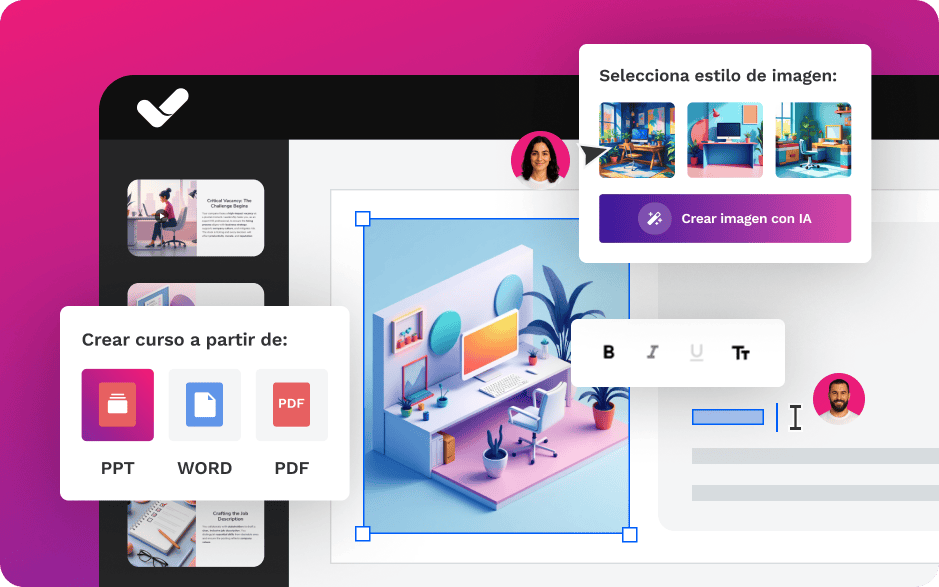
isEazy Author is an authoring tool that includes AI Autopilot, an artificial intelligence feature that automatically converts documents into interactive courses. The process is straightforward:
1. Upload your documentation to isEazy Author
Log in to isEazy Author and upload your document. The tool supports PDFs, PowerPoint files, and other common document formats used in corporate training. You don’t need to prepare or adapt the file beforehand.
2. The AI analyzes the content and generates the structure
AI Autopilot analyzes the document and automatically generates a pedagogically sound structure: it divides the content into thematic blocks, organizes the learning flow, and selects the most effective resource type for each section — games, comparisons, videos, role plays, assessments — without requiring you to make any technical decisions.
3. Review and adjust whatever you need
The generated course is fully editable. You can modify the order of blocks, adjust the tone, add images or additional resources, and customize the design with your corporate identity. Final control always remains with you.
4. Export to SCORM and upload to your LMS
Once the content has been validated, export the course in SCORM 1.2 or SCORM 2004 with a single click and upload it to your LMS. From that point, you have full tracking: time spent, completion rate, activity results, and data by user.
AI automation: what isEazy Autopilot can and cannot do
One of the most common mistakes when adopting AI tools for L&D is having misaligned expectations: assuming AI writes perfect, ready-to-publish courses, or conversely, distrusting it entirely and not using it at all. The reality is more nuanced.
What isEazy Autopilot does well:
- Generates a coherent course structure from a source document or objectives brief in seconds.
- Drafts explanatory texts in the desired tone (formal, conversational, technical) and in multiple languages simultaneously.
- Creates varied assessment questions — multiple choice, true/false, matching concepts — aligned with the content of each module.
- Generates basic images and visual resources to illustrate concepts without needing a designer.
- Proposes interactive activity variations to increase learner engagement.
Where human supervision remains essential:
- Verification of technical or regulatory data: AI can produce inaccuracies in specialized content (legal regulations, security procedures, financial data).
- Alignment with organizational culture and voice: generated texts may need tone adjustments or examples more specific to the company’s context.
- Design of practical competency assessments: rubrics for evaluating complex skills require expert human judgment.
- Validation by subject matter experts (SMEs): no course should be published without the relevant area owner having reviewed content accuracy.
The most effective model is not “AI instead of L&D”, but “L&D with AI”: the training professional defines the what and the why, and AI accelerates the how.

Common mistakes when automating training content production
Implementing automation in the L&D pipeline without a clear strategy creates its own problems. These are the most frequent mistakes and how to avoid them:
1. Publishing AI output without editorial review
AI generates plausible content, not necessarily accurate content. In sectors with demanding technical or regulatory requirements, an error in the training content can have serious consequences. Establishing a minimum review process — at least one read-through by the SME before publishing — is non-negotiable.
2. Automating without defining pedagogical criteria upfront
The AI tool needs clear instructions to generate useful content: well-defined learning objectives, audience level, desired activity types. Without that context, the output will be generic and unusable.
3. Ignoring brand and corporate identity control
Automatically generated courses tend to be visually neutral. If the organization has a strong visual identity or a distinctive communication tone, those parameters must be configured in the authoring tool from the outset — not at the end.
4. Automating everything at once
Teams that try to transform their entire production process simultaneously typically fail due to change overload. The most effective strategy is to start with one specific phase — usually layout or assessment generation — and scale progressively.
5. Not measuring the impact on time and quality
Without comparative metrics (production time before/after, editorial error rates, learner satisfaction), it is impossible to justify the investment or optimize the process. Define production KPIs from the very first automated project.
Where to start: a 4-week implementation plan
For L&D teams starting from a predominantly manual process, this four-week plan introduces automation in a controlled and measurable way:
Week 1: Diagnosis and tool selection
Map the current production process for a typical course: identify how many hours each phase takes, who is involved, and where the real bottlenecks are. With that map, evaluate 2–3 authoring tools with AI (free trial) and select the one that best fits the output formats required by the current LMS. Connect with isEazy for a personalized Author demo with Autopilot.
Week 2: Pilot project with a real course
Choose an existing course of medium complexity (15–30 minutes duration) and reproduce it using the new tool with AI. Measure actual production time and compare it with the previous process. Identify which phases were most accelerated and where bottlenecks persist.
Week 3: Review, adjustment, and validation
Submit the pilot course to the same SME review process that would be applied to a manually produced course. Document the adjustments required to the AI output: these adjustments become the “standard brief” for future automated projects (tone instructions, accuracy criteria, content restrictions).
Week 4: Define the standard process and scale
With the pilot’s learnings, document the new AI-powered production workflow: who does what, in what order, with which tool, and with which quality criteria. Publish the first automated course on the LMS and measure completion rate and learner satisfaction metrics to compare against manually produced courses.
Frequently asked questions about automating training content
How much time can an L&D team save by automating content creation?
The savings depend on the starting point, but industry data is consistent: according to LinkedIn Learning’s 2024 Workplace Learning Report, L&D teams that integrate AI into their production workflow reduce course creation time by 40% to 60%. In practical terms, a 30-minute course that previously required 3–4 weeks of production can be completed in 1–2 weeks when structuring, initial drafting, and layout are automated. The biggest savings come not from writing faster, but from eliminating the back-and-forth between instructional design and technical production: with tools like isEazy Author with Autopilot, the same professional who designs the course can produce it without relying on an external technical team.
Which automation tool is best for small L&D teams?
For small teams (1–5 people), the most important criterion is not the power of the AI but end-to-end integration: a tool that covers everything from creation to distribution avoids having to learn and maintain multiple platforms. isEazy Author is especially well-suited for this profile because it allows teams to create, edit, and publish courses in the same environment, with integrated AI to accelerate content structuring and drafting. Other options like Articulate Storyline or Adobe Captivate offer greater customization but require a steeper learning curve and do not include an LMS or distribution. For teams without technical resources, the most valuable automation is the one that reduces dependency on specialist profiles.
Can AI generate SCORM content ready to publish?
Yes, but with important nuances. Tools like isEazy Author with Autopilot can generate a course structure and content with AI and export it directly in SCORM 1.2, SCORM 2004, or xAPI, ready to upload to any LMS. However, automatically generated content needs editorial review before publishing: AI can make inaccuracies in technical or sector-specific data, and the tone may not align with the organization’s voice. The practical recommendation is to use AI to generate 70–80% of the content (structure, base texts, activity types) and reserve human time for accuracy review, example personalization, and assessment adjustment. With this model, the generated SCORM is of publishable quality within a few hours.
Which training content creation processes should NOT be automated?
There are four areas where automation should be minimal or closely supervised. First, learning needs analysis: identifying which competencies are lacking and why requires conversations with managers and performance data that no AI can collect on its own. Second, high-stakes assessment design: multiple-choice questions can be generated automatically, but the evaluation criteria for practical competencies must be defined by subject matter experts. Third, cultural personalization: when content is aimed at teams in different countries or cultures, examples and references need human review to avoid bias or contextual errors. Fourth, technical validation of specialized content: in sectors such as healthcare, finance, or legal, AI-generated texts must always pass through a subject matter expert before publishing.
Featured articles




WEBINAR
AI-powered course creation, step by step
Master AI in isEazy Author in under an hour.
Register Now


Looking for an easy, agile and efficient authoring tool?
Create accessible, engaging and dynamic e-learning courses with artificial intelligence in minutes.

Looking for an easy, agile and efficient authoring tool?
Create accessible, engaging and dynamic e-learning courses with artificial intelligence in minutes.
Related articles

Fernando González Zurita
May 28, 2026
Authoring tools: what they are, key features, and how to choose yours
Read more
Cristina Sánchez
October 5, 2023
How accessible is your authoring tool? Insist on only true accessibility!
Read more

Antonio González Pozo
June 8, 2026
Employee Training Activities: Types, Examples and How to Implement Them
Read more