WHITEPAPER
How to adapt your in-person training to an online format with microlearning

Brain
The first AI trained to teach

Author
The #1 AI-powered authoring tool on the market

Factory
Custom e-learning content factory

Skills
Comprehensive power skills course catalog

LMS
All-in-one LMS platform with AI

Engage
App for managing frontline teams
FEATURES

AINew
Unlock your full potential and speed up course creation with artificial intelligence.

Accessibility
Automatically meet accessibility guidelines—without sacrificing interactivity!

Interactivity
Boost engagement with interactive, ready-to-use activities that make learning fun.

Course Creation
Reduce the time it takes to create your e-learning courses with our authoring tool.

Distribution
We offer you different distribution options, so that nothing can stop you.

SCORM
Publish your course in SCORM format and share it on any LMS.
SERVICES

Instrucional Design
Surprise your students with multimedia and interactive content.

Custom Courses
We create e-learning courses for you—tailored to your needs and hassle-free!

Virtual Reality
Turn learning into an immersive experience.

Custom Avatars
Give your courses and videos a unique touch with personalized avatars.

Audiovisual FactoryNew
Turn training into something dynamic and visual with engaging videos.
CATALOG

Course catalog
Over 600 skills and competency courses to help you adapt to your team's needs.
Microsoft Copilot AcademyNew
Your professionals will learn how to apply Copilot AI to key processes within your organization.

Artificial Intelligence Academy
Train your teams in the practical use of AI to boost productivity and innovation in your company.

Cybersecurity Academy
Capacita a tu empresa con el catálogo más completo en seguridad digital corporativa.

Use cases
Choose the solution that best fits your needs

Industries
Solutions for all types of industries
USE CASES

Onboarding
Facilitate the onboarding process, productivity and engagement of your new employees.

Upskilling
Boost your team's skills and prepare them for the challenges of the future with upskilling.

Microlearning
Discover all the advantages of microlearning and boost your training results.

Gamification
Enjoy addictive training that will get your professionals hooked.

Internal Communication
Improve communication in your company and enjoy an aligned and committed team.

Mobile learning
Agile, flexible, and interactive learning—built for today’s digital-first workforce.
INDUSTRIES

Banking and financial services
Training in compliance, cybersecurity, customer service, and key skills development.

Pharmaceuticals and healthcare
Digital onboarding, regulatory updates, and ongoing training for healthcare staff.

Retail and consumer
Agile and scalable training for in-store, operational, and customer service teams.

Industry and manufacturing
Training in processes, safety, and corporate culture for distributed teams.

Education and training
Digital solutions for training centers, internal academies, and corporate universities.

Technology and telecommunications
Development of technical talent, digital skills, and upskilling and reskilling programs.
CLIENTS

MAPFRE
How MAPFRE turn e-learning into sales with isEazy

Pepco
A personalised learning experience for a growing team.

BBVA
Digitisation and creation of high quality e-learning content.

Shiseido
We increase the engagement of the training with a social and gamified app.

Telefónica
Large-scale reskilling for the company's digital transformation.

Vodafone
A personalised learning experience for a growing team.
More than 1,000 companies already rely on isEazy.


MEET ISEAZY

Events
Discover our upcoming events and connect with the future of e-learning.

News
Find out the latest news about isEazy: press releases, partnerships, updates...

Contact
Leave us your personal details and we will contact you as soon as possible.
About isEazyNew
Find out more about our company.

Careers
We are looking for the best talent, join our team!

Partners
Become our partner and grow your business.
INTERESTING RESOURCES

Blog
The best content on e-learning: trends, tools and key strategies.

Whitepapers
Gain valuable insights and stay ahead of industry trends.

Product releases
The latest news and releases of our e-learning products and solutions.

Glossary
Definitions of the most commonly used terms and key industry concepts.

Guides
Discover the best step-by-step tips and tricks to optimize your L&D strategy.

Webinars
Video sessions on our products, trends and more

Comparatives
Compare e-learning solutions available on the market and choose the most suitable one.

Create professional courses in minutes, now for less.
Stay up to date with all our latest news
 Subscribe to our newsletter
Stay up to date with all our latest news

November 11, 2026

CONTENT CREATED BY:

Table of contents
You train your team, the course gets completed, the satisfaction surveys come back fine. A month later, nobody remembers the procedure. It isn’t a lack of interest and it isn’t a problem with your content: it’s how human memory works, and someone measured it almost 140 years ago.
The Ebbinghaus forgetting curve is probably the most cited and worst understood concept in corporate training. In this article you’ll see what the original experiment actually says, why the percentages going around don’t describe your employees, and which evidence-backed strategies really do flatten the curve.
The forgetting curve is the graphical representation of how retention of something learned decays as time passes without review. Its shape is very characteristic: a steep drop in the first hours and days, followed by a progressive flattening. Whatever survives the first week tends to stick around for quite a while.
It was described by Hermann Ebbinghaus, a German psychologist, in his work Über das Gedächtnis (“On Memory”), published in 1885. It was the first serious attempt to measure forgetting experimentally rather than describe it philosophically, and that’s why it’s still a reference.
The core idea it contributes is simple and still holds: forgetting isn’t a failure, it’s memory’s default behavior. Without intervention, what’s learned is lost. Designing training while ignoring that is like filling a leaky bucket.
This is where it’s worth reading the fine print, because it explains almost every misunderstanding that followed.
Ebbinghaus worked with a single experimental subject: himself. And what he memorized wasn’t concepts, procedures or skills, but lists of nonsense syllables along the lines of “WID”, “ZOF” or “KAJ”. He chose them that way deliberately, precisely to strip out any prior meaning, any context and any chance of associating the material with something he already knew.
To measure forgetting he didn’t use a test, but the savings method: he calculated how much less effort it took to relearn a list he had already studied. That “saving” is the percentage you see on the curve.
The reference modern replication was published by Jaap Murre and Joeri Dros in PLOS ONE in July 2015. They repeated the experiment with the same method, around 70 hours of learning spread over more than two months, and again with a single subject. Their conclusions are interesting both for what they confirm and for what they qualify:
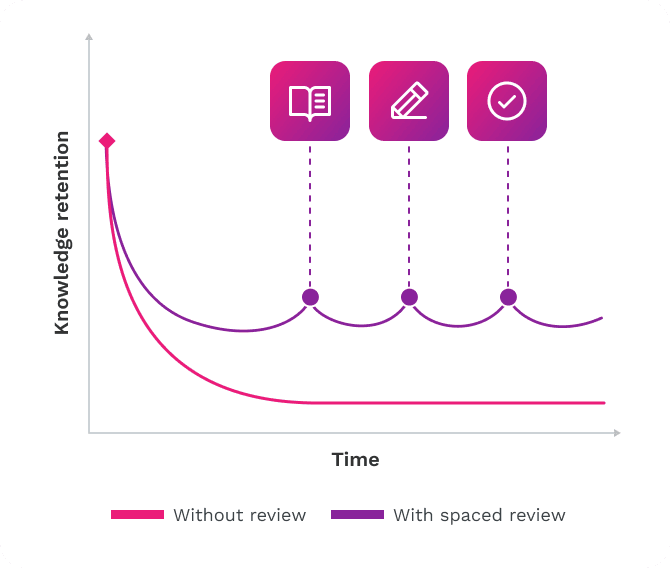
Search for “forgetting curve” and you’ll find the same paragraph repeated across dozens of sites: we forget roughly half in an hour, 70% in a day and 90% in a week. They’re presented as if they described someone who has just finished your workplace safety course.
They don’t, and the difference matters when you’re making decisions:
| What the experiment measured | What it’s made to say |
|---|---|
| Nonsense syllables, chosen to mean nothing | Content with context, examples and on-the-job application |
| A single subject, the researcher himself | An entire organization’s workforce |
| Material unrelated to any prior knowledge | Topics that connect with what the person already knows and does |
| Savings when relearning a list | The ability to apply a procedure at work |
| No practice, no feedback, no later use | Learning that gets reinforced by using it every day |
Does that mean the forgetting curve is useless? Quite the opposite. It means you have to use it as a mental model, not as a data table. What’s actionable in Ebbinghaus’s finding isn’t any specific percentage, but three things:
And there’s an uncomfortable corollary: the more abstract and less applicable your content is, the more it resembles Ebbinghaus’s syllables and the faster it will be forgotten. The best defense against the forgetting curve starts with the design of the content, not with the review schedule.
Translated into concrete decisions, the forgetting curve calls into question the most widespread training format in companies: the single, intensive course, consumed in one sitting and never revisited.
That format is convenient to manage —you plan it, you deliver it, you close the file— and it’s precisely the worst possible one from a retention standpoint. It concentrates all the learning at the moment the curve starts to fall, and then never touches it again.
There are three practical implications that tend to get overlooked:
None of this requires throwing out your existing courses. It requires adding a reinforcement strategy that today, in most training plans, simply doesn’t exist.
WHITEPAPER
How to adapt your in-person training to an online format with microlearning


These are the interventions with solid evidence behind them, ordered by impact relative to the effort they cost.
This is the best documented strategy of all. Instead of concentrating the learning, you spread it across sessions separated in time. The meta-analysis by Cepeda, Pashler and colleagues, published in Psychological Bulletin in 2006, gathered 839 effect estimates from 317 experiments and confirmed something key: the optimal interval between reviews grows as the retention horizon grows.
In other words: there is no such thing as “the” reinforcement schedule. It depends on when you need the person to remember.
Forcing people to retrieve information from memory retains far more than re-exposing them to it. Roediger and Karpicke demonstrated this in 2006 with an elegant design: after five minutes, rereading the material produced better results than having taken a test; but after two days and after a week, the result clearly reversed in favor of those who had been tested.
It’s a cheap change with a big effect: replace the end-of-module summary with three questions that force people to answer without looking. Reinforcement activities serve exactly this function.
Microlearning fits the curve naturally: short, repeatable units you can look up at the moment of need. A three-minute learning pill someone reviews before a client call is worth more, in retention terms, than an hour-long course consumed months earlier. Microlearning videos and mobile learning are especially useful for teams that don’t work in front of a computer.
Nothing flattens the curve like using what you’ve learned. When knowledge is put into practice, each use works as a spontaneous review. Hence the value of simulation training and realistic scenarios: they shorten the distance between learning and applying, which is where most of the learning is lost.
Alternating related topics instead of exhausting them one at a time makes studying harder in the short term, but improves long-term retention. It’s counterintuitive and it works. We cover it in depth in our article on interleaved learning, or interleaving.
Formative assessment turns measurement into part of the learning: every check is both retrieval practice and a signal of where reinforcement is needed. It’s the strategy that connects the previous five and lets you decide, with data, what’s worth insisting on.
Designing content as reusable learning objects makes all of the above vastly easier: it lets you recombine pieces for reviews without rebuilding the whole course.
The practical question is when to place the reinforcements. The study by Cepeda and colleagues published in Psychological Science in 2008, with more than 1,350 participants, gives the most useful rule there is: the optimal gap between sessions grows with the horizon, but shrinks as a proportion of that horizon. The authors measured an optimum of between 20% and 40% of the horizon when the test was a week away, dropping to between 5% and 10% when it was a year away.
Translated into a training plan:
| When do they need to remember it? | First reinforcement | Later reinforcements |
|---|---|---|
| Within 1 week | At 24-48 hours | One more at 3-4 days |
| Within 1 month | At 2-3 days | At one week and at 2-3 weeks |
| Within 6 months | At one week | At one month and at 3 months |
| Within 1 year | At 2-3 weeks | At 3 and at 8 months |
| Daily use on the job | At 24 hours | The work itself acts as the review |
Two warnings about this table. First: these are starting points, not a law; complex content and content that isn’t used daily need more reinforcements. Second: a reinforcement only counts if it forces retrieval. Resending the course PDF isn’t a reinforcement, it’s an attachment.
CASE STUDY
We helped Clarel transform its knowledge into interactive and effective microcontents

Without measurement, any reinforcement plan is guesswork. The good news is you don’t need to set up a study: it’s enough to change what you look at and when.
In long programs, such as an online onboarding, measuring retention at 30, 60 and 90 days is also the fastest way to spot which part of the content is surplus and which needs reinforcing.
The Ebbinghaus forgetting curve describes something true and easy to ignore: without reinforcement, what’s learned is lost, and lost fast. What it doesn’t describe is your employees, because the percentages in circulation come from one man memorizing nonsense syllables in 1885 and from a 2015 replication also run with a single subject. The shape of the curve is an excellent mental model; the figures aren’t. Used well, the curve doesn’t justify training more, but training in a different order: less intensity all at once and more spaced reviews that force people to remember.
The obstacle is almost never pedagogical, it’s operational. Scheduling reinforcements at three days, one month and three months, across dozens of programs and thousands of people, is unworkable by hand. isEazy LMS lets you build learning paths with spaced reinforcements, formative assessments and on-demand content, and then measure whether retention actually improves at 30 and at 90 days. Want to see it with your own programs? Request a demo.
It’s the graphical representation of how retention of something learned decays as time passes without review. It was described by the German psychologist Hermann Ebbinghaus in 1885, based on an experiment on himself: he memorized lists of nonsense syllables and measured how much effort it took to relearn them days later. The drop is very steep in the first hours and then flattens out. The important thing is that the curve describes a real tendency, but the specific percentages come from an experiment with a single person and meaningless material.
That figure circulates constantly, but it can’t simply be transferred to corporate training. It comes from Ebbinghaus’s experiment with nonsense syllables and a single subject. The most rigorous modern replication, published by Murre and Dros in PLOS ONE in 2015, was also run with a single subject and measured a saving of 4.1% at 31 days. A course with context, examples and practical application is forgotten far more slowly than a list of syllables. The shape of the curve is useful as a mental model; the exact figures are not.
It depends on the horizon: the further away the moment when the person has to remember something, the further apart the reviews should be. The study by Cepeda and colleagues published in Psychological Science in 2008, with more than 1,350 participants, found that the optimal gap between sessions is equivalent to between 20% and 40% of the horizon when the test is a week away, dropping to between 5% and 10% when it’s a year away. In practice, for something to be remembered six months out, it’s worth scheduling reinforcements after a few days, after a few weeks and after a month.
Taking a test, as long as what matters is medium-term recall. Roediger and Karpicke showed in 2006 that rereading produces better results on an immediate test, after five minutes, but that after two days and after a week the people who had to retrieve the information from memory clearly come out ahead. This is known as the testing effect, or retrieval practice. That’s why a reinforcement activity that forces people to answer retains more than showing the same material again.
With a combination of four things: reviews spaced out over time instead of a single intensive course, activities that force people to retrieve information from memory, short content accessible at the moment of need, and real opportunities to apply what’s been learned on the job. None of the four requires rebuilding the training from scratch: most programs already have the content, what they lack is a reinforcement schedule and a way to measure whether retention improves.

Need fast, effective, and easy-to-digest content?
Reinforce learning and boost knowledge retention with the most engaging multimedia and interactive micro-content


Create AI-powered courses with 30% off
This Black Friday, get the market's #1 AI-powered authoring tool at an unbeatable price.