
CASE STUDY
We helped Clarel transform its knowledge into interactive and effective microcontents

Brain
The first AI trained to teach

Author
The #1 AI-powered authoring tool on the market

Factory
Custom e-learning content factory

Skills
Comprehensive power skills course catalog

LMS
All-in-one LMS platform with AI

Engage
App for managing frontline teams
Product

What is Brain?
Everything you need to know about the first AI trained to teach.

How does it work?
Adaptive, conversational, and contextual. That’s learning with Brain.

Security
Why your company’s knowledge never leaves your environment or trains other models.

Comparison
Discover what sets isEazy Brain apart from other AI solutions.

Frequently Asked Questions
Want to learn more? Find answers to all your questions about isEazy Brain here.
FEATURES

AINew
Unlock your full potential and speed up course creation with artificial intelligence.

Accessibility
Automatically meet accessibility guidelines—without sacrificing interactivity!

Interactivity
Boost engagement with interactive, ready-to-use activities that make learning fun.

Course Creation
Reduce the time it takes to create your e-learning courses with our authoring tool.

Distribution
We offer you different distribution options, so that nothing can stop you.

SCORM
Publish your course in SCORM format and share it on any LMS.
SERVICES

Instrucional Design
Surprise your students with multimedia and interactive content.

Custom Courses
We create e-learning courses for you—tailored to your needs and hassle-free!

Virtual Reality
Turn learning into an immersive experience.

Custom Avatars
Give your courses and videos a unique touch with personalized avatars.

Audiovisual FactoryNew
Turn training into something dynamic and visual with engaging videos.
CATALOG

Course catalog
Over 600 skills and competency courses to help you adapt to your team's needs.
Microsoft Copilot AcademyNew
Your professionals will learn how to apply Copilot AI to key processes within your organization.

Artificial Intelligence Academy
Train your teams in the practical use of AI to boost productivity and innovation in your company.

Cybersecurity Academy
Capacita a tu empresa con el catálogo más completo en seguridad digital corporativa.
FEATURES

Learning platform
Manage all your training from one place

Analitycs
Measure the impact of your training

Learning Experience
Offer a unique learning experience to your team
Content Library
Choose from hundreds of expert-created courses
Authoring Tool
Create your own content—faster than ever

Use cases
Choose the solution that best fits your needs

Industries
Solutions for all types of industries
USE CASES

Onboarding
Facilitate the onboarding process, productivity and engagement of your new employees.

Upskilling
Boost your team's skills and prepare them for the challenges of the future with upskilling.

Microlearning
Discover all the advantages of microlearning and boost your training results.

Gamification
Enjoy addictive training that will get your professionals hooked.

Internal Communication
Improve communication in your company and enjoy an aligned and committed team.

Mobile learning
Agile, flexible, and interactive learning—built for today’s digital-first workforce.
INDUSTRIES

Banking and financial services
Training in compliance, cybersecurity, customer service, and key skills development.

Pharmaceuticals and healthcare
Digital onboarding, regulatory updates, and ongoing training for healthcare staff.

Retail and consumer
Agile and scalable training for in-store, operational, and customer service teams.

Industry and manufacturing
Training in processes, safety, and corporate culture for distributed teams.

Education and training
Digital solutions for training centers, internal academies, and corporate universities.

Technology and telecommunications
Development of technical talent, digital skills, and upskilling and reskilling programs.
CLIENTS

MAPFRE
How MAPFRE turn e-learning into sales with isEazy

Pepco
A personalised learning experience for a growing team.

BBVA
Digitisation and creation of high quality e-learning content.

Shiseido
We increase the engagement of the training with a social and gamified app.

Telefónica
Large-scale reskilling for the company's digital transformation.

Vodafone
A personalised learning experience for a growing team.
More than 1,000 companies already rely on isEazy.





MEET ISEAZY

Events
Discover our upcoming events and connect with the future of e-learning.

News
Find out the latest news about isEazy: press releases, partnerships, updates...

Contact
Leave us your personal details and we will contact you as soon as possible.
About isEazyNew
Find out more about our company.

Careers
We are looking for the best talent, join our team!

Partners
Become our partner and grow your business.
INTERESTING RESOURCES

Blog
The best content on e-learning: trends, tools and key strategies.

Whitepapers
Gain valuable insights and stay ahead of industry trends.

Product releases
The latest news and releases of our e-learning products and solutions.

Glossary
Definitions of the most commonly used terms and key industry concepts.

Guides
Discover the best step-by-step tips and tricks to optimize your L&D strategy.

Webinars
Video sessions on our products, trends and more

Comparatives
Compare e-learning solutions available on the market and choose the most suitable one.




Table of contents
A learning pill is a brief, self-contained learning unit focused on a single objective, allowing the learner to acquire or reinforce a specific piece of knowledge or skill in a short time. Its duration typically ranges from 3 to 15 minutes, and its instructional design is built around focus: one idea, one application context and, when appropriate, a knowledge check.
In corporate training, learning pills have become one of the most widely used formats by L&D teams. Their adoption responds to a clear reality: according to LinkedIn’s Workplace Learning Report 2024, 90% of professionals say limited time is the main barrier to learning. The learning pill solves exactly that problem by fitting into the real gaps of the working day.
Not every piece of short content qualifies as a learning pill. For a resource to fulfil this role in a corporate e-learning strategy, it must meet five fundamental characteristics:
| Criterion | Learning pill | Classic e-learning course |
|---|---|---|
| Duration | 3–15 minutes | 30–90 minutes or more |
| Objective | One specific concept or skill | Broad competency or learning path |
| Ideal format | Video, infographic, quiz, scenario | Structured SCORM, modules |
| Consumption | In the workflow, from mobile | Dedicated session, usually on PC |
| Retention | High for reinforcement and review | High for initial learning |
| Production cost | Low–medium | Medium–high |
There are four main formats of learning pill in corporate e-learning. The choice between them depends on the content type, the learner profile and the consumption context:
Learning pills reach their full potential when they form part of a deliberate learning strategy, not when created in isolation. Three methodologies amplify their impact:
Microlearning: the learning pill is the core format of microlearning. When correctly designed within a microlearning path, each pill covers a knowledge node that connects to the previous one and prepares the learner for the next.
Learning loops: learning loops use pills as activation and reinforcement units within short cycles. The learner receives a pill, applies it in their work and returns to consolidate via a complementary pill.
Drip-feed learning: distributing learning pills at spaced intervals enables spaced repetition, improving retention without overloading the learner. Particularly useful for onboarding, compliance training and product updates.
Clarel is a representative example of the impact a learning pill strategy can have on distributed teams. With more than 600 points of sale across Spain, the company needed to train its professionals simultaneously, consistently and on mobile devices. Thanks to isEazy, they achieved 84% engagement in their gamified microlearning programme. Discover how they did it →
CASE STUDY
We helped Clarel transform its knowledge into interactive and effective microcontents


Learning pills reach their true impact when they reach the employee at the right time and place. In environments with distributed teams — stores, branches, logistics centres or deskless workers — distributing training through traditional channels or email creates friction, low adoption and poor traceability.
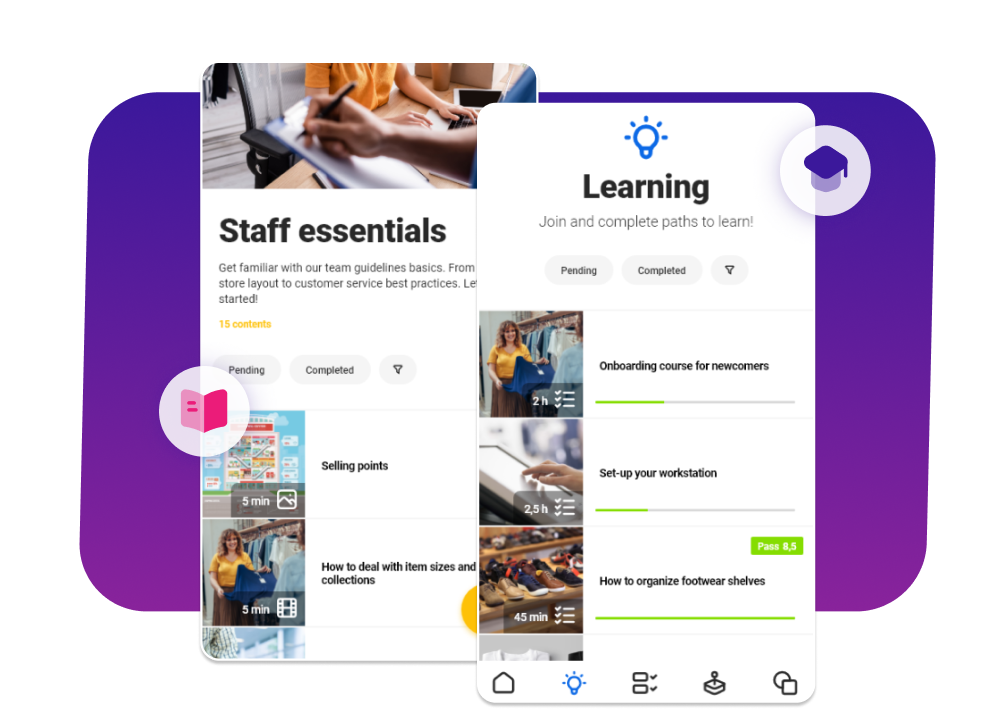
isEazy Engage is the solution designed specifically for frontline workers. It integrates the delivery of learning pills, internal communication, operational management and learning analytics into a single app. This allows L&D managers to push pills directly to the employee’s mobile, measure completion rates in real time and combine microlearning with tasks, checklists and announcements in a single environment.
The result is training that requires no separate session: the learning pill becomes part of the daily workflow, not an interruption of it.
A learning pill typically lasts between 3 and 15 minutes. The most common range in corporate e-learning is 5 to 10 minutes — enough time to convey a specific concept or skill without causing cognitive fatigue. Some formats, such as microvideo or interactive infographics, can be even shorter (2 to 3 minutes) when the goal is reviewing or reinforcing previously acquired knowledge.
Microlearning is the learning methodology based on short, focused content. A learning pill is one of the specific formats within that methodology, alongside others such as video clips, infographics or quizzes. In other words, every learning pill is microlearning, but not all microlearning necessarily takes the form of a pill. The key distinction is that a learning pill implies structured instructional design: a learning objective, content and a comprehension check.
Creating an effective learning pill involves four steps: first, define a single learning objective (one specific skill or concept, not several at once); second, choose the format best suited to the content (video for processes, infographic for comparative data, quiz for review); third, design the content concisely, removing anything non-essential; and fourth, add a comprehension check — a question or short practical exercise. Tools like isEazy Author let you build learning pills with all these elements without any technical knowledge.
Learning pills are more appropriate than lengthy courses in four scenarios: when you need to update specific knowledge (regulatory change, new tool, new process); when the team has limited time and training must fit into the workflow; when you want to reinforce prior learning (spaced repetition); and when you aim to boost engagement with more dynamic, mobile-friendly content. Full courses remain valuable for learning new, complex competencies that require deep contextualisation.

Train your team with brief and engaging content that facilitates understanding and guarantees learning
Request a demo
Need fast, effective, and easy-to-digest content?
Reinforce learning and boost knowledge retention with the most engaging multimedia and interactive micro-content