CASE STUDY
Discover how we helped Grupo AKRON unlock its internal talent.

Brain
The first AI trained to teach

Author
The #1 AI-powered authoring tool on the market

Factory
Custom e-learning content factory

Skills
Comprehensive power skills course catalog

LMS
All-in-one LMS platform with AI

Engage
App for managing frontline teams
Product

What is Brain?
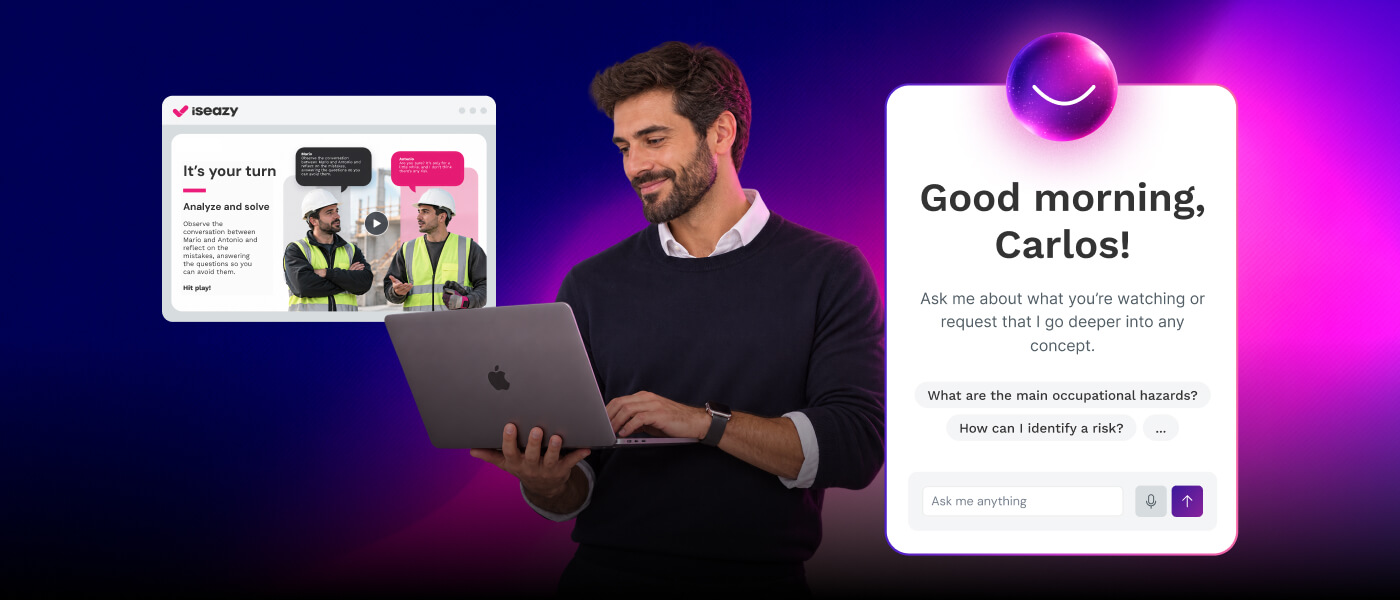
Everything you need to know about the first AI trained to teach.

How does it work?
Adaptive, conversational, and contextual. That’s learning with Brain.

Security
Why your company’s knowledge never leaves your environment or trains other models.

Comparison
Discover what sets isEazy Brain apart from other AI solutions.

Frequently Asked Questions
Want to learn more? Find answers to all your questions about isEazy Brain here.
FEATURES

AINew
Unlock your full potential and speed up course creation with artificial intelligence.

Accessibility
Automatically meet accessibility guidelines—without sacrificing interactivity!

Interactivity
Boost engagement with interactive, ready-to-use activities that make learning fun.

Course Creation
Reduce the time it takes to create your e-learning courses with our authoring tool.

Distribution
We offer you different distribution options, so that nothing can stop you.

SCORM
Publish your course in SCORM format and share it on any LMS.
SERVICES

Instrucional Design
Surprise your students with multimedia and interactive content.

Custom Courses
We create e-learning courses for you—tailored to your needs and hassle-free!

Virtual Reality
Turn learning into an immersive experience.

Custom Avatars
Give your courses and videos a unique touch with personalized avatars.

Audiovisual FactoryNew
Turn training into something dynamic and visual with engaging videos.
CATALOG

Course catalog
Over 600 skills and competency courses to help you adapt to your team's needs.
Microsoft Copilot AcademyNew
Your professionals will learn how to apply Copilot AI to key processes within your organization.

Artificial Intelligence Academy
Train your teams in the practical use of AI to boost productivity and innovation in your company.

Cybersecurity Academy
Capacita a tu empresa con el catálogo más completo en seguridad digital corporativa.
FEATURES

Learning platform
Manage all your training from one place

Analitycs
Measure the impact of your training

Learning Experience
Offer a unique learning experience to your team
Content Library
Choose from hundreds of expert-created courses
Authoring Tool
Create your own content—faster than ever

Use cases
Choose the solution that best fits your needs

Industries
Solutions for all types of industries
USE CASES

Onboarding
Facilitate the onboarding process, productivity and engagement of your new employees.

Upskilling
Boost your team's skills and prepare them for the challenges of the future with upskilling.

Microlearning
Discover all the advantages of microlearning and boost your training results.

Gamification
Enjoy addictive training that will get your professionals hooked.

Internal Communication
Improve communication in your company and enjoy an aligned and committed team.

Mobile learning
Agile, flexible, and interactive learning—built for today’s digital-first workforce.
INDUSTRIES

Banking and financial services
Training in compliance, cybersecurity, customer service, and key skills development.

Pharmaceuticals and healthcare
Digital onboarding, regulatory updates, and ongoing training for healthcare staff.

Retail and consumer
Agile and scalable training for in-store, operational, and customer service teams.

Industry and manufacturing
Training in processes, safety, and corporate culture for distributed teams.

Education and training
Digital solutions for training centers, internal academies, and corporate universities.

Technology and telecommunications
Development of technical talent, digital skills, and upskilling and reskilling programs.
CLIENTS

MAPFRE
How MAPFRE turn e-learning into sales with isEazy

Pepco
A personalised learning experience for a growing team.

BBVA
Digitisation and creation of high quality e-learning content.

Shiseido
We increase the engagement of the training with a social and gamified app.

Telefónica
Large-scale reskilling for the company's digital transformation.

Vodafone
A personalised learning experience for a growing team.
More than 1,000 companies already rely on isEazy.



MEET ISEAZY

Events
Discover our upcoming events and connect with the future of e-learning.

News
Find out the latest news about isEazy: press releases, partnerships, updates...

Contact
Leave us your personal details and we will contact you as soon as possible.
About isEazyNew
Find out more about our company.

Careers
We are looking for the best talent, join our team!

Partners
Become our partner and grow your business.
INTERESTING RESOURCES

Blog
The best content on e-learning: trends, tools and key strategies.

Whitepapers
Gain valuable insights and stay ahead of industry trends.

Product releases
The latest news and releases of our e-learning products and solutions.

Glossary
Definitions of the most commonly used terms and key industry concepts.

Guides
Discover the best step-by-step tips and tricks to optimize your L&D strategy.

Webinars
Video sessions on our products, trends and more

Comparatives
Compare e-learning solutions available on the market and choose the most suitable one.


WEBINAR
Master AI in isEazy Author in under an hour.




GUIDE
Prepare your organization to comply with the new AI regulations

Stay up to date with all our latest news
 Subscribe to our newsletter
 Stay up to date with all our latest news

September 18, 2026

CONTENT CREATED BY:

Table of contents
Talent development in companies is no longer an optional initiative. It is a strategic necessity for any organization that wants to retain its best professionals, adapt to change, and build internal capabilities sustainably. According to Zippia, companies that offer development opportunities retain their employees 34% more than those that don’t.
In this article, you’ll find a comprehensive guide on what talent development is, how to design it in six phases, which methods work today, how to measure it, and which trends will shape the L&D agenda in 2027.
Talent development is a strategy built around planned, purposeful actions to strengthen employees’ skills, knowledge, and competencies within an organization. It aims to equip professionals to take on new roles and responsibilities, enabling them to grow and evolve over time. It is a long-term strategy that begins at the moment of hiring and runs throughout the employee’s entire career — encompassing personal development, leadership, innovation, and adaptability to change.
Talent management is the umbrella: it covers the full employee lifecycle — attraction, selection, compensation, performance evaluation, and retention. Talent development focuses specifically on growth: how each professional’s competencies evolve over time. Both are complementary, and the most mature organizations work them in an integrated way.
| Criteria | Talent management | Talent development |
|---|---|---|
| Scope | Full employee lifecycle | Professional growth and continuous learning |
| Main objective | Right profiles in each role | Competencies to take on new challenges |
| Time horizon | Short and medium term | Medium and long term |
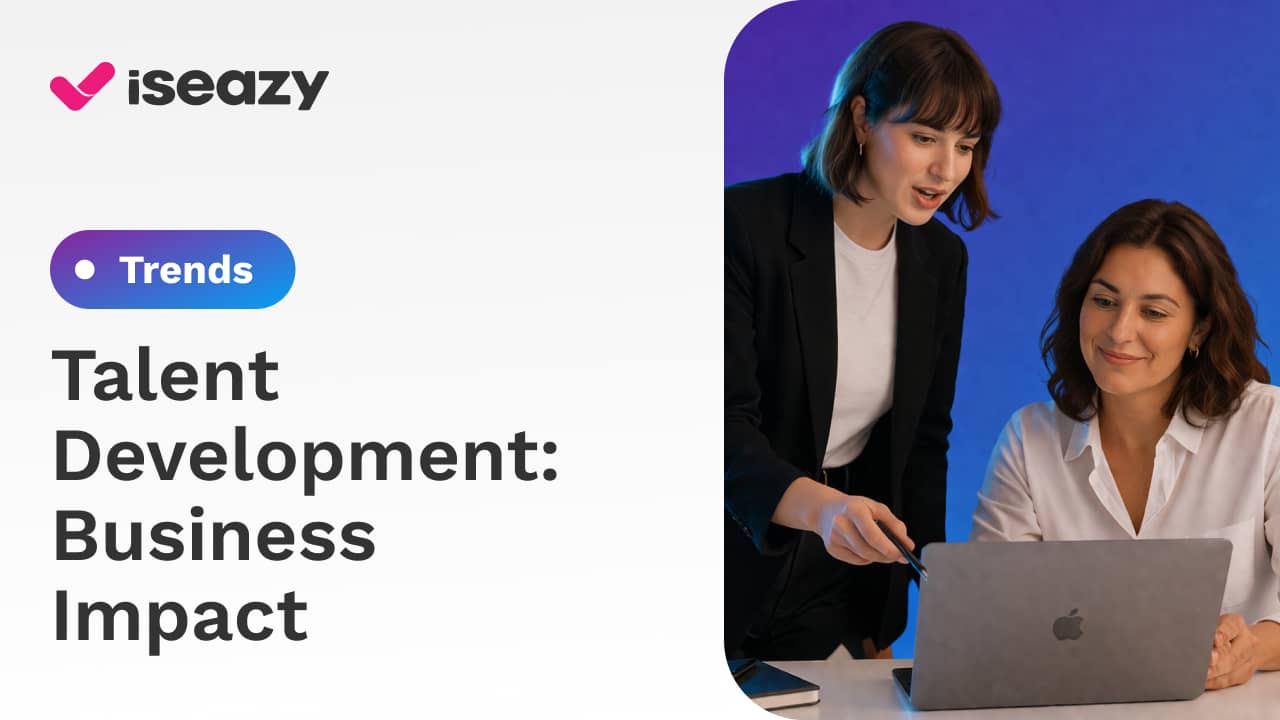
Talent development generates direct impact on performance, motivation, absenteeism reduction, and employer brand. When professionals feel they are growing and can see a clear path forward, their commitment increases and turnover falls.
For talent development to generate real results, it needs a structured, deliberate framework. This strategic planning process helps organizations identify development needs and design effective programs that fuel both employee and business growth. These six phases provide a solid framework for successful execution:
In the first phase, organizations must define development objectives that are clearly aligned with the company’s vision, mission, and strategy. This means answering concrete questions: what capabilities does the business need to compete over the next two to three years? Which profiles are critical, and which risk becoming obsolete? Goals must be specific, measurable, and tied to business outcomes — not just HR aspirations. Without this strategic grounding, a development plan risks becoming nothing more than a course catalogue with no direction.
The second phase calls for a thorough analysis of the current skills, knowledge, and competencies across the workforce. Tools such as skills mapping and the competency map allow organizations to pinpoint precisely where the gaps lie between available talent and what the organization needs. This diagnosis must be grounded in real data: performance evaluation results, internal surveys, manager interviews, and turnover analysis by area. Without a rigorous assessment, the development plan risks investing in irrelevant training. Learn more in our guide on how to identify training needs.
With gaps identified, learning pathways can be designed. Effective training is not just a course catalogue: it combines formal learning (courses, certifications, workshops), social learning (mentoring, communities of practice, peer feedback), and experiential learning (real projects, internal rotations, new responsibilities). This approach — known as the 70-20-10 model — recognizes that the most impactful learning happens on the job, not just in a classroom. Solutions like isEazy Skills provide a full catalogue of transversal and digital skills training, without needing to build all content from scratch.
Once the training program is underway, it’s essential to implement effective tools and methods to evaluate employee performance and real progress. This phase isn’t just about scoring people — it’s about generating useful data to fine-tune the program and inform decisions. The most relevant tools include regular performance reviews, objective check-ins, and 360-degree evaluations, which gather feedback from managers, peers, and collaborators to provide a complete picture of the program’s impact on actual workplace behavior. These are complemented by key performance indicator tracking and performance enablement assessments that connect learning directly to business outcomes. Evaluation must be continuous and systematic — not an annual formality.
To ensure a consistent flow of high-quality talent, development initiatives must be integrated with attraction and selection strategies. This means identifying growth-potential candidates during the hiring process, implementing effective onboarding that accelerates the learning curve, and creating development opportunities from day one. Internal mobility is a key lever here: when employees see that higher-responsibility roles are filled from within, their motivation and commitment rise significantly — while dependence on the external job market decreases.
In this final phase, organizations implement recognition and retention strategies to sustain high levels of engagement. This includes recognition programs tied to the development of new competencies, growth opportunities, and more collaborative and enriching work. Employee development plans with clearly communicated career paths project an inspiring professional horizon that reinforces commitment and preserves strategic knowledge within the organization. When professionals see that their efforts have real momentum, turnover falls and a culture of learning takes hold.
Beyond traditional training programs, a set of methodologies is transforming how organizations develop their teams.
Gamification has reinvented the delivery of learning, offering employees training experiences that produce real behavioral change. According to TalentLMS, 89% of employees say gamification makes them more productive. Its key benefits include higher motivation, stronger engagement, and better knowledge retention.

Built on social learning theory, these platforms enable employees to share knowledge, collaborate on projects, and participate in communities. According to Edgar Dale’s learning pyramid, we learn up to 75% more when we teach or discuss with others. Skills management tools support this exchange by connecting professionals with the right resources and people.
Short 5-to-10-minute modules allow employees to acquire new skills flexibly, integrating learning into the working day without disrupting it. According to the Research Institute of America, microlearning increases knowledge retention by up to 80% compared to traditional training formats.

Measuring the success of talent development programs is essential to ensure that investments in training are generating positive results. Without clear metrics, there’s no plan — just spending. Here are the main measurement strategies and tools:
Quarterly reviews are the recommended minimum for detecting deviations and adjusting the program before they affect outcomes. A strong measurement system doesn’t just evaluate the past — it allows you to course-correct in real time.
| Indicator | How to measure it | Tool |
|---|---|---|
| Retention rate | % of employees who remain after 12 months vs. prior year | HR platform / turnover reports |
| Internal promotion rate | % of vacancies filled with internal talent | ATS / HR reports |
| Competency progress | Performance evaluations pre/post program | LMS / assessment platform |
| Program completion rate | % of employees who complete each learning pathway | LMS / training platform |
| 360-degree evaluations | Average multisource feedback score before/after | 360-degree evaluation tool |
| Impact on productivity | Improvement in business KPIs linked to trained area | Business / HR dashboard |
AKRON Group is a prime example of how a company can implement a scalable upskilling and reskilling program with measurable results. Working with isEazy, they built a talent development plan designed to prepare their teams for the sector’s evolving demands — combining technical and transversal skills training on a platform accessible from any device. Discover how AKRON developed talent across their organization →
The 2027 horizon consolidates shifts already transforming the L&D agenda. Understanding them now is essential for designing programs that will remain relevant tomorrow.
More and more companies are structuring talent around concrete, measurable competencies rather than titles and departments. According to Deloitte’s Global Human Capital Trends 2024 report, 93% of respondents consider this model important or very important for business success. The competency map becomes a strategic tool — not just an HR document — for designing upskilling and reskilling pathways and making internal mobility decisions grounded in real data.
Artificial intelligence is redefining what personalized learning actually means — it’s no longer about recommending a course based on a profile, but about adapting the learning experience in real time according to each professional’s context, objectives, and current state. Tools like isEazy Brain turn each company’s real corporate knowledge into adaptive learning agents that adjust to each employee — closing the gap between generic training and what each professional actually needs in their day-to-day work. This is “training that thinks”: conversational, contextual, and adaptive.
According to LinkedIn, employees who move internally have a 41% higher retention rate than those who don’t. Organizations that design clear mobility pathways — and communicate them actively — keep their employees seeing a future inside the company, not outside it.
The era of “we delivered 40 hours of training” as a success metric is over. The most advanced organizations connect LMS data with performance evaluations and business KPIs, building a measurement model that goes far beyond completion rates.
Rolling out a talent development program is rarely without obstacles. Knowing them in advance makes it possible to anticipate and address them before they stall the initiative:
Talent development in companies is far more than a collection of courses or isolated training initiatives. As we’ve seen throughout this article, it is a strategic, ongoing process — from needs identification and learning pathway design to impact measurement and the creation of learning cultures that endure. When it is built well — with rigorous diagnosis, clear phases, innovative methods, and metrics that connect learning to business outcomes — talent development reduces turnover, raises productivity, strengthens commitment, and builds a competitive advantage that competitors cannot quickly replicate: the accumulated knowledge and loyalty of professionals who truly know the organization.
For this process to be agile and scalable, organizations need training solutions that reduce the time and cost of launching quality programs. isEazy Skills is a flat-rate corporate training platform offering a catalogue of courses in transversal and digital skills — leadership, communication, productivity, digital competencies, upskilling and reskilling — ready to deploy without in-house content production. L&D teams can focus on strategy and support, while the platform handles the content. Request a free demo and discover how isEazy Skills can accelerate talent development in your organization.
Talent management is the strategic umbrella that covers the entire employee lifecycle: attraction, selection, compensation, performance evaluation, and offboarding. Talent development, on the other hand, focuses specifically on growth — how each professional’s skills, knowledge, and performance evolve over time. In other words, talent management is about “having and keeping talent”; talent development is about “making it grow.” Both disciplines are complementary, and the most mature organizations integrate them by linking career paths, continuous learning, and internal mobility with the company’s strategic objectives.
The impact of a talent development plan varies depending on the depth of the actions taken and the KPIs being tracked. Generally, the first visible results — such as increased engagement or improved performance evaluations — tend to appear within 3 to 6 months of the program launch. However, impact on talent retention and team productivity is usually more noticeable after the first year. The key is to define clear KPIs from the start (retention rate, internal promotion rate, evaluation results) and conduct regular reviews — at least quarterly — to adjust the program based on data. A plan without measurable follow-up will rarely deliver the expected results.
According to LinkedIn Learning’s 2024 Workplace Learning Report, the most in-demand skills in talent development programs are leadership and management competencies, communication, critical thinking, and digital skills. These are increasingly joined by competencies related to AI applied to work and adaptability to change. In the 2026–2027 context, organizations leading in this space are embracing skills-based organization models: rather than defining roles by job titles or departments, they structure talent around concrete, measurable competencies. This enables more precise skills gap identification, more effective upskilling and reskilling pathways, and data-driven internal mobility decisions.
E-learning has become one of the key pillars of corporate talent development due to its flexibility, scalability, and personalization capabilities. Unlike traditional in-person training, it allows employees to learn at their own pace, access content from any device, and pick up where they left off whenever needed. When combined with methodologies such as microlearning — short, focused modules — gamification, and personalized learning paths tailored to each employee’s profile, the impact on knowledge retention and practical application increases significantly. Platforms like isEazy Skills offer corporate training catalogs covering transversal and digital skills, enabling companies to implement upskilling and reskilling programs efficiently, without having to develop all content from scratch.

GUIDE
Prepare your organization to comply with the new AI Regulations
Download guide


Your team’s talent is your greatest asset. Grow it with isEazy Skills
Develop soft skills and key competencies with a comprehensive course catalog designed to accelerate your team’s growth.


Your team’s talent is your greatest asset. Grow it with isEazy Skills
Develop soft skills and key competencies with a comprehensive course catalog designed to accelerate your team’s growth.