CASE STUDY
We helped STF Group achieve an 87% completion rate in its leadership program

Brain
The first AI trained to teach

Author
The #1 AI-powered authoring tool on the market

Factory
Custom e-learning content factory

Skills
Comprehensive power skills course catalog

LMS
All-in-one LMS platform with AI

Engage
App for managing frontline teams
Product

What is Brain?
Everything you need to know about the first AI trained to teach.

Learning agent: CompanionNew
Supports learners and answers their questions right inside the course, without breaking the audit trail.

How does it work?
Adaptive, conversational, and contextual. That’s learning with Brain.
FEATURES

AINew
Unlock your full potential and speed up course creation with artificial intelligence.

Accessibility
Automatically meet accessibility guidelines—without sacrificing interactivity!

Interactivity
Boost engagement with interactive, ready-to-use activities that make learning fun.

Course Creation
Reduce the time it takes to create your e-learning courses with our authoring tool.

Distribution
We offer you different distribution options, so that nothing can stop you.

SCORM
Publish your course in SCORM format and share it on any LMS.
SERVICES

Instrucional Design
Surprise your students with multimedia and interactive content.

Custom Courses
We create e-learning courses for you—tailored to your needs and hassle-free!

Virtual Reality
Turn learning into an immersive experience.

Custom Avatars
Give your courses and videos a unique touch with personalized avatars.

Audiovisual FactoryNew
Turn training into something dynamic and visual with engaging videos.
CATALOG

Course catalog
Over 600 skills and competency courses to help you adapt to your team's needs.
Microsoft Copilot AcademyNew
Your professionals will learn how to apply Copilot AI to key processes within your organization.

Artificial Intelligence Academy
Train your teams in the practical use of AI to boost productivity and innovation in your company.

Cybersecurity Academy
Capacita a tu empresa con el catálogo más completo en seguridad digital corporativa.

Use cases
Choose the solution that best fits your needs

Industries
Solutions for all types of industries
USE CASES

Onboarding
Facilitate the onboarding process, productivity and engagement of your new employees.

Upskilling
Boost your team's skills and prepare them for the challenges of the future with upskilling.

Microlearning
Discover all the advantages of microlearning and boost your training results.

Gamification
Enjoy addictive training that will get your professionals hooked.

Internal Communication
Improve communication in your company and enjoy an aligned and committed team.

Mobile learning
Agile, flexible, and interactive learning—built for today’s digital-first workforce.
INDUSTRIES

Banking and financial services
Training in compliance, cybersecurity, customer service, and key skills development.

Pharmaceuticals and healthcare
Digital onboarding, regulatory updates, and ongoing training for healthcare staff.

Retail and consumer
Agile and scalable training for in-store, operational, and customer service teams.

Industry and manufacturing
Training in processes, safety, and corporate culture for distributed teams.

Education and training
Digital solutions for training centers, internal academies, and corporate universities.

Technology and telecommunications
Development of technical talent, digital skills, and upskilling and reskilling programs.
CLIENTS

MAPFRE
How MAPFRE turn e-learning into sales with isEazy

Pepco
A personalised learning experience for a growing team.

BBVA
Digitisation and creation of high quality e-learning content.

Shiseido
We increase the engagement of the training with a social and gamified app.

Telefónica
Large-scale reskilling for the company's digital transformation.

Vodafone
A personalised learning experience for a growing team.
More than 1,000 companies already rely on isEazy.





MEET ISEAZY

Events
Discover our upcoming events and connect with the future of e-learning.

News
Find out the latest news about isEazy: press releases, partnerships, updates...

Contact
Leave us your personal details and we will contact you as soon as possible.
About isEazyNew
Find out more about our company.

Careers
We are looking for the best talent, join our team!

Partners
Become our partner and grow your business.
INTERESTING RESOURCES

Blog
The best content on e-learning: trends, tools and key strategies.

Whitepapers
Gain valuable insights and stay ahead of industry trends.

Product releases
The latest news and releases of our e-learning products and solutions.

Glossary
Definitions of the most commonly used terms and key industry concepts.

Guides
Discover the best step-by-step tips and tricks to optimize your L&D strategy.

Webinars
Video sessions on our products, trends and more

Comparatives
Compare e-learning solutions available on the market and choose the most suitable one.


WEBINAR
Master AI in isEazy Author in under an hour.




GUIDE
Prepare your organization to comply with the new AI regulations

Stay up to date with all our latest news
 Subscribe to our newsletter
 Stay up to date with all our latest news

June 17, 2026

CONTENT CREATED BY:

Table of contents
New manager training is the set of programs and resources designed to support professionals taking on a leadership role for the first time. Its goal is to equip them with the skills to lead teams: from people management to decision-making, including communication and talent development.
In the corporate learning context, these programs are one of the highest-impact investments for L&D and HR departments. An ill-prepared new manager doesn’t just underperform: they generate disengagement in their team, increase turnover and drag down business results. That’s why designing a structured program — rather than improvising — makes all the difference.
The most common mistake in organizations is promoting the best technical professional and assuming they will naturally become a good manager. The leap from individual contributor to team leader is not a gradual evolution: it is a radical change of role that requires a completely different set of competencies.
The data confirms this. According to the Cegos 2025 International Barometer on New Managers, leadership and team motivation is the skill new managers most want to develop when taking on the role, both for themselves and from an HR perspective. However, most organizations do not have a structured program for this transition: the new manager is expected to learn on the job, with the human and operational costs that entails.
Current context adds complexity. New managers in 2026 must manage hybrid or distributed teams, integrate AI tools into their daily operations and lead multigenerational profiles with very different expectations. Generic leadership training is no longer enough: they need programs tailored to the real challenges of their organization and sector.
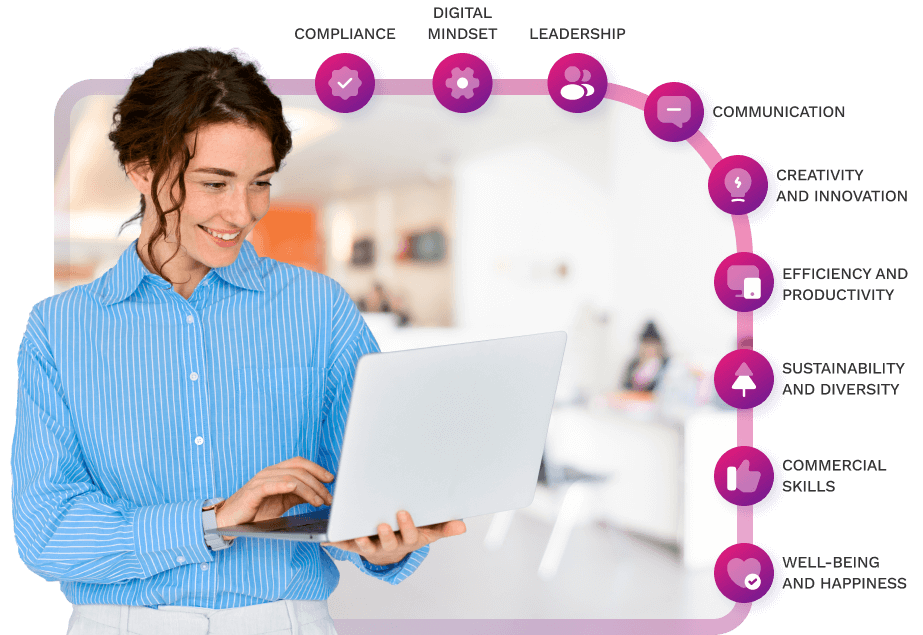
An effective new manager training program is not an endless list of modules. The best initiatives focus on a core set of critical competencies, developed in depth and connected to real job situations. These are the essential skills:
The new manager must learn to generate commitment without relying solely on hierarchical authority. This includes understanding what motivates each team member, knowing how to delegate with confidence and building an environment where people want to give their best. You can find specialized content on this in the Leadership catalog.
Communicating is not just transmitting information: it is generating clarity, alignment and trust. New managers need to develop active listening, constructive feedback, meeting facilitation and communication skills in hybrid environments where misunderstandings multiply. The Communication Skills catalog covers all these competencies.
People management is loaded with emotional tension: conflicts, underperformance, pressure for results. Emotional intelligence allows the manager to regulate their own reactions, empathize with the team and handle difficult situations without unnecessary escalation.
New managers face decisions with incomplete information and under pressure. Learning to structure the decision-making process, identify cognitive biases and act with agility without losing judgment is a critical competency for any leadership role.
Giving improvement feedback, setting clear objectives and having difficult conversations about performance are skills most new managers have never practiced. Without specific training, they will avoid these conversations and the team will pay the price.
One of the most common mistakes of the new manager is continuing to perform tasks they should now delegate. Learning to delegate effectively — with the right level of autonomy and follow-up — is essential to scale impact and free up time for leadership responsibilities.
Designing a manager training program is not the same as building a course catalogue. The most effective programs follow a logic of progressive learning that combines content, practice and reflection. This is the structure that works:
| Phase | Objective | Recommended tools |
|---|---|---|
| 1. Diagnosis | Identify the starting point: competency gaps, team profile and organizational context | 360º assessments, interviews, skills assessment |
| 2. Role onboarding | Understand what it means to be a manager in this organization: values, culture, expectations | E-learning, in-person sessions, initial mentoring |
| 3. Competency training | Develop the key skills of the program in a structured and progressive way | LMS, microlearning, workshops, gamification |
| 4. Practice and application | Apply learning in real situations with support | Real projects, role-playing, individual coaching |
| 5. Evaluation and follow-up | Measure the real impact on the team and business results | Team KPIs, climate surveys, performance evaluations |
One critical aspect many programs overlook: training does not end when the course finishes. Post-training follow-up (tutorials, communities of practice, resources at the moment of need) is what determines whether learning consolidates or evaporates in the first few weeks.
Technology is not the center of a manager training program, but choosing the right tools makes the difference between a scalable, efficient program and one that relies on manual effort and measures no results. These are the main options L&D departments use today:
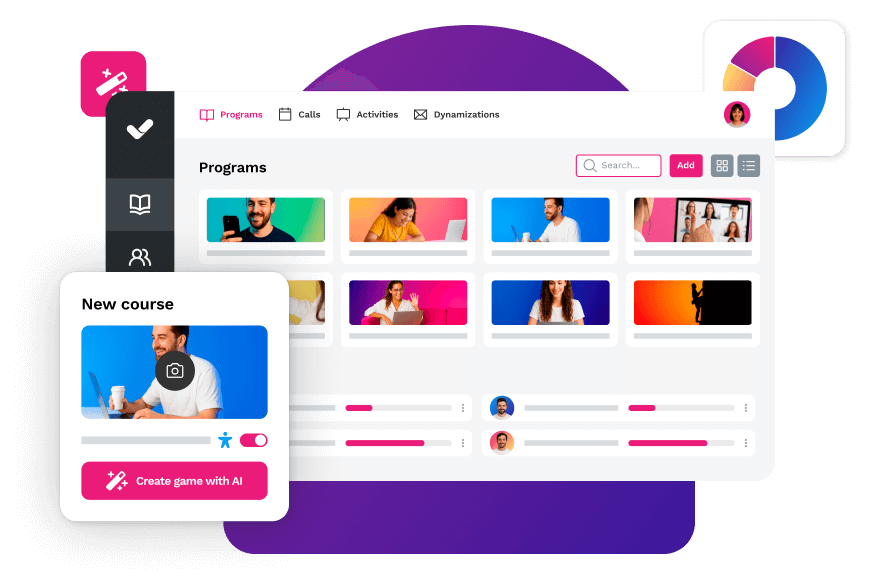
A Learning Management System (LMS) allows you to manage the complete manager program itinerary: assign modules, track progress, automate reminders and generate impact reports. It is the hub from which L&D controls who has completed what and what the progress level is for each participant.
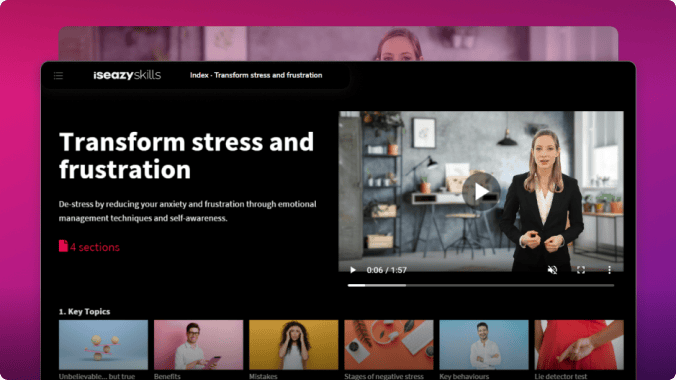
Skills platforms such as isEazy Skills offer specialized content catalogues in leadership, communication, emotional intelligence and team management. They allow you to launch a manager program with quality content without needing to produce it from scratch, accelerating implementation timelines.

Gamification applied to manager training has demonstrated a direct impact on completion rates and knowledge retention. Challenges, leaderboards, badges and healthy competition dynamics transform a mandatory program into an experience managers want to complete.

During the training process, the new manager also needs to learn to communicate with their team in a structured way. isEazy Engage allows managers to practice operational communication, sending updates and tracking tasks in a real environment, directly connecting training with on-the-job practice.

Knowing the most frequent mistakes is as useful as knowing best practices. These are the errors that recur most in manager training programs and that L&D departments can avoid with careful planning:
STF Group is a great example of how a well-designed leadership training program can transform results. With isEazy, they achieved an 87% completion rate in their leadership development program, one of the hardest engagement indicators to reach in programs of this kind. Discover how they did it →
CASE STUDY
We helped STF Group achieve an 87% completion rate in its leadership program


New manager training should not be limited to an isolated course. For it to have real impact, it needs continuity, practice, follow-up and tools that help transfer learning into the day-to-day reality of the team. With isEazy, you can design a complete learning experience for your new leaders: from content creation and training management to access to specialized courses, team communication, gamification and custom training project development.
That way, every new manager can move forward with greater confidence, develop their leadership skills and generate a positive impact on the people they support. Discover all isEazy tools and transform your manager training into a continuous, practical and measurable experience.
There is no universal duration, but the most effective programs run between 3 and 6 months. The key is not accumulating training hours, but alternating theoretical sessions with real on-the-job practice, mentoring and reflection spaces. A program that is too short (less than 4 weeks) does not allow the new manager to integrate learning into their daily routine, while one that is too long without intermediate milestones loses impact and adherence. The ideal approach is to structure it into modules with concrete learning objectives and periodic evaluations that allow the program to be adjusted based on each person’s progress.
New manager training focuses on the transition from individual contributor to leadership role: how to manage people for the first time, delegate, give feedback and build team authority. Training for experienced executives or middle managers, on the other hand, deepens strategic skills, large-scale change management, decision-making in complex contexts and organizational influence. In practical terms, the new manager first needs to build confidence and basic people management tools; the senior executive needs to broaden their vision and organizational impact.
Measuring the real impact of a manager training program requires going beyond post-training satisfaction surveys. The most relevant indicators include: the retention rate of the team led by the new manager (teams with well-trained managers show lower turnover), team performance evaluation results before and after the program, team engagement levels measured through climate surveys, and business objectives achieved. The Kirkpatrick model offers a 4-level framework (reaction, learning, behavior, results) that helps structure this measurement systematically.
The most effective programs combine several formats: e-learning allows learners to absorb theoretical concepts at their own pace and with flexibility; microlearning facilitates learning at the moment of need (just before a difficult meeting, for example); in-person or live workshops enhance social learning and practice in safe environments; and individual mentoring or coaching accelerates real-world application. Gamification has also proven particularly effective at increasing engagement in leadership development programs, with completion rates noticeably higher than traditional formats.

WHITEPAPER
Discover the power skills that will transform your company in 2025
Download whitepaper

Develop Leadership Skills Across Your Team
Empower your team with the most comprehensive leadership training catalog available

Develop Leadership Skills Across Your Team
Empower your team with the most comprehensive leadership training catalog available