WHITEPAPER
How to adapt your in-person training to an online format with microlearning

Brain
The first AI trained to teach

Author
The #1 AI-powered authoring tool on the market

Factory
Custom e-learning content factory

Skills
Comprehensive power skills course catalog

LMS
All-in-one LMS platform with AI

Engage
App for managing frontline teams
Product

What is Brain?
Everything you need to know about the first AI trained to teach.

How does it work?
Adaptive, conversational, and contextual. That’s learning with Brain.

Security
Why your company’s knowledge never leaves your environment or trains other models.

Comparison
Discover what sets isEazy Brain apart from other AI solutions.

Frequently Asked Questions
Want to learn more? Find answers to all your questions about isEazy Brain here.
FEATURES

AINew
Unlock your full potential and speed up course creation with artificial intelligence.

Accessibility
Automatically meet accessibility guidelines—without sacrificing interactivity!

Interactivity
Boost engagement with interactive, ready-to-use activities that make learning fun.

Course Creation
Reduce the time it takes to create your e-learning courses with our authoring tool.

Distribution
We offer you different distribution options, so that nothing can stop you.

SCORM
Publish your course in SCORM format and share it on any LMS.
SERVICES

Instrucional Design
Surprise your students with multimedia and interactive content.

Custom Courses
We create e-learning courses for you—tailored to your needs and hassle-free!

Virtual Reality
Turn learning into an immersive experience.

Custom Avatars
Give your courses and videos a unique touch with personalized avatars.

Audiovisual FactoryNew
Turn training into something dynamic and visual with engaging videos.
CATALOG

Course catalog
Over 600 skills and competency courses to help you adapt to your team's needs.
Microsoft Copilot AcademyNew
Your professionals will learn how to apply Copilot AI to key processes within your organization.

Artificial Intelligence Academy
Train your teams in the practical use of AI to boost productivity and innovation in your company.

Cybersecurity Academy
Capacita a tu empresa con el catálogo más completo en seguridad digital corporativa.
FEATURES

Learning platform
Manage all your training from one place

Analitycs
Measure the impact of your training

Learning Experience
Offer a unique learning experience to your team
Content Library
Choose from hundreds of expert-created courses
Authoring Tool
Create your own content—faster than ever

Use cases
Choose the solution that best fits your needs

Industries
Solutions for all types of industries
USE CASES

Onboarding
Facilitate the onboarding process, productivity and engagement of your new employees.

Upskilling
Boost your team's skills and prepare them for the challenges of the future with upskilling.

Microlearning
Discover all the advantages of microlearning and boost your training results.

Gamification
Enjoy addictive training that will get your professionals hooked.

Internal Communication
Improve communication in your company and enjoy an aligned and committed team.

Mobile learning
Agile, flexible, and interactive learning—built for today’s digital-first workforce.
INDUSTRIES

Banking and financial services
Training in compliance, cybersecurity, customer service, and key skills development.

Pharmaceuticals and healthcare
Digital onboarding, regulatory updates, and ongoing training for healthcare staff.

Retail and consumer
Agile and scalable training for in-store, operational, and customer service teams.

Industry and manufacturing
Training in processes, safety, and corporate culture for distributed teams.

Education and training
Digital solutions for training centers, internal academies, and corporate universities.

Technology and telecommunications
Development of technical talent, digital skills, and upskilling and reskilling programs.
CLIENTS

MAPFRE
How MAPFRE turn e-learning into sales with isEazy

Pepco
A personalised learning experience for a growing team.

BBVA
Digitisation and creation of high quality e-learning content.

Shiseido
We increase the engagement of the training with a social and gamified app.

Telefónica
Large-scale reskilling for the company's digital transformation.

Vodafone
A personalised learning experience for a growing team.
More than 1,000 companies already rely on isEazy.





MEET ISEAZY

Events
Discover our upcoming events and connect with the future of e-learning.

News
Find out the latest news about isEazy: press releases, partnerships, updates...

Contact
Leave us your personal details and we will contact you as soon as possible.
About isEazyNew
Find out more about our company.

Careers
We are looking for the best talent, join our team!

Partners
Become our partner and grow your business.
INTERESTING RESOURCES

Blog
The best content on e-learning: trends, tools and key strategies.

Whitepapers
Gain valuable insights and stay ahead of industry trends.

Product releases
The latest news and releases of our e-learning products and solutions.

Glossary
Definitions of the most commonly used terms and key industry concepts.

Guides
Discover the best step-by-step tips and tricks to optimize your L&D strategy.

Webinars
Video sessions on our products, trends and more

Comparatives
Compare e-learning solutions available on the market and choose the most suitable one.


WEBINAR
Master AI in isEazy Author in under an hour.




GUIDE
Prepare your organization to comply with the new AI regulations

Stay up to date with all our latest news
 Subscribe to our newsletter
 Stay up to date with all our latest news

September 17, 2026

CONTENT CREATED BY:

Table of contents
Today’s professionals have just 24 minutes a week for learning, according to Deloitte. In that context, hour-long courses have stopped being the answer. Microlearning is the methodology that breaks knowledge into short, focused, easy-to-absorb capsules designed to fit into the real pace of work. In this guide, you’ll find everything you need to understand it, apply it, and get the most out of it in your organization.
The concept has a scientific foundation: according to Ebbinghaus’s forgetting curve, we forget up to 70% of what we learn within the first 24 hours without reinforcement. Microlearning, by presenting content in small, spaced doses, counteracts this effect and significantly improves retention. Research from the Research Institute of America estimates that microlearning can improve retention by up to 80% compared to traditional training.
Although the terms are often used interchangeably, there is a nuance. A learning pill is any short unit of content (a video, a short article, an infographic). A microlearning module also implies a defined learning objective, deliberate instructional design, and typically some form of assessment or reinforcement. In other words: every microlearning unit is a learning pill, but not every pill is well-designed microlearning.
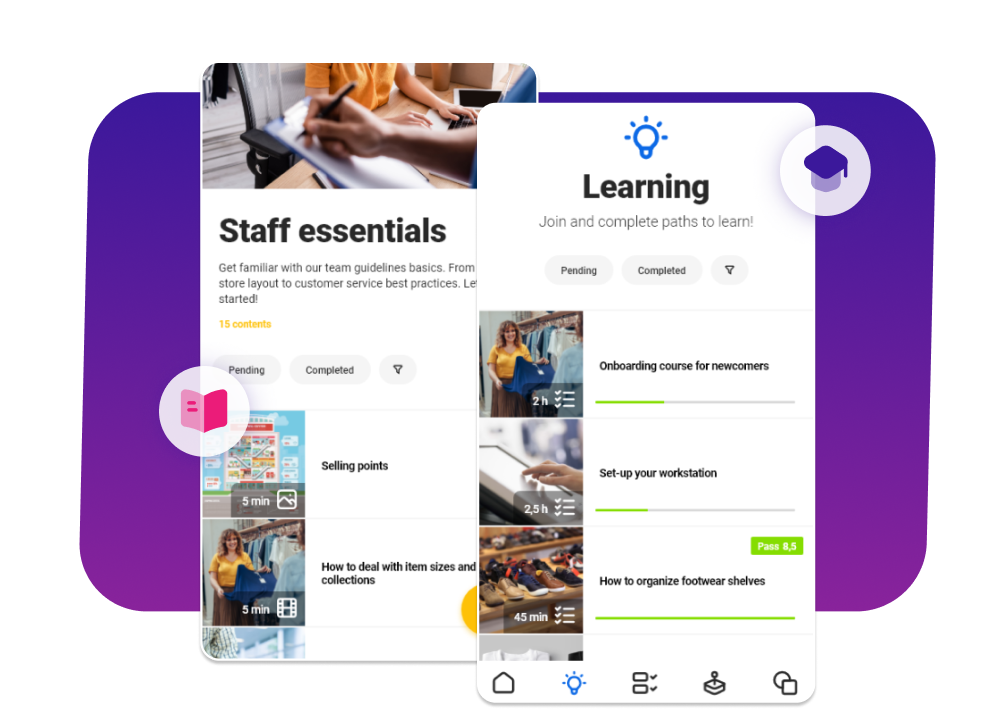
Microlearning has proven highly effective in corporate training programs by enabling fast learning and the reinforcement of specific skills within the workplace. Here are its main advantages:
Shorter, more focused modules increase participants’ attention. An employee is far more likely to complete an 8-minute module than a 45-minute one. This translates directly into higher completion rates. Additionally, information delivered in small doses is better remembered: microlearning combined with spaced repetition is one of the most effective retention strategies that learning science has to offer.
Microlearning lets employees make use of downtime — breaks between meetings, commutes. Being mobile-accessible, it fits into the modern professional’s lifestyle without competing with their day-to-day responsibilities. According to Deloitte, employees can dedicate only 1% of their working week to learning — roughly 24 minutes — and microlearning is designed precisely for that window.
Microlearning cuts costs on two fronts: staffing (fewer hours needed from in-person trainers) and infrastructure and production time. Short modules are faster to create, easier to update, and simpler to scale across the entire organization simultaneously.
When employees know upfront that training will only take a few minutes, resistance disappears. According to a Gallup survey, 58% of employees are more motivated to use their company’s training tools when content is presented in microlearning format. It also sustainably improves learner engagement over time.
Unlike traditional training, microlearning does not risk saturating participants’ working memory. By delivering information in small doses, employees can process it better, avoid fatigue, and maintain engagement throughout the entire learning journey.
Microlearning is the natural format for mobile learning. For frontline workers — retail staff, logistics, manufacturing, field teams — who have no access to a computer during their shift, smartphone-accessible microlearning is, in many cases, the only realistic way to receive continuous training.
WHITEPAPER
How to adapt your in-person training to an online format with microlearning


| Criteria | Microlearning | Traditional training |
|---|---|---|
| Session duration | 3–15 minutes | 1–8 hours |
| Estimated retention | Up to +80% (Research Institute of America) | Rapid forgetting curve without reinforcement |
| Access | Any device, anytime | Generally in-person or on PC |
| Production cost | Low and scalable | High (infrastructure, trainers) |
| Content updates | Fast and modular | Requires full redesign |
| Completion rate | High (short modules) | Lower for long-format content |
While microlearning is highly effective, it’s worth knowing when and in which contexts to apply it. The method works best when it comes to learning specific individual skills or reinforcing previously acquired knowledge. For complex or high-concept content, microlearning is most effective as a complement to a broader program.
These are modules covering a very specific topic or skill, available at the exact moment the employee needs them. This type of just-in-time training aligns with how most people consume information today: when we need to know something, we look for an immediate answer. Applied to corporate training, it lets employees resolve specific doubts before a meeting, when facing a new process, or at the start of a project.
Mobile learning is one of the most practical solutions for today’s multitasking professional. If an employee uses a commute or a break to complete their training, what makes more sense: a 45-minute course or a series of 8-minute micro-modules? The difference microlearning makes in these contexts is clear.
The reality in many companies is that employees can only train in the gaps their workday leaves. According to Deloitte, that adds up to less than 5 minutes a day for someone working a 40-hour week. Microlearning is designed exactly for this scenario.
People tend to forget between 50% and 70% of what they learn within the first 24 hours. Continuous training combined with microlearning addresses this through spaced repetition: short modules distributed over time, with exercises and quizzes that force active knowledge retrieval.
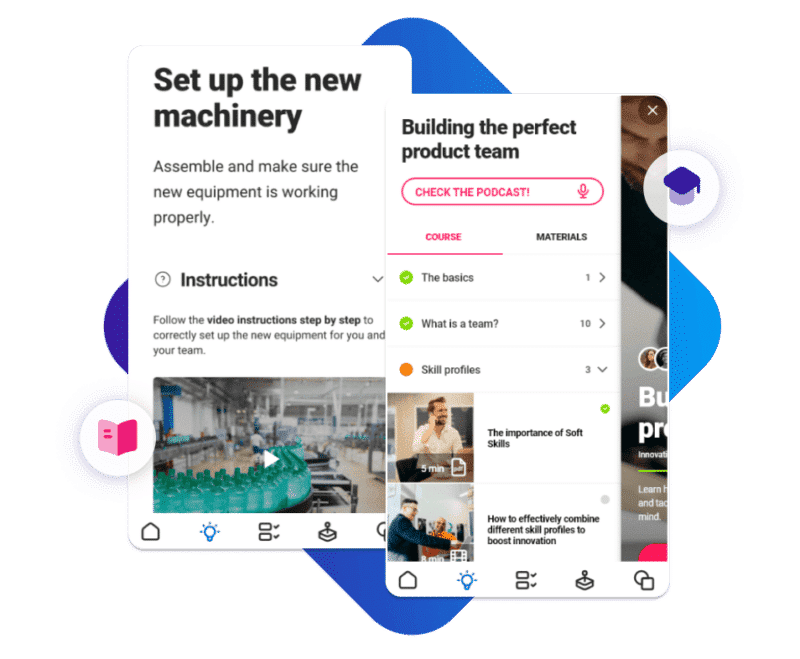
Microlearning is ideal for developing technical skills, as complex topics can be broken down into progressive micro-modules. Short videos or tutorials make dense content more accessible. You can explore the most effective formats in our guide on microlearning videos.
The onboarding process is one of microlearning’s most powerful use cases. Rather than overwhelming a new hire with hours of training in their first week, micro-training progressively distributes information: what they need to know today, what they’ll need tomorrow, and what they can reinforce the following week. This improves both knowledge retention and the onboarding experience.
Training on regulatory compliance, risk prevention, or internal policies is often perceived as tedious. Microlearning — especially when it incorporates quizzes and gamification elements — transforms this type of content into something more digestible and easy to complete, without sacrificing rigor.
Embedding training in the flow of work itself is the natural evolution of microlearning. Rather than interrupting the workday to train, employees access content exactly when they need it and in the context where they’ll use it. You can explore this approach further in our article on learning in the flow of work.
Microlearning is versatile by nature. It can take many forms depending on the learning objective and the team’s profile. Knowing them will help you choose the most appropriate one for each situation.
| Format | Characteristics | When to use it |
|---|---|---|
| Short video (3–10 min) | The most effective and popular format. Pausable, repeatable and easy to consume on mobile. | Explaining processes, product launches, tool tutorials |
| Infographic and visual resource | Visual synthesis of processes, statistics or workflows. | Reinforcing learned concepts, internal communication |
| Interactive quiz | Assesses and consolidates knowledge. Gamifiable with points and rankings. | Compliance, regulatory training, post-session review |
| Podcast and audio (5–8 min) | Consumable while doing other tasks. No full visual attention required. | Commuting, low-concentration tasks |
| Structured text pill | Short article with subheadings and bold text. Distributable via newsletter or intranet. | Procedure updates, internal news |
| Just-in-time micro-module | Designed to be consulted at the exact moment it is needed. | Before a meeting, when facing a new process |
Confusing the two is common. The reality is that they are complementary, not mutually exclusive.
E-learning is the umbrella term that covers all technology-mediated learning: LMS platforms, online courses, webinars, structured learning itineraries. It can involve multi-hour sessions and complex content architecture.
Microlearning is a content design philosophy that can be applied within e-learning. Any online course can be structured into short modules following micro-training principles. A well-known example is Duolingo: an e-learning app built on a microlearning model with short, gamified, mobile-friendly lessons.
At isEazy we work with this logic: microlearning courses for companies do not replace structured training programs — they complement them, reinforcing knowledge between sessions, updating specific skills, and keeping employees engaged over time. If you want a broader look at e-learning content and its formats, check out our dedicated guide.
To successfully implement a microlearning strategy in your company, keep these key recommendations in mind:
Visual content has a direct positive impact on information retention. Integrate graphics, videos, and interactive resources into your modules. You can explore the types of interactive learning that work best in corporate training, and also look into video learning for corporate training to get the most out of the audiovisual format.
Always define the key concepts you want to convey before producing the module. Content must be aligned with each employee’s specific objectives and those of the organization. A module that doesn’t address a real on-the-job need gets abandoned before it’s finished.
Incorporating collaborative elements and immediate feedback into your modules builds a more dynamic learning environment. Employees can share experiences and knowledge, enriching the process. Immediate feedback also helps them identify and work on their weak points.
Information delivered in small doses, combined with spacing and repetition, contributes to better long-term retention. Distribute content so employees can return to key topics after a time interval. Periodic reinforcement activities are especially useful for this purpose.
Microlearning and gamification are two methodologies that, combined, boost motivation and learning. Daily challenges, quick questions, leaderboards — these elements make the experience more engaging and memorable.
E-learning podcasts are one of the fastest-growing microlearning formats. They allow employees to train while performing other tasks that don’t require full visual attention: commuting, routine tasks, breaks. A 5–8 minute episode on a specific skill can be just as effective as a longer in-person session.
Implementing tracking and assessment systems lets you measure the effectiveness of your training. Use analytics to evaluate employee engagement and information retention, and adjust content when needed. Always define your indicators before launching the program — not after.

Now that you understand what microlearning is and how to use it, it’s time to identify where in your training program to apply it most effectively.
Microlearning can be used in onboarding programs, to explain specific tasks via just-in-time learning, or in internal communications when you need to align teams around multiple processes simultaneously. But its primary use is in-company training, and you can apply it in areas such as:
Microlearning is perfectly suited to the most digital-native generations, remote workers, and frontline employees, giving them access to agile, dynamic training that’s always available from their smartphone.
Microlearning is especially powerful as a vehicle for upskilling (improving current competencies) and reskilling (acquiring new skills for a different role). Its short modules enable a gradual transition without overwhelming the employee: each week they learn a little more, reinforce what they’ve covered, and advance without disrupting their day-to-day work. This combination is one of the most strategically relevant approaches in talent management today, and microlearning — embedded in a continuous training plan — is the tool that makes it scalable.
We mentioned earlier that combining microlearning with gamification is a best practice. Why? Because gamification makes the microlearning experience even more engaging, so employees retain knowledge better and for longer.
The combination of gamification and microlearning allows you to:
A real-world example of this combination in action: Clarel, a drugstore and beauty retail chain, achieved an 84% engagement rate in its store employee training programs by integrating gamified microlearning with isEazy. Find out how they did it →
CASE STUDY
We helped Clarel transform its knowledge into interactive and effective microcontents

As we’ve seen, microlearning adapts to a wide variety of contexts and needs. Here are the most common formats and what each one contributes:
Microlearning can help your company significantly reduce the time and cost you invest in training employees, while enabling them to acquire new knowledge quickly and easily. If you’re looking for a dedicated microlearning solution, our microlearning platform is designed so any company can create, distribute, and measure training capsules without friction.
To get started, discover isEazy Engage, the training app built to hook your employees from day one. Design your training with the most engaging interactive microcontent on the market and multiply your results while your employees learn effortlessly.
And if your goal is to develop competencies and skills continuously, isEazy Skills offers the most comprehensive catalog on the market in microlearning format: a 60% audiovisual content and 40% interactive resources blend, designed so that learning transfers directly to the job.
A microlearning module typically lasts between 3 and 10 minutes, though it can run up to 15 minutes depending on the content. What matters is not a fixed duration, but that each capsule focuses on a single learning objective. This format aligns with Deloitte’s finding that professionals have just 1% of their working week available for learning — roughly 24 minutes. In that context, a brief, well-designed module is far more effective than a long session an employee will never complete.
Yes, microlearning adapts to virtually any professional profile, though it is especially effective for frontline workers, remote employees, and those with highly fragmented schedules. Because it is accessible from a smartphone and requires no long blocks of time, it removes the main barriers to workplace learning. For profiles with more complex or structured learning needs, microlearning works best as a complement to broader programs rather than as a standalone methodology.
Traditional e-learning is typically structured around multi-hour courses with extensive curricula and a linear progression. Microlearning, by contrast, breaks that same knowledge into self-contained capsules of a few minutes, each focused on a single concept or skill. The two approaches are not mutually exclusive — in fact, many e-learning platforms incorporate microlearning principles into their design. The key difference lies in content granularity and how it is consumed: microlearning is pull-based (employees access it when they need it), while traditional e-learning tends to be push-based (the company assigns a set itinerary).
The impact of microlearning can be measured through a combination of metrics: module completion rates, results on post-learning assessments or quizzes, time-to-application of knowledge on the job, and improvements in business indicators linked to the trained area (sales, error rates, onboarding time). A well-configured LMS can cross-reference this data automatically. Most importantly, define your KPIs before launching the program — not after — so measurement has a clear baseline to work from.

GUIDE
Prepare your organization to comply with the new AI Regulations
Download guide


Need fast, effective, and easy-to-digest content?
Reinforce learning and boost knowledge retention with the most engaging multimedia and interactive micro-content

Need fast, effective, and easy-to-digest content?
Reinforce learning and boost knowledge retention with the most engaging multimedia and interactive micro-content