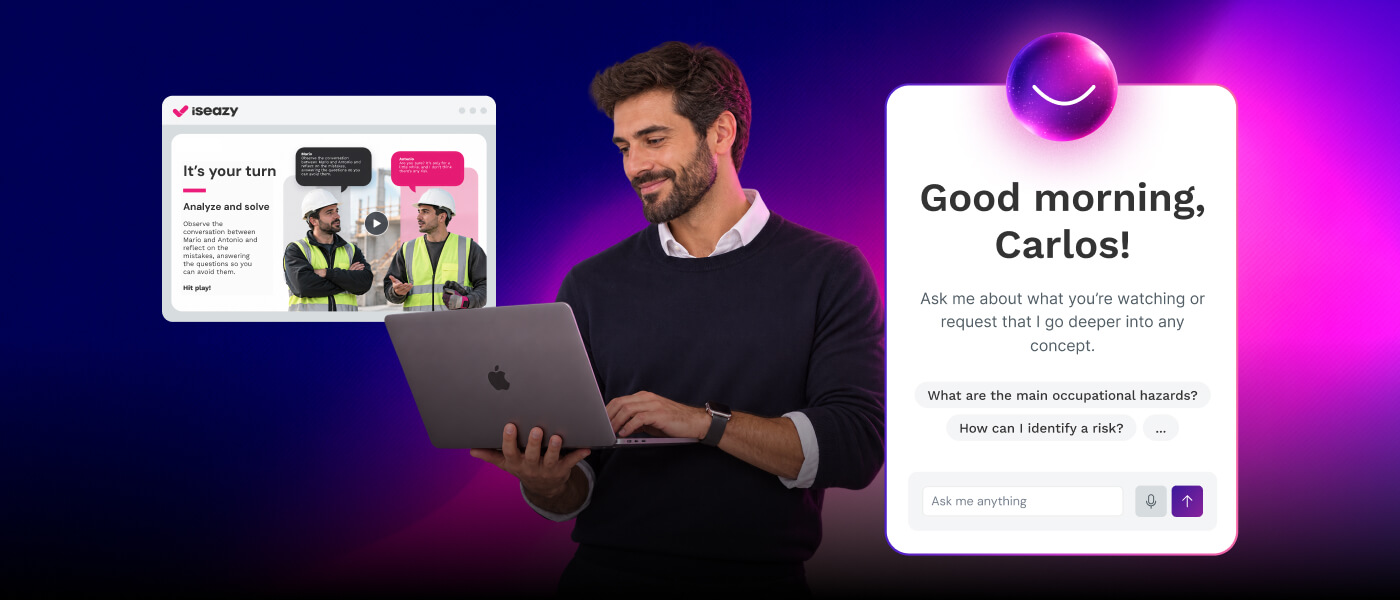
CASE STUDY
Learn how we helped AKRON Group promote upskilling and reskilling of their workforce

Brain
The first AI trained to teach

Author
The #1 AI-powered authoring tool on the market

Factory
Custom e-learning content factory

Skills
Comprehensive power skills course catalog

LMS
All-in-one LMS platform with AI

Engage
App for managing frontline teams
Product

What is Brain?
Everything you need to know about the first AI trained to teach.

How does it work?
Adaptive, conversational, and contextual. That’s learning with Brain.

Security
Why your company’s knowledge never leaves your environment or trains other models.

Comparison
Discover what sets isEazy Brain apart from other AI solutions.

Frequently Asked Questions
Want to learn more? Find answers to all your questions about isEazy Brain here.
FEATURES

AINew
Unlock your full potential and speed up course creation with artificial intelligence.

Accessibility
Automatically meet accessibility guidelines—without sacrificing interactivity!

Interactivity
Boost engagement with interactive, ready-to-use activities that make learning fun.

Course Creation
Reduce the time it takes to create your e-learning courses with our authoring tool.

Distribution
We offer you different distribution options, so that nothing can stop you.

SCORM
Publish your course in SCORM format and share it on any LMS.
SERVICES

Instrucional Design
Surprise your students with multimedia and interactive content.

Custom Courses
We create e-learning courses for you—tailored to your needs and hassle-free!

Virtual Reality
Turn learning into an immersive experience.

Custom Avatars
Give your courses and videos a unique touch with personalized avatars.

Audiovisual FactoryNew
Turn training into something dynamic and visual with engaging videos.
CATALOG

Course catalog
Over 600 skills and competency courses to help you adapt to your team's needs.
Microsoft Copilot AcademyNew
Your professionals will learn how to apply Copilot AI to key processes within your organization.

Artificial Intelligence Academy
Train your teams in the practical use of AI to boost productivity and innovation in your company.

Cybersecurity Academy
Capacita a tu empresa con el catálogo más completo en seguridad digital corporativa.
FEATURES

Learning platform
Manage all your training from one place

Analitycs
Measure the impact of your training

Learning Experience
Offer a unique learning experience to your team
Content Library
Choose from hundreds of expert-created courses
Authoring Tool
Create your own content—faster than ever

Use cases
Choose the solution that best fits your needs

Industries
Solutions for all types of industries
USE CASES

Onboarding
Facilitate the onboarding process, productivity and engagement of your new employees.

Upskilling
Boost your team's skills and prepare them for the challenges of the future with upskilling.

Microlearning
Discover all the advantages of microlearning and boost your training results.

Gamification
Enjoy addictive training that will get your professionals hooked.

Internal Communication
Improve communication in your company and enjoy an aligned and committed team.

Mobile learning
Agile, flexible, and interactive learning—built for today’s digital-first workforce.
INDUSTRIES

Banking and financial services
Training in compliance, cybersecurity, customer service, and key skills development.

Pharmaceuticals and healthcare
Digital onboarding, regulatory updates, and ongoing training for healthcare staff.

Retail and consumer
Agile and scalable training for in-store, operational, and customer service teams.

Industry and manufacturing
Training in processes, safety, and corporate culture for distributed teams.

Education and training
Digital solutions for training centers, internal academies, and corporate universities.

Technology and telecommunications
Development of technical talent, digital skills, and upskilling and reskilling programs.
CLIENTS

MAPFRE
How MAPFRE turn e-learning into sales with isEazy

Pepco
A personalised learning experience for a growing team.

BBVA
Digitisation and creation of high quality e-learning content.

Shiseido
We increase the engagement of the training with a social and gamified app.

Telefónica
Large-scale reskilling for the company's digital transformation.

Vodafone
A personalised learning experience for a growing team.
More than 1,000 companies already rely on isEazy.





MEET ISEAZY

Events
Discover our upcoming events and connect with the future of e-learning.

News
Find out the latest news about isEazy: press releases, partnerships, updates...

Contact
Leave us your personal details and we will contact you as soon as possible.
About isEazyNew
Find out more about our company.

Careers
We are looking for the best talent, join our team!

Partners
Become our partner and grow your business.
INTERESTING RESOURCES

Blog
The best content on e-learning: trends, tools and key strategies.

Whitepapers
Gain valuable insights and stay ahead of industry trends.

Product releases
The latest news and releases of our e-learning products and solutions.

Glossary
Definitions of the most commonly used terms and key industry concepts.

Guides
Discover the best step-by-step tips and tricks to optimize your L&D strategy.

Webinars
Video sessions on our products, trends and more

Comparatives
Compare e-learning solutions available on the market and choose the most suitable one.


WEBINAR
Master AI in isEazy Author in under an hour.




GUIDE
Prepare your organization to comply with the new AI regulations

Stay up to date with all our latest news
 Subscribe to our newsletter
 Stay up to date with all our latest news

May 5, 2026

CONTENT CREATED BY:

Table of contents
Non-formal training in the workplace is today one of the most important pillars of talent development. Unlike formal education, it does not lead to an official qualification, but it offers something equally valuable: the ability to learn exactly what is needed, when it is needed, and in the format best suited to each team. According to LinkedIn Learning’s Workplace Learning Report, 94% of employees say they would stay longer at a company that invests in their learning and professional development. In this guide, you will find everything you need to know to design, implement, and measure a non-formal training plan that generates real impact in your organisation.
Non-formal training refers to any learning process that does not form part of the official state-regulated education system. It does not lead to an academic qualification with official validity (such as a university degree or vocational qualification), but it can generate certificates, accreditations, or simply knowledge and competencies that can be applied directly to the job.
From an Excel course on the internal training platform to a tailored leadership programme, or a series of microlessons on the new sales protocol: all of this is non-formal training. In the corporate context, non-formal training is the most common form of continuous learning — the kind that allows organisations to respond quickly to new challenges, close skills gaps, and keep their teams aligned with business objectives.

Understanding the differences between both modalities is essential for making good decisions as an L&D professional. It is not a matter of one being better than the other, but of knowing when and what each one is for.
| Criterion | Formal training | Non-formal training |
|---|---|---|
| Qualification | Official degree (university, vocational, master's) | Internal certificate or proprietary accreditation |
| Regulation | Ministry of Education | Public employment bodies / free market |
| Duration | Months or years | Hours, days, or weeks |
| Flexibility | Rigid (fixed curriculum) | Total (adaptable to the company) |
| Cost | High (tuition, fees) | Variable; may be publicly subsidised |
| Focus | Academic and theoretical | Practical and role-oriented |
For most corporate training needs — onboarding, upskilling, compliance, product launches, soft skills — non-formal training is the most agile and cost-effective option.
One of the great strengths of non-formal training is its versatility. It can take many different forms depending on the objective, the employee profile, and the available resources:

Non-formal training is not simply a cheaper alternative: it is a strategic tool that, when well designed, generates real return. These are its main advantages in the corporate environment:

Good intentions with training are not enough. Real impact comes from having a structured plan. This 4-step framework helps you design and execute non-formal training programmes in an effective and measurable way:
Before creating any content, identify the skills gap: what can employees do today, and what will they need to do tomorrow? The most useful sources are performance reviews, manager interviews, analysis of common errors, or customer feedback. This step defines the learning objectives and priority audiences.
With the needs clearly defined, select the most appropriate formats (e-learning, microlearning, blended, mentoring), structure the learning pathways, and produce the content. This is the phase where an authoring tool like isEazy Author makes the difference: it allows you to create interactive, professional-quality courses without technical knowledge, in a fraction of the time required by traditional tools.
A good LMS is essential for deploying content to all employees, managing enrolments, sending reminders, and ensuring that training reaches the right person at the right time. Without a platform, management becomes a manually intensive, error-prone process.
Measuring results is not optional. Define KPIs before launching (completion, knowledge gain, job application, business impact), collect data during the programme, and use it to continuously improve content and methodology. A plan that is not measured is a plan that is not improving.

E-learning has transformed the way companies execute their non-formal training. What once required classrooms, travel, and in-person trainers can now be delivered digitally, asynchronously, and in a personalised way to any employee, anywhere, on any device.
The combination of non-formal training and e-learning is particularly powerful because:
Companies like AKRON Group have leveraged this combination to drive upskilling and reskilling programmes at scale, transforming their internal training processes with measurable results in both employee development and business performance.
CASE STUDY
Learn how we helped AKRON Group promote upskilling and reskilling of their workforce


Beyond creating one-off courses, the most mature L&D organisations structure their non-formal training around skills catalogues that enable employees to develop autonomously and in alignment with the company’s strategic objectives.
isEazy Skills offers a ready-to-use catalogue of over 600 courses in key areas (leadership, communication, productivity, digital skills, wellbeing, and more), perfectly integrable into any non-formal training plan. Each course is designed using a microlearning methodology to maximise retention and engagement, without requiring large blocks of time from employees.

Choosing the right tool is key to making your non-formal training programme work. From skills platforms to specialised solutions, here are some of the most relevant options on the market:

Features
Benefits
Ratings
Specialized Schools
Features
Benefits
Ratings
Specialized Schools

Features
Advantages
Ratings
Features
Advantages
Ratings

Features
Advantages
Ratings
Features
Advantages
Ratings
Non-formal training is no longer an optional complement to talent strategy: it is its backbone. In a business environment where skills become obsolete in less than five years (according to the World Economic Forum’s Future of Jobs Report), the ability to learn with agility has become a critical organisational competency.
Companies that design well-structured non-formal training programmes — with clear objectives, appropriate formats, the right technology, and rigorous measurement — achieve better-prepared teams, stronger talent retention, and a more resilient organisation in the face of change.
If you are ready to take the next step, isEazy Author and isEazy LMS give you everything you need to create, manage, and measure non-formal training that truly makes a difference. Request a demo and discover how leading companies are transforming their L&D strategy with isEazy.
Non-formal training is not generally mandatory, although there are sector-specific exceptions established in collective agreements that may set a minimum number of annual training hours. What is recognised in employment law is the right of employees to professional development and training at work. Beyond legal obligations, companies that invest in ongoing non-formal training gain clear competitive advantages: lower turnover, higher productivity, and teams that are better equipped to adapt to change.
Non-formal training can be subsidised through various public funding schemes depending on the country. In Spain, for example, companies can apply training credits managed by FUNDAE (the State Foundation for Employment Training), based on their size and previous social security contributions. These credits can be applied to courses, workshops, e-learning programmes, or any training activity that improves employee competencies, provided the relevant requirements are met. Small and micro businesses typically benefit from especially favourable conditions.
Non-formal training encompasses a wide range of formats adapted to each company’s needs: in-person or virtual courses and workshops, e-learning and microlearning programmes, mentoring and coaching, on-the-job training, communities of practice, job rotation, conferences, webinars, and learning pills. In recent years, e-learning has become the dominant format in corporate environments due to its flexibility, scalability, and personalisation capabilities — especially when combined with an LMS platform that enables learning tracking.
Measuring the impact of non-formal training requires defining indicators before launching any training initiative. The most common KPIs in corporate settings are: programme completion rate and engagement, results from assessments or knowledge tests, practical application on the job (measured through observation or self-assessment), improvement in associated business indicators (productivity, quality, onboarding time), and return on investment (training ROI). The Kirkpatrick model — reaction, learning, behaviour, and results — remains the most widely used framework for structuring this measurement systematically.

Streamline your training management
Experience the power of AI in an LMS that has it all


Streamline your training management
Experience the power of AI in an LMS that has it all