Brain
The first AI trained to teach

Author
The #1 AI-powered authoring tool on the market

Factory
Custom e-learning content factory

Skills
Comprehensive power skills course catalog

LMS
All-in-one LMS platform with AI

Engage
App for managing frontline teams


FEATURES

AINew
Unlock your full potential and speed up course creation with artificial intelligence.

Accessibility
Automatically meet accessibility guidelines—without sacrificing interactivity!

Interactivity
Boost engagement with interactive, ready-to-use activities that make learning fun.

Course Creation
Reduce the time it takes to create your e-learning courses with our authoring tool.

Distribution
We offer you different distribution options, so that nothing can stop you.

SCORM
Publish your course in SCORM format and share it on any LMS.

SERVICES

Instrucional Design
Surprise your students with multimedia and interactive content.

Custom Courses
We create e-learning courses for you—tailored to your needs and hassle-free!

Virtual Reality
Turn learning into an immersive experience.

Custom Avatars
Give your courses and videos a unique touch with personalized avatars.

Audiovisual FactoryNew
Turn training into something dynamic and visual with engaging videos.

CATALOG

Course catalog
Over 600 skills and competency courses to help you adapt to your team's needs.
Microsoft Copilot AcademyNew
Your professionals will learn how to apply Copilot AI to key processes within your organization.

Artificial Intelligence Academy
Train your teams in the practical use of AI to boost productivity and innovation in your company.

Cybersecurity Academy
Capacita a tu empresa con el catálogo más completo en seguridad digital corporativa.


Use cases
Choose the solution that best fits your needs

Industries
Solutions for all types of industries
USE CASES

Onboarding
Facilitate the onboarding process, productivity and engagement of your new employees.

Upskilling
Boost your team's skills and prepare them for the challenges of the future with upskilling.

Microlearning
Discover all the advantages of microlearning and boost your training results.

Gamification
Enjoy addictive training that will get your professionals hooked.

Internal Communication
Improve communication in your company and enjoy an aligned and committed team.

Mobile learning
Agile, flexible, and interactive learning—built for today’s digital-first workforce.
INDUSTRIES

Banking and financial services
Training in compliance, cybersecurity, customer service, and key skills development.

Pharmaceuticals and healthcare
Digital onboarding, regulatory updates, and ongoing training for healthcare staff.

Retail and consumer
Agile and scalable training for in-store, operational, and customer service teams.

Industry and manufacturing
Training in processes, safety, and corporate culture for distributed teams.

Education and training
Digital solutions for training centers, internal academies, and corporate universities.

Technology and telecommunications
Development of technical talent, digital skills, and upskilling and reskilling programs.
CLIENTS

MAPFRE
How MAPFRE turn e-learning into sales with isEazy

Pepco
A personalised learning experience for a growing team.

BBVA
Digitisation and creation of high quality e-learning content.

Shiseido
We increase the engagement of the training with a social and gamified app.

Telefónica
Large-scale reskilling for the company's digital transformation.

Vodafone
A personalised learning experience for a growing team.
More than 1,000 companies already rely on isEazy.






MEET ISEAZY

Events
Discover our upcoming events and connect with the future of e-learning.

News
Find out the latest news about isEazy: press releases, partnerships, updates...

Contact
Leave us your personal details and we will contact you as soon as possible.
About isEazyNew
Find out more about our company.

Careers
We are looking for the best talent, join our team!

Partners
Become our partner and grow your business.

INTERESTING RESOURCES

Blog
The best content on e-learning: trends, tools and key strategies.

Whitepapers
Gain valuable insights and stay ahead of industry trends.

Product releases
The latest news and releases of our e-learning products and solutions.

Glossary
Definitions of the most commonly used terms and key industry concepts.

Guides
Discover the best step-by-step tips and tricks to optimize your L&D strategy.

Webinars
Video sessions on our products, trends and more

Comparatives
Compare e-learning solutions available on the market and choose the most suitable one.


WEBINAR
Master AI in isEazy Author in under an hour.




GUIDE
Prepare your organization to comply with the new AI regulations


AUTHORING TOOL
Create courses automatically and generate interactive activities, games, translations, and multimedia resources in seconds.

Stay up to date with all our latest news
 Subscribe to our newsletter
 Stay up to date with all our latest news

June 16, 2026
Quiet cracking: what it is and how it affects employee engagement

CONTENT CREATED BY:

Table of contents
What is quiet cracking?
Quiet cracking, or silent fracturing, is a state of progressive emotional deterioration in which an employee maintains their external performance while losing motivation, engagement, and wellbeing from within. Unlike other phenomena such as quiet quitting, it is not a conscious choice: it is an invisible process that particularly affects the most committed profiles.
In today’s organizational landscape, quiet cracking represents one of the greatest risks to talent retention and corporate culture. Its invisibility makes it a difficult problem to detect until it has already caused significant damage to the team.
Origin of the concept and current context
The term was coined and popularized by TalentLMS from its 2024 report, which revealed that 54% of employees feel unhappy at work, with a frequency ranging from occasional to constant. Unlike quiet quitting — which emerged as a conscious, viral response to post-pandemic exhaustion — quiet cracking describes something deeper: a deterioration that is not chosen, and that the employee themselves often fails to recognize.
The phenomenon has intensified in recent years due to several converging factors: a cooler labor market that traps employees in roles they no longer find fulfilling, technological acceleration — especially AI — and a lack of investment in professional development. According to an Upwork report, 88% of top AI-using employees report burnout and are twice as likely to consider leaving their company.
Quiet cracking vs. quiet quitting: key differences
Although both concepts coexist in today’s HR vocabulary and share the root of employee disengagement, they respond to very different dynamics. Understanding the difference is key to choosing the right response strategy.
| Aspect | Quiet quitting | Quiet cracking |
|---|---|---|
| Nature | Conscious, voluntary decision | Involuntary emotional deterioration |
| External performance | Measurably drops | Maintained or appears normal |
| Visibility | Detectable through performance metrics | Nearly invisible to managers and HR |
| Most affected profile | Demotivated or conflicted employees | High-commitment, high-performance employees |
| Warning sign | Active reduction of effort | Subtle shifts in energy and attitude |
| Main cause | Dissatisfaction with working conditions | Lack of development, recognition, or purpose |
| Risk to the organization | Short-term productivity loss | Loss of key talent in the medium to long term |
Signs and symptoms of quiet cracking every manager should know
The greatest challenge of quiet cracking is that its symptoms don’t show up in standard performance KPIs. The employee keeps delivering, meeting deadlines, and attending meetings. The deterioration occurs in subtler layers that require active, close observation:
- Reduced proactive participation: stops proposing ideas, contributing in meetings, or going beyond what’s asked.
- Emotional distance: responses become shorter, more formal, and less personal.
- Loss of interest in development: declines training opportunities, new projects, or additional responsibilities they would previously have welcomed.
- Physical signs of exhaustion: more absences, arriving just on time, leaving at the exact end of the workday.
- Disconnection from company culture: reduced participation in team initiatives, events, or informal communication channels.
- Shift in relational quality: spontaneous collaboration decreases and transactional communication increases.
According to business psychologist Dannielle Haig, quiet cracking “can go unnoticed for long periods of time” because it shows up in subtle ways: “a drop in creativity, slower decision-making, more mistakes, or less collaboration.” By the time the manager notices it, the damage is often already deep.
Causes of quiet cracking in the corporate environment
Quiet cracking doesn’t have a single cause. It is the result of a set of systemic factors that, combined, create the ideal environment for an employee to fracture silently:
- Absence of professional development: the lack of learning and growth opportunities is the most commonly cited cause. Only 1 in 4 companies offers formal training in new skills, according to Upwork.
- Lack of recognition: employees experiencing quiet cracking are 152% more likely to feel undervalued, according to TalentLMS.
- Routine without challenge: when work becomes predictable and offers no new stimulation, intrinsic motivation erodes progressively.
- Silent overload: taking on additional responsibilities without visible compensation generates accumulated tension with no outlet.
- Technological uncertainty: the acceleration of AI without accompanying training creates anxiety and a sense of obsolescence.
- Closed labor market: difficulty changing jobs in limited-hiring environments traps employees in roles that no longer fulfill them.
The aggregate cost of this phenomenon is quantifiable: according to Gallup’s State of the Global Workplace report, employee disengagement costs $438 billion annually in lost productivity worldwide.
Impact of quiet cracking on employee engagement and talent retention
Quiet cracking is not just an individual wellbeing issue — it has direct, measurable consequences on the metrics that matter most to organizations. An employee in a state of quiet cracking may maintain basic productivity in the short term, but they are on an exit trajectory that accelerates over time.
The most documented impacts include:
- Higher voluntary turnover: employees showing symptoms of quiet cracking are significantly more likely to be actively seeking new opportunities, even if they don’t communicate it.
- Loss of tacit knowledge: when a high-performing profile who has been in quiet cracking leaves, they take years of accumulated knowledge with them — knowledge that is difficult to transfer.
- Contagion effect: emotional disengagement is contagious. A team with several members in quiet cracking tends to develop a low-commitment culture that also affects those who are still motivated.
- Erosion of innovation: creativity and initiative are the first capabilities to withdraw when an employee fractures silently, reducing the team’s continuous improvement capacity.
For L&D and HR teams, quiet cracking is a signal that development programs, recognition, and culture are not working as they should. It is not an individual problem — it is an organizational symptom.
Grupo AKRON is a strong example of how a well-implemented upskilling and reskilling strategy can reverse employee disengagement. With isEazy, AKRON designed a continuous learning program that connected skills development with their teams’ career goals, achieving significant improvements in engagement and talent retention.
Find out how they did it →
How to prevent quiet cracking from HR and L&D: 4 key levers
The good news is that quiet cracking is preventable — and reversible in its early stages — if the organization acts proactively. These are the four levers that HR and L&D teams can activate:
1. Continuous learning and professional development
Investing in employee growth is the most direct antidote. Employees who received training the previous year feel significantly more confident and engaged in their role, according to TalentLMS. Professional development is not an optional benefit — it’s a signal that the company is investing in the person. Discover how to build effective manager training programs.
2. Structured and frequent recognition
Informal or one-off recognition is not enough. It’s necessary to design structured feedback cycles — pulse surveys, frequent one-to-ones, celebration of achievements — that make each person’s value visible before they feel unnoticed.
3. Psychological safety and open communication
Employees in quiet cracking rarely ask for help because they don’t identify their own state. Creating environments where it’s safe to voice difficulties — without fear of consequences — is fundamental for problems to surface before they worsen. Training managers in active listening and early detection is key here. Explore how microlearning can support manager development at scale.
4. Purposeful career path design
Monotony is one of the main causes of quiet cracking. Offering projects with new challenges, personalized career plans, and internal mobility opportunities maintains the employee’s emotional connection to their work and to the organization.
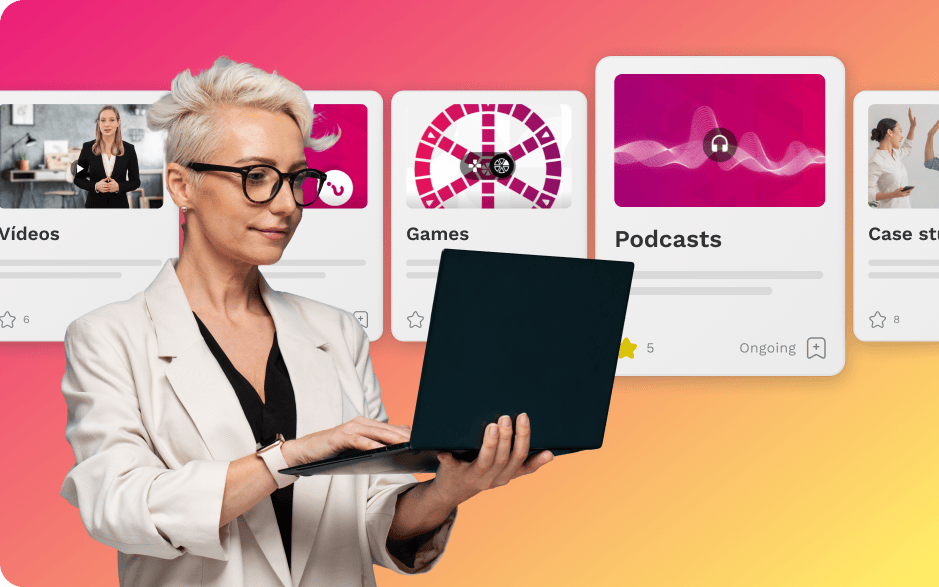
The role of continuous learning as an antidote to quiet cracking
Of all the levers available to prevent quiet cracking, continuous learning has the greatest impact on the root causes of the phenomenon. Not because it’s a “benefit” that superficially improves job satisfaction, but because it directly targets the two fractures that break an employee most: the feeling of stagnation and the absence of recognized value.
A well-designed upskilling and reskilling program does three things at once: it develops skills the organization needs, gives the employee a visible growth trajectory, and communicates that the company is investing in their future. This triple function turns learning into a tool for engagement management, not just technical training.
Organizations that integrate learning into the flow of work — with microlearning, personalized pathways, and training accessible from any device — ensure that professional development is not a separate activity from work, but part of the employee’s daily experience. This reduces the feeling of stagnation that fuels quiet cracking.
Conclusion: quiet cracking as an opportunity for transformation
Quiet cracking is, above all, a signal. An indicator that something in the relationship between the employee and the organization is failing — silently but persistently. For HR and L&D teams, recognizing this phenomenon early is not just a matter of wellbeing: it is a strategic priority for retention and culture.
The good news is that organizations that understand quiet cracking as an organizational symptom — not an individual problem — have the tools to reverse it. Investing in continuous learning, creating genuine recognition channels, training managers in early detection, and designing purposeful career paths are not peripheral wellbeing initiatives: they are the foundations of a culture where employees don’t need to crack silently to be seen.
Companies that act before reaching the breaking point will hold a real competitive advantage in the talent war of the coming years. Request a demo and discover how isEazy can help you prevent quiet cracking.
Frequently asked questions about quiet cracking
What’s the difference between quiet cracking and burnout?
Although they share some symptoms, burnout is a state of extreme, visible exhaustion that typically disrupts job performance. Quiet cracking, on the other hand, is far more subtle: the employee maintains their external level of output while deteriorating emotionally on the inside. Burnout is usually recognized because performance visibly drops; quiet cracking can go undetected for months or even years because the worker continues to “function” on the surface. This invisibility is precisely what makes it so dangerous.
How can I detect quiet cracking in my team?
The most telling signs aren’t found in performance metrics, but in behavioral shifts: reduced proactive participation in meetings or communication channels, loss of initiative, shorter and more formal-than-usual responses, or decreased interest in projects that previously motivated the employee. Managers should pay attention to gradual changes in energy and attitude, especially among profiles who were historically proactive. Frequent pulse surveys and structured one-to-one conversations are key tools for detecting it early.
Does quiet cracking only affect low-performing employees?
No — and that’s what makes it an especially high-stakes risk. Quiet cracking most often affects high-performing profiles: committed employees who internalize pressure, don’t voice their struggles, and keep delivering even while emotionally fractured. According to Upwork’s research, top AI-using employees are twice as likely to experience burnout, placing them at the center of the problem. Losing these profiles has a direct cost in productivity, culture, and retention.
What role does training play in preventing quiet cracking?
Continuous learning is one of the most effective levers for preventing quiet cracking because it directly targets two of its root causes: the lack of professional development and the feeling of stagnation. According to TalentLMS, employees who received training the previous year feel significantly more confident and engaged in their role. Designing personalized upskilling and reskilling programs — connected to the employee’s interests and career goals — not only reduces the risk of quiet cracking but also reinforces the emotional bond with the organization.
Featured articles




WHITEPAPER
Design an onboarding plan that wins over new talent
Learn how to create a strong, effective onboarding program that improves retention and employer branding.
Download whitepaper


Las mejores soluciones e-learning
Elije la herramienta que mejor se adapta a tus necesidades y pruébala gratis.


Las mejores soluciones e-learning
Elije la herramienta que mejor se adapta a tus necesidades y pruébala gratis.
Related articles