Brain
The first AI trained to teach

Author
The #1 AI-powered authoring tool on the market

Factory
Custom e-learning content factory

Skills
Comprehensive power skills course catalog

LMS
All-in-one LMS platform with AI

Engage
App for managing frontline teams
Product

What is Brain?
Everything you need to know about the first AI trained to teach.

How does it work?
Adaptive, conversational, and contextual. That’s learning with Brain.

Security
Why your company’s knowledge never leaves your environment or trains other models.

Comparison
Discover what sets isEazy Brain apart from other AI solutions.

Frequently Asked Questions
Want to learn more? Find answers to all your questions about isEazy Brain here.

FEATURES

AINew
Unlock your full potential and speed up course creation with artificial intelligence.

Accessibility
Automatically meet accessibility guidelines—without sacrificing interactivity!

Interactivity
Boost engagement with interactive, ready-to-use activities that make learning fun.

Course Creation
Reduce the time it takes to create your e-learning courses with our authoring tool.

Distribution
We offer you different distribution options, so that nothing can stop you.

SCORM
Publish your course in SCORM format and share it on any LMS.

SERVICES

Instrucional Design
Surprise your students with multimedia and interactive content.

Custom Courses
We create e-learning courses for you—tailored to your needs and hassle-free!

Virtual Reality
Turn learning into an immersive experience.

Custom Avatars
Give your courses and videos a unique touch with personalized avatars.

Audiovisual FactoryNew
Turn training into something dynamic and visual with engaging videos.

CATALOG

Course catalog
Over 600 skills and competency courses to help you adapt to your team's needs.
Microsoft Copilot AcademyNew
Your professionals will learn how to apply Copilot AI to key processes within your organization.

Artificial Intelligence Academy
Train your teams in the practical use of AI to boost productivity and innovation in your company.

Cybersecurity Academy
Capacita a tu empresa con el catálogo más completo en seguridad digital corporativa.
FEATURES

Learning platform
Manage all your training from one place

Analitycs
Measure the impact of your training

Learning Experience
Offer a unique learning experience to your team
Content Library
Choose from hundreds of expert-created courses
Authoring Tool
Create your own content—faster than ever


Use cases
Choose the solution that best fits your needs

Industries
Solutions for all types of industries
USE CASES

Onboarding
Facilitate the onboarding process, productivity and engagement of your new employees.

Upskilling
Boost your team's skills and prepare them for the challenges of the future with upskilling.

Microlearning
Discover all the advantages of microlearning and boost your training results.

Gamification
Enjoy addictive training that will get your professionals hooked.

Internal Communication
Improve communication in your company and enjoy an aligned and committed team.

Mobile learning
Agile, flexible, and interactive learning—built for today’s digital-first workforce.
INDUSTRIES

Banking and financial services
Training in compliance, cybersecurity, customer service, and key skills development.

Pharmaceuticals and healthcare
Digital onboarding, regulatory updates, and ongoing training for healthcare staff.

Retail and consumer
Agile and scalable training for in-store, operational, and customer service teams.

Industry and manufacturing
Training in processes, safety, and corporate culture for distributed teams.

Education and training
Digital solutions for training centers, internal academies, and corporate universities.

Technology and telecommunications
Development of technical talent, digital skills, and upskilling and reskilling programs.
CLIENTS

MAPFRE
How MAPFRE turn e-learning into sales with isEazy

Pepco
A personalised learning experience for a growing team.

BBVA
Digitisation and creation of high quality e-learning content.

Shiseido
We increase the engagement of the training with a social and gamified app.

Telefónica
Large-scale reskilling for the company's digital transformation.

Vodafone
A personalised learning experience for a growing team.
More than 1,000 companies already rely on isEazy.






MEET ISEAZY

Events
Discover our upcoming events and connect with the future of e-learning.

News
Find out the latest news about isEazy: press releases, partnerships, updates...

Contact
Leave us your personal details and we will contact you as soon as possible.
About isEazyNew
Find out more about our company.

Careers
We are looking for the best talent, join our team!

Partners
Become our partner and grow your business.

INTERESTING RESOURCES

Blog
The best content on e-learning: trends, tools and key strategies.

Whitepapers
Gain valuable insights and stay ahead of industry trends.

Product releases
The latest news and releases of our e-learning products and solutions.

Glossary
Definitions of the most commonly used terms and key industry concepts.

Guides
Discover the best step-by-step tips and tricks to optimize your L&D strategy.

Webinars
Video sessions on our products, trends and more

Comparatives
Compare e-learning solutions available on the market and choose the most suitable one.


WEBINAR
Master AI in isEazy Author in under an hour.




GUIDE
Prepare your organization to comply with the new AI regulations

Stay up to date with all our latest news
 Subscribe to our newsletter
 Stay up to date with all our latest news

June 9, 2026
Burnout syndrome: how to prevent workplace burnout through digital training plans

CONTENT CREATED BY:

Table of contents
Burnout syndrome affects 77% of workers at some point in their career, according to The Adecco Group’s Global Workforce of the Future 2023 report. In the corporate environment, workplace burnout is not just an individual health problem: it is an indicator of organizational failures that can be prevented. And continuous learning is one of the most effective levers for doing so.
What is burnout syndrome?
Burnout syndrome, also known as occupational burnout, is a state of physical, emotional and mental exhaustion caused by chronic, unmanaged work-related stress. Unlike temporary stress, burnout is a cumulative process that profoundly alters a person’s relationship with their work.
In 2019, the World Health Organization (WHO) officially included it in the International Classification of Diseases (ICD-11) as an occupational phenomenon. This formal recognition obliged organizations to address it with structured preventive strategies.
Burnout manifests in three dimensions:
- Energy depletion or exhaustion: a feeling of physical and emotional emptiness that does not go away with rest.
- Cynicism or mental detachment: an attitude of indifference or negativity towards work and colleagues.
- Reduced professional efficacy: the perception of being unable to perform at the expected level, accompanied by a loss of confidence in one’s own abilities.
It is important to distinguish burnout from ordinary work stress: stress is a temporary, reversible response, while burnout is a chronic state that requires active intervention, both individual and organizational. You can explore the impact of psychological wellbeing in the corporate environment further in our article on mental health at work.
Burnout phases: how workplace burnout develops
Burnout does not appear overnight. It is a progressive process that goes through identifiable stages, offering HR and L&D teams intervention windows before the damage becomes irreversible.
- Phase 1 — Initial enthusiasm: high motivation, excessive involvement, difficulty switching off. The person puts in more than the job can give back.
- Phase 2 — Stagnation: expectations go unmet. Frustration appears, along with a sense of disproportionate effort and early doubts about the meaning of work.
- Phase 3 — Chronic frustration: irritability, concentration problems, deteriorating working relationships. Work becomes a constant source of discomfort.
- Phase 4 — Apathy and disengagement: the employee operates on autopilot. Initiative, creativity and commitment disappear. Emotional absenteeism is total, even though the person is still physically present.
- Phase 5 — Collapse: functional incapacity. This can lead to prolonged sick leave, associated physical health problems (insomnia, immune disorders) and the need for clinical intervention.
Identifying warning signs in phases 2 and 3 is where the organization has the greatest capacity for impact. Training and wellbeing programs are especially effective as preventive measures at these early stages.

Causes of burnout in the corporate environment
Burnout has individual causes, but the most determining ones are organizational. According to LinkedIn Learning’s Workplace Learning Report 2024, 94% of employees say they would stay longer at a company that invests in their professional development. When that investment is absent, the risk of burnout multiplies.
The main structural causes of burnout in organizations are:
- Sustained work overload: a volume of tasks that systematically exceeds the employee’s capacity.
- Lack of autonomy and control: no room to make decisions about how and when to do the work.
- Disconnection from purpose: lack of clarity about the real impact of one’s own work on the organization’s objectives.
- Absence of recognition: sustained effort with no positive feedback or perceived reward.
- Professional stagnation: a feeling of not progressing or developing, with no access to training or clear career plans.
- Toxic work environment: unmanaged conflicts, punitive leadership or lack of team support.
This last cause — professional stagnation — is particularly relevant for L&D teams: the absence of training opportunities does not only affect a company’s competitiveness, it is a direct driver of burnout and disengagement.
Consequences of burnout for the organization
Burnout is not just a wellbeing problem: it has a measurable economic and operational impact. According to the European Agency for Safety and Health at Work (EU-OSHA), chronic work-related stress — of which burnout is the most severe expression — accounts for more than 50% of absenteeism in Europe.
The most documented organizational consequences include:
- Increased absenteeism and turnover: employees with burnout leave the company up to 2.5 times more than average, according to Gallup data (2023).
- Drop in productivity: presenteeism (being present without performing) can cost organizations more than sick leave itself.
- Deterioration of team climate: burnout is contagious; teams that coexist with severely exhausted individuals experience greater collective demotivation.
- Loss of key talent: the most committed, high-performing profiles are paradoxically the most vulnerable to burnout, due to their higher initial level of involvement.
- Increase in errors and operational risks: cognitive exhaustion raises the error rate in tasks requiring concentration and judgement.
How to prevent burnout through digital training plans
Training is not just a reactive response to burnout: it is a structural preventive strategy. When continuous learning is part of the organizational culture, employees feel that the company is investing in their development — which directly addresses two of the main causes of burnout: professional stagnation and lack of autonomy.
An effective digital training plan for preventing burnout should be built around four pillars:
- Learning autonomy: allowing each employee to choose what to learn, when and at their own pace. Imposed training increases the burden; self-chosen training generates agency and control — both protective factors against burnout.
- Microlearning integrated into the workflow: short content (5–15 minutes) accessible from mobile devices, which does not add scheduling stress and can be consumed when the employee needs it. This format is especially effective because it reduces the perception of “training as an additional obligation”.
- Planned upskilling and reskilling: programs to develop new competencies — both technical and soft — that restore the employee’s sense of growth and progression. Including emotional management, resilience and communication skills is particularly relevant in high-demand environments.
- Learning gamification: game mechanics applied to training (points, challenges, levels, recognition) that increase intrinsic motivation and make learning a positive experience rather than an added burden.
The key is not to offer more training, but to design it so that it is perceived as a valuable resource, not just another item on the to-do list.
| Preventive strategy | Impact on burnout | Implementation level |
|---|---|---|
| Upskilling and reskilling plans | High — reduces stagnation and restores sense of progress | Medium-high |
| Microlearning in the workflow | High — adds no cognitive load and keeps competencies active | Low-medium |
| Learning gamification | Medium-high — increases motivation and training adherence | Medium |
| Training in emotional self-management skills | High — acts directly on exhaustion and resilience | Medium |
| Healthy leadership programs | Very high — leadership style is the strongest predictor of burnout | High |
| Flexibility in training format | Medium — gives autonomy and reduces perception of obligation | Low |
Grupo AKRON is a good example of how a well-designed upskilling and reskilling strategy can transform the employee experience. With isEazy, AKRON drove competency development programs that equipped their teams with new skills and restored a sense of professional growth in a high-demand environment. Find out how they did it →
The role of the L&D Manager in preventing burnout
Learning & Development professionals have a strategic role that goes beyond designing training programs: they are responsible for creating environments where continuous learning acts as a protective factor against burnout.
For training to be truly preventive, the L&D Manager must:
- Map the highest-risk touchpoints: identify which roles, departments or moments in the work cycle (onboarding, role changes, peak workloads) concentrate the greatest vulnerability to burnout.
- Design training that restores control: programs where employees have a say in what they learn and how they progress generate a sense of autonomy — one of the most robust protective factors against burnout.
- Include emotional self-management competencies: not just technical skills. Training in mindfulness, stress management, resilience and assertive communication has a direct impact on employees’ ability to sustain work pressure without reaching breaking point.
- Monitor training participation as an early warning signal: a sharp drop in completion rates or content engagement can be an early alert of burnout before it shows up in other metrics. An LMS platform with advanced analytics makes it easier to catch these signals in time.
- Collaborate with HR and leadership: burnout prevention cannot rest solely on the individual or on L&D alone. It requires an organizational approach covering culture, workload, recognition and leadership.

Digital tools to support wellbeing and learning
Technology can be a powerful ally in burnout prevention when used to reduce friction, broaden access to training and personalize the learning experience.
Among the most useful solutions for L&D teams looking to address wellbeing through training:
- LMS platforms with engagement analytics: allow early signs of disengagement (course abandonment, reduced interactions) to be detected and acted upon before burnout takes hold.
- Authoring tools for creating accessible, reusable content: they make it easier to produce quality in-house training without relying on external resources, speeding up the training response to new team needs. Find out more about what authoring tools are and how they can help your L&D strategy.
- Skills catalogs covering soft skills and wellbeing: a catalog of courses on emotional management, resilience, communication or leadership allows employees to access content autonomously, without waiting for the company to design a specific program.
In that regard, the isEazy Skills catalog includes specific courses on wellbeing, stress management, resilience and personal development, available for employees to consume in the format and at the pace that best fits their working rhythm. You can also explore the full isEazy Skills platform to see how it can support your team’s development.
Conclusion
Burnout syndrome is preventable. Not with patch-up solutions — a meditation session here, a day off there — but with organizational strategies that address the root causes: lack of autonomy, absence of development, overload without meaning.
Digital training plans, when well designed, work on several fronts at once: they restore a sense of progress, develop self-management skills, and signal to employees that the company is investing in their growth. That alone is one of the most powerful protective factors against burnout.
For L&D and HR teams, the message is clear: training is not just a performance resource — it is a wellbeing strategy. And organizations that understand this have more committed, more resilient teams that are less exposed to burnout.
Frequently asked questions about burnout syndrome
How long does it take to recover from burnout?
Recovery from burnout varies depending on its severity and the support received. In mild cases, with adjustments to workload and rest habits, recovery can take between one and three months. In moderate or severe cases, recovery may extend from six months to a year, especially if psychological support is required. The key is to act as soon as the first symptoms appear and not wait until exhaustion is complete. Organizations that have wellbeing and continuous learning programs in place create environments where recovery is faster and relapse is less likely.
What is the difference between work stress and burnout?
Work stress is a temporary response to a high-demand situation: when the stressor disappears, the body and mind recover. Burnout, on the other hand, is a chronic state that sets in when stress is sustained over time without recovery. The main difference is that stress is usually accompanied by hyperactivation (urgency, anxiety, over-involvement), while burnout is characterized by emotional disconnection, loss of meaning and deep exhaustion. Another key distinction: stress can affect any area of life, while burnout is specifically linked to the work environment and to one’s sense of professional effectiveness.
What types of training are most effective for preventing burnout?
The most effective training programs for preventing burnout are those that combine three approaches: emotional self-management skills (mindfulness, stress management, resilience), professional competencies that restore a sense of control and progress (upskilling and reskilling), and healthy leadership training for middle managers. In terms of format, microlearning is particularly suitable because it integrates into the workflow without adding cognitive load. Gamified programs have also shown higher adherence rates. What matters most is that training is not perceived as an additional obligation, but as a development tool that employees choose for themselves.
How can an L&D Manager measure the level of burnout in their team?
L&D Managers do not diagnose burnout, but they can identify early warning signs through learning indicators: a drop in course completion rates, abandonment of training programs that previously had active participation, reduced interaction with collaborative content, or lower response rates to learning surveys. Combined with HR data such as increased absenteeism or reduced performance, these indicators allow organizations to act preventively. Tools such as an LMS with advanced analytics make it easier to detect these signals before burnout becomes entrenched.
Featured articles

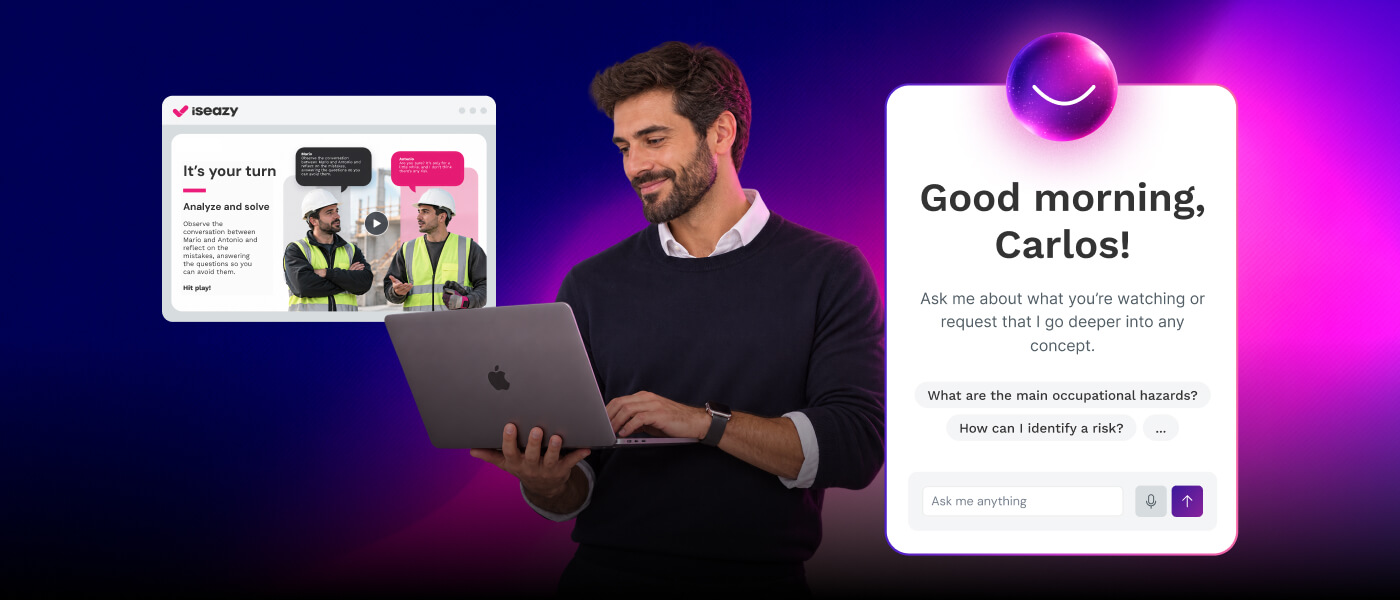


Your team’s talent is your greatest asset. Grow it with isEazy Skills
Develop soft skills and key competencies with a comprehensive course catalog designed to accelerate your team’s growth.


Your team’s talent is your greatest asset. Grow it with isEazy Skills
Develop soft skills and key competencies with a comprehensive course catalog designed to accelerate your team’s growth.
Related articles