CASE STUDY
Learn how we helped AKRON Group promote upskilling and reskilling of their workforce

Brain
The first AI trained to teach

Author
The #1 AI-powered authoring tool on the market

Factory
Custom e-learning content factory

Skills
Comprehensive power skills course catalog

LMS
All-in-one LMS platform with AI

Engage
App for managing frontline teams
Product

What is Brain?
Everything you need to know about the first AI trained to teach.

Learning agent: CompanionNew
Supports learners and answers their questions right inside the course, without breaking the audit trail.

How does it work?
Adaptive, conversational, and contextual. That’s learning with Brain.
FEATURES

AINew
Unlock your full potential and speed up course creation with artificial intelligence.

Accessibility
Automatically meet accessibility guidelines—without sacrificing interactivity!

Interactivity
Boost engagement with interactive, ready-to-use activities that make learning fun.

Course Creation
Reduce the time it takes to create your e-learning courses with our authoring tool.

Distribution
We offer you different distribution options, so that nothing can stop you.

SCORM
Publish your course in SCORM format and share it on any LMS.
SERVICES

Instrucional Design
Surprise your students with multimedia and interactive content.

Custom Courses
We create e-learning courses for you—tailored to your needs and hassle-free!

Virtual Reality
Turn learning into an immersive experience.

Custom Avatars
Give your courses and videos a unique touch with personalized avatars.

Audiovisual FactoryNew
Turn training into something dynamic and visual with engaging videos.
CATALOG

Course catalog
Over 600 skills and competency courses to help you adapt to your team's needs.
Microsoft Copilot AcademyNew
Your professionals will learn how to apply Copilot AI to key processes within your organization.

Artificial Intelligence Academy
Train your teams in the practical use of AI to boost productivity and innovation in your company.

Cybersecurity Academy
Capacita a tu empresa con el catálogo más completo en seguridad digital corporativa.

Use cases
Choose the solution that best fits your needs

Industries
Solutions for all types of industries
USE CASES

Onboarding
Facilitate the onboarding process, productivity and engagement of your new employees.

Upskilling
Boost your team's skills and prepare them for the challenges of the future with upskilling.

Microlearning
Discover all the advantages of microlearning and boost your training results.

Gamification
Enjoy addictive training that will get your professionals hooked.

Internal Communication
Improve communication in your company and enjoy an aligned and committed team.

Mobile learning
Agile, flexible, and interactive learning—built for today’s digital-first workforce.
INDUSTRIES

Banking and financial services
Training in compliance, cybersecurity, customer service, and key skills development.

Pharmaceuticals and healthcare
Digital onboarding, regulatory updates, and ongoing training for healthcare staff.

Retail and consumer
Agile and scalable training for in-store, operational, and customer service teams.

Industry and manufacturing
Training in processes, safety, and corporate culture for distributed teams.

Education and training
Digital solutions for training centers, internal academies, and corporate universities.

Technology and telecommunications
Development of technical talent, digital skills, and upskilling and reskilling programs.
CLIENTS

MAPFRE
How MAPFRE turn e-learning into sales with isEazy

Pepco
A personalised learning experience for a growing team.

BBVA
Digitisation and creation of high quality e-learning content.

Shiseido
We increase the engagement of the training with a social and gamified app.

Telefónica
Large-scale reskilling for the company's digital transformation.

Vodafone
A personalised learning experience for a growing team.
More than 1,000 companies already rely on isEazy.


MEET ISEAZY

Events
Discover our upcoming events and connect with the future of e-learning.

News
Find out the latest news about isEazy: press releases, partnerships, updates...

Contact
Leave us your personal details and we will contact you as soon as possible.
About isEazyNew
Find out more about our company.

Careers
We are looking for the best talent, join our team!

Partners
Become our partner and grow your business.
INTERESTING RESOURCES

Blog
The best content on e-learning: trends, tools and key strategies.

Whitepapers
Gain valuable insights and stay ahead of industry trends.

Product releases
The latest news and releases of our e-learning products and solutions.

Glossary
Definitions of the most commonly used terms and key industry concepts.

Guides
Discover the best step-by-step tips and tricks to optimize your L&D strategy.

Webinars
Video sessions on our products, trends and more

Comparatives
Compare e-learning solutions available on the market and choose the most suitable one.


WEBINAR
Master AI in isEazy Author in under an hour.




GUIDE
Prepare your organization to comply with the new AI regulations


AUTHORING TOOL
Create courses automatically and generate interactive activities, games, translations, and multimedia resources in seconds.

Stay up to date with all our latest news
 Subscribe to our newsletter
 Stay up to date with all our latest news

May 18, 2026

CONTENT CREATED BY:

Table of contents
A multidisciplinary team is a working group made up of professionals with different backgrounds, specialisations and areas of knowledge who collaborate in a coordinated way to achieve a common goal. Unlike traditional homogeneous teams, diversity of profiles is precisely their main asset: it allows complex problems to be tackled from multiple perspectives and generates more complete, innovative solutions.
In the context of corporate training and talent management, multidisciplinary teams have become a key structure for organisations competing in highly complex environments. According to McKinsey, companies with diverse and integrated teams are 35% more likely to outperform their competitors financially. However, managing them requires specific competencies in leadership, communication and continuous learning that not all organisations have developed.
Not all teams with diverse profiles work the same way. There are three models with different degrees of integration between disciplines, and choosing the right one for each project is a strategic decision:
| Type | Level of integration | When to use it |
|---|---|---|
| Multidisciplinary | Each discipline works from its own methodology; collaboration at defined contact points | Projects where each area must execute autonomously and deliverables are combined at the end |
| Interdisciplinary | Disciplines actively integrate; a shared language and framework are created | Innovation, product design or transformation projects where the solution emerges from interaction |
| Transdisciplinary | Disciplinary boundaries are transcended; the team generates new knowledge beyond any starting discipline | Applied research, social impact projects or challenges without a known solution |
In business practice, most high-performance teams operate in the space between multidisciplinary and interdisciplinary: diverse profiles that have developed enough common language to collaborate fluidly, without losing the depth of their specialisation.
Simply bringing together diverse profiles is not enough to have a functional multidisciplinary team. These are the characteristics that set apart teams that truly perform:

Organisations that invest in multidisciplinary structures gain concrete, measurable competitive advantages:
For a multidisciplinary team to work, it is not enough to define which disciplines are involved: you need to clarify what role each person plays in the collective dynamic. These are the roles that tend to appear in high-performance teams:

Building an effective multidisciplinary team is not a random process. These are the key stages:
1. Define the objective precisely: before selecting profiles, clarify what problem needs to be solved and what type of outcome is expected. A vague objective leads to a poorly sized team.
2. Identify the necessary disciplines: map the areas of knowledge the project requires. The goal is not to include every possible department, but those with something concrete to contribute to the specific challenge.
3. Select profiles with complementary skills: find the most suitable people in each discipline, prioritising not only technical competence but also the capacity for collaboration and interdisciplinary communication.
4. Define roles and responsibilities from the outset: establish who leads, who coordinates and what each member’s contribution is before the project kicks off. Ambiguity at this stage is the main source of subsequent conflicts.
5. Invest in the team’s internal onboarding: before diving into the work, dedicate time so members understand each other’s disciplines, languages and ways of working. This initial investment multiplies efficiency throughout the project.
6. Establish explicit coordination protocols: define how decisions are made, how conflicts are escalated and what tools are used to track progress. Multidisciplinary teams need more structure than homogeneous teams, not less.
Day-to-day management of a multidisciplinary team requires a different approach to that of homogeneous teams. These strategies have proven their effectiveness:

The diversity of profiles that is the strength of these teams is also the source of their main challenges. These are the most common:
Many multidisciplinary teams fail to reach their potential not through lack of talent, but because of avoidable mistakes in their design or management:
The performance of a multidisciplinary team has a clear ceiling: the level of understanding its members have of each other’s disciplines. That is why investing in cross-training is not a luxury, but a structural condition for the team to function.
In practice, this means two things. First, upskilling in transversal skills: interprofessional communication, systems thinking, managing ambiguity, team facilitation. Competencies that do not belong to any specific discipline but are essential for very different people to work together effectively. Second, training in the fundamentals of other disciplines: a designer who understands engineering constraints, a developer who grasps business priorities, an HR specialist who knows financial language. They do not need to become experts; they need enough context to collaborate without friction.
Tools like isEazy Skills allow organisations to deploy cross-training programmes at scale, with personalised learning paths for each profile and real-time tracking of skill development. Multidisciplinary teams that invest in this type of continuous learning perform consistently better over time.
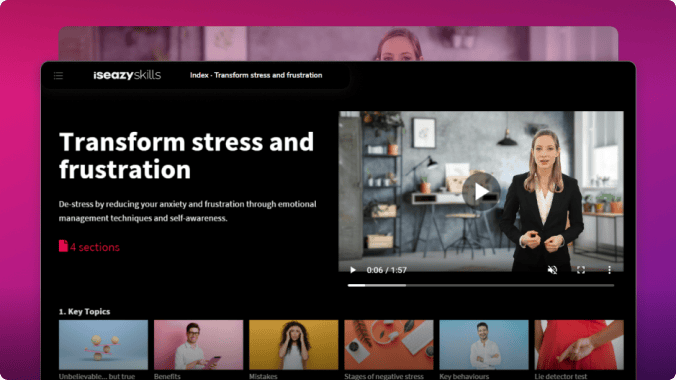
Grupo AKRON is a strong example of how an organisation can systematise upskilling and reskilling across its teams at scale. With isEazy, AKRON launched a competency development programme that allowed professionals from different areas to continuously update their skills in line with business objectives. Discover how they did it →
CASE STUDY
Learn how we helped AKRON Group promote upskilling and reskilling of their workforce


Multidisciplinary teams are not a passing trend or a management fad: they are a structural response to the growing complexity of business environments. The challenges organisations face today — digital transformation, customer experience, sustainability, product innovation — cannot be solved from a single discipline. They require the integration of diverse perspectives, and that is only possible if the organisation knows how to build, manage and develop this type of team.
The key is not to bring together brilliant profiles and leave them to it. It is to invest in the conditions that make collaboration possible: clear objectives, defined roles, common processes, psychological safety and, above all, continuous training that enables each member to understand and connect with the disciplines of their colleagues.
Organisations that master this are not just more innovative — they are more resilient, more agile and better prepared for whatever comes next. Discover isEazy today.
The fundamental difference lies in the degree of integration between members. In a multidisciplinary team, each professional contributes their expertise from their own discipline: they work in parallel towards a common goal, but maintain their individual methodologies and perspectives. In an interdisciplinary team, by contrast, the boundaries between disciplines blur: members actively integrate their knowledge, create shared frameworks and develop a common language. The result is deeper collaboration, but also more complex to manage. For most business innovation or product projects, the interdisciplinary model delivers greater value; for projects where each area must execute autonomously, the multidisciplinary model is more efficient.
Leading a multidisciplinary team requires a different profile to traditional hierarchical leadership. The leader must combine three key capabilities: translation between disciplines (being able to understand the language of each area and facilitate mutual understanding between specialisations), managing ambiguity (these teams frequently work on complex projects where roles are not always perfectly defined), and focus on the common goal (preventing each specialist from optimising only for their own area at the expense of the collective result). A good multidisciplinary team leader also actively invests in the continuous learning of members, identifying knowledge gaps between disciplines and facilitating cross-learning.
Multidisciplinary teams are especially suitable when the problem or project requires knowledge from more than one area and no single discipline can solve it alone. Common scenarios include: developing new products or services that combine technology, design and business; digital transformation projects that require IT, HR and operations to work together; innovation initiatives where diverse perspectives are a source of competitive advantage; and complex organisational challenges such as designing onboarding programmes, culture change or sustainability strategies. They are less appropriate for highly specialised tasks where depth of knowledge in a single discipline is the primary success factor.
Effective management of multidisciplinary teams relies on three types of tools and practices. In communication and coordination: project management platforms such as Asana, Jira or Notion that centralise tasks, timelines and responsibilities, combined with clear team rituals such as dailies or retrospectives. In training and development: cross-upskilling programmes that allow each member to understand the language of other disciplines — not so that everyone becomes an expert in everything, but so they have enough context to collaborate without friction. In culture and dynamics: establishing explicit team norms about how decisions are made, how conflict is managed and how knowledge is shared is just as important as the technology tools used.

WHITEPAPER
Download our whitepaper and learn how to adapt your corporate culture to digital change.
Download whitepaper


Strong company culture doesn’t happen by chance—it’s built
With isEazy, build it from within. Training, communication, development—everything you need to turn culture into your best competitive edge.


Strong company culture doesn’t happen by chance—it’s built
With isEazy, build it from within. Training, communication, development—everything you need to turn culture into your best competitive edge.