Brain
The first AI trained to teach

Author
The #1 AI-powered authoring tool on the market

Factory
Custom e-learning content factory

Skills
Comprehensive power skills course catalog

LMS
All-in-one LMS platform with AI

Engage
App for managing frontline teams
Product

What is Brain?
Everything you need to know about the first AI trained to teach.

Learning agent: CompanionNew
Supports learners and answers their questions right inside the course, without breaking the audit trail.

How does it work?
Adaptive, conversational, and contextual. That’s learning with Brain.

FEATURES

AINew
Unlock your full potential and speed up course creation with artificial intelligence.

Accessibility
Automatically meet accessibility guidelines—without sacrificing interactivity!

Interactivity
Boost engagement with interactive, ready-to-use activities that make learning fun.

Course Creation
Reduce the time it takes to create your e-learning courses with our authoring tool.

Distribution
We offer you different distribution options, so that nothing can stop you.

SCORM
Publish your course in SCORM format and share it on any LMS.

SERVICES

Instrucional Design
Surprise your students with multimedia and interactive content.

Custom Courses
We create e-learning courses for you—tailored to your needs and hassle-free!

Virtual Reality
Turn learning into an immersive experience.

Custom Avatars
Give your courses and videos a unique touch with personalized avatars.

Audiovisual FactoryNew
Turn training into something dynamic and visual with engaging videos.

CATALOG

Course catalog
Over 600 skills and competency courses to help you adapt to your team's needs.
Microsoft Copilot AcademyNew
Your professionals will learn how to apply Copilot AI to key processes within your organization.

Artificial Intelligence Academy
Train your teams in the practical use of AI to boost productivity and innovation in your company.

Cybersecurity Academy
Capacita a tu empresa con el catálogo más completo en seguridad digital corporativa.


Use cases
Choose the solution that best fits your needs

Industries
Solutions for all types of industries
USE CASES

Onboarding
Facilitate the onboarding process, productivity and engagement of your new employees.

Upskilling
Boost your team's skills and prepare them for the challenges of the future with upskilling.

Microlearning
Discover all the advantages of microlearning and boost your training results.

Gamification
Enjoy addictive training that will get your professionals hooked.

Internal Communication
Improve communication in your company and enjoy an aligned and committed team.

Mobile learning
Agile, flexible, and interactive learning—built for today’s digital-first workforce.
INDUSTRIES

Banking and financial services
Training in compliance, cybersecurity, customer service, and key skills development.

Pharmaceuticals and healthcare
Digital onboarding, regulatory updates, and ongoing training for healthcare staff.

Retail and consumer
Agile and scalable training for in-store, operational, and customer service teams.

Industry and manufacturing
Training in processes, safety, and corporate culture for distributed teams.

Education and training
Digital solutions for training centers, internal academies, and corporate universities.

Technology and telecommunications
Development of technical talent, digital skills, and upskilling and reskilling programs.
CLIENTS

MAPFRE
How MAPFRE turn e-learning into sales with isEazy

Pepco
A personalised learning experience for a growing team.

BBVA
Digitisation and creation of high quality e-learning content.

Shiseido
We increase the engagement of the training with a social and gamified app.

Telefónica
Large-scale reskilling for the company's digital transformation.

Vodafone
A personalised learning experience for a growing team.
More than 1,000 companies already rely on isEazy.






MEET ISEAZY

Events
Discover our upcoming events and connect with the future of e-learning.

News
Find out the latest news about isEazy: press releases, partnerships, updates...

Contact
Leave us your personal details and we will contact you as soon as possible.
About isEazyNew
Find out more about our company.

Careers
We are looking for the best talent, join our team!

Partners
Become our partner and grow your business.

INTERESTING RESOURCES

Blog
The best content on e-learning: trends, tools and key strategies.

Whitepapers
Gain valuable insights and stay ahead of industry trends.

Product releases
The latest news and releases of our e-learning products and solutions.

Glossary
Definitions of the most commonly used terms and key industry concepts.

Guides
Discover the best step-by-step tips and tricks to optimize your L&D strategy.

Webinars
Video sessions on our products, trends and more

Comparatives
Compare e-learning solutions available on the market and choose the most suitable one.


WEBINAR
Master AI in isEazy Author in under an hour.




GUIDE
Prepare your organization to comply with the new AI regulations

Stay up to date with all our latest news
 Subscribe to our newsletter
 Stay up to date with all our latest news

May 26, 2026
Serious games in corporate training: how to train complex processes with games

CONTENT CREATED BY:

Table of contents
Corporate training has spent decades looking for ways to train complex processes without putting real operations at risk. Serious games are, today, one of the most effective answers to that challenge: simulated environments where employees learn by doing, make mistakes without consequences, and consolidate procedures through direct experience.
But do they really work for processes that require precision, protocol and decision-making under pressure? The evidence says yes, and the data backs it up.
What are serious games: definition and origin
The term “serious game” was coined by Clark Abt in his 1970 book of the same name, although the idea of learning through play is as old as humanity itself. In the context of today’s corporate training, a serious game is an interactive application designed with a dual purpose: to entertain and to train.
Unlike a conventional video game, the primary objective is not enjoyment, but the learning of a specific process, skill or behaviour. And unlike a standard e-learning course, the format is not the transmission of information, but the simulation of real situations where the learner must act, decide and face the consequences of their decisions within the game.
Some common examples in corporate training:
- Sales and negotiation simulators where employees practise conversations with virtual customers
- Digital role-play games to train customer service protocols or conflict management
- Regulatory compliance environments where employees practise decision-making in complex situations
- Industrial process simulations with potential risk scenarios
Why serious games work for complex processes
Learning complex processes requires something passive formats cannot offer: deliberate practice in a real context. Reading a procedure manual or watching an explanatory video activates declarative memory (knowing that something exists), but does not build procedural memory (knowing how to do it under pressure).
Serious games target exactly that blind spot. The neuroscience of learning explains why:
- Immediate feedback: the brain consolidates learning better when it receives a correction signal right after the action. A serious game can deliver that feedback in real time — something impossible in large-scale face-to-face training.
- Distributed cognitive load: well-designed games introduce complexity progressively, respecting working memory limits. According to John Sweller’s cognitive load theory, breaking learning into manageable scenes significantly improves retention.
- Emotional learning: immersion in a scenario with consequences activates the amygdala and reinforces memory consolidation. We learn better what matters to us, and games generate that state of emotional activation in a controlled way.
According to a study by the Research Institute of America, e-learning can increase retention by 25% to 60% compared to traditional classroom training. A meta-analysis published in Simulation & Gaming (Sitzmann, 2011) found that simulators and serious games improve procedural retention by 14% compared to other training methods.
Types of serious games for corporate training
Not all complex processes require the same type of game. The choice of format depends on the training objective, the learner’s profile and the resources available for design:
| Type | Main objective | Typical use case |
|---|---|---|
| Process simulator | Procedural memory, technical precision | Industrial operations, medical protocol, machinery handling |
| Branching scenario | Decision-making, critical thinking | Customer service, compliance, conflict management |
| Digital role-play | Interpersonal skills, communication | Negotiation, leadership, selection interviews |
| Training escape room | Teamwork, problem-solving | Onboarding, corporate culture, lateral thinking |
| Strategy game | Systemic vision, planning | Team management, resource planning, P&L |
What complex processes can be trained with serious games
The common question in L&D teams is: what type of processes is it worth introducing a serious game for? The answer has more to do with the profile of the process than with the industry. These are the cases where the format delivers a clear return:
- Compliance and regulation: failure to comply with security protocols, GDPR, occupational risk prevention or financial regulation has real legal and economic consequences. A serious game allows practising correct decision-making in limit situations repeatedly, until the procedure becomes automatic.
- Technical onboarding: bringing an employee into a highly complex operational role can require weeks of in-person training. A workplace simulator can significantly reduce that time, without risk to the operation or to the employee.
- Safety training: high-hazard environments (construction, chemicals, mining, aviation) cannot afford real-life mistakes. Serious games create the risk context without the risk, allowing emergency responses to be practised until they become automatic.
- Customer service in critical situations: handling a difficult complaint, communicating bad news or closing a complex negotiation are skills that only consolidate through practice. Digital role-play allows repeating those conversations without affecting relationships with real customers.
- Leadership and decision-making: managers need to practise decisions under uncertainty, managing teams in conflict or communicating during organisational change. Management simulators provide that safe practice space.
The key criterion: if a mistake in real practice carries a high cost (economic, reputational, legal or in terms of safety), the process is a candidate for a serious game.
Serious games vs. traditional e-learning: when to use each format
Serious games do not replace traditional e-learning: they complement it. The choice of format should be guided by the training objective, the criticality of the process and the resources available:
| Criterion | Traditional e-learning | Serious game |
|---|---|---|
| Objective | Transfer knowledge, raise awareness | Train procedures, automate responses |
| Retention at 30 days | Low-medium without reinforcement | High through active practice and immediate feedback |
| Production cost | Low-medium | Medium-high (more instructional design) |
| Development time | Weeks | Weeks to months depending on complexity |
| Best suited when... | The process is informational or low-criticality | Mistakes have a real cost and require deliberate practice |
| Engagement | Depends on design | High by nature of the format |
Tools for delivering serious games to your employees: which to choose
The market for tools of this type has matured significantly. The choice of tool determines production speed, the ability to update content and integration with the rest of your training. Here you can compare the main options on the market:

Features
Benefits
Subscription plans
Use cases
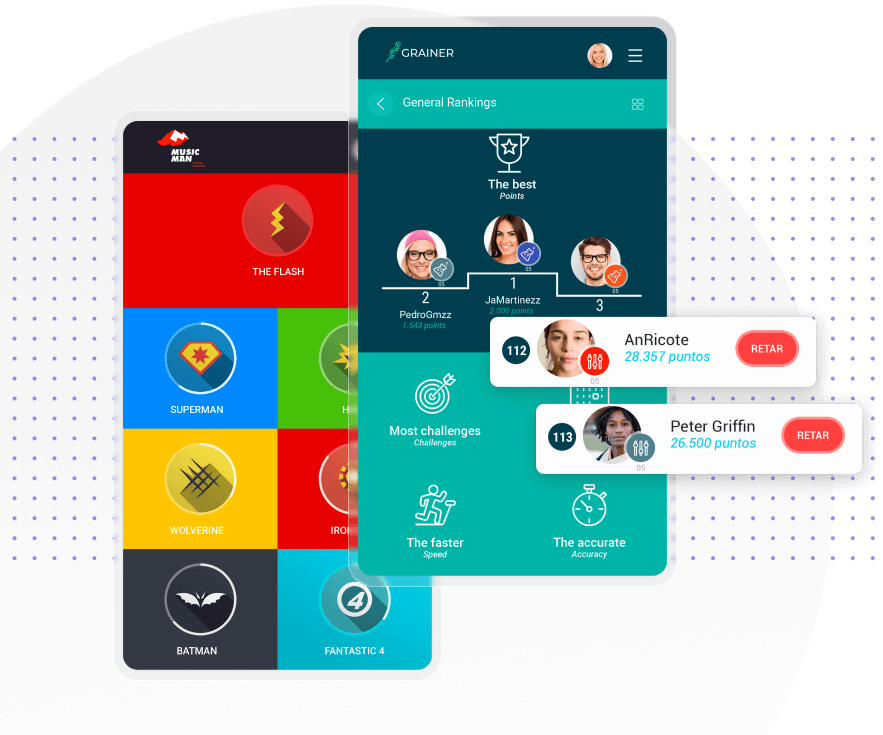
- Game creation (individual, team vs. team, multiplayer). Turn any training content into an addictive quiz that multiplies your training results by 10.
- Quizzes with all types of multimedia questions: text, audio, video, images, and 13 different content types to suit any learning objective.
- Challenges and knowledge contests to keep your team motivated and constantly improving.
- Rankings, levels, and achievements (rewards and prizes) fully customizable to drive healthy competition and engagement.
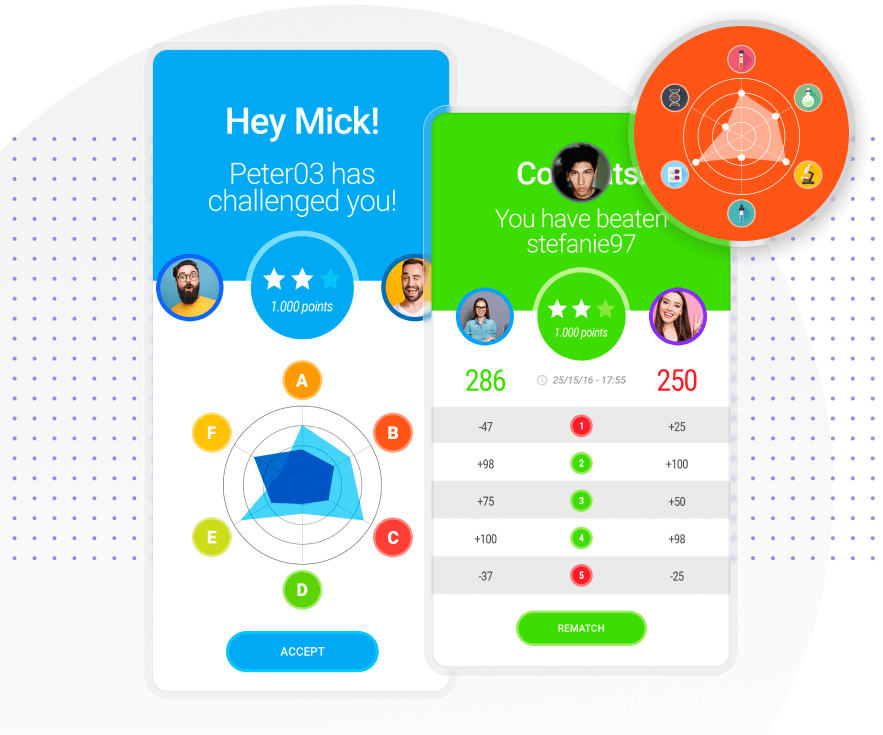
- Dashboard and analytics panel with complete metrics: participation, access, progress, activities, and more. Includes a knowledge radar to track each professional’s level before and after the game.
- Progress reports and analysis by knowledge category, to identify strengths and areas for improvement for each professional.
- Social and collaborative app (chat, push notifications, comments, collaboration, likes) that turns learning into a shared, connected experience.
- Customization (colors, logos, avatars, icons, corporate branding). The app adapts 100% to your brand image and needs.
- All types of questions, audio, video, images, etc. to create rich and varied learning experiences.
- Mobile access, so your professionals can play and learn from anywhere, at any time.
- Real-time feedback, so participants know their results instantly and reinforce their learning.
- Ease of use, no technical knowledge required to create and launch corporate games in minutes. Ready in a maximum of 15 business days.
- Smart search to find content and activities instantly.
- Customer area and dedicated support to accompany you at every step.
- Multiple languages (over 23 languages), to reach global teams without barriers.
- Multiple uses (training, sales, corporate culture): up to 98% engagement and 90% course completion.
- Professional: up to 50 users. 1 game, 100 questions, 1 language, and standard customization (logo and colors).
- Business: up to 250 users. 1 game, unlimited questions and languages, and advanced customization. The most popular plan.
- Enterprise: from 251 users. Multiple games, all Business plan features plus: custom app in app stores, management autonomy, user integration and SSO, manager dashboards, and an onboarding training session.
All plans include: levels and rankings, push notifications, knowledge challenges, help center and support, progress reports, 13 content types (audio, image, video, quizzes, games…), analysis by knowledge category, and custom help screens.
- Employee training: turn your training content into addictive games with rankings, challenges, and rewards. Achieve up to 98% engagement and up to 90% course completion among your professionals.
- Sales team enablement: keep your sales network always up to date and motivated. Reinforce product knowledge, sales techniques, and key messaging in a dynamic and competitive way.
- Corporate culture: drive a sense of belonging and reinforce your company’s values through collaborative game experiences. Turn your employees into the protagonists and ambassadors of your organization.
Features
- Game creation (individual, team vs. team, multiplayer). Turn any training content into an addictive quiz that multiplies your training results by 10.
- Quizzes with all types of multimedia questions: text, audio, video, images, and 13 different content types to suit any learning objective.
- Challenges and knowledge contests to keep your team motivated and constantly improving.
- Rankings, levels, and achievements (rewards and prizes) fully customizable to drive healthy competition and engagement.
- Dashboard and analytics panel with complete metrics: participation, access, progress, activities, and more. Includes a knowledge radar to track each professional’s level before and after the game.
- Progress reports and analysis by knowledge category, to identify strengths and areas for improvement for each professional.
- Social and collaborative app (chat, push notifications, comments, collaboration, likes) that turns learning into a shared, connected experience.
Benefits
- Customization (colors, logos, avatars, icons, corporate branding). The app adapts 100% to your brand image and needs.
- All types of questions, audio, video, images, etc. to create rich and varied learning experiences.
- Mobile access, so your professionals can play and learn from anywhere, at any time.
- Real-time feedback, so participants know their results instantly and reinforce their learning.
- Ease of use, no technical knowledge required to create and launch corporate games in minutes. Ready in a maximum of 15 business days.
- Smart search to find content and activities instantly.
- Customer area and dedicated support to accompany you at every step.
- Multiple languages (over 23 languages), to reach global teams without barriers.
- Multiple uses (training, sales, corporate culture): up to 98% engagement and 90% course completion.
Subscription plans
- Professional: up to 50 users. 1 game, 100 questions, 1 language, and standard customization (logo and colors).
- Business: up to 250 users. 1 game, unlimited questions and languages, and advanced customization. The most popular plan.
- Enterprise: from 251 users. Multiple games, all Business plan features plus: custom app in app stores, management autonomy, user integration and SSO, manager dashboards, and an onboarding training session.
All plans include: levels and rankings, push notifications, knowledge challenges, help center and support, progress reports, 13 content types (audio, image, video, quizzes, games…), analysis by knowledge category, and custom help screens.
Use cases
- Employee training: turn your training content into addictive games with rankings, challenges, and rewards. Achieve up to 98% engagement and up to 90% course completion among your professionals.
- Sales team enablement: keep your sales network always up to date and motivated. Reinforce product knowledge, sales techniques, and key messaging in a dynamic and competitive way.
- Corporate culture: drive a sense of belonging and reinforce your company’s values through collaborative game experiences. Turn your employees into the protagonists and ambassadors of your organization.

Features
Advantages
Plans and pricing
- Live sessions and self-paced activities: users can host real-time games or assign activities for participants to complete within a specified deadline.
- Results reports: provides data on participation, correct answers, unanswered questions, scores, and individual results. Report availability depends on the selected plan.
- Different test formats: users can combine quizzes, true-or-false questions, and other interactive formats. Available question types vary by plan.
- Individual and group kahoots: supports individual activities, live sessions, and team-based game modes.
- Leaderboards and podium: displays participant scores and rankings during the activity and shows a final podium when the game ends.
- Content cloning and duplication: users can create an editable copy of their own kahoots or certain public kahoots shared by other users.
- Social and collaborative area: teams can share, organize, and edit content in collaborative workspaces, as well as distribute updates and internal communication resources through certain business solutions.
- AI-assisted generator: creates questions and content from a topic or source material. Availability and supported source formats depend on the selected plan.
- Access to shared content: users can search for publicly shared kahoots created by other users, use them as inspiration, or duplicate them when the creator’s settings allow it.
- Easy participant access: the administrator or creator launches the activity, and participants can join using a PIN, direct link, or QR code from a browser or the mobile app. Downloading the app is not required.
- Multimedia content: supports different question formats, videos, and images to create interactive activities.
- Multiple languages: the interface is available in several languages, and users can create questions and content for international teams.
- Ease of use: its visual editor is designed to create, duplicate, and launch activities without advanced technical knowledge.
- Multiple use cases: it can be used for training, sales, meetings, presentations, internal communications, and customer service activities.
- Kahoot! 360 Pro Start: USD 19 per month per presenter, billed annually at USD 228.
- Kahoot! 360 Pro Standard: standard price of USD 29 per month per presenter, billed annually at USD 348.
- Kahoot! 360 Pro Plus: USD 49 per month per presenter, billed annually at USD 588.
- Kahoot! 360 Pro Max: standard price of USD 79 per month per presenter, billed annually at USD 948.
- Kahoot! 360 Pro Ultra: standard price of USD 99 per month per presenter, billed annually at USD 1,188.
- Kahoot! 360 for Enterprises: a solution for organizations that require multiple licenses, centralized administration, and tailored terms. Pricing is available upon request.
- Licensing model: professional plans require a separate license for each person who creates, presents, or assigns kahoots. Participants joining with a PIN do not need an account or license.
- Pricing terms: professional plans are available with annual billing. Prices exclude VAT or applicable taxes and may vary by country, currency, and current promotions.
Features
- Live sessions and self-paced activities: users can host real-time games or assign activities for participants to complete within a specified deadline.
- Results reports: provides data on participation, correct answers, unanswered questions, scores, and individual results. Report availability depends on the selected plan.
- Different test formats: users can combine quizzes, true-or-false questions, and other interactive formats. Available question types vary by plan.
- Individual and group kahoots: supports individual activities, live sessions, and team-based game modes.
- Leaderboards and podium: displays participant scores and rankings during the activity and shows a final podium when the game ends.
- Content cloning and duplication: users can create an editable copy of their own kahoots or certain public kahoots shared by other users.
- Social and collaborative area: teams can share, organize, and edit content in collaborative workspaces, as well as distribute updates and internal communication resources through certain business solutions.
- AI-assisted generator: creates questions and content from a topic or source material. Availability and supported source formats depend on the selected plan.
Advantages
- Access to shared content: users can search for publicly shared kahoots created by other users, use them as inspiration, or duplicate them when the creator’s settings allow it.
- Easy participant access: the administrator or creator launches the activity, and participants can join using a PIN, direct link, or QR code from a browser or the mobile app. Downloading the app is not required.
- Multimedia content: supports different question formats, videos, and images to create interactive activities.
- Multiple languages: the interface is available in several languages, and users can create questions and content for international teams.
- Ease of use: its visual editor is designed to create, duplicate, and launch activities without advanced technical knowledge.
- Multiple use cases: it can be used for training, sales, meetings, presentations, internal communications, and customer service activities.
Plans and pricing
- Kahoot! 360 Pro Start: USD 19 per month per presenter, billed annually at USD 228.
- Kahoot! 360 Pro Standard: standard price of USD 29 per month per presenter, billed annually at USD 348.
- Kahoot! 360 Pro Plus: USD 49 per month per presenter, billed annually at USD 588.
- Kahoot! 360 Pro Max: standard price of USD 79 per month per presenter, billed annually at USD 948.
- Kahoot! 360 Pro Ultra: standard price of USD 99 per month per presenter, billed annually at USD 1,188.
- Kahoot! 360 for Enterprises: a solution for organizations that require multiple licenses, centralized administration, and tailored terms. Pricing is available upon request.
- Licensing model: professional plans require a separate license for each person who creates, presents, or assigns kahoots. Participants joining with a PIN do not need an account or license.
- Pricing terms: professional plans are available with annual billing. Prices exclude VAT or applicable taxes and may vary by country, currency, and current promotions.

Features
Advantages
Pricing
- Individual and team challenges: organizations can set up competitions for employees, teams, stores, districts, or regions.
- Points, badges, and levels: includes progression mechanics designed to encourage participation throughout each challenge.
- Participant segmentation: contests and activities can be assigned to specific groups based on team, location, or region.
- Sales incentive gamification: enables organizations to create challenges linked to training goals, behaviors, or selected sales metrics.
- Instant performance notifications: sends alerts, reminders, and updates related to activities, challenges, and participant progress.
- Sales data integration: connects activities with business data sources to link them to selected performance indicators.
- Live leaderboards: displays updated rankings by employee, team, store, district, or region.
- Sales contest creation: allows administrators to configure the audience, duration, goals, and scoring rules for each competition.
- Performance tracking: provides information on participant progress, engagement, and results throughout each challenge.
- Designed for sales teams: primarily focuses on engaging and supporting sales representatives and frontline teams.
- Configurable competitions: organizations can adapt the duration, participants, and goals of each challenge.
- Custom rewards: incentives can be linked to the achievement of goals and results defined by the organization.
- Automated incentives: automates the assignment of points and selected rewards according to configured rules.
- Real-time updates: displays leaderboard changes and participant progress throughout each contest.
- Custom pricing: Arcade does not publish fixed pricing for its business plans.
- Quote available upon request: organizations must contact the sales team to receive a proposal based on team size and business requirements.
Features
- Individual and team challenges: organizations can set up competitions for employees, teams, stores, districts, or regions.
- Points, badges, and levels: includes progression mechanics designed to encourage participation throughout each challenge.
- Participant segmentation: contests and activities can be assigned to specific groups based on team, location, or region.
- Sales incentive gamification: enables organizations to create challenges linked to training goals, behaviors, or selected sales metrics.
- Instant performance notifications: sends alerts, reminders, and updates related to activities, challenges, and participant progress.
- Sales data integration: connects activities with business data sources to link them to selected performance indicators.
- Live leaderboards: displays updated rankings by employee, team, store, district, or region.
- Sales contest creation: allows administrators to configure the audience, duration, goals, and scoring rules for each competition.
- Performance tracking: provides information on participant progress, engagement, and results throughout each challenge.
Advantages
- Designed for sales teams: primarily focuses on engaging and supporting sales representatives and frontline teams.
- Configurable competitions: organizations can adapt the duration, participants, and goals of each challenge.
- Custom rewards: incentives can be linked to the achievement of goals and results defined by the organization.
- Automated incentives: automates the assignment of points and selected rewards according to configured rules.
- Real-time updates: displays leaderboard changes and participant progress throughout each contest.
Pricing
- Custom pricing: Arcade does not publish fixed pricing for its business plans.
- Quote available upon request: organizations must contact the sales team to receive a proposal based on team size and business requirements.

Features
Advantages
Pricing
- Quiz and lesson creation: enables users to combine questions, slides, and multimedia resources within interactive learning activities.
- Live sessions and asynchronous activities: activities can be hosted in real time or assigned for participants to complete within a specified deadline.
- Individual and team modes: includes participant-paced activities, instructor-led sessions, and Team vs. Team experiences.
- Results reports: provides information on participation, responses, scores, accuracy, and individual performance.
- Existing content import: users can use slides, documents, questions, and other existing resources as a starting point for new activities.
- AI-assisted content creation: enables users to generate questions and quizzes from prompts, documents, or reference materials.
- In-person and remote delivery: supports in-person, remote, and asynchronous activities across different devices.
- Multiple use cases: can be used for formal education, professional training, onboarding, compliance training, sales, meetings, and presentations.
- Leaderboards: displays participant scores and rankings during gamified activities.
- Flexible access: participants can join activities through a browser or the mobile app using different devices.
- Scheduled activities: administrators can configure start dates, deadlines, and attempt limits for selected activities.
- Interactive lessons: combines slides, questions, images, audio, and video within a single learning experience.
- Whiteboard: includes drawing and annotation questions that allow participants to write, highlight, or mark a blank canvas or uploaded image.
- Microlearning content: supports short activities and resources designed to assess or reinforce specific knowledge.
- Mobile application: provides access to quizzes, lessons, and activities from mobile devices.
- Essential monthly: USD 125 per month with monthly billing and one seat for creating, managing, or hosting content.
- Essential annual: USD 75 per month, billed annually at USD 900, with up to three seats.
- Pro: USD 125 per month, billed annually at USD 1,500, with a minimum of five seats.
- Free trial: Wayground for Business offers a 14-day free trial with no credit card required.
- Conditions: pricing, available features, and the number of included seats depend on the selected plan.
Features
- Quiz and lesson creation: enables users to combine questions, slides, and multimedia resources within interactive learning activities.
- Live sessions and asynchronous activities: activities can be hosted in real time or assigned for participants to complete within a specified deadline.
- Individual and team modes: includes participant-paced activities, instructor-led sessions, and Team vs. Team experiences.
- Results reports: provides information on participation, responses, scores, accuracy, and individual performance.
- Existing content import: users can use slides, documents, questions, and other existing resources as a starting point for new activities.
- AI-assisted content creation: enables users to generate questions and quizzes from prompts, documents, or reference materials.
- In-person and remote delivery: supports in-person, remote, and asynchronous activities across different devices.
- Multiple use cases: can be used for formal education, professional training, onboarding, compliance training, sales, meetings, and presentations.
- Leaderboards: displays participant scores and rankings during gamified activities.
Advantages
- Flexible access: participants can join activities through a browser or the mobile app using different devices.
- Scheduled activities: administrators can configure start dates, deadlines, and attempt limits for selected activities.
- Interactive lessons: combines slides, questions, images, audio, and video within a single learning experience.
- Whiteboard: includes drawing and annotation questions that allow participants to write, highlight, or mark a blank canvas or uploaded image.
- Microlearning content: supports short activities and resources designed to assess or reinforce specific knowledge.
- Mobile application: provides access to quizzes, lessons, and activities from mobile devices.
Pricing
- Essential monthly: USD 125 per month with monthly billing and one seat for creating, managing, or hosting content.
- Essential annual: USD 75 per month, billed annually at USD 900, with up to three seats.
- Pro: USD 125 per month, billed annually at USD 1,500, with a minimum of five seats.
- Free trial: Wayground for Business offers a 14-day free trial with no credit card required.
- Conditions: pricing, available features, and the number of included seats depend on the selected plan.
Challenges and limitations of serious games in corporate training
Serious games are not the perfect solution for every training challenge. Knowing their limitations is just as important as knowing their strengths:
- Higher initial design investment: delivering an effective serious game requires more instructional design time than a standard e-learning course. A good tool can narrow this gap, but the underlying work remains necessary.
- Need for updates: if the process the game trains changes, the serious game must be updated. Working with a modular tool makes this maintenance easier; doing it in a closed system can turn it into a burden.
- Adoption curve: not all employee profiles adapt to a game format equally quickly. Frontline teams tend to adopt it easily; senior profiles or those with lower digital exposure may need a prior introduction.
- Does not replace supervised real-world practice: a serious game prepares the employee for real practice, but cannot fully replace it in high-criticality processes. It should be understood as a preparation phase, not the close of the training cycle.
Serious games in your training strategy: where to start
Learning complex processes through play is not a futuristic promise: it is an established practice in the organisations that invest most heavily in effective training. The key is not the game itself, but the planning behind it: a well-mapped process, a coherent consequence tree and feedback that connects each decision to real on-the-job impact.
If your organisation has critical processes where mistakes carry a real cost, distributed teams that need standardised training, or high turnover demanding fast and effective onboarding, serious games are a training investment with a measurable return.
Tools like isEazy Game allow you to deliver those experiences in the simplest way possible, with an easy and intuitive interface. The starting point is identifying which process in your organisation would benefit most from letting your employees practise it without real-world risk.
Frequently asked questions about serious games
What is the difference between serious games and gamification?
Although both concepts apply game mechanics to training, they are not the same. Gamification adds game elements (points, badges, leaderboards) to existing training content without altering its structure. Serious games, on the other hand, are learning experiences designed entirely as games: the learner learns by doing, making decisions and facing consequences within a simulated environment. In corporate training, gamification improves engagement in an e-learning course; a serious game trains complete skills and processes through direct experience.
Are serious games suitable for any type of company?
Serious games are especially effective in companies with complex operational processes, high staff turnover, strict compliance requirements or teams distributed across multiple locations. They are widely used in retail, financial services, healthcare, logistics and manufacturing. Smaller organisations can also benefit, provided they choose a modular authoring tool that allows scalable and updatable production without large development investments.
How is the impact of a serious game in corporate training measured?
The impact of a serious game is measured at three levels. At the learning level: pass rates, scores per scene and number of attempts needed to complete the process. At the behaviour level: observable improvement in real-world process execution compared to a control group or pre-training baseline. At the business level: reduction in errors, incidents or complaints linked to the trained process, time-to-competency reduction and ROI calculation. A good LMS or reporting platform is essential to collect and analyse this data systematically.
How long does it take to create a serious game with an authoring tool?
Production time depends on the complexity of the process being simulated and the tool used. With a professional authoring tool like isEazy Author, a mid-level serious game (10–15 interactive scenes, branching and automated feedback) can be ready in 2–4 weeks with a team of one or two people. Interactive templates and AI assistants significantly reduce instructional design and visual production time, without requiring any programming knowledge.
Featured articles




WHITEPAPER
Do you know what are the essential skills for business success?
Discover the power skills that will transform your company
Download whitepaper


Transform your training into a unique experience
Discover how isEazy Game can transform your training content into attractive and effective games


Transform your training into a unique experience
Discover how isEazy Game can transform your training content into attractive and effective games
Related articles