CASE STUDY
How Clarel achieved over 84% engagement in their training with gamification.

Brain
The first AI trained to teach

Author
The #1 AI-powered authoring tool on the market

Factory
Custom e-learning content factory

Skills
Comprehensive power skills course catalog

LMS
All-in-one LMS platform with AI

Engage
App for managing frontline teams
Product

What is Brain?
Everything you need to know about the first AI trained to teach.

Learning agent: CompanionNew
Supports learners and answers their questions right inside the course, without breaking the audit trail.

How does it work?
Adaptive, conversational, and contextual. That’s learning with Brain.
FEATURES

AINew
Unlock your full potential and speed up course creation with artificial intelligence.

Accessibility
Automatically meet accessibility guidelines—without sacrificing interactivity!

Interactivity
Boost engagement with interactive, ready-to-use activities that make learning fun.

Course Creation
Reduce the time it takes to create your e-learning courses with our authoring tool.

Distribution
We offer you different distribution options, so that nothing can stop you.

SCORM
Publish your course in SCORM format and share it on any LMS.
SERVICES

Instrucional Design
Surprise your students with multimedia and interactive content.

Custom Courses
We create e-learning courses for you—tailored to your needs and hassle-free!

Virtual Reality
Turn learning into an immersive experience.

Custom Avatars
Give your courses and videos a unique touch with personalized avatars.

Audiovisual FactoryNew
Turn training into something dynamic and visual with engaging videos.
CATALOG

Course catalog
Over 600 skills and competency courses to help you adapt to your team's needs.
Microsoft Copilot AcademyNew
Your professionals will learn how to apply Copilot AI to key processes within your organization.

Artificial Intelligence Academy
Train your teams in the practical use of AI to boost productivity and innovation in your company.

Cybersecurity Academy
Capacita a tu empresa con el catálogo más completo en seguridad digital corporativa.

Use cases
Choose the solution that best fits your needs

Industries
Solutions for all types of industries
USE CASES

Onboarding
Facilitate the onboarding process, productivity and engagement of your new employees.

Upskilling
Boost your team's skills and prepare them for the challenges of the future with upskilling.

Microlearning
Discover all the advantages of microlearning and boost your training results.

Gamification
Enjoy addictive training that will get your professionals hooked.

Internal Communication
Improve communication in your company and enjoy an aligned and committed team.

Mobile learning
Agile, flexible, and interactive learning—built for today’s digital-first workforce.
INDUSTRIES

Banking and financial services
Training in compliance, cybersecurity, customer service, and key skills development.

Pharmaceuticals and healthcare
Digital onboarding, regulatory updates, and ongoing training for healthcare staff.

Retail and consumer
Agile and scalable training for in-store, operational, and customer service teams.

Industry and manufacturing
Training in processes, safety, and corporate culture for distributed teams.

Education and training
Digital solutions for training centers, internal academies, and corporate universities.

Technology and telecommunications
Development of technical talent, digital skills, and upskilling and reskilling programs.
CLIENTS

MAPFRE
How MAPFRE turn e-learning into sales with isEazy

Pepco
A personalised learning experience for a growing team.

BBVA
Digitisation and creation of high quality e-learning content.

Shiseido
We increase the engagement of the training with a social and gamified app.

Telefónica
Large-scale reskilling for the company's digital transformation.

Vodafone
A personalised learning experience for a growing team.
More than 1,000 companies already rely on isEazy.





MEET ISEAZY

Events
Discover our upcoming events and connect with the future of e-learning.

News
Find out the latest news about isEazy: press releases, partnerships, updates...

Contact
Leave us your personal details and we will contact you as soon as possible.
About isEazyNew
Find out more about our company.

Careers
We are looking for the best talent, join our team!

Partners
Become our partner and grow your business.
INTERESTING RESOURCES

Blog
The best content on e-learning: trends, tools and key strategies.

Whitepapers
Gain valuable insights and stay ahead of industry trends.

Product releases
The latest news and releases of our e-learning products and solutions.

Glossary
Definitions of the most commonly used terms and key industry concepts.

Guides
Discover the best step-by-step tips and tricks to optimize your L&D strategy.

Webinars
Video sessions on our products, trends and more

Comparatives
Compare e-learning solutions available on the market and choose the most suitable one.


WEBINAR
Master AI in isEazy Author in under an hour.




GUIDE
Prepare your organization to comply with the new AI regulations

Stay up to date with all our latest news
 Subscribe to our newsletter
 Stay up to date with all our latest news

May 25, 2026

CONTENT CREATED BY:

Table of contents
Gamification is the application of mechanics and dynamics from games — points, levels, challenges, rewards — in non-recreational contexts such as corporate training. Its goal is to activate the intrinsic motivation of people to improve learning, retention, and engagement. According to Training Journal, 89% of employees say that gamification makes them more productive and happier at work.
While there are many initiatives and corporate training activities designed to make learning more engaging, gamification taps into fundamental human instincts: competition, achievement, recognition, and progress. That is why its impact goes far beyond simply making a course “more fun.” If you want to explore how to implement it in your organization, check out our guide to gamification at work.

The characteristics of gamification in e-learning are the structural elements that, when combined, transform a standard learning process into an active, motivating, and measurable experience. In the corporate L&D environment, these characteristics are not mere aesthetic add-ons: each one has a direct impact on completion rates, knowledge retention, and employee engagement.
The following table summarizes the 8 main characteristics of gamification, the game mechanic behind each one, and the specific benefit they bring to a corporate training environment:
| Characteristic | Game mechanic | Benefit in corporate training |
|---|---|---|
| Friendly competition | Leaderboards and rankings | Increases active participation and consistency |
| Motivating rewards | Points, badges, and trophies | Reinforces desired behaviors and achievements |
| Personalization | Avatars, adaptive learning paths | Improves relevance and individual retention |
| Progression and unlocking | Levels and unlockable achievements | Sustains interest over time |
| Constant feedback | Scores and immediate feedback | Corrects mistakes and reinforces learning |
| Compelling narrative | Story and missions | Creates immersion and emotional connection with content |
| Impactful visual design | Gamified interface | Improves user experience and engagement |
| Social collaboration | Teams, group challenges, and community | Fosters peer learning and team cohesion |
Competition is one of the most powerful drivers of gamification. Leaderboards, team tournaments, or timed challenges create an atmosphere of healthy rivalry that pushes participants to surpass their own limits and those of their peers. In corporate onboarding programs, for example, introducing progress rankings among new employees accelerates the learning curve and increases module completion rates.
The key is to keep competition within friendly boundaries: the best gamified designs display relative progress in a positive way, celebrating individual achievements rather than penalizing those who fall behind. In training contexts, this translates into teams competing to complete a shared challenge before a deadline — for instance, during the launch of a new product.

Within a gamification strategy, elements such as points, badges, and leaderboards encourage users to engage with learning. An employee is far more likely to complete a training module if doing so unlocks a visible achievement for their peers or earns them points redeemable for real benefits.
Rewards work because they activate the dopamine system: the brain anticipates the prize before receiving it, which keeps alertness and motivation high throughout the process. To maximize their effectiveness, rewards should be immediate, occasionally unexpected (surprise), and proportional to the actual effort involved. You can explore the types and applications in more detail in our article on rewards in gamification.
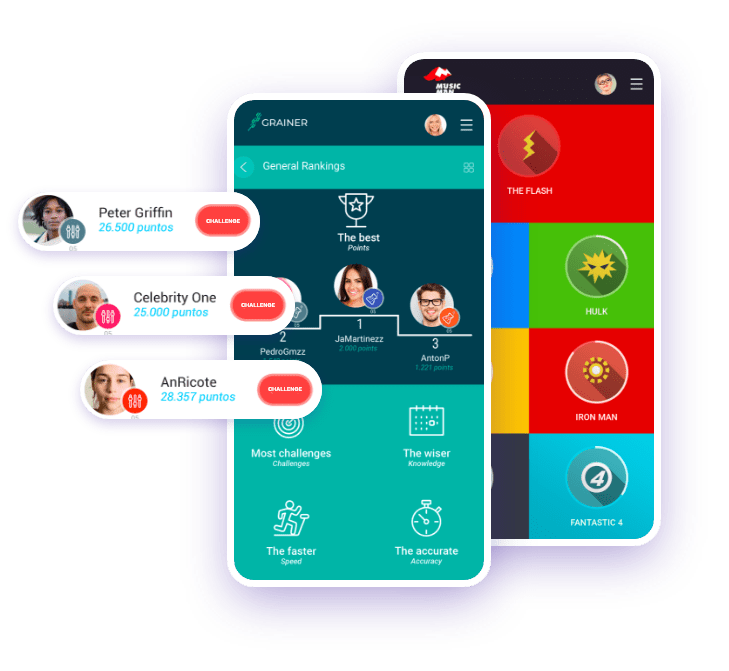
Not all employees learn the same way or start from the same level of knowledge. Personalization in gamification makes it possible to adapt the learning journey to each person’s skills and competencies: adaptive learning paths, customizable avatars, progressive difficulty levels, or content unlocked based on the user’s profile.
This characteristic has a dual impact: it increases the perceived relevance of the content (the employee feels the training “is for them”) and improves retention, as material is delivered at the right time and at the right level. In large organizations with heterogeneous teams, personalization is what sets a generic training program apart from a truly effective learning experience.
The sense of moving forward is one of the most powerful psychological drivers in game design, and in gamified training too. Progress bars, level systems, unlockable certificates, or content that reveals itself upon completing previous stages keep the employee focused on a concrete, visible goal.
From an instructional design perspective, progression also serves an additional pedagogical function: it forces content to be structured in logical, sequenced blocks, which improves comprehension and reduces cognitive overload. In LMS platforms integrated with gamification mechanics, this system also generates valuable tracking data for the L&D manager: what percentage of the team has completed each level, where drop-offs occur, and so on.

In traditional training, feedback tends to arrive late: at the end of a module, in the final assessment, or worst of all, weeks later. Gamification inverts this model: immediate feedback is continuous and specific. The employee knows in real time whether they answered correctly, how many points they have earned, and what they need to improve to progress.
This instant feedback is especially powerful when combined with formative assessment: rather than measuring learning at the end of the process, it is evaluated throughout, allowing for real-time corrections. The result is a cycle of continuous improvement that accelerates knowledge acquisition and reduces errors on the job.

A good narrative transforms an e-learning course into a mission. The employee does not simply “complete modules”: they investigate a case, overcome a fictional business crisis, or help a character make decisions. This approach, known as storytelling applied to learning, increases immersion, emotional connection with the content, and, as a result, long-term retention.
From a design perspective, narrative does not require complex production: even a simple story with a clear context (character + problem + progression) is enough to trigger the immersion effect. The most effective gamification strategies in education integrate narrative as the throughline of the entire training program, not as a one-off decorative element.
Visual design is not just aesthetics: it is part of the signaling system that tells users what to do, how they are progressing, and what they have achieved. Colors, animations, achievement iconography, and clean, visually coherent interfaces all contribute to making the learning experience feel attractive and professional.
In authoring tools like isEazy Author, the visual design of gamified courses is built into the templates: L&D managers can create visually striking experiences without any design expertise, using pre-built interactive components that already incorporate the mechanics of progression, feedback, and reward.

The social dimension of gamification turns learning into a shared experience. Team challenges, gamified discussion forums, collaborative projects, or peer mentoring systems build a community fabric around training that reinforces both learning and organizational culture.
Collaboration is also a powerful retention mechanism: people learn and remember better when they teach others or solve problems as a group. To maximize this effect, gamified platforms must provide structured interaction spaces — not just open chat — where collaborative learning has clear objectives and measurable outcomes. You can read more about this approach in our article on collaborative tools in e-learning.
Not all gamification is the same. When it comes to corporate training at scale — teams of hundreds or thousands of people, multiple locations, high turnover — the characteristics an organization looks for in a gamified app are more demanding than those of a consumer game. The context of use, integration with other systems, and the ability to measure results are just as important as the experience design.
These are the key capabilities a gamified corporate training solution must offer, aligned with the most effective gamification strategies in L&D environments:
The app must integrate game mechanics — missions, challenges, levels, rankings — directly into the training modules, not as a layer added on top of a traditional LMS. The gamified experience must be native: the employee lives the learning as an adventure, not an obligation.

The reward system must be flexible and configurable: points, badges, trophies, digital certificates, or even real incentives (discounts, time off, public recognition). The key is that rewards are meaningful to the employee and visible in their work environment, not only within the platform.
A gamified corporate app without analytics is a game without a scoreboard. L&D managers need to know what percentage of the team has completed each challenge, where drop-offs occur, which mechanics generate the most engagement, and how training progress correlates with business metrics. The dashboard must be actionable, not merely descriptive.

As seen in the characteristics above, the social dimension is an integral part of effective gamification. The app must include structured interaction spaces: teams, group challenges, department-level rankings, and peer recognition mechanisms that reinforce a culture of continuous learning in the organization.
Clarel is a real example of how gamification transforms training at the point of sale. With isEazy, the retail chain achieved 84% engagement across its training programs, simultaneously training employees across multiple stores with gamified, mobile-first content. Find out how they did it →
CASE STUDY
How Clarel achieved over 84% engagement in their training with gamification.


Below you will find the leading gamification platforms for corporate training in 2026, with current ratings to help you choose the one that best fits your organization’s needs:

Features
Benefits
Pricing
Accessibility
Awards
Features
Benefits
Pricing
Accessibility
Awards

Features
Advantages
Plans and pricing
Features
Advantages
Plans and pricing

Features
Advantages
Pricing
Features
Advantages
Pricing

Features
Advantages
Pricing
Features
Advantages
Pricing
Understanding the characteristics of gamification is the first step. The second is having a tool that implements them natively, with no coding or advanced design resources required.
isEazy Game is isEazy’s gamified training solution: a platform built specifically for corporate teams that want to increase engagement, improve knowledge retention, and make learning an experience employees want to repeat. It integrates all the characteristics described in this article — competition, rewards, progression, narrative, feedback, and collaboration — in a visually attractive environment that is easy for the L&D manager to administer.
Ready to see how it works in your organization? Request a free demo of isEazy Game and discover the impact gamification can have on your team.
Gamification in corporate training is built on a set of key characteristics that make learning more engaging and effective. These include friendly competition, which drives employee participation and commitment; motivating rewards such as points and badges, which encourage the achievement of goals; and personalization, which allows the experience to be tailored to each user’s individual needs. Elements like level progression and unlocking, constant feedback, and immersive narrative also help maintain interest and improve knowledge retention.
Gamification is effective because it activates employees’ natural instincts for competitiveness, achievement, and reward, making learning more engaging and motivating. By integrating game mechanics into training — such as points, levels, and challenges — it turns a passive process into an active, participatory experience. This not only improves knowledge retention but also increases completion rates and overall employee engagement with corporate training programs.
Visual design plays a key role in gamification, as an attractive and well-structured experience improves user engagement. Elements such as avatars, bold colors, animations, and an intuitive interface help create an immersive learning environment. Using a design consistent with corporate identity also allows employees to feel more connected to the company and its organizational culture.
One of the fundamental characteristics of gamification is its ability to foster collaboration and teamwork. Through tools such as group challenges, shared leaderboards, and interactive forums, employees can exchange knowledge, solve problems together, and learn from their peers. This social interaction reinforces the sense of community within the company and supports a richer and more effective learning experience.

Mientras tus profesionales se divierten con los juegos pedagógicos más adictivos
¡Solicita una demo!Contáctanos


Transform your training into a unique experience
Discover how isEazy Game can transform your training content into attractive and effective games

Transform your training into a unique experience
Discover how isEazy Game can transform your training content into attractive and effective games