Your imagination has no limits. Now, your authoring tool doesn’t either

Brain
The first AI trained to teach

Author
The #1 AI-powered authoring tool on the market

Factory
Custom e-learning content factory

Skills
Comprehensive power skills course catalog

LMS
All-in-one LMS platform with AI

Engage
App for managing frontline teams
Product

What is Brain?
Everything you need to know about the first AI trained to teach.

How does it work?
Adaptive, conversational, and contextual. That’s learning with Brain.

Security
Why your company’s knowledge never leaves your environment or trains other models.

Comparison
Discover what sets isEazy Brain apart from other AI solutions.

Frequently Asked Questions
Want to learn more? Find answers to all your questions about isEazy Brain here.
FEATURES

AINew
Unlock your full potential and speed up course creation with artificial intelligence.

Accessibility
Automatically meet accessibility guidelines—without sacrificing interactivity!

Interactivity
Boost engagement with interactive, ready-to-use activities that make learning fun.

Course Creation
Reduce the time it takes to create your e-learning courses with our authoring tool.

Distribution
We offer you different distribution options, so that nothing can stop you.

SCORM
Publish your course in SCORM format and share it on any LMS.
SERVICES

Instrucional Design
Surprise your students with multimedia and interactive content.

Custom Courses
We create e-learning courses for you—tailored to your needs and hassle-free!

Virtual Reality
Turn learning into an immersive experience.

Custom Avatars
Give your courses and videos a unique touch with personalized avatars.

Audiovisual FactoryNew
Turn training into something dynamic and visual with engaging videos.
CATALOG

Course catalog
Over 600 skills and competency courses to help you adapt to your team's needs.
Microsoft Copilot AcademyNew
Your professionals will learn how to apply Copilot AI to key processes within your organization.

Artificial Intelligence Academy
Train your teams in the practical use of AI to boost productivity and innovation in your company.

Cybersecurity Academy
Capacita a tu empresa con el catálogo más completo en seguridad digital corporativa.
FEATURES

Learning platform
Manage all your training from one place

Analitycs
Measure the impact of your training

Learning Experience
Offer a unique learning experience to your team
Content Library
Choose from hundreds of expert-created courses
Authoring Tool
Create your own content—faster than ever

Use cases
Choose the solution that best fits your needs

Industries
Solutions for all types of industries
USE CASES

Onboarding
Facilitate the onboarding process, productivity and engagement of your new employees.

Upskilling
Boost your team's skills and prepare them for the challenges of the future with upskilling.

Microlearning
Discover all the advantages of microlearning and boost your training results.

Gamification
Enjoy addictive training that will get your professionals hooked.

Internal Communication
Improve communication in your company and enjoy an aligned and committed team.

Mobile learning
Agile, flexible, and interactive learning—built for today’s digital-first workforce.
INDUSTRIES

Banking and financial services
Training in compliance, cybersecurity, customer service, and key skills development.

Pharmaceuticals and healthcare
Digital onboarding, regulatory updates, and ongoing training for healthcare staff.

Retail and consumer
Agile and scalable training for in-store, operational, and customer service teams.

Industry and manufacturing
Training in processes, safety, and corporate culture for distributed teams.

Education and training
Digital solutions for training centers, internal academies, and corporate universities.

Technology and telecommunications
Development of technical talent, digital skills, and upskilling and reskilling programs.
CLIENTS

MAPFRE
How MAPFRE turn e-learning into sales with isEazy

Pepco
A personalised learning experience for a growing team.

BBVA
Digitisation and creation of high quality e-learning content.

Shiseido
We increase the engagement of the training with a social and gamified app.

Telefónica
Large-scale reskilling for the company's digital transformation.

Vodafone
A personalised learning experience for a growing team.
More than 1,000 companies already rely on isEazy.





MEET ISEAZY

Events
Discover our upcoming events and connect with the future of e-learning.

News
Find out the latest news about isEazy: press releases, partnerships, updates...

Contact
Leave us your personal details and we will contact you as soon as possible.
About isEazyNew
Find out more about our company.

Careers
We are looking for the best talent, join our team!

Partners
Become our partner and grow your business.
INTERESTING RESOURCES

Blog
The best content on e-learning: trends, tools and key strategies.

Whitepapers
Gain valuable insights and stay ahead of industry trends.

Product releases
The latest news and releases of our e-learning products and solutions.

Glossary
Definitions of the most commonly used terms and key industry concepts.

Guides
Discover the best step-by-step tips and tricks to optimize your L&D strategy.

Webinars
Video sessions on our products, trends and more

Comparatives
Compare e-learning solutions available on the market and choose the most suitable one.


WEBINAR
Master AI in isEazy Author in under an hour.




GUIDE
Prepare your organization to comply with the new AI regulations

Stay up to date with all our latest news
 Subscribe to our newsletter
 Stay up to date with all our latest news

January 8, 2026

CONTENT CREATED BY:
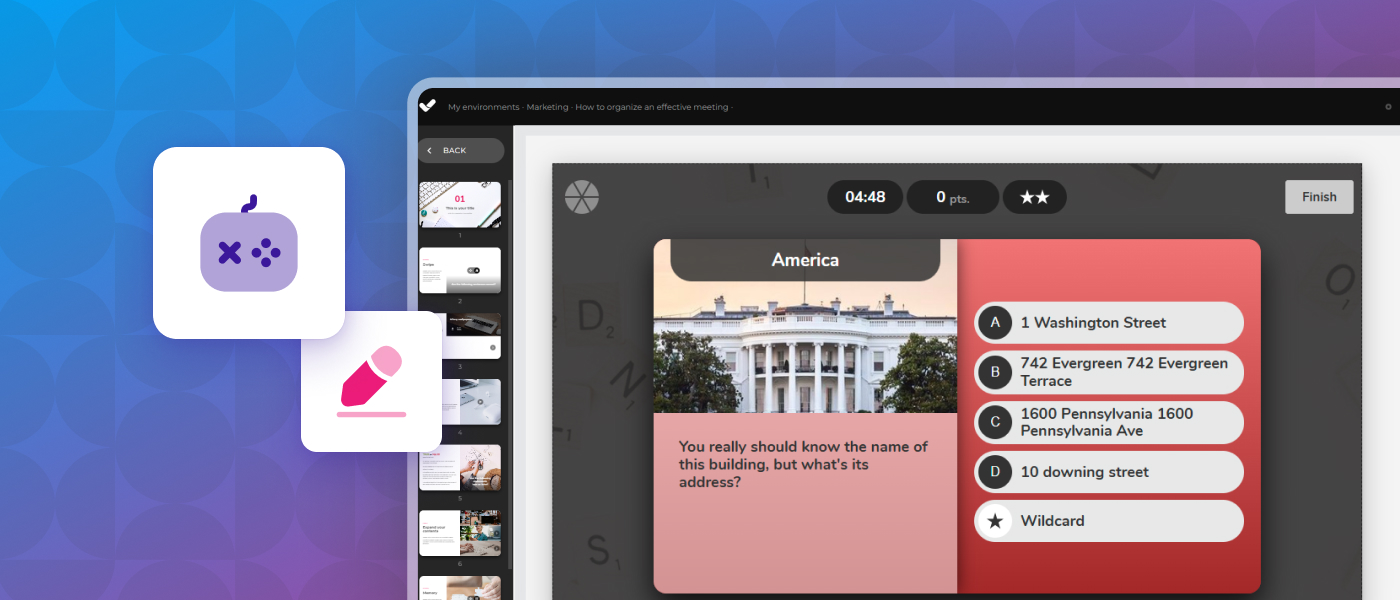
Table of contents
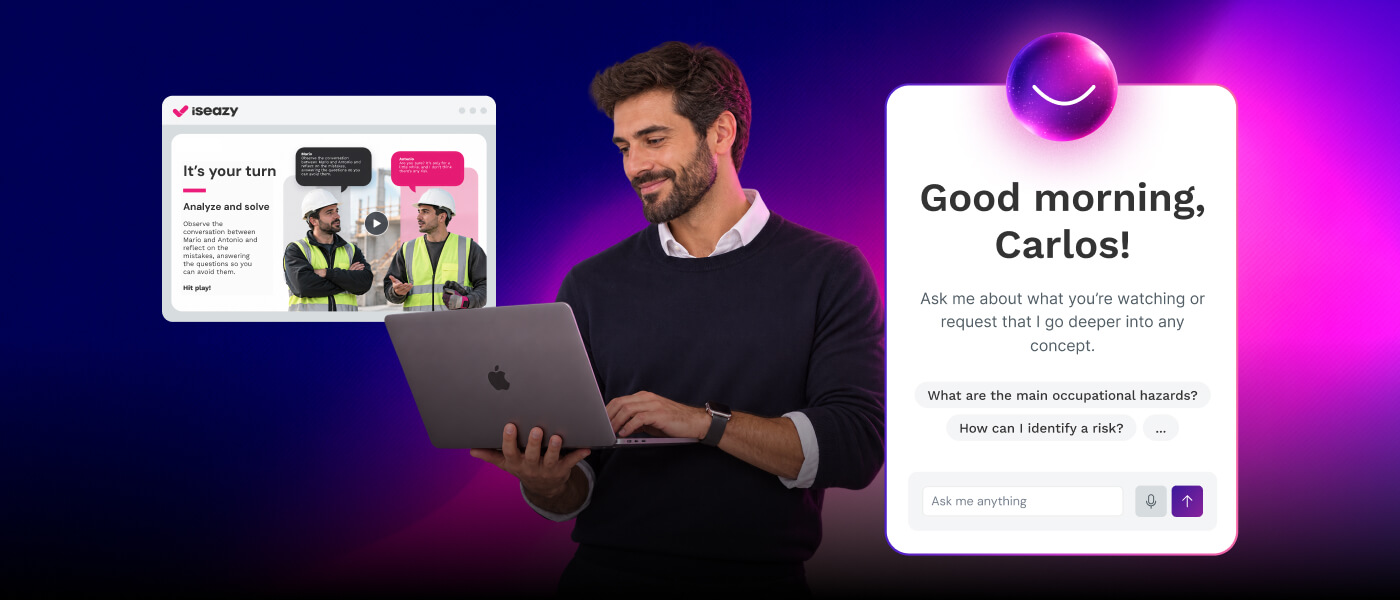
Imagine your employees eagerly looking forward to the next training module. Competing in a healthy way to complete courses. Retaining information like never before. Sounds impossible? It isn’t when you combine artificial intelligence with gamification.
According to a SAGE Open study, 80% of traditional gamification activities fail to meet their business goals due to poor design. But when you add AI to the process of creating gamified activities, the story changes dramatically: not only does engagement increase by up to 60% and knowledge retention improves by 40%, but productivity when creating training content skyrockets.
In this post, you’ll discover how AI is revolutionizing gamification in corporate training, how to create AI-powered gamified courses, and how to design gamified activities faster, more consistently, and at scale.
Gamification has evolved a lot since its early days of “adding points to everything.” Today—especially when it’s combined with artificial intelligence in the creation process—it has become a strategic methodology that radically transforms how learning happens in corporate environments.
Gamification is about applying game mechanics and dynamics in non-game contexts, such as corporate training. But careful—it’s not about turning training into a video game. It’s about using specific elements that spark people’s intrinsic motivation. Key elements include:
Why it works from a psychology standpoint: Gamification activates three fundamental human needs according to self-determination theory:
Many companies confuse the terms gamification, Game-Based Learning, and Serious Games—or games as we traditionally know them. This leads to failed implementations. Here’s the clear distinction:
| Concept | What it is | Examples and when to use it |
|---|---|---|
| Gamification | Add game mechanics to existing content | Example: Compliance course with a points and rankings system. When to use it: When you already have content and want to increase engagement. |
| Game-Based Learning | Games designed specifically for teaching | Example: Branching scenarios or role plays. When to use it: When you need practice in realistic environments. |
| Serious Games | Full games with deep learning objectives | Example: A strategy game to teach crisis management. When to use it: When the topic is complex and requires full immersion. |
Most companies need gamification, because it’s more flexible, less costly, and easy to integrate into existing programs. But it’s not enough to add badges and expect results. Effective gamification requires these non-negotiable components:
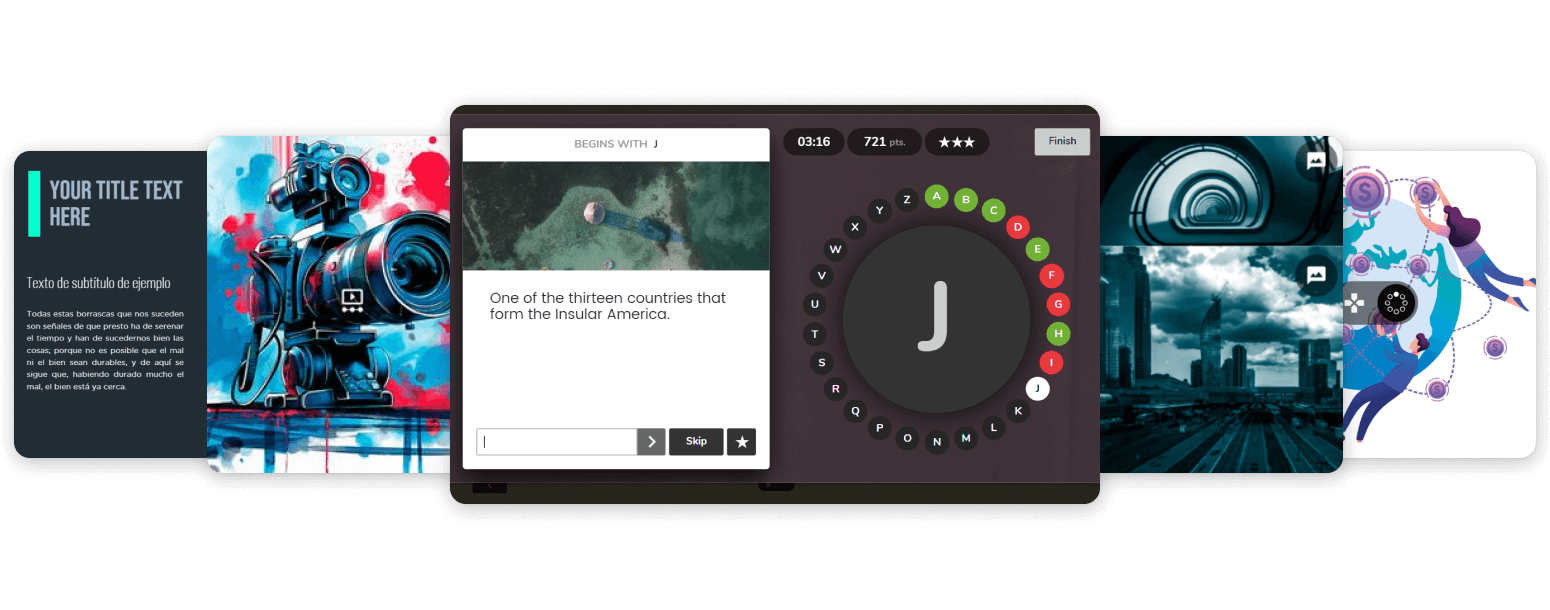
Artificial intelligence doesn’t just make gamification easier to implement—it makes it exponentially more effective. In the past, creating a gamified course took weeks or months: designing activities, programming interactions, adjusting difficulty levels. It was a slow, costly process that required specialized teams. Today, with authoring tools like isEazy Author, you can create interactive and gamified experiences in a matter of minutes. This approach turns an AI-powered authoring tool into the primary ally for L&D teams that need to produce more training without increasing resources.
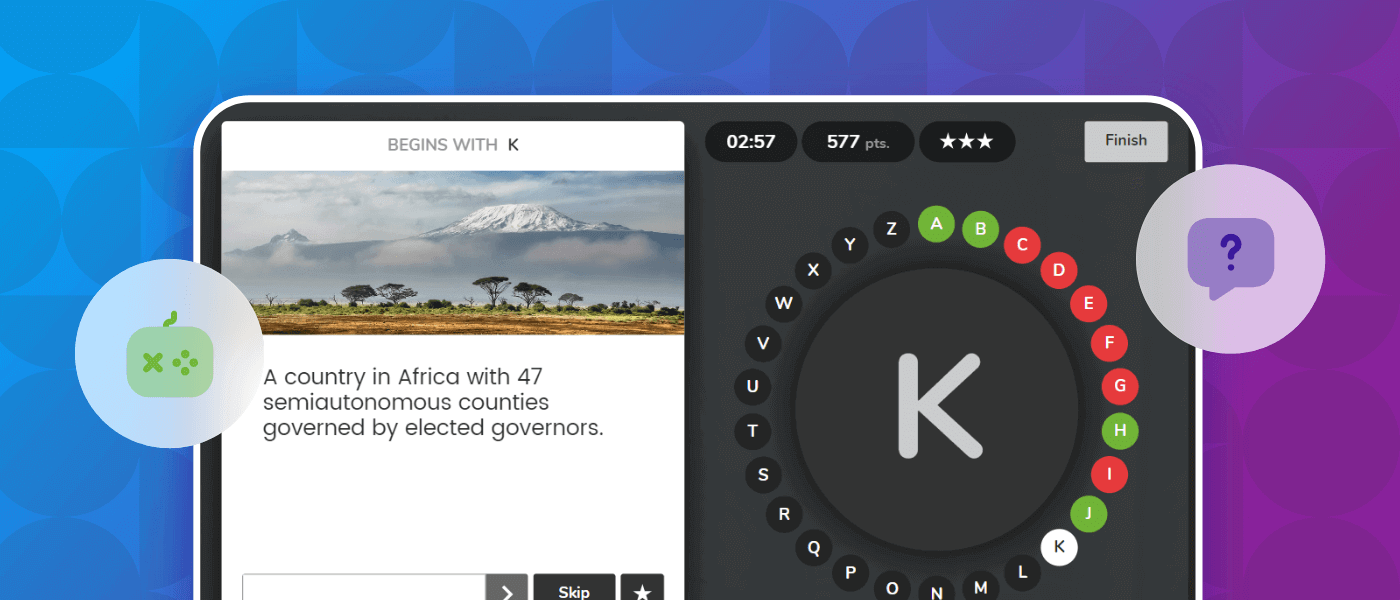
What does this mean? That you don’t have to invest time and effort in thinking through, planning, and laying out games or exercises. In one click, the AI in isEazy Author automatically adds educational games based on your course content. Wheel of Fortune-style, Trivia, Memory… or interactive chat-style exercises, ABC, grouping, ordering… and many more—without needing design or programming skills.
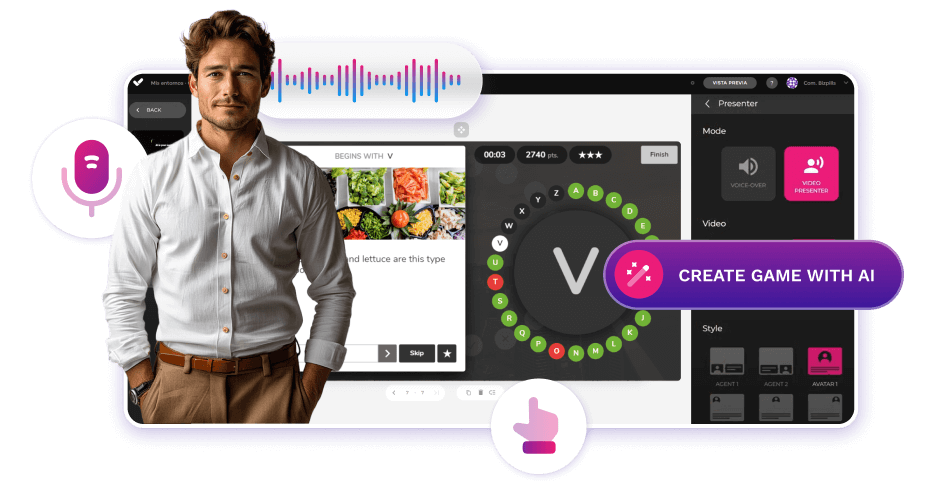
In fact, the way you create interactive courses can go even further with the new AI Autopilot from isEazy Author, which enables you to:
Practical example: Imagine you have a 50-page manual on new safety procedures. Before, you would take 2–3 weeks to turn it into an interactive course. With AI Autopilot:
Your imagination has no limits. Now, your authoring tool doesn’t either
Discover the new AI Autopilot from isEazy Author


Below you’ll find examples of AI-powered gamified activities designed to reinforce understanding, retention, and application—without complicating course design.
The key to making knowledge stick isn’t repeating the same thing 100 times—it’s presenting it in multiple ways and across varied contexts. This is where AI-powered gamification shines. Monotony is the enemy of learning. Offering a variety of gamified formats keeps the brain active and receptive. Some of the most effective formats by content type include:
Ideal for reinforcing processes, protocols, and procedural steps, because they force learners to reconstruct the logical sequence of a task and understand dependencies. This type of exercise is especially well-suited for operational training, onboarding, and compliance content, as it turns a “step-by-step” into a practical activity that’s easy to assess.
Very useful for working on cause-and-effect relationships, definitions, concepts, and categories, because they help create fast and solid mental associations. These matching exercises allow you to turn theoretical content into a short, clear dynamic—perfect for checking understanding and reinforcing key concepts without friction.
Recommended for developing soft skills, customer service, leadership, or ethics, because they place learners in real situations and allow them to practice decision-making without risk. With isEazy Author, you can create branching scenarios based on your course content. The AI takes care of generating the story and the different branches, and you can automatically add avatar videos, audio, images, and as many decision points as you want. Here’s a post that explains this interactive step by step and how to create it in minutes.
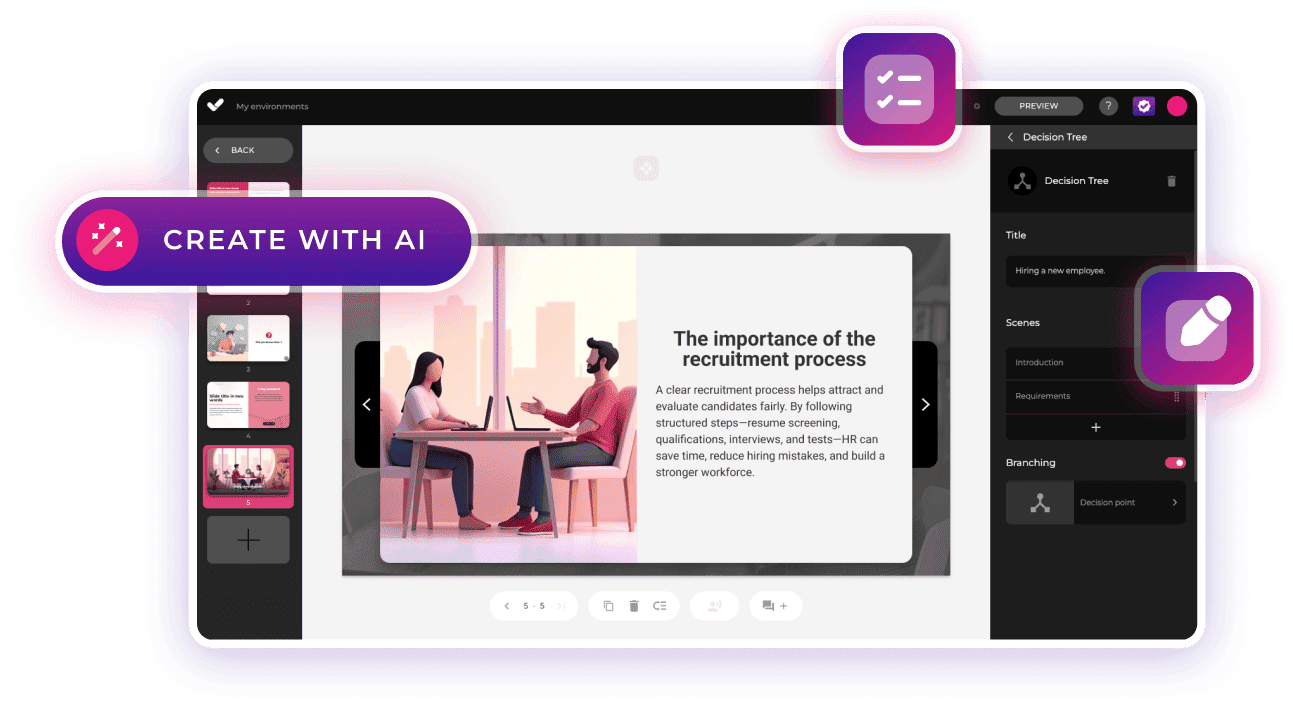
When the goal is to review key concepts without increasing time spent, “short challenge” style games are especially effective. They keep attention high, encourage repetition without feeling monotonous, and make it easy to embed frequent reviews within the learning path.

Discover here all the interactive elements isEazy Author offers—and that you can add to your courses in just one click thanks to AI.
| Training objective | Recommended formats |
|---|---|
| Onboarding | Sequence ordering, matching, branching scenarios, assessments. |
| Compliance / H&S (PRL) | Sequence ordering, matching, branching scenarios, assessments. |
| Product / Sales | Category-based trivia, “ring” quiz (rosco), assessments, branching scenarios. |
| Soft skills | Branching scenarios, chat/role-play exercises. |
| Operational processes | Ordering, memory games, module-based refreshers. |
Enough theory. Here is your concrete action plan to implement AI-powered gamification in your company.
Before you gamify anything, you need to know exactly what you want to achieve. Vague goals lead to mediocre results. You can use these goals as a guide:
Not all types of gamification work for every objective. Use this decision matrix:
If there isn’t a clear learning objective, games feel decorative. Start with what the learner needs to be able to do, and choose the format afterwards.
Repeating the same type of activity over and over reduces engagement. Alternate formats (ordering, matching, quick games, scenarios) to keep attention high and reinforce learning from different angles.
The mechanics can’t overshadow the content. Prioritize activities that require applying concepts and provide useful feedback—not just “correct/incorrect.”
The value of a gamified activity is in the explanation: why it’s right or wrong and how to do it better. Without this, retention drops.
If the learner has to “learn how to play,” you lose impact. Simple rules, short instructions, and one primary action per screen.
The combination of AI and gamification works when it’s designed with intention: clear objectives, short but meaningful experiences, a variety of formats, and real personalization that avoids both boredom and frustration. Technology accelerates and optimizes, but impact comes when learning connects with the employee’s day-to-day work. If you want to take the first step with a practical approach:
And if your goal is to drastically reduce production time without sacrificing quality, isEazy Author and the new AI Autopilot let you go from documentation to interactive courses in minutes—integrating gamification from the initial design and freeing your team from technical, manual tasks.

Ready to turn training into an experience people actually want to complete—and remember? Request a demo and discover how to take your corporate training to the next level with AI and gamification.
Gamification adds game mechanics to existing content (points, challenges, leaderboards), while Game-Based Learning relies on games designed specifically to teach. In corporate training, gamification is often the starting point because it’s more flexible and scalable.
Primarily, it speeds up instructional design: it helps turn documentation or an idea into a learning structure and interactive activities ready for validation, reducing manual planning and layout work.
Activities that force recall and application: sequencing steps, matching concepts, short review games (ring quiz/“rosco”, memory, word games, trivia), and branching scenarios when judgment and decision-making are required.
When the goal is to train decision-making (soft skills, customer service, leadership, ethics) and simulate consequences in a safe environment. It’s the most powerful format when you want applied learning, not just memorization.
Define measurable learning objectives, include useful feedback in each activity, and prioritize formats that require learners to apply knowledge. Gamification should be a means to learning, not an aesthetic end goal.
It depends on the objective, but a practical guideline is to alternate short theory with frequent micro-activities. What matters is that each activity reinforces a specific concept and doesn’t add unnecessary complexity.
Yes. If you start from a manual or procedure, the key is to turn it into a clear structure and then integrate activities that assess understanding and application. This is one of the scenarios where AI can reduce production time the most.

WEBINAR
Master AI in isEazy Author in under an hour.
Register Now


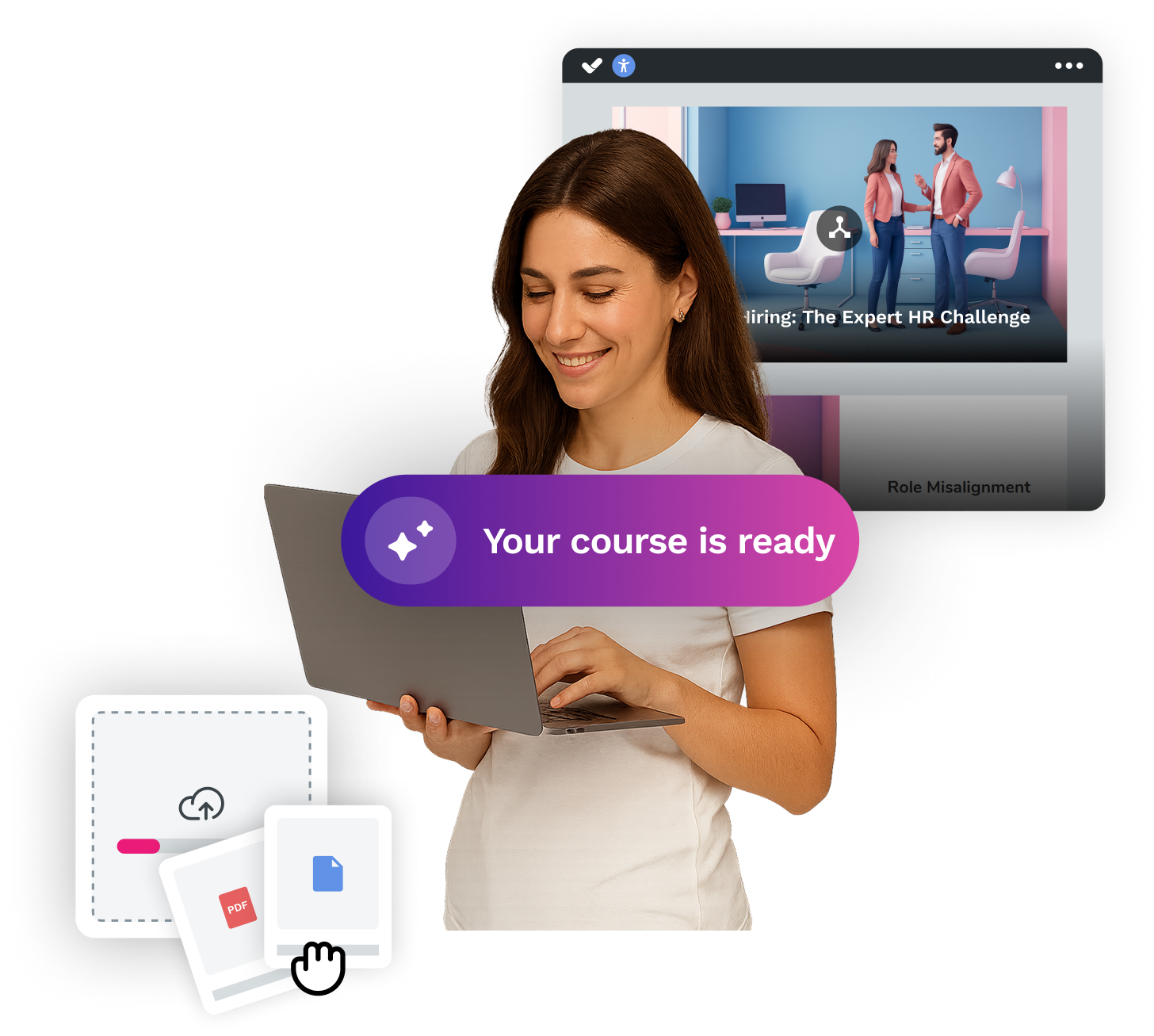
Activate autopilot and create courses at AI speed
Transform your ideas or documents into spectacular courses automatically, with the #1 AI authoring tool on the market.


Activate autopilot and create courses at AI speed
Transform your ideas or documents into spectacular courses automatically, with the #1 AI authoring tool on the market.