CASE STUDY
We helped Clarel transform its knowledge into interactive and effective microcontents

Brain
The first AI trained to teach

Author
The #1 AI-powered authoring tool on the market

Factory
Custom e-learning content factory

Skills
Comprehensive power skills course catalog

LMS
All-in-one LMS platform with AI

Engage
App for managing frontline teams
Product

What is Brain?
Everything you need to know about the first AI trained to teach.

How does it work?
Adaptive, conversational, and contextual. That’s learning with Brain.

Security
Why your company’s knowledge never leaves your environment or trains other models.

Comparison
Discover what sets isEazy Brain apart from other AI solutions.

Frequently Asked Questions
Want to learn more? Find answers to all your questions about isEazy Brain here.
FEATURES

AINew
Unlock your full potential and speed up course creation with artificial intelligence.

Accessibility
Automatically meet accessibility guidelines—without sacrificing interactivity!

Interactivity
Boost engagement with interactive, ready-to-use activities that make learning fun.

Course Creation
Reduce the time it takes to create your e-learning courses with our authoring tool.

Distribution
We offer you different distribution options, so that nothing can stop you.

SCORM
Publish your course in SCORM format and share it on any LMS.
SERVICES

Instrucional Design
Surprise your students with multimedia and interactive content.

Custom Courses
We create e-learning courses for you—tailored to your needs and hassle-free!

Virtual Reality
Turn learning into an immersive experience.

Custom Avatars
Give your courses and videos a unique touch with personalized avatars.

Audiovisual FactoryNew
Turn training into something dynamic and visual with engaging videos.
CATALOG

Course catalog
Over 600 skills and competency courses to help you adapt to your team's needs.
Microsoft Copilot AcademyNew
Your professionals will learn how to apply Copilot AI to key processes within your organization.

Artificial Intelligence Academy
Train your teams in the practical use of AI to boost productivity and innovation in your company.

Cybersecurity Academy
Capacita a tu empresa con el catálogo más completo en seguridad digital corporativa.
FEATURES

Learning platform
Manage all your training from one place

Analitycs
Measure the impact of your training

Learning Experience
Offer a unique learning experience to your team
Content Library
Choose from hundreds of expert-created courses
Authoring Tool
Create your own content—faster than ever

Use cases
Choose the solution that best fits your needs

Industries
Solutions for all types of industries
USE CASES

Onboarding
Facilitate the onboarding process, productivity and engagement of your new employees.

Upskilling
Boost your team's skills and prepare them for the challenges of the future with upskilling.

Microlearning
Discover all the advantages of microlearning and boost your training results.

Gamification
Enjoy addictive training that will get your professionals hooked.

Internal Communication
Improve communication in your company and enjoy an aligned and committed team.

Mobile learning
Agile, flexible, and interactive learning—built for today’s digital-first workforce.
INDUSTRIES

Banking and financial services
Training in compliance, cybersecurity, customer service, and key skills development.

Pharmaceuticals and healthcare
Digital onboarding, regulatory updates, and ongoing training for healthcare staff.

Retail and consumer
Agile and scalable training for in-store, operational, and customer service teams.

Industry and manufacturing
Training in processes, safety, and corporate culture for distributed teams.

Education and training
Digital solutions for training centers, internal academies, and corporate universities.

Technology and telecommunications
Development of technical talent, digital skills, and upskilling and reskilling programs.
CLIENTS

MAPFRE
How MAPFRE turn e-learning into sales with isEazy

Pepco
A personalised learning experience for a growing team.

BBVA
Digitisation and creation of high quality e-learning content.

Shiseido
We increase the engagement of the training with a social and gamified app.

Telefónica
Large-scale reskilling for the company's digital transformation.

Vodafone
A personalised learning experience for a growing team.
More than 1,000 companies already rely on isEazy.





MEET ISEAZY

Events
Discover our upcoming events and connect with the future of e-learning.

News
Find out the latest news about isEazy: press releases, partnerships, updates...

Contact
Leave us your personal details and we will contact you as soon as possible.
About isEazyNew
Find out more about our company.

Careers
We are looking for the best talent, join our team!

Partners
Become our partner and grow your business.
INTERESTING RESOURCES

Blog
The best content on e-learning: trends, tools and key strategies.

Whitepapers
Gain valuable insights and stay ahead of industry trends.

Product releases
The latest news and releases of our e-learning products and solutions.

Glossary
Definitions of the most commonly used terms and key industry concepts.

Guides
Discover the best step-by-step tips and tricks to optimize your L&D strategy.

Webinars
Video sessions on our products, trends and more

Comparatives
Compare e-learning solutions available on the market and choose the most suitable one.


WEBINAR
Master AI in isEazy Author in under an hour.




GUIDE
Prepare your organization to comply with the new AI regulations

Stay up to date with all our latest news
 Subscribe to our newsletter
 Stay up to date with all our latest news

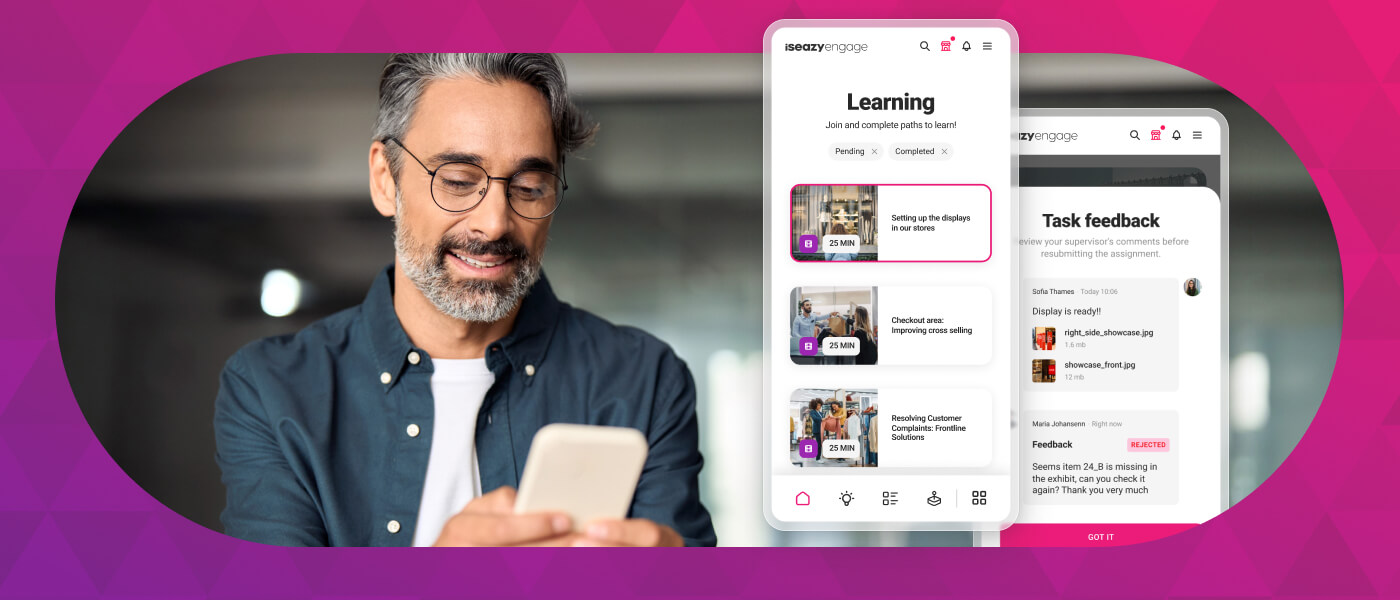
Table of contents
Learning in the flow of work is a training model that integrates learning directly into the working day, at the exact moment an employee needs it. No scheduled breaks, no courses disconnected from the day-to-day. Knowledge arrives when the real need arises.
The term was coined by analyst Josh Bersin in 2018 and has since become one of the most relevant approaches for L&D teams. The reason is simple: according to the LinkedIn Workplace Learning Report 2024, 65% of employees say they don’t have time to train using the traditional model. Learning in the flow of work eliminates that problem by embedding training within the tasks themselves.
To fully understand this approach, it helps to compare it with the classic training model. The goal isn’t to replace one system with the other, but to understand when and how to use each one:
| Element | Traditional e-learning | Learning in the flow of work |
|---|---|---|
| When learning happens | In a separate moment away from work | While working, at the moment of need |
| Format | Structured long-duration courses | Microlearning content, 2–5 minutes |
| Assessment | Exams or tests at the end of the course | Immediate application and performance metrics |
| Access | LMS platform outside the work flow | Embedded in daily tools |
| Impact on productivity | Indirect, deferred over time | Direct, observable within the same working day |
The way people work has changed, but in many organisations training still operates the same way it did twenty years ago: lengthy sessions, courses scheduled weeks in advance, and content that rarely connects with what an employee needs to solve that same afternoon.
The data confirms the urgency:
The market evolves faster than traditional training cycles. Companies that stick to the “annual course plus assessment” model are not only losing efficiency — they are failing to respond to the learning needs that emerge every week within their teams.
Learning in the flow of work is not simply a new way of presenting content. It is a shift in the results that follow. When learning becomes part of the daily working routine, the impact is tangible for both individuals and the organisation.
When training appears at the right moment and has a clear, immediate purpose, employees participate naturally. It is no longer perceived as an external obligation but as concrete help for something they are doing right now. The result is higher engagement, significantly lower dropout rates, and a far more natural relationship with continuous learning. Employees no longer need external motivation to develop.
Learning in the flow of work optimises time without taking it away. Unproductive hours, commutes, and content that employees will never apply are reduced. Companies such as Microsoft and Deloitte report 15–25% greater learning effectiveness when it happens within the actual work flow.
Because it is directly tied to day-to-day performance, learning in the flow of work is far easier to measure and justify. Metrics shift from training hours to business indicators: error reduction, resolution time, and adoption rate. IBM recorded an ROI exceeding 2,280% after integrating contextual learning analytics into its internal processes (IBM’s Basic Blue e-learning Initiative, Nucleus Research).
This approach does not just aim to transfer knowledge — it aims to change how people work. By drawing on immediate feedback and continuous learning, it enables rapid adjustments in behaviour and task execution. Improvements are visible day by day, with a direct impact on team results.
Implementing learning in the flow of work is not about adding microlearning content to an LMS and waiting for results. It requires a planned strategy that addresses culture, technology, and impact measurement. These are the practices that make the real difference:
The first step is making content available at the exact moment and place where the need arises. This means mobile compatibility, frictionless access from the tools employees already use, and content that requires no prior download. If access is slow or complicated, the employee won’t learn — they’ll carry on and the knowledge opportunity is lost. Mobile learning is a key enabler at this stage.
The goal is not to add yet another platform. Learning in the flow of work is most effective when content appears inside the systems employees already have open: the CRM, the intranet, the company chat, or the LMS itself. The fewer context switches required, the greater the likelihood of learning at the right moment. This connects directly with the concept of just-in-time training.
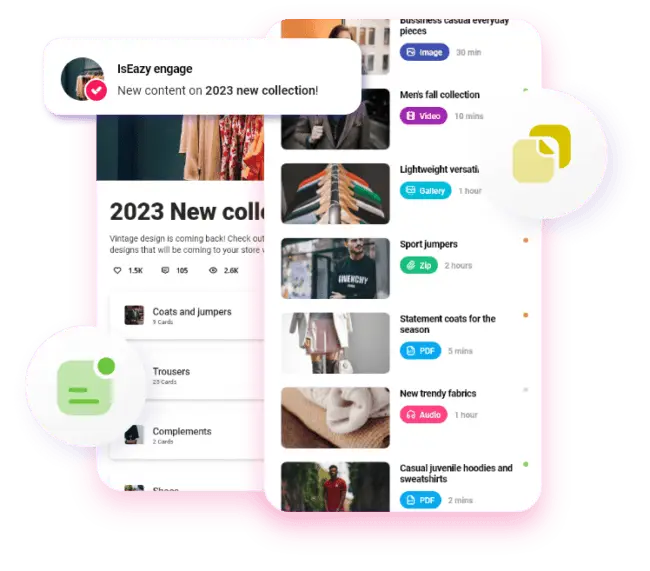
Not everyone needs the same thing at the same time. For learning in the flow of work to succeed, content must be tied to the specific task the employee is performing. This requires segmentation by role, level, and stage within the work process. A sales manager needs a different type of content from a support technician, even when both are working within the same process.
Duration matters. Microlearning content between 2 and 5 minutes is the ideal format: it can be consumed at the moment of need without breaking the work rhythm. Short videos, infographics, checklists, and brief simulations drive greater retention and faster application than long courses. Well-designed microlearning programmes require 50% less average completion time (Atrivity, Effective Microlearning).
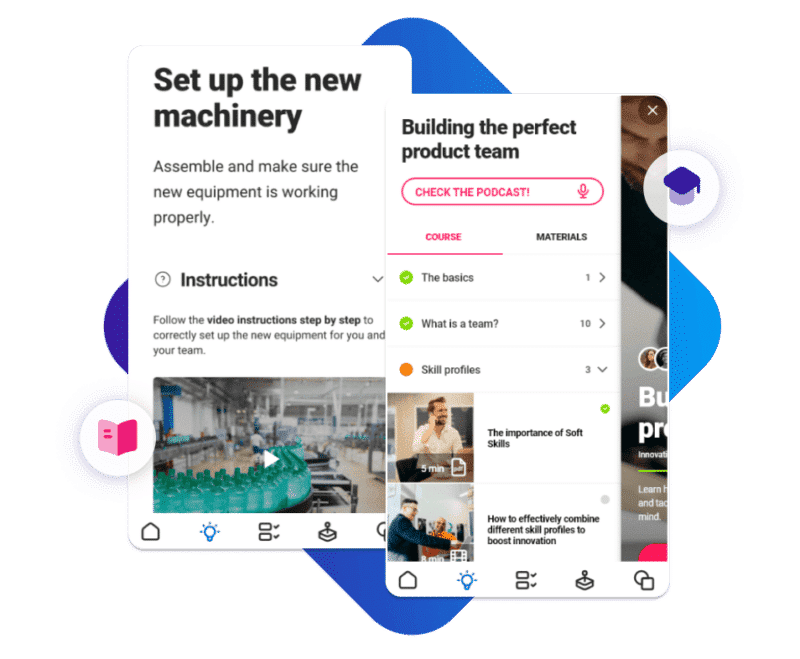
Learning in the flow of work is not static. Measuring real impact is the only way to know whether it is working and to improve it. The relevant metrics are not training hours but performance indicators: error rate before and after, task resolution time, and adoption rate of new processes. An LMS with advanced analytics allows this improvement cycle to be closed systematically. This connects with the 70-20-10 model, where 70% of real learning happens on the job.

Although learning in the flow of work has clear advantages, implementation is not without its difficulties. Knowing them in advance allows for a more robust strategy.
The main technology obstacle is not a lack of tools — it is getting them to communicate with each other. An LMS that doesn’t integrate with the CRM, intranet, or communication tools forces the employee to switch context to learn, which breaks the very principle of flow-based learning. The solution is to choose platforms with open APIs and native integrations with the company’s existing digital ecosystem.
The hardest barrier is not technical — it is cultural. If the organisation holds the perception that training consumes productive time, learning in the flow of work will face resistance from both employees and middle managers. Overcoming this requires visible leadership commitment to continuous learning and explicitly linking training to business objectives, not just personal development.
Without real impact metrics, any investment in learning in the flow of work is difficult to justify to senior leadership. The path forward is to start with a controlled pilot of 6–8 weeks on a specific process (such as onboarding or customer support), measure KPIs before and after, and scale from the results. The numbers speak for themselves when the pilot is well designed.
As the model scales, the volume of microlearning content grows — and with it the risk of inconsistencies, duplicates, or outdated information. Content governance is critical: establishing clear processes for review, updating, and curation is just as important as initial creation. AI-powered knowledge management tools can help automate part of this process.
One of the most significant advantages of learning in the flow of work is that it is easier to measure than traditional training, because its effects are immediate and connected to real performance. The common mistake is to keep measuring training hours or completion rates when the relevant metrics are entirely different.
The key KPIs for evaluating the impact of learning in the flow of work are:
An LMS with advanced analytics is essential to capture these metrics systematically. Without visibility into contextual learning behaviour, learning in the flow of work is difficult to justify or improve. Data-driven personalised learning is the natural next step once these metrics are up and running.
Although learning in the flow of work has clear advantages, implementation is not without its difficulties. Knowing them in advance allows for a more robust strategy.
The main technology obstacle is not a lack of tools — it is getting them to communicate with each other. An LMS that doesn’t integrate with the CRM, intranet, or communication tools forces the employee to switch context in order to learn, breaking the very principle of flow-based learning. The solution is to choose platforms with open APIs and native integrations with the company’s existing digital ecosystem.
The hardest barrier is not technical — it is cultural. If the organisation holds the perception that training consumes productive time, learning in the flow of work will face resistance from both employees and middle managers. Overcoming this requires visible leadership commitment to continuous learning and explicitly linking training to business objectives, not just personal development.
Without real impact metrics, any investment in learning in the flow of work is difficult to justify to senior leadership. The path forward is to start with a controlled pilot of 6–8 weeks on a specific process (such as onboarding or customer support), measure KPIs before and after, and scale from the results. The numbers speak for themselves when the pilot is well designed.
As the model scales, the volume of microlearning content grows — and with it the risk of inconsistencies, duplicates, or outdated information. Content governance is critical: establishing clear processes for review, updating, and curation is just as important as initial creation. AI-powered knowledge management tools can help automate part of this process.

Clarel is a strong example of how a company with a dispersed retail network can implement learning in the flow of work effectively. With hundreds of stores and teams who don’t have access to a fixed computer during their working day, the challenge was to deliver training at the right moment and in the right format. Using isEazy, Clarel managed to train its teams across multiple points of sale simultaneously, with content accessible from mobile devices and adapted to the real rhythm of in-store work. Find out how they did it →
CASE STUDY
We helped Clarel transform its knowledge into interactive and effective microcontents


Learning in the flow of work is not a passing trend — it is the natural response to how people genuinely learn. When knowledge is available at the moment of need, embedded in day-to-day tools, and presented in the right format, the impact is immediate and measurable.
For L&D teams, this represents a shift in role: from course coordinators to designers of continuous learning experiences. It means choosing the right tools, crafting content that works in real contexts, and measuring outcomes that matter to the business.
isEazy offers tools built to make this model a reality: from creating engaging microlearning content with isEazy Author, to managing and analysing learning in real time with isEazy LMS, and developing competencies with isEazy Skills. If you want to put learning at the heart of your team’s workflow, the first step is exploring which tool fits your context best.
If you want to explore how learning evolves across the organisation beyond the individual work flow, on-the-job training (OJT) is a natural complement to this model.
The main difference is timing and context. Traditional training usually happens outside daily work, in structured courses with generic content. Learning in the flow of work integrates directly into the employee’s real tasks and appears exactly when needed — enabling immediate application and a greater overall impact.
No. Although it is especially useful for frontline or deskless workers, this approach works for any role. Anyone who needs to resolve doubts, access information, or learn something new while working can benefit from contextual, real-time learning.
Short, practical, and actionable content. Microlearning, short videos, quick reference guides, checklists, and interactive quizzes are a far better fit than long courses. The key is that the content helps the employee perform a specific task better, right at the moment they need it.
Beyond completion rates, impact is measured through real usage and day-to-day application. Indicators such as engagement, recurrence, task resolution, feedback, and improvements in performance reveal whether the learning is generating tangible business results.
The best starting point is identifying the critical moments in daily workflows where questions or frequent errors arise. From there, create simple content, embed it into the tools teams already use, and measure adoption to iterate. Starting small and scaling progressively is usually the most effective strategy.

GUIDE
Prepare your organization to comply with the new AI Regulations
Download guide


All Your Training Needs in One Powerful Tool!
Training management, content library, course creation, and progress tracking—everything in a single subscription!


All Your Training Needs in One Powerful Tool!
Training management, content library, course creation, and progress tracking—everything in a single subscription!