CASE STUDY
We helped STF Group achieve an 87% completion rate in its leadership program

Brain
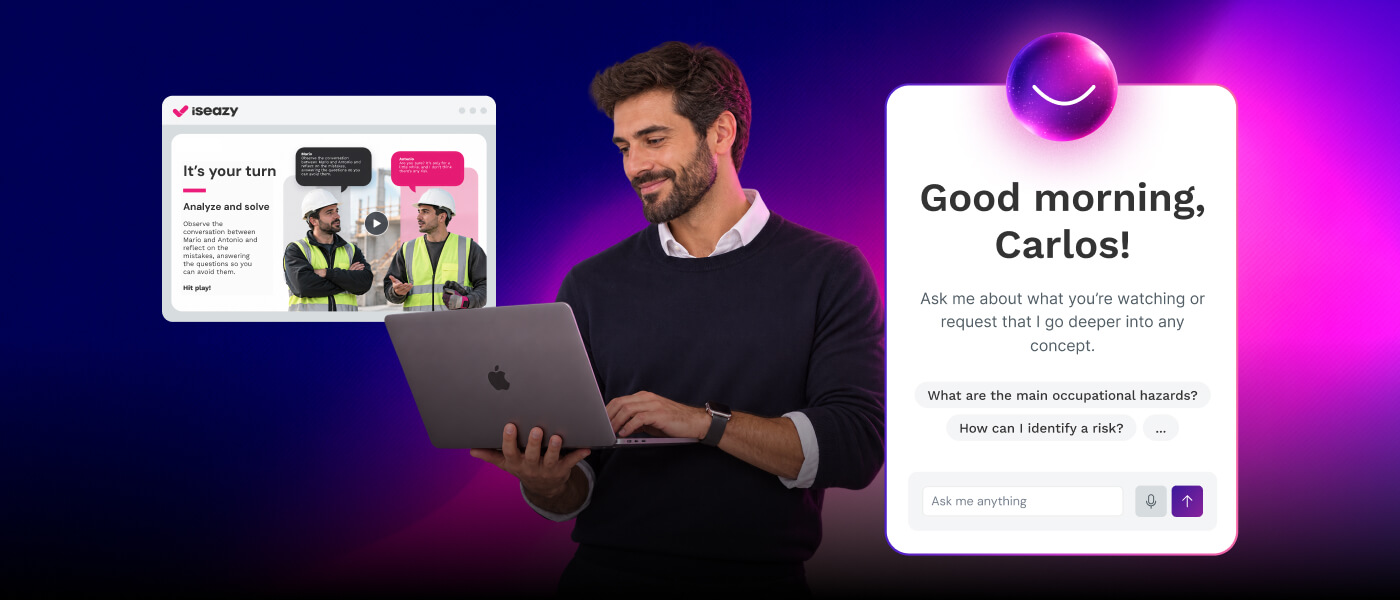
The first AI trained to teach

Author
The #1 AI-powered authoring tool on the market

Factory
Custom e-learning content factory

Skills
Comprehensive power skills course catalog

LMS
All-in-one LMS platform with AI

Engage
App for managing frontline teams
Product

What is Brain?
Everything you need to know about the first AI trained to teach.

How does it work?
Adaptive, conversational, and contextual. That’s learning with Brain.

Security
Why your company’s knowledge never leaves your environment or trains other models.

Comparison
Discover what sets isEazy Brain apart from other AI solutions.

Frequently Asked Questions
Want to learn more? Find answers to all your questions about isEazy Brain here.
FEATURES

AINew
Unlock your full potential and speed up course creation with artificial intelligence.

Accessibility
Automatically meet accessibility guidelines—without sacrificing interactivity!

Interactivity
Boost engagement with interactive, ready-to-use activities that make learning fun.

Course Creation
Reduce the time it takes to create your e-learning courses with our authoring tool.

Distribution
We offer you different distribution options, so that nothing can stop you.

SCORM
Publish your course in SCORM format and share it on any LMS.
SERVICES

Instrucional Design
Surprise your students with multimedia and interactive content.

Custom Courses
We create e-learning courses for you—tailored to your needs and hassle-free!

Virtual Reality
Turn learning into an immersive experience.

Custom Avatars
Give your courses and videos a unique touch with personalized avatars.

Audiovisual FactoryNew
Turn training into something dynamic and visual with engaging videos.
CATALOG

Course catalog
Over 600 skills and competency courses to help you adapt to your team's needs.
Microsoft Copilot AcademyNew
Your professionals will learn how to apply Copilot AI to key processes within your organization.

Artificial Intelligence Academy
Train your teams in the practical use of AI to boost productivity and innovation in your company.

Cybersecurity Academy
Capacita a tu empresa con el catálogo más completo en seguridad digital corporativa.
FEATURES

Learning platform
Manage all your training from one place

Analitycs
Measure the impact of your training

Learning Experience
Offer a unique learning experience to your team
Content Library
Choose from hundreds of expert-created courses
Authoring Tool
Create your own content—faster than ever

Use cases
Choose the solution that best fits your needs

Industries
Solutions for all types of industries
USE CASES

Onboarding
Facilitate the onboarding process, productivity and engagement of your new employees.

Upskilling
Boost your team's skills and prepare them for the challenges of the future with upskilling.

Microlearning
Discover all the advantages of microlearning and boost your training results.

Gamification
Enjoy addictive training that will get your professionals hooked.

Internal Communication
Improve communication in your company and enjoy an aligned and committed team.

Mobile learning
Agile, flexible, and interactive learning—built for today’s digital-first workforce.
INDUSTRIES

Banking and financial services
Training in compliance, cybersecurity, customer service, and key skills development.

Pharmaceuticals and healthcare
Digital onboarding, regulatory updates, and ongoing training for healthcare staff.

Retail and consumer
Agile and scalable training for in-store, operational, and customer service teams.

Industry and manufacturing
Training in processes, safety, and corporate culture for distributed teams.

Education and training
Digital solutions for training centers, internal academies, and corporate universities.

Technology and telecommunications
Development of technical talent, digital skills, and upskilling and reskilling programs.
CLIENTS

MAPFRE
How MAPFRE turn e-learning into sales with isEazy

Pepco
A personalised learning experience for a growing team.

BBVA
Digitisation and creation of high quality e-learning content.

Shiseido
We increase the engagement of the training with a social and gamified app.

Telefónica
Large-scale reskilling for the company's digital transformation.

Vodafone
A personalised learning experience for a growing team.
More than 1,000 companies already rely on isEazy.





MEET ISEAZY

Events
Discover our upcoming events and connect with the future of e-learning.

News
Find out the latest news about isEazy: press releases, partnerships, updates...

Contact
Leave us your personal details and we will contact you as soon as possible.
About isEazyNew
Find out more about our company.

Careers
We are looking for the best talent, join our team!

Partners
Become our partner and grow your business.
INTERESTING RESOURCES

Blog
The best content on e-learning: trends, tools and key strategies.

Whitepapers
Gain valuable insights and stay ahead of industry trends.

Product releases
The latest news and releases of our e-learning products and solutions.

Glossary
Definitions of the most commonly used terms and key industry concepts.

Guides
Discover the best step-by-step tips and tricks to optimize your L&D strategy.

Webinars
Video sessions on our products, trends and more

Comparatives
Compare e-learning solutions available on the market and choose the most suitable one.


WEBINAR
Master AI in isEazy Author in under an hour.




GUIDE
Prepare your organization to comply with the new AI regulations

Stay up to date with all our latest news
 Subscribe to our newsletter
 Stay up to date with all our latest news

April 20, 2026

CONTENT CREATED BY:

Table of contents
A MOOC (Massive Open Online Course) is a digital learning model accessible to anyone with an internet connection, with no limit on participants and, in most cases, free of charge. It emerged in 2008 in the academic world, but today it is a strategic tool for corporate upskilling and reskilling in companies worldwide.
MOOC stands for Massive Open Online Course. Each word of the acronym describes an essential characteristic of the model:
Unlike a custom-built corporate e-learning course, a MOOC is designed for global and heterogeneous audiences. They are delivered by a wide variety of organisations: elite universities (Stanford, MIT, Harvard), technology companies (Google, IBM, Microsoft), and specialised educational institutions. According to data from Class Central, in 2024 there were more than 220 million registered MOOC students globally, and over 1,300 academic institutions offer some type of open online course.
The history of MOOCs is relatively short but highly impactful. In just over fifteen years, they have gone from being an academic experiment to becoming a pillar of global continuous learning.
The term “MOOC” was coined in 2008 by Dave Cormier and Bryan Alexander to describe the course Connectivism and Connective Knowledge (CCK08), taught by George Siemens and Stephen Downes at the University of Manitoba, Canada. Originally designed for 25 enrolled students, the course attracted over 2,300 additional participants on an open and free basis — demonstrating for the first time the massive potential of the model.
The turning point came in 2012, dubbed the “Year of the MOOC” by The New York Times. That year, Sebastian Thrun, a Stanford professor, launched an artificial intelligence course that drew 160,000 students from more than 190 countries. The success was so remarkable that Thrun founded Udacity, the first commercial MOOC platform. Almost simultaneously, two Stanford professors co-founded Coursera, and MIT together with Harvard created edX. In the Spanish-speaking world, MiriadaX (backed by Telefónica and Universia) became the first major Hispanic platform, giving access to universities in 23 Ibero-American countries.
Platforms evolved from the 100% free model towards freemium structures: open access to content, but paid certification. Coursera and edX began offering Specializations and MicroMasters — multi-course programmes with university recognition. According to Class Central’s State of the MOOC 2020 report, the number of new MOOCs grew by 60% during the COVID-19 pandemic, driven by a massive surge in demand for digital learning.
The integration of artificial intelligence has transformed MOOCs: recommendation algorithms personalise learning pathways, virtual tutors provide immediate feedback, and microlearning breaks content down into high-density, short-duration modules. In 2024, platforms such as Coursera introduced generative AI assistants embedded directly within courses. The global MOOC market reached $8.6 billion in 2024, according to the Global Market Insights report, and is expected to surpass $25 billion by 2030.
Beyond the acronym, MOOCs share a set of characteristics that distinguish them from other online learning formats:
Like any learning model, MOOCs have strengths and limitations worth understanding before integrating them into a learning strategy.
These three concepts coexist in the corporate learning ecosystem but address different needs. Here is a clear comparison to understand when to use each one:
| Criterion | MOOC | Corporate LMS |
|---|---|---|
| Audience | Massive and open (anyone) | Internal and controlled (employees) |
| Personalisation | Low (generic content) | High (tailored content) |
| Corporate control | None | Full (data, progress, compliance) |
| Cost | Free or low cost | Investment in platform + content |
| Certification | External digital (Coursera, edX...) | Internal, recognised by the company |
The second table compares MOOCs with authoring tools for creating your own content:
| Criterion | MOOC (consumption) | Authoring tool (creation) |
|---|---|---|
| Main function | Consuming external training | Creating your own e-learning courses |
| Scalability | Unlimited (thousands of users) | Depends on the LMS platform chosen |
| Interactivity | Low to medium (forums and quizzes) | High (simulations, branching, AI) |
The corporate world has incorporated MOOCs as a complement to training plans, particularly for developing transversal skills and digital competencies. According to LinkedIn Learning’s Workplace Learning Report 2024, 89% of L&D professionals consider proactively developing employee skills to be the top priority of their departments. MOOCs allow organisations to respond to this demand in an agile and cost-effective way.
However, integrating MOOCs into the workplace is not without its challenges. The main use cases in a corporate context include:
The most significant limitation in a corporate context is that MOOCs do not cover business-specific training needs: internal processes, proprietary products, company policies, or corporate culture. For that, the most effective solution is to combine access to external MOOCs with a corporate LMS platform and proprietary content created with an authoring tool that enables the development of courses tailored to the organisation’s real needs.
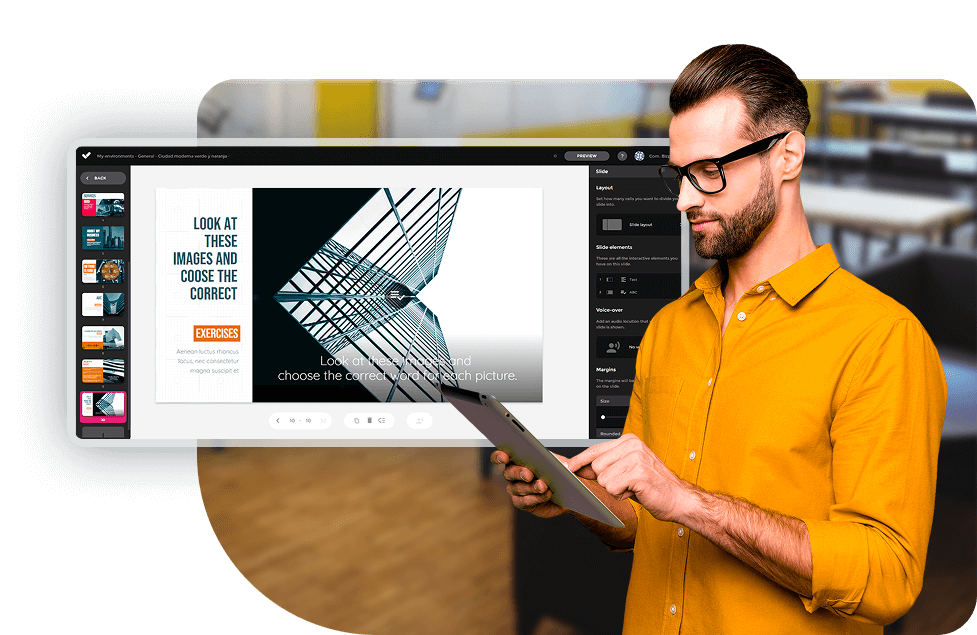
STF Group is a prime example of how a company can use corporate e-learning to achieve exceptional results. Through a leadership programme with isEazy Skills, they achieved an 87% completion rate in their corporate courses — demonstrating that content tailored to a company’s culture and objectives generates far greater engagement than generic MOOCs.
Discover how they did it →
CASE STUDY
We helped STF Group achieve an 87% completion rate in its leadership program


Artificial intelligence is rapidly redefining MOOCs. The key transformations already underway in 2025 include:
The future points towards a hybrid model: MOOC platforms that integrate corporate content creation tools, enabling companies to combine open catalogues with proprietary modules in a single learning experience.

The MOOC platform ecosystem has matured considerably. Here are the most relevant ones at global level:
For companies that need to go beyond these catalogues and develop their own training content, isEazy Author enables the creation of personalised courses tailored to the specific needs of the organisation. Meanwhile, isEazy Skills offers the most comprehensive catalogue of ready-made courses on the market, focused on soft skills and digital competencies, available in 8 languages and constantly updated.
MOOCs have democratised access to knowledge on a global scale and represent a valuable tool for continuous learning. However, their effectiveness in corporate contexts depends on how they are integrated into a broader training strategy.
If your goal is to develop transversal skills across your team, MOOCs offer an accessible and scalable solution. If, on the other hand, you need to train your employees with up-to-date content designed specifically for the professional world and available in multiple languages, a corporate course catalogue like isEazy Skills offers advantages that no generic MOOC can match: ready-to-use soft skills and digital skills courses, regularly updated and designed to maximise engagement. The most effective strategy in 2026 combines both approaches: external MOOC catalogues for self-directed learning, and a high-quality professional training catalogue for the structured development of talent within the organisation.
Find out how isEazy can help you build a complete corporate training strategy that brings together the best of both worlds.
Yes, many companies integrate MOOCs into their corporate training strategy, particularly for developing transversal skills such as communication, leadership, critical thinking or digital competencies. Platforms like Coursera for Business or LinkedIn Learning offer curated catalogue access for teams. However, MOOCs do not replace business-specific training: for internal processes, onboarding, compliance or developing company-specific skills, they need to be complemented with proprietary corporate e-learning solutions. The most effective combination is typically a corporate LMS that integrates own content with access to external MOOC catalogues.
A MOOC (Massive Open Online Course) is designed for massive, open audiences with no personalisation or corporate control. A corporate e-learning course, on the other hand, is designed specifically for the objectives, culture and needs of a particular company. MOOCs are ideal for general training or upskilling in transversal skills, while corporate e-learning allows content to be adapted to internal processes, specific regulations or proprietary products. For companies that need to measure business impact, maintain control over content and ensure confidentiality, corporate e-learning offers clear advantages that a public MOOC cannot provide.
The value of a MOOC certificate depends on the institution issuing it and the recognition it holds in the sector. Certificates from platforms such as Coursera (backed by universities like Stanford or MIT) or edX (MIT, Harvard) carry increasing weight in recruitment processes, especially for technology and digital profiles. However, most employers value the practical application of knowledge more than the certificate itself. In corporate environments, internal training programmes certified by the company’s own LMS tend to be more relevant for talent management and internal promotion.
The duration of a MOOC varies considerably depending on the platform and subject matter. Most last between 4 and 12 weeks, with an estimated commitment of 2 to 6 hours per week. However, with the growing trend towards microlearning, an increasing number of platforms offer short-format MOOCs (1–2 weeks or modules of less than one hour) designed for just-in-time learning. In a business context, short modules have higher completion rates and are better suited to teams’ availability. The completion rate for traditional long-form MOOCs is around 10–15%, according to data from MIT and Harvard (2019).

Enhance your team's skills with isEazy Skills
Discover how isEazy Skills can transform your team’s skills with high-impact courses

Enhance your team's skills with isEazy Skills
Discover how isEazy Skills can transform your team’s skills with high-impact courses