In training, one of the most common reasons a course fails is not the content, but the design. Topics that are too broad, endless blocks of information, unclear objectives, or zero practice. The result: employees “complete it,” but they don’t apply it.
That’s where the concept of a training module comes in. A module is the minimum unit that allows you to turn a topic into real learning: focused, structured, easy to consume, and, above all, measurable. It is the most effective way to move from “we need to train on this” to “we already know what to teach, how to teach it, and according to which evaluation criteria.”
In addition, the term is used in two different worlds. In formal vocational education, a module has an official definition, assigned hours, and defined learning outcomes. In corporate e-learning, the concept is more flexible, but the logic is the same: dividing learning into coherent pieces that can be completed, assessed, and updated without having to redesign an entire course.
In this post, you’ll see what a training module is, how it differs from a training program, what types exist, which elements cannot be missing, and how to create one step by step so that it’s not just “content,” but a tool that impacts performance.
What is a training module?
A training module is a structured learning unit that addresses a specific topic or competency within a broader training program. Its function is to break down content into manageable and coherent blocks, making it easier for learners to progressively acquire knowledge and skills.
In the context of formal vocational education, a training module is equivalent to a subject within a vocational program or professional certificate. It has a defined number of hours, specific learning outcomes, and evaluation criteria established by the National Qualifications System.
In the context of corporate e-learning, the term is used more broadly to refer to any digital content unit that is part of a course or learning path.
What is the difference between a training module and a training program?
Although they are often confused, they are not the same. A training program is the complete program (for example, Marketing and Advertising Technician), while a training module is each of the subjects or blocks that make it up (Market Research, Visual Merchandising, etc.). In other words: the program is the whole, and the module is one of its parts.
Aspect
Training Module
Training Program
What it is
A learning unit that covers a specific competency or subject.
A complete training program that leads to an official qualification.
Scope
It is part of the program. It has specific objectives and content.
It is the set of all modules required to obtain the qualification.
Marketing and Advertising Technician, Administration and Finance Technician.
Types of training modules
There is no single model. Depending on the context and the learning objective, training modules can take different formats:
Informational module: presents concepts, processes, or regulations. It relies on text, images, and infographics. It is usually the starting point before moving on to practice.
Video module: ideal for visual explanations, process demonstrations, or expert interviews. It increases engagement and supports retention.
Interactive module: incorporates drag-and-drop activities, branching scenarios, simulations, or practical case studies. It is the most effective format for developing applicable skills.
Assessment module: its main function is to measure learning through quizzes, open-ended questions, or practical exercises. It can be placed at the beginning (diagnostic assessment), during (formative assessment), or at the end of the learning path (summative assessment).
Blended module: combines several formats within the same unit: reading + video + quiz. It is the most common format on modern e-learning platforms.
WHITEPAPER
Looking for the perfect tool to create interactive courses? Here's how to choose it
Before you start creating content, it is important to verify that your module includes these essential elements:
1. Clear learning objectives
They must specify what the learner will know or be able to do by the end of the module. Use specific action verbs: analyze, identify, apply, demonstrate. Well-defined objectives guide both the content design and the assessment.
2. Relevant and up-to-date content
Include only what is necessary to achieve the objectives. Excess information creates cognitive overload and reduces retention. Ask yourself: is this content essential for the role or competency I want to develop?
4. Structured organization into sections
Dividing the module into thematic blocks facilitates navigation and allows learners to resume the content where they left off. The progression should move from general to specific, from theory to practice.
5. Interactivity
Modules that incorporate active elements, quizzes, exercises, and scenarios achieve higher engagement and better transfer of learning to the workplace.
5. Thoughtful visual design
A visually clean and consistent module improves the learner experience and conveys professionalism. Design is not an accessory: it directly impacts motivation to complete the training.
Integrated assessment
Without assessment, there is no data on learning. Include at least one checkpoint within the module, not just at the end of the course.
Accessibility
Subtitles in videos, appropriate contrast, mobile compatibility. A training module must be able to be completed from any device and be accessible to all employee profiles.
How to create a training module step by step
Designing an effective training module is not a matter of inspiration, but of method. When a clear sequence is followed—from identifying the need to final validation—the result stops being “informational content” and becomes applicable learning. These are the key steps to build a module with real impact on performance:
1. Define the learning problem
Before creating content, understand what knowledge or skill gap exists. What are employees unable to do that they should be able to do? Is it a knowledge issue, a skill issue, or a motivation issue? The answer determines the module’s approach.
2. Set SMART objectives
Objectives must be specific, measurable, achievable, relevant, and time-bound. An objective such as “improve communication” is too vague. One like “the employee will be able to handle a customer complaint by following the protocol in under 5 minutes” is actionable and measurable.
3. Design the content structure
Organize the content into blocks or sections. A typical structure includes: introduction with context → theoretical development → example or case study → activity or exercise → summary and closing. Avoid units longer than 20–30 minutes: microlearning improves completion rates and retention.
4. Select the appropriate format
The format should serve the objective. To develop a procedure, a simulation or step-by-step video works better than text. To convey regulations, a structured infographic may be more effective than an extensive manual.
5. Include activities and assessment
Do not leave assessment until the end of the course. Insert knowledge-check questions within the module itself. Branching scenarios are especially useful for simulating real situations and helping learners make decisions in a safe environment.
6. Review and pilot test
Before publishing, have a small group of employees complete the module and gather their feedback. Is the duration appropriate? Is the content clear? Are the activities relevant? This step saves time and costs in the long term.
How to evaluate the success of a training module
Creating the module is only half the work. Measuring its impact is just as important. Some key indicators include:
Completion rate: What percentage of learners complete the module? A low rate may indicate content that is not relevant, too long, or poorly structured.
Assessment results: What is the average score learners achieve? Are there questions that most learners miss? This points to content that needs reinforcement or a different explanation.
Learner satisfaction: Post-training surveys collect feedback on content quality, level of difficulty, and relevance to daily work.
Workplace transfer: The most valuable and the hardest indicator to measure: are employees applying what they learned? Follow-ups at 30, 60, and 90 days can provide useful data on the real impact of the training.
Impact on business KPIs: Reduction in errors, improved process times, increased sales, decreased incidents… Effective training is reflected in concrete business metrics.
Tools for creating training modules
Today, it is no longer necessary to code or have advanced technical knowledge to create high-quality training modules. Modern authoring tools allow you to develop interactive, structured, and visually appealing content in a matter of hours.
isEazy Author is an authoring tool specifically designed for training and L&D teams. It allows you to organize content into sections and subsections, add interactive elements, videos, and assessments, and publish modules accessible from any device—without requiring technical expertise. If you want to create professional training modules quickly and without complications, you can try it for free.
isEazy Author
The Leading AI Authoring Tool on the Market
Features
Benefits
Pricing
Accessibility
Awards
AI features: generate images, games and exercises, automatic subtitles, voiceovers, advanced interactive elements, avatars, and AI video presenters to bring your content to life.
AI Autopilot: automatic course creation from documents or ideas, with pedagogical structure, interactive resources, and applied visual identity. Transform any content into a publish-ready course in minutes.
Templates: over 25 ready-to-use interactive templates, editable and customizable with corporate colors, typography, and logo via the Smart Colors feature.
Drag-and-drop editor: visual editing to create courses with no technical, programming, or design knowledge required.
Automatic responsive design: courses adapt to any device without manual adjustments, with dual mode so each learner can access content in their preferred format.
Multi-format: export in SCORM 1.2, SCORM 2004, xAPI, and HTML5, compatible with any LMS on the market.
Automatic translation: full AI-powered course translation into over 40 languages, with no need for external translators.
Text to speech: professional voiceovers automatically generated from content, with selection of gender, language, and voice variation.
PowerPoint import: convert presentations into interactive e-learning courses in just a couple of clicks.
Real-time collaboration: simultaneous collaborative work on the same course with integrated comments, change tracking, and automatic saving with restore points.
Brand customization: styles, colors, typography, and logo to maintain corporate consistency across all content.
Gamification: points, badges, and leaderboards to motivate learners and increase engagement.
Assessments and quizzes: multiple question types and answer logic, with AI-powered automatic generation of final assessment tests based on course content.
Multimedia library: built-in bank of images, videos, icons, and graphic resources, with AI image generation adapted to your course style.
Integrations: connection with LMS platforms (SCORM, xAPI), external platforms, and management systems. A built-in learning environment is also available without leaving isEazy Author.
AI-powered: automates key creation tasks and drastically reduces production time. Over 36,000 users and 120,000 projects created in more than 90 countries speak for themselves.
Intuitive and visual interface: everything is edited intuitively with no learning curve, with pre-configured ready-to-use resources.
Real collaborative experience: distributed teams can work in parallel with real-time feedback, ideal for content factories and L&D teams.
Total flexibility: ideal for both occasional creators and large-scale production teams. Compatible with any LMS and 100% cloud-based.
Visual and professional courses: no designers or developers needed, with quality results recognized by Training Industry and eLearning Industry 2026.
Cost savings: less need for external resources and greater efficiency in content creation. Calculate your savings with the AI Autopilot ROI calculator.
Constantly evolving: new features released regularly and agile multilingual support, with real accessibility up to WCAG level AA and 80% of level AAA.
FREE plan: free forever. Ideal for exploring the tool with no commitment.
Professional: from €80/month. 1 author and up to 5 GB of storage.
Business: from €208/month. 2 authors and up to 12 GB of storage. The most popular plan.
Enterprise: custom authors and storage. Contact us for pricing.
Real standards compliance: courses compatible with level AA (100%) and up to 80% of level AAA of the Web Content Accessibility Guidelines (WCAG), and with Section 508 of the U.S. Rehabilitation Act.
Dual mode: create a single SCORM course and your learners can access it in their preferred mode, with or without accessibility adaptations, without duplicating production work.
Accessible interactive elements: all interactive resources in isEazy Author are designed to provide the same learning experience to all learners, regardless of their needs.
Contextual editor guidance: tips and guides built into the editor so any author can create quality accessible content easily, with no prior technical knowledge required.
Without sacrificing design or interactivity: accessibility in isEazy Author does not mean compromising visual impact or content richness. Accessible, attractive, and effective courses all at once.
Training Industry 2026: Top 20 AI Content Creation.
eLearning Industry 2026: Best AI-Powered Authoring Tool and Learning & Skills Development.
Training Industry 2025: Top 20 AI Content Creation.
eLearning Industry 2025: Best e-Learning Authoring Tool.
Brandon Hall 2024: Excellence Awards.
eLearning Industry 2024: Best Game Design and AI Watchlist.
G2 2024: Momentum Leader, High Performer, and High Performer Mid-Market.
Crozdesk 2024: Quality Choice, Trusted Vendor, and Happiest Users.
Software Advice 2024: FrontRunners.
Software Suggest 2024: Category Leader.
Features
AI features: generate images, games and exercises, automatic subtitles, voiceovers, advanced interactive elements, avatars, and AI video presenters to bring your content to life.
AI Autopilot: automatic course creation from documents or ideas, with pedagogical structure, interactive resources, and applied visual identity. Transform any content into a publish-ready course in minutes.
Templates: over 25 ready-to-use interactive templates, editable and customizable with corporate colors, typography, and logo via the Smart Colors feature.
Drag-and-drop editor: visual editing to create courses with no technical, programming, or design knowledge required.
Automatic responsive design: courses adapt to any device without manual adjustments, with dual mode so each learner can access content in their preferred format.
Multi-format: export in SCORM 1.2, SCORM 2004, xAPI, and HTML5, compatible with any LMS on the market.
Automatic translation: full AI-powered course translation into over 40 languages, with no need for external translators.
Text to speech: professional voiceovers automatically generated from content, with selection of gender, language, and voice variation.
PowerPoint import: convert presentations into interactive e-learning courses in just a couple of clicks.
Real-time collaboration: simultaneous collaborative work on the same course with integrated comments, change tracking, and automatic saving with restore points.
Brand customization: styles, colors, typography, and logo to maintain corporate consistency across all content.
Gamification: points, badges, and leaderboards to motivate learners and increase engagement.
Assessments and quizzes: multiple question types and answer logic, with AI-powered automatic generation of final assessment tests based on course content.
Multimedia library: built-in bank of images, videos, icons, and graphic resources, with AI image generation adapted to your course style.
Integrations: connection with LMS platforms (SCORM, xAPI), external platforms, and management systems. A built-in learning environment is also available without leaving isEazy Author.
Benefits
AI-powered: automates key creation tasks and drastically reduces production time. Over 36,000 users and 120,000 projects created in more than 90 countries speak for themselves.
Intuitive and visual interface: everything is edited intuitively with no learning curve, with pre-configured ready-to-use resources.
Real collaborative experience: distributed teams can work in parallel with real-time feedback, ideal for content factories and L&D teams.
Total flexibility: ideal for both occasional creators and large-scale production teams. Compatible with any LMS and 100% cloud-based.
Visual and professional courses: no designers or developers needed, with quality results recognized by Training Industry and eLearning Industry 2026.
Cost savings: less need for external resources and greater efficiency in content creation. Calculate your savings with the AI Autopilot ROI calculator.
Constantly evolving: new features released regularly and agile multilingual support, with real accessibility up to WCAG level AA and 80% of level AAA.
Pricing
FREE plan: free forever. Ideal for exploring the tool with no commitment.
Professional: from €80/month. 1 author and up to 5 GB of storage.
Business: from €208/month. 2 authors and up to 12 GB of storage. The most popular plan.
Enterprise: custom authors and storage. Contact us for pricing.
Accessibility
Real standards compliance: courses compatible with level AA (100%) and up to 80% of level AAA of the Web Content Accessibility Guidelines (WCAG), and with Section 508 of the U.S. Rehabilitation Act.
Dual mode: create a single SCORM course and your learners can access it in their preferred mode, with or without accessibility adaptations, without duplicating production work.
Accessible interactive elements: all interactive resources in isEazy Author are designed to provide the same learning experience to all learners, regardless of their needs.
Contextual editor guidance: tips and guides built into the editor so any author can create quality accessible content easily, with no prior technical knowledge required.
Without sacrificing design or interactivity: accessibility in isEazy Author does not mean compromising visual impact or content richness. Accessible, attractive, and effective courses all at once.
Awards
Training Industry 2026: Top 20 AI Content Creation.
eLearning Industry 2026: Best AI-Powered Authoring Tool and Learning & Skills Development.
Training Industry 2025: Top 20 AI Content Creation.
eLearning Industry 2025: Best e-Learning Authoring Tool.
Brandon Hall 2024: Excellence Awards.
eLearning Industry 2024: Best Game Design and AI Watchlist.
G2 2024: Momentum Leader, High Performer, and High Performer Mid-Market.
Crozdesk 2024: Quality Choice, Trusted Vendor, and Happiest Users.
Software Advice 2024: FrontRunners.
Software Suggest 2024: Category Leader.
Other tools available on the market are:
Gomo
Features
Benefits
Pricing
Cloud-based authoring: access from anywhere with no installation required. Always automatically updated, with no software update interruptions.
Responsive design: courses automatically adapt to mobile, tablet, and desktop, with accessibility support and region-based content controls.
Multilingual management: create and manage versions in over 160 languages and dialects from a single project, with right-to-left language support and automatic AI translation or XLIFF file export and import.
Template and theme library: facilitates visually consistent brand design, with themes customizable by logo and corporate colors, and a custom theme development option.
Multi-channel publishing: distribute content via SCORM, xAPI, web, and app, with optional connection to Bridge LMS as a learning management platform.
Real-time collaboration: simultaneous editing by multiple team members, with integrated review and comment features.
Built-in AI: text generation, content review, and automatic translation via OpenAI integration.
100% cloud-based: eliminates local software dependencies and facilitates remote work, always running the latest version with no IT team intervention required.
Ideal for global teams: simplifies translation and maintenance of localized versions in over 160 languages from a single base course.
Mobile-first design: ensures a great learning experience on all devices, with content variables adaptable by learner role or location.
Flexible publishing: use courses in an LMS, on the web, or in custom apps, with a 21-day free trial available for Small and Medium plans.
Small: for independent authors. 21-day free trial available.
Medium: for teams of 4 or more authors, with the option to add additional users.
Enterprise: for large teams or companies needing greater flexibility and features. Minimum 12-month contract for all plans.
Pricing available on request in USD, GBP, and EUR.
Features
Cloud-based authoring: access from anywhere with no installation required. Always automatically updated, with no software update interruptions.
Responsive design: courses automatically adapt to mobile, tablet, and desktop, with accessibility support and region-based content controls.
Multilingual management: create and manage versions in over 160 languages and dialects from a single project, with right-to-left language support and automatic AI translation or XLIFF file export and import.
Template and theme library: facilitates visually consistent brand design, with themes customizable by logo and corporate colors, and a custom theme development option.
Multi-channel publishing: distribute content via SCORM, xAPI, web, and app, with optional connection to Bridge LMS as a learning management platform.
Real-time collaboration: simultaneous editing by multiple team members, with integrated review and comment features.
Built-in AI: text generation, content review, and automatic translation via OpenAI integration.
Benefits
100% cloud-based: eliminates local software dependencies and facilitates remote work, always running the latest version with no IT team intervention required.
Ideal for global teams: simplifies translation and maintenance of localized versions in over 160 languages from a single base course.
Mobile-first design: ensures a great learning experience on all devices, with content variables adaptable by learner role or location.
Flexible publishing: use courses in an LMS, on the web, or in custom apps, with a 21-day free trial available for Small and Medium plans.
Pricing
Small: for independent authors. 21-day free trial available.
Medium: for teams of 4 or more authors, with the option to add additional users.
Enterprise: for large teams or companies needing greater flexibility and features. Minimum 12-month contract for all plans.
Pricing available on request in USD, GBP, and EUR.
iSpring Learn
Designed for easy integration
Features
Benefits
Technology, compatibility, and integration
Pricing
Learning paths: personalized training journeys by profile, department, or branch, with automatic course enrollment and progress tracking.
Analytics and reports: detailed reports on completions, scores, engagement, and performance by user or team. Includes report templates and scheduled reports.
Platform customization: white-labeling with custom domain, logo, colors, and cover image to adapt the LMS to your corporate identity.
Built-in course authoring tool: create HTML5/SCORM courses, interactive quizzes, role-play simulations, and training videos directly from the LMS, with an AI assistant to speed up content production.
Social learning, mobile learning, and gamification: corporate newsfeed, chat between learners and instructors, native iOS and Android app with offline access, and a points, badges, and leaderboards system.
360-degree employee evaluation tool: unlimited feedback sessions, competency profile builder, and visual reports to identify strengths and areas for improvement.
Analytics and reporting: real-time tracking of progress, completions, and engagement, with exportable and scheduled reports for administrators and managers.
Mobile app with offline learning support: access courses from any device, with downloadable content and automatic sync when back online.
Responsive design and intuitive interface: learner portal with clear pending and completed content sections, accessible with no learning curve.
Scalability: pay-per-active-user model, unlimited storage, and 24/7 technical support included in all plans.
Compatible with SCORM 1.2 and 2004, as well as PPT, MP4, PDF, MP3, and more formats.
Integrations with Udemy, Go1, LinkedIn Learning, and other course libraries. API available for custom integrations.
SSO and custom role and permission management.
SaaS, cloud-based with Amazon AWS infrastructure.
Pay-per-active-user model (only billed for users who have logged in at least once per month).
Start: from $2.29 USD per user/month (indicative price, check with iSpring LMS for current rates).
Business: from $3.14 USD per user/month (indicative price, check with iSpring LMS for current rates).
Custom plan available for organizations with specific needs.
14-day free trial available.
Features
Learning paths: personalized training journeys by profile, department, or branch, with automatic course enrollment and progress tracking.
Analytics and reports: detailed reports on completions, scores, engagement, and performance by user or team. Includes report templates and scheduled reports.
Platform customization: white-labeling with custom domain, logo, colors, and cover image to adapt the LMS to your corporate identity.
Built-in course authoring tool: create HTML5/SCORM courses, interactive quizzes, role-play simulations, and training videos directly from the LMS, with an AI assistant to speed up content production.
Social learning, mobile learning, and gamification: corporate newsfeed, chat between learners and instructors, native iOS and Android app with offline access, and a points, badges, and leaderboards system.
Benefits
360-degree employee evaluation tool: unlimited feedback sessions, competency profile builder, and visual reports to identify strengths and areas for improvement.
Analytics and reporting: real-time tracking of progress, completions, and engagement, with exportable and scheduled reports for administrators and managers.
Mobile app with offline learning support: access courses from any device, with downloadable content and automatic sync when back online.
Responsive design and intuitive interface: learner portal with clear pending and completed content sections, accessible with no learning curve.
Scalability: pay-per-active-user model, unlimited storage, and 24/7 technical support included in all plans.
Technology, compatibility, and integration
Compatible with SCORM 1.2 and 2004, as well as PPT, MP4, PDF, MP3, and more formats.
Integrations with Udemy, Go1, LinkedIn Learning, and other course libraries. API available for custom integrations.
SSO and custom role and permission management.
SaaS, cloud-based with Amazon AWS infrastructure.
Pricing
Pay-per-active-user model (only billed for users who have logged in at least once per month).
Start: from $2.29 USD per user/month (indicative price, check with iSpring LMS for current rates).
Business: from $3.14 USD per user/month (indicative price, check with iSpring LMS for current rates).
Custom plan available for organizations with specific needs.
14-day free trial available.
How to create a training module step by step with isEazy Author
Designing an effective training module does not depend solely on methodology. The tool you use also plays a key role. When the technical environment is complex or unintuitive, much of the time is spent formatting instead of designing the learning experience.
With isEazy Author, the process is simplified and focused on what truly matters: the instructional structure and the learner experience.
1. Choose the type of module you need
Before you begin, define the most appropriate format based on the duration and objective.
With isEazy Author, you can create:
Classic courses, designed for more extensive training programs, with multiple sections and structured navigation.
Express courses, created for agile microcontent, optimized for mobile consumption and app-style navigation.
This choice determines the module architecture and the learner experience.
2. Define the visual style and template
Design directly impacts motivation and completion rates. The tool works through slides that act as a canvas on which you can incorporate content and resources.
You can:
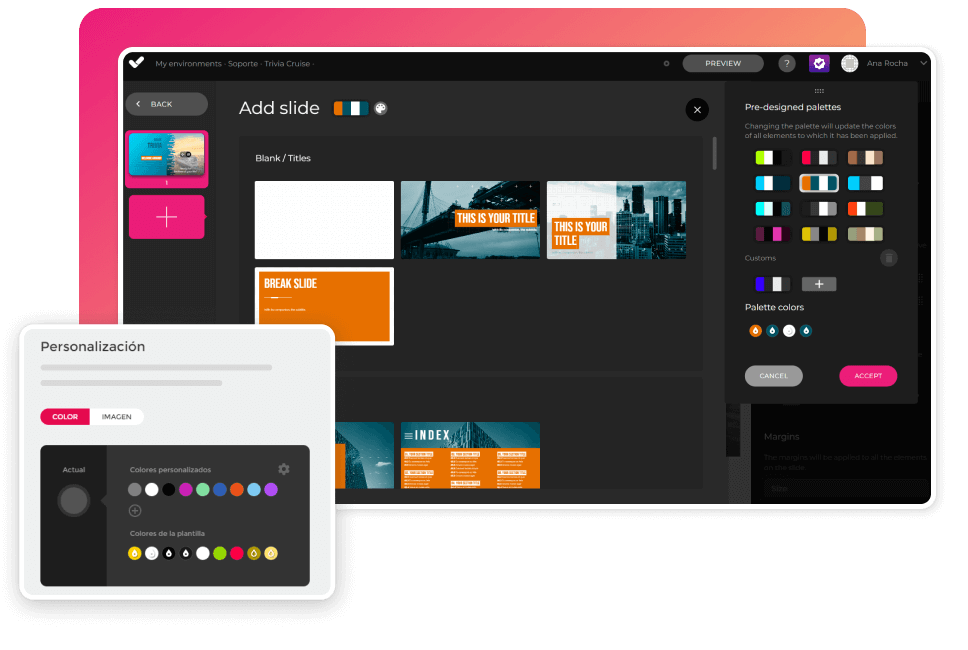
Select pre-designed templates.
Customize the color palette and typography.
Incorporate your corporate identity.
Create your own templates aligned with your brand.
This way, each module maintains visual consistency without requiring design expertise.
3. Structure the module content
Once the style is defined, it’s time to organize the content into sections and subsections.
You can:
Create the module from scratch.
Import content from PowerPoint.
Reorganize blocks easily through a drag & drop interface.
The structure can follow a classic scheme: context → development → example → practice → closing. The tool makes this organization seamless, without technical friction.
4. Incorporate multimedia and interactive elements
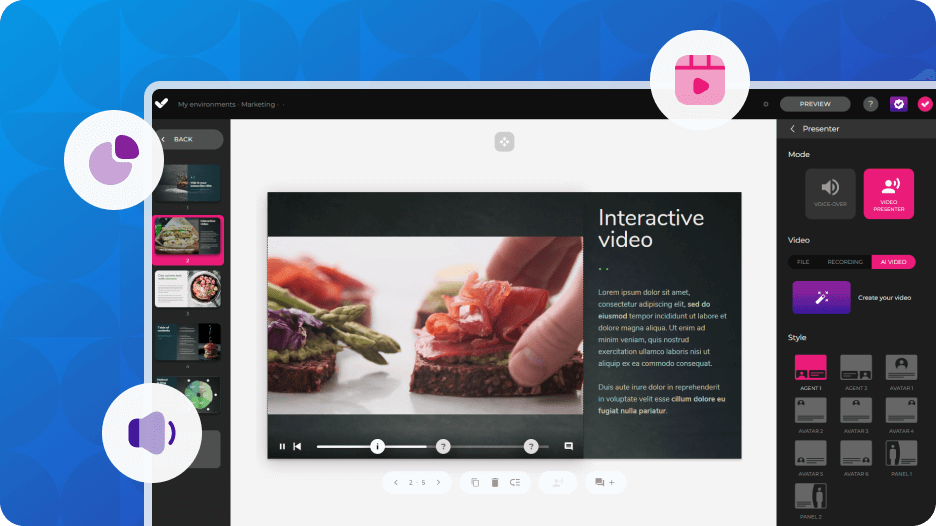
Interactivity is key to ensuring transfer to the workplace. On each slide, you can add:
Videos.
Exercises.
Games.
Decision-making scenarios.
Comparisons.
Role plays.
These resources not only increase engagement, but also turn the learner into an active participant in their own learning. In addition, they allow you to provide immediate feedback and reinforce key concepts within the module itself.
5. Publish and distribute your module
Once completed, you can:
Publish it on isEazy Author Go, your own learning environment—without leaving isEazy Author!
Export it in SCORM or xAPI format to integrate into your LMS.
Share it via direct link.
Embed it in your intranet or corporate website.
The module is ready to track progress, results, and completion without requiring additional technical development.
The result is a structured, interactive, and measurable training module, created in hours instead of weeks.
CASE STUDY
Discover how fischer streamlined course creation with the perfect authoring tool.
Creating a training module is not just about writing content, but about structuring it with instructional logic. That is the stage where training teams invest the most time: organizing ideas, deciding which resource to use at each moment, and giving overall coherence to the module.
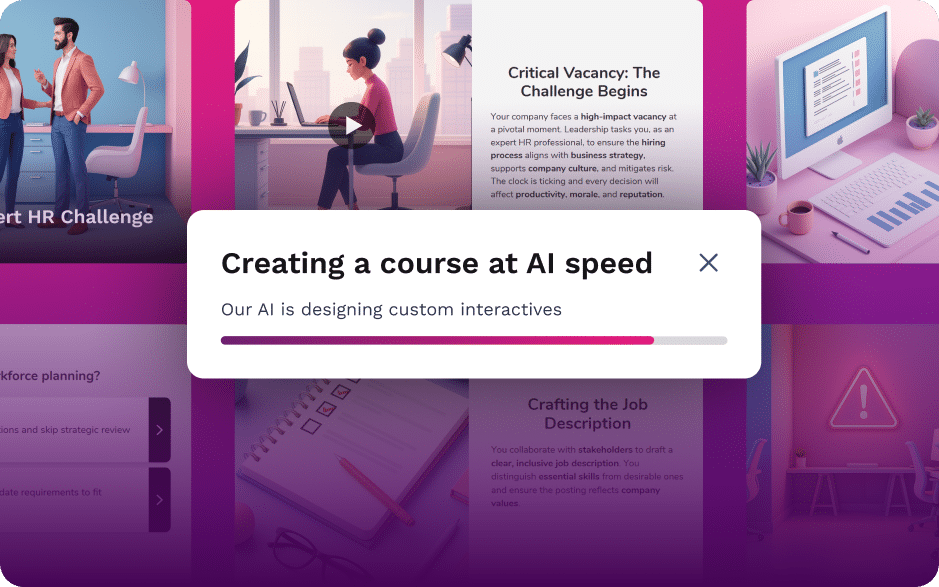
AI Autopilot automates precisely that phase. Starting from an idea or your own corporate documentation, it generates a complete instructional structure in minutes, with modules, lessons, activities, and interactivity aligned with the learning objective. It does not just produce text: it proposes a training architecture with real pedagogical logic.
Visual design, progressive content organization, and accessibility standards are also integrated from the start. And, as always, final control remains yours: you can reorganize, edit, or adjust any part before publishing.
Instead of starting from a blank page, you begin with a solid foundation ready to validate and optimize.
Do you already have a training plan in place, or are you just starting to structure learning in your company? isEazy Author can help you move from scattered content to coherent, engaging, and measurable training modules. Try the #1 AI-powered authoring tool on the market today.
Frequently asked questions about the training module
What exactly is a training module?
A training module is a structured learning unit that focuses on a specific competency, topic, or skill within a broader training program. It can be part of an official vocational qualification or a corporate e-learning course. Its purpose is to organize content into coherent blocks with clearly defined objectives, practical activities, and evaluation criteria that allow learning outcomes to be measured effectively.
What is the difference between a training module and a training program?
A training program is the complete educational pathway that leads to a formal qualification or comprehensive learning outcome, while a training module is one of the individual units or subjects that make up that program. In other words, the program is the whole, and the module is one of its components. In corporate training contexts, the term “module” is used more flexibly, but it still refers to a self-contained unit within a larger learning journey.
How long should a training module be?
There is no single standard duration, as it depends on the objective and context. In formal education, modules often have a predefined number of instructional hours. In corporate e-learning, it is generally recommended that a module last no more than 20–30 minutes if designed as microlearning, or be divided into clearly structured sections if longer. The key is to maintain learner attention and enable practical application without creating cognitive overload.
What elements should an effective training module include?
An effective training module should include clear learning objectives, relevant and up-to-date content, a well-organized structure, practical activities that encourage participation, and integrated assessment. It is also essential to pay attention to visual design and accessibility, incorporating elements such as subtitles, appropriate color contrast, and mobile compatibility to ensure that all learners can complete the module without barriers.
How do you evaluate the success of a training module?
The success of a training module can be measured through several indicators, including completion rates, assessment results, learner satisfaction, and, most importantly, knowledge transfer to the workplace. It is also advisable to analyze business performance metrics, such as error reduction, process improvement, or sales growth, since these data points demonstrate whether the learning initiative has generated tangible impact.
What tools can be used to create a training module?
Today, authoring tools make it possible to design professional training modules without advanced technical skills. These platforms allow instructional designers to organize content into sections, incorporate interactive elements, and export courses in LMS-compatible formats such as SCORM or xAPI. When selecting a tool, organizations should consider usability, customization capabilities, interactivity features, and reporting options to ensure effective learning measurement.
Here you can assess and customize the services that we'd like to use on this website. You're in charge! Enable or disable services as you see fit. To learn more, please read our .
We have to include them in order for certain web pages to function securely. These cookies are strictly necessary, so they cannot be rejected or modified.
Cookie
Duration
Description
_ga
2 years
The _ga cookie, installed by Google Analytics, calculates visitor, session and campaign data and also keeps track of site usage for the site's analytics report. The cookie stores information anonymously and assigns a randomly generated number to recognize unique visitors.
_ga_YW3LY84JY6
2 years
This cookie is installed by Google Analytics.
_gat_gtag_UA_90425332_3
1 minute
Set by Google to distinguish users.
_gat_UA-26043609-7
1 minute
A variation of the _gat cookie set by Google Analytics and Google Tag Manager to allow website owners to track visitor behaviour and measure site performance. The pattern element in the name contains the unique identity number of the account or website it relates to.
_gat_UA-90425332-3
1 minute
A variation of the _gat cookie set by Google Analytics and Google Tag Manager to allow website owners to track visitor behaviour and measure site performance. The pattern element in the name contains the unique identity number of the account or website it relates to.
_gcl_au
3 months
Provided by Google Tag Manager to experiment advertisement efficiency of websites using their services.
_gid
1 day
Installed by Google Analytics, _gid cookie stores information on how visitors use a website, while also creating an analytics report of the website's performance. Some of the data that are collected include the number of visitors, their source, and the pages they visit anonymously.
_icl_visitor_lang_js
1 day
This cookie is stored by WPML WordPress plugin. The purpose of the cookie is to store the redirected language.
Bootstrap
11 months
Bootstrap code
cookielawinfo-checkbox-advertisement
1 year
Set by the GDPR Cookie Consent plugin, this cookie is used to record the user consent for the cookies in the "Advertisement" category .
cookielawinfo-checkbox-analytics
11 months
This cookie is set by GDPR Cookie Consent plugin. The cookie is used to store the user consent for the cookies in the category "Analytics".
cookielawinfo-checkbox-functional
11 months
The cookie is set by GDPR cookie consent to record the user consent for the cookies in the category "Functional".
cookielawinfo-checkbox-nece
1 year
Cookie law info
cookielawinfo-checkbox-necessary
11 months
This cookie is set by GDPR Cookie Consent plugin. The cookies is used to store the user consent for the cookies in the category "Necessary".
cookielawinfo-checkbox-others
11 months
This cookie is set by GDPR Cookie Consent plugin. The cookie is used to store the user consent for the cookies in the category "Other.
cookielawinfo-checkbox-performance
11 months
This cookie is set by GDPR Cookie Consent plugin. The cookie is used to store the user consent for the cookies in the category "Performance".
CookieLawInfoConsent
1 year
Records the default button state of the corresponding category & the status of CCPA. It works only in coordination with the primary cookie.
Google Font API
11 months
Google Font API
IDE
1 year 24 days
Google DoubleClick IDE cookies are used to store information about how the user uses the website to present them with relevant ads and according to the user profile.
Pardot
11 months
The pardot cookie is set while the visitor is logged in as a Pardot user. The cookie indicates an active session and is not used for tracking.
test_cookie
15 minutes
The test_cookie is set by doubleclick.net and is used to determine if the user's browser supports cookies.
viewed_cookie_policy
11 months
The cookie is set by the GDPR Cookie Consent plugin and is used to store whether or not user has consented to the use of cookies. It does not store any personal data.
wp-wpml_current_language
session
Language cookies
wpml_browser_redirect_test
session
This cookie is set by WPML WordPress plugin and is used to test if cookies are enabled on the browser.
They collect information in order to measure, evaluate performance, and improve the quality of your experience on our site.
Cookie
Duration
Description
_ga
2 years
The _ga cookie, installed by Google Analytics, calculates visitor, session and campaign data and also keeps track of site usage for the site's analytics report. The cookie stores information anonymously and assigns a randomly generated number to recognize unique visitors.
_ga_YW3LY84JY6
2 years
This cookie is installed by Google Analytics.
_gat_gtag_UA_90425332_3
1 minute
Set by Google to distinguish users.
_gat_UA-26043609-7
1 minute
A variation of the _gat cookie set by Google Analytics and Google Tag Manager to allow website owners to track visitor behaviour and measure site performance. The pattern element in the name contains the unique identity number of the account or website it relates to.
_gat_UA-90425332-3
1 minute
A variation of the _gat cookie set by Google Analytics and Google Tag Manager to allow website owners to track visitor behaviour and measure site performance. The pattern element in the name contains the unique identity number of the account or website it relates to.
_gcl_au
3 months
Provided by Google Tag Manager to experiment advertisement efficiency of websites using their services.
_gid
1 day
Installed by Google Analytics, _gid cookie stores information on how visitors use a website, while also creating an analytics report of the website's performance. Some of the data that are collected include the number of visitors, their source, and the pages they visit anonymously.
_icl_visitor_lang_js
1 day
This cookie is stored by WPML WordPress plugin. The purpose of the cookie is to store the redirected language.
wpml_browser_redirect_test
session
This cookie is set by WPML WordPress plugin and is used to test if cookies are enabled on the browser.
We use them to provide you with efficient and personalized advertisements that we believe are relevant to your interests. You may see them on other sites that you visit.
Cookie
Duration
Description
IDE
1 year 24 days
Google DoubleClick IDE cookies are used to store information about how the user uses the website to present them with relevant ads and according to the user profile.
test_cookie
15 minutes
The test_cookie is set by doubleclick.net and is used to determine if the user's browser supports cookies.