The first AI trained to teach

Brain
The first AI trained to teach

Author
The #1 AI-powered authoring tool on the market

Factory
Custom e-learning content factory

Skills
Comprehensive power skills course catalog

LMS
All-in-one LMS platform with AI

Engage
App for managing frontline teams
Discover isEazy Brain


Product
What is Brain?
Everything you need to know about the first AI trained to teach.
Learning agent: CompanionNew
Supports learners and answers their questions right inside the course, without breaking the audit trail.
How does it work?
Adaptive, conversational, and contextual. That’s learning with Brain.
Discover isEazy Author


 See all features
FEATURES
AINew
Unlock your full potential and speed up course creation with artificial intelligence.
Accessibility
Automatically meet accessibility guidelines—without sacrificing interactivity!
Interactivity
Boost engagement with interactive, ready-to-use activities that make learning fun.
Course Creation
Reduce the time it takes to create your e-learning courses with our authoring tool.
Distribution
We offer you different distribution options, so that nothing can stop you.
SCORM
Publish your course in SCORM format and share it on any LMS.
Discover isEazy Factory


SERVICES
Instrucional Design
Surprise your students with multimedia and interactive content.
Custom Courses
We create e-learning courses for you—tailored to your needs and hassle-free!
Virtual Reality
Turn learning into an immersive experience.
Custom Avatars
Give your courses and videos a unique touch with personalized avatars.
Audiovisual FactoryNew
Turn training into something dynamic and visual with engaging videos.
Discover isEazy Skills


CATALOG
Course catalog
Over 600 skills and competency courses to help you adapt to your team's needs.
Microsoft Copilot AcademyNew
Your professionals will learn how to apply Copilot AI to key processes within your organization.
Artificial Intelligence Academy
Train your teams in the practical use of AI to boost productivity and innovation in your company.
Cybersecurity Academy
Capacita a tu empresa con el catálogo más completo en seguridad digital corporativa.
Discover isEazy LMS


FEATURES
Learning platform
Manage all your training from one place
Analitycs
Measure the impact of your training
Learning Experience
Offer a unique learning experience to your team
Content Library
Choose from hundreds of expert-created courses
Authoring Tool
Create your own content—faster than ever

Use cases
Choose the solution that best fits your needs

Industries
Solutions for all types of industries
See all solutions


 See all solutions
USE CASES
Onboarding
Facilitate the onboarding process, productivity and engagement of your new employees.
Upskilling
Boost your team's skills and prepare them for the challenges of the future with upskilling.
Microlearning
Discover all the advantages of microlearning and boost your training results.
Gamification
Enjoy addictive training that will get your professionals hooked.
Internal Communication
Improve communication in your company and enjoy an aligned and committed team.
Mobile learning
Agile, flexible, and interactive learning—built for today’s digital-first workforce.
Discover our industries


 View all industries
INDUSTRIES
Banking and financial services
Training in compliance, cybersecurity, customer service, and key skills development.
Pharmaceuticals and healthcare
Digital onboarding, regulatory updates, and ongoing training for healthcare staff.
Retail and consumer
Agile and scalable training for in-store, operational, and customer service teams.
Industry and manufacturing
Training in processes, safety, and corporate culture for distributed teams.
Education and training
Digital solutions for training centers, internal academies, and corporate universities.
Technology and telecommunications
Development of technical talent, digital skills, and upskilling and reskilling programs.
CLIENTS

MAPFRE
How MAPFRE turn e-learning into sales with isEazy

Pepco
A personalised learning experience for a growing team.

BBVA
Digitisation and creation of high quality e-learning content.

Shiseido
We increase the engagement of the training with a social and gamified app.

Telefónica
Large-scale reskilling for the company's digital transformation.

Vodafone
A personalised learning experience for a growing team.
More than 1,000 companies already rely on isEazy.





MEET ISEAZY

Events
Discover our upcoming events and connect with the future of e-learning.

News
Find out the latest news about isEazy: press releases, partnerships, updates...

Contact
Leave us your personal details and we will contact you as soon as possible.
About isEazyNew
Find out more about our company.

Careers
We are looking for the best talent, join our team!

Partners
Become our partner and grow your business.
INTERESTING RESOURCES

Blog
The best content on e-learning: trends, tools and key strategies.

Whitepapers
Gain valuable insights and stay ahead of industry trends.

Product releases
The latest news and releases of our e-learning products and solutions.

Glossary
Definitions of the most commonly used terms and key industry concepts.

Guides
Discover the best step-by-step tips and tricks to optimize your L&D strategy.

Webinars
Video sessions on our products, trends and more

Comparatives
Compare e-learning solutions available on the market and choose the most suitable one.


WEBINAR
AI-powered course creation, step by step
Master AI in isEazy Author in under an hour.

05/11/2026

11:00 AM ET



GUIDE
Does your training plan comply with the EU AI Act?
Prepare your organization to comply with the new AI regulations

Subscribe to our newsletter
Stay up to date with all our latest news
 Subscribe to our newsletter
 Stay up to date with all our latest news

October 13, 2026
“AI Companion” in corporate training: how to support employee learning with AI

CONTENT CREATED BY:
Yolanda Amores
Chief Marketing Officer at isEazy

Table of contents
What is an “AI Companion” in corporate training?
An “AI Companion” in corporate training is an artificial intelligence system that accompanies the employee throughout their learning experience, offering guidance, explanations or contextual support at the moment they need it. Unlike other AI applications, its role is not limited to answering one-off questions: it is present before, during and after the training, following the professional through the entire process.
The term does not yet have a universally standardized definition in the industry, and in practice it overlaps with concepts such as AI assistant or AI tutor. Depending on the design and the level of development of each solution, an “AI Companion” may incorporate features of both.
An “AI Companion” in corporate training accompanies the employee throughout their learning experience before, during and after the training. It can offer guidance, explanations and contextual support and, depending on its design, also incorporate AI tutor features.
The rise of tools such as ChatGPT or Claude has reshaped what professionals expect when they learn: they want to ask, iterate and get answers tailored to their context, not consume the same course as all their colleagues. According to data from the consultancy Gallup, 4 out of 10 employees who use AI at work already use it to learn new things. In that sense, the “AI Companion” is a direct response to that expectation applied to the corporate environment.
In this article we explain what an “AI Companion” actually is, how it differs from an AI assistant or an AI tutor, how it can support the employee across the learning cycle and what any L&D or HR lead should consider before implementing it.
AI assistant, AI tutor and “AI Companion”: three distinct roles
Before getting into how the “AI Companion” works, it is worth clarifying the difference between three concepts that are often used interchangeably but that serve different functions. It is important to stress that these categories are not watertight compartments: in practice, many solutions combine characteristics of more than one, and the industry has not yet settled on a definitive taxonomy.
| Concept | Main function | Key idea |
|---|---|---|
| AI assistant | Answers queries, locates information, summarizes documents, recommends resources. It does not necessarily have a pedagogical purpose. | The assistant helps |
| AI tutor | Has an explicit pedagogical intent: it helps you understand, practice or reach a learning objective. It rephrases, asks questions, gives feedback. | The tutor teaches |
| AI Companion | Continuous, contextual support. It can integrate assistant and tutor features, but the emphasis is on being available throughout the entire learning experience. | The companion accompanies |
Put another way: an AI assistant can help you find the procedure you are looking for; an AI tutor can help you understand and practice it; an “AI Companion” can do both and still be available when you return to your job the next day with a new question.
This distinction is especially relevant for L&D teams, since not every training context requires the same level of support. Understanding which type of system best fits each need is the first step towards making an informed decision.
How an “AI Companion” acts before, during and after the training
One of the characteristics that best defines an “AI Companion” is its presence throughout the entire learning cycle, not just at the moment the course is consumed. This support can be broken down into three moments:
Before the training
- Diagnosing the employee’s prior level of knowledge in order to shape the experience from the start.
- Recommending learning paths or resources tailored to the profile, the role and the learning objectives.
- Resolving any questions the employee may have before starting the formal content.
During the training
- Contextual support within the course itself: the system knows which part of the content the employee is in and can adapt explanations, examples or level of depth.
- Resolving questions without interrupting the learning flow or taking the employee out of the training environment.
- Reinforcing concepts at the moment the learner encounters them, not at the end of the module.
- Practice and simulation: the ability to rehearse real situations with immediate feedback before applying them on the job.
After the training
- Availability as a point of reference when the employee needs to apply what they have learned in their day-to-day work.
- Spaced reinforcement: the system can suggest reviews or activities at the right moment to consolidate knowledge.
- Performance support: quick access to procedures, policies or internal information in the real context of work, cutting down time lost looking for information.
This model responds directly to the concept of learning in the flow of work: training does not happen only in the LMS, but integrated into the employee’s real workflow.


Use cases for the “AI Companion” in corporate training
The “AI Companion” is not a niche solution: its applications cover some of the most frequent challenges in corporate training.
- Onboarding: the new employee can resolve questions about processes, culture or internal tools in real time, without having to wait for a colleague to be available. This support reduces the initial learning curve and speeds up integration.
- Compliance and regulatory training: in heavily regulated sectors, the “AI Companion” can keep knowledge up to date and answer specific queries about protocols without having to turn to an internal expert.
- Upskilling and reskilling: an “AI Companion” can diagnose each employee’s starting point, adapt the path to what they actually need to learn and offer continuous reinforcement throughout the process.
- Sales and product training: sales teams can practice real situations with immediate feedback before applying them on the job. Take a look at our article on AI role play in training.
- Just-in-time learning: the employee accesses the exact knowledge they need, at the exact moment they need it, without having to complete an entire course. A concept directly related to just-in-time learning.
Grupo Puerto de Cartagena is an example of an organization that has chosen to integrate artificial intelligence into its training strategy to improve the employee experience, the completion rate and satisfaction with its training programs. Find out how they did it →
CASE STUDY
How Grupo Puerto de Cartagena optimized their training with isEazy Author’s AI.


Potential benefits for the employee and the L&D team
When it is well implemented, an “AI Companion” can add value both for the employee and for the training team:
For the employee
- 24/7 availability: access to training support at any time, without depending on a trainer’s schedule or on the LMS being open at that moment.
- Personalized experience: they do not receive the same training as everyone else, but an experience tailored to their level, their pace and their goals.
- Less frustration: questions are resolved the moment they come up, not days after the module has been completed.
- Greater transfer to the job: being able to practice in a safe environment before facing the real situation improves how knowledge is applied.
For the L&D team
- Scalability without sacrificing personalization: it is possible to offer a personalized experience to every employee, whether the organization has a hundred people or a hundred thousand.
- Lower operational load: repetitive queries can be resolved automatically, freeing up the team’s time.
- Richer learning data: the “AI Companion” can record usage patterns, frequent questions and drop-off points, giving the L&D team valuable information for improving the content.
- Greater measurable impact: according to research from MIT and Stanford, adopting AI can improve productivity by an average of 14%, and personalized learning is one of the factors that contributes most to that result.
To go deeper into how AI is transforming corporate training as a whole, you can take a look at our guide to AI in e-learning.

Limits, risks and ethical considerations
Like any technology that has an impact on people, the “AI Companion” is not free of risks. A responsible approach requires considering them before implementing:
- Algorithmic bias: if the system is trained on biased or unrepresentative data, it can reproduce those biases in its recommendations or in the way it adapts the experience to different profiles. Human oversight of the content and of response patterns is essential.
- Data privacy and security: systems that work with corporate information must guarantee that this information does not leave the organization’s environment, is not shared with third parties and is not used to train external models. Complying with GDPR and the EU AI Act is not optional.
- Technological dependence: an employee who resolves every question through the companion may lose the habit of searching, reasoning or cross-checking on their own. Instructional design has to address this actively.
- Trusting unverified answers: systems that do not work from a validated corporate knowledge source can generate incorrect answers that look authoritative. In compliance, safety or business-critical procedures, this can have serious consequences.
- An AI Companion does not replace the trainer: AI support is an aid, not a substitute. Human relationships, contextual judgment and the ability to read complex situations are dimensions AI cannot cover.
Bringing an “AI Companion” into the training strategy therefore requires not only a technology decision, but also a clear governance framework covering how it is used, who oversees it and how its impact is measured.
How to implement an “AI Companion” responsibly
There is no single implementation model, but there is a set of criteria any L&D team should consider before putting an “AI Companion” in the hands of its employees:
- Define the scope before choosing the technology. Will the AI Companion provide support inside the course, as performance support on the job, or at both moments? Will it resolve questions, and will it also assess? Does it work with the company’s own corporate knowledge or with generic information? The answers to these questions determine what kind of solution makes sense.
- Secure a quality knowledge source. An “AI Companion” is only as good as the information it works with. If the manuals, procedures and policies are out of date or contradictory, the system will reproduce them faithfully.
- Design with human oversight. Especially in the first few months, set up processes for reviewing the system’s answers. Being able to supervise what the companion generates before it reaches the employee is not a limitation: it is a quality guarantee.
- Measure the right things. The number of queries resolved is an operational indicator, not a learning indicator. Define metrics that reflect whether the AI Companion is generating real transfer: application on the job, fewer errors, faster onboarding.
- Inform your employees. Knowing that they are interacting with an AI system, how their information is used and what they can do if they get an incorrect answer is not just an ethical obligation: it also improves trust in the system and how much it gets used.
- Plan a gradual rollout. Starting with a narrow use case makes it possible to learn, adjust and prove value before scaling. Take a look as well at our article on AI for corporate training and how to structure an adoption strategy.
The “AI Companion” in the context of adaptive learning
The “AI Companion” does not operate in a vacuum: its effectiveness grows when it is part of a broader adaptive learning strategy. Adaptation refers not only to the content (what is learned), but also to the moment (when it is learned), the format (how it is learned) and the level of support (how much help each person needs).
Within that framework, the companion is the element that makes it possible for learning to be genuinely personalized at scale: not because a human trainer accompanies each employee individually, but because an intelligent system can do so simultaneously for thousands of people, with full traceability and without sacrificing pedagogical quality.
The challenge for L&D teams is not only choosing the right technology, but designing the experience around it: what happens before the employee opens the course, what happens inside it, and what happens when they close it and go back to their job. The e-learning tutor has evolved in that direction, and the “AI Companion” is its most complete expression in today’s corporate environment.
isEazy Brain and its Companion learning agent
isEazy Brain is isEazy’s AI-native platform, designed to turn corporate knowledge into adaptive, contextual and conversational learning experiences. It works with each organization’s real, authorized knowledge to turn it into learning agents capable of accompanying every professional throughout their learning.
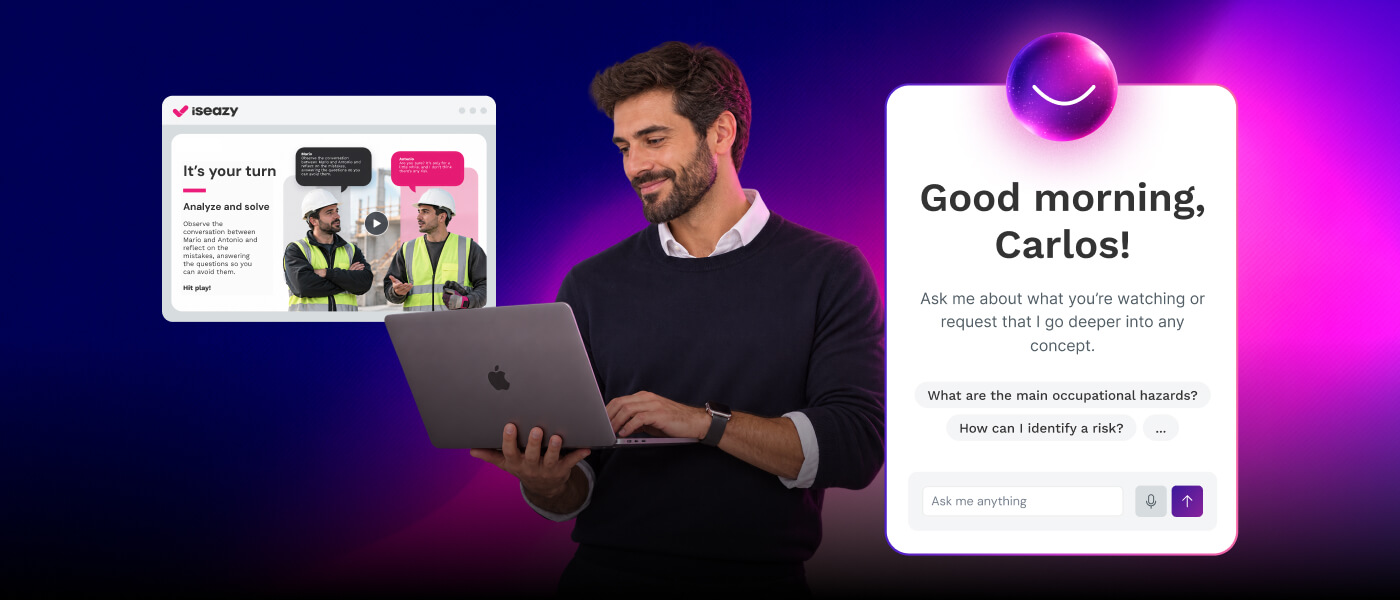
One of them is Companion, the isEazy Brain learning agent built into the course itself. Companion knows where in the content the professional is and uses that context to offer the pedagogical support they need at each moment, without forcing them to leave the learning experience.
That way, the professional can:
- Resolve questions on the spot, without interrupting their learning journey.
- Understand a concept better, receiving explanations adapted to their level and context.
- Go deeper into what they are learning through examples, connections and additional context.
- Practice before facing a real situation, making decisions and receiving feedback.
- Transfer the knowledge to their job, connecting what they have learned with specific professional situations.
Companion works from the corporate knowledge authorized by the organization, so its answers and resources are built on the information the company decides to bring into its environment. On top of that, knowledge stays isolated per organization and can be kept under rules, limits and human oversight.
In this way, isEazy Brain brings learning support into the course itself: the content keeps its journey and traceability, but every professional can receive contextual, personalized support when they need it. A way of turning a shared training experience into learning that is much closer to one-to-one.

x
Conclusion: supporting learning with AI and good judgment
An “AI Companion” can add a new layer of support to corporate learning: resolving questions, rephrasing explanations, making review easier and helping connect the training with situations on the job. However, its usefulness does not depend on the technology alone, but on having a well-defined use case, reliable knowledge sources, instructional design and human oversight.
The goal should not be to replace trainers, managers or L&D teams, but to extend their capacity to support people. Solutions such as isEazy Brain are exploring this evolution through conversational experiences designed to support the employee during the training. As these technologies mature, organizations will be able to gradually broaden their scope, starting with narrow, measurable projects under human control.
What if your employees could resolve questions, review content and apply what they have learned in real time, without leaving their workflow? Find out how to make it possible with isEazy Brain in action and take the first step towards smarter training.
Frequently Asked Questions about the AI Companion in training
Does an AI Companion replace the trainer or the L&D team?
No. The AI Companion is a support system, not a substitute. Trainers and L&D teams remain essential for designing the training strategy, selecting and validating the knowledge the system will use, overseeing the quality of its answers and making sure the learning has a real impact on the business. What the companion can do is take on the most repetitive tasks —resolving frequent queries, providing individualized reinforcement, adapting the pace to each person— so that the L&D team can concentrate on what AI cannot replace: pedagogical judgment, human relationships and the strategic vision of training.
How is an AI Companion different from a chatbot?
A chatbot answers questions. An AI Companion accompanies a process. The difference is not just in the name: a generic chatbot works with public information from the internet, has no context about what the employee is learning or about the organization’s training objectives, and is not designed with pedagogical criteria. An AI Companion, by contrast, works integrated into the learning experience, knows where in the process the employee is, can adapt the type of interaction to the moment and the objective, and is conceived to generate real transfer to the job, not just to answer questions in isolation.
Do you need an LMS to implement an AI Companion?
It depends on how the solution is designed. Some AI Companions are conceived to operate within an existing LMS, accompanying the learner during the training and recording completion and traceability through standards such as SCORM. Others can work as a performance support layer independent of the LMS, accessible from the employee’s work environment. In any case, integration with the existing training ecosystem —LMS, authoring tool, internal knowledge sources— is one of the key factors to evaluate before implementation.
How is the privacy of corporate knowledge guaranteed in an AI Companion?
This is one of the most critical aspects when evaluating any AI Companion solution for the enterprise environment. The fundamental points to verify are: that the company’s knowledge does not leave its environment or get shared with other customers; that it is not used to train external AI models; and that the solution complies with GDPR and, in the case of the European market, with the EU AI Act. It is equally important that there is traceability of who accesses what information and when, and that the organization keeps real control over which documents form part of the system’s knowledge base.
Featured articles


WEBINAR
AI-powered course creation, step by step
Master AI in isEazy Author in under an hour.
Register Now



Related articles

Sara De la Torre
September 1, 2026
AI Avatars for Corporate Training: Create Professional Videos Without Recording
Read more

Cristina Sánchez
August 5, 2026
Chatbot for business: what it solves, what it doesn’t, and when you need something more
Read more

Fernando González Zurita
August 25, 2026
AI Risks in Corporate Training (and How to Manage Them)
Read more