CASE STUDY
How Pepco was able to comprehensively manage employee training with an LMS

Brain
The first AI trained to teach

Author
The #1 AI-powered authoring tool on the market

Factory
Custom e-learning content factory

Skills
Comprehensive power skills course catalog

LMS
All-in-one LMS platform with AI

Engage
App for managing frontline teams
Product

What is Brain?
Everything you need to know about the first AI trained to teach.

How does it work?
Adaptive, conversational, and contextual. That’s learning with Brain.

Security
Why your company’s knowledge never leaves your environment or trains other models.

Comparison
Discover what sets isEazy Brain apart from other AI solutions.

Frequently Asked Questions
Want to learn more? Find answers to all your questions about isEazy Brain here.
FEATURES

AINew
Unlock your full potential and speed up course creation with artificial intelligence.

Accessibility
Automatically meet accessibility guidelines—without sacrificing interactivity!

Interactivity
Boost engagement with interactive, ready-to-use activities that make learning fun.

Course Creation
Reduce the time it takes to create your e-learning courses with our authoring tool.

Distribution
We offer you different distribution options, so that nothing can stop you.

SCORM
Publish your course in SCORM format and share it on any LMS.
SERVICES

Instrucional Design
Surprise your students with multimedia and interactive content.

Custom Courses
We create e-learning courses for you—tailored to your needs and hassle-free!

Virtual Reality
Turn learning into an immersive experience.

Custom Avatars
Give your courses and videos a unique touch with personalized avatars.

Audiovisual FactoryNew
Turn training into something dynamic and visual with engaging videos.
CATALOG

Course catalog
Over 600 skills and competency courses to help you adapt to your team's needs.
Microsoft Copilot AcademyNew
Your professionals will learn how to apply Copilot AI to key processes within your organization.

Artificial Intelligence Academy
Train your teams in the practical use of AI to boost productivity and innovation in your company.

Cybersecurity Academy
Capacita a tu empresa con el catálogo más completo en seguridad digital corporativa.
FEATURES

Learning platform
Manage all your training from one place

Analitycs
Measure the impact of your training

Learning Experience
Offer a unique learning experience to your team
Content Library
Choose from hundreds of expert-created courses
Authoring Tool
Create your own content—faster than ever

Use cases
Choose the solution that best fits your needs

Industries
Solutions for all types of industries
USE CASES

Onboarding
Facilitate the onboarding process, productivity and engagement of your new employees.

Upskilling
Boost your team's skills and prepare them for the challenges of the future with upskilling.

Microlearning
Discover all the advantages of microlearning and boost your training results.

Gamification
Enjoy addictive training that will get your professionals hooked.

Internal Communication
Improve communication in your company and enjoy an aligned and committed team.

Mobile learning
Agile, flexible, and interactive learning—built for today’s digital-first workforce.
INDUSTRIES

Banking and financial services
Training in compliance, cybersecurity, customer service, and key skills development.

Pharmaceuticals and healthcare
Digital onboarding, regulatory updates, and ongoing training for healthcare staff.

Retail and consumer
Agile and scalable training for in-store, operational, and customer service teams.

Industry and manufacturing
Training in processes, safety, and corporate culture for distributed teams.

Education and training
Digital solutions for training centers, internal academies, and corporate universities.

Technology and telecommunications
Development of technical talent, digital skills, and upskilling and reskilling programs.
CLIENTS

MAPFRE
How MAPFRE turn e-learning into sales with isEazy

Pepco
A personalised learning experience for a growing team.

BBVA
Digitisation and creation of high quality e-learning content.

Shiseido
We increase the engagement of the training with a social and gamified app.

Telefónica
Large-scale reskilling for the company's digital transformation.

Vodafone
A personalised learning experience for a growing team.
More than 1,000 companies already rely on isEazy.





MEET ISEAZY

Events
Discover our upcoming events and connect with the future of e-learning.

News
Find out the latest news about isEazy: press releases, partnerships, updates...

Contact
Leave us your personal details and we will contact you as soon as possible.
About isEazyNew
Find out more about our company.

Careers
We are looking for the best talent, join our team!

Partners
Become our partner and grow your business.
INTERESTING RESOURCES

Blog
The best content on e-learning: trends, tools and key strategies.

Whitepapers
Gain valuable insights and stay ahead of industry trends.

Product releases
The latest news and releases of our e-learning products and solutions.

Glossary
Definitions of the most commonly used terms and key industry concepts.

Guides
Discover the best step-by-step tips and tricks to optimize your L&D strategy.

Webinars
Video sessions on our products, trends and more

Comparatives
Compare e-learning solutions available on the market and choose the most suitable one.


WEBINAR
Master AI in isEazy Author in under an hour.




September 2, 2026

CONTENT CREATED BY:

Table of contents
In 2026, designing a corporate training plan is no longer just a “best practice” — it is a strategic decision. According to FUNDAE data, only 40% of companies have a structured training plan in place, even though organizations that invest in continuous training achieve up to 24% higher productivity and a reduction in staff turnover of up to 34%. In a market shaped by digital transformation, talent scarcity, and automation, that difference determines who grows and who gets left behind.
In this complete guide you will discover what a training plan is, why it is critical for business success, and how to design one step by step. You will find a structured methodology, sector-specific examples, a downloadable template, and tool recommendations to implement it successfully.

A corporate training plan is a structured strategy that defines what skills and knowledge employees need to develop, how and when they will acquire them, and how the impact on the business will be measured. It is not a list of courses: it is a roadmap that answers three key questions: what each group needs to learn, for which business objective, and how and when they are going to learn it.
It is used as part of the company’s development plan or within the L&D strategy to improve employees’ current performance and prepare them to take on different roles in the future. A training plan sets clear learning objectives, identifies the organization’s training needs, and defines the actions and resources required to meet them.
To understand it fully, it helps to distinguish it from related concepts:
There is no doubt that any company investing in employee training is investing in its own success. In the long run, training plans translate into growth — both in productivity and innovation.
But beyond the impact on results, a well-designed training plan changes the way the organization works from the inside. It transforms the relationship between company and employee: from a simple employment transaction to a mutual development alliance. Organizations with a learning culture attract better talent, retain more of it, and respond faster to market changes.
According to the LinkedIn Learning Workforce Report 2025, 94% of employees say they would stay longer at a company if it invested in their professional development. And according to Gallup data, business units with engaged employees record 21% higher profitability. Training is one of the main drivers of that engagement.
Below, we analyze the specific impact of training plans for both organizations and employees themselves.
Training plans make it possible to identify employees’ weaknesses and address them, while maximizing their strengths through targeted learning. This produces professionals who perform their tasks with a thorough understanding of their responsibilities, at a good pace, and without sacrificing quality. According to the skills gap analysis, identifying these gaps before designing the plan is the most critical step for achieving real results.
It is very easy for an employee to lose motivation when they cannot perform their role in line with the organization’s expectations. Workplace training fosters skill development and boosts employee morale, turning every team member into a key asset for the company’s success.
Mistakes happen in any organization, but they occur far more often when employees lack the knowledge to fulfill their role. A training plan creates more competent employees, reduces errors, and closes the gaps that hinder productivity and profitability — including those caused by shifts in trends and technological advances.
Professionals want to belong to organizations that promote a culture of continuous learning and development. According to the LinkedIn Learning Workforce Report 2025, companies that have moved from one-off training to a “skills intelligence” model — based on ongoing mapping and prediction of competency gaps — show significantly higher innovation rates. As a result, employees feel motivated to explore new challenges and improve their performance.
Implementing a training plan not only has a positive impact on company growth — it also delivers direct benefits for employees. According to the World Economic Forum’s Future of Jobs Report 2023, up to 74% of young professionals would consider leaving their job if they do not have development opportunities. Here are some of the main benefits:
Designing a corporate training plan is not about “picking courses” and rolling them out. An effective training plan is a structured process that makes it possible to detect skills gaps, align learning with business objectives, and measure real impact on performance. Below, we walk through how to create a training plan step by step — from the initial diagnosis to the final evaluation.
Before designing any learning path, you need to understand what training is actually needed. Identifying training needs is the foundation of any plan, because it allows you to pinpoint:
A thorough needs analysis prevents one of the most common mistakes: investing resources in content that is never applied on the job. You can combine several data sources:
Expected output: a needs map with priority competencies, affected groups/roles, urgency level (high/medium/low), and business impact.
Once needs have been identified, the next step is to translate them into clear objectives. If objectives cannot be measured, the plan cannot be justified or improved. The ideal approach is to use SMART objectives: Specific, Measurable, Achievable, Relevant, and Time-bound.
Some examples of SMART objectives in a training plan:

This is where the “skeleton” of the plan is built. It is time to decide what will be taught, to whom, in what order, and with what learning logic. Rather than thinking in terms of isolated courses, a better approach is to build learning paths:
The design should follow three principles: direct applicability (what is learned is used on the job), microlearning where possible (short, actionable content), and continuous reinforcement (reminders and assessments, not just content consumption).
The format defines how learning is delivered and has an impact on budget, scalability, and experience. There is no single “best” format — only the most appropriate one for each type of content, team dispersal, urgency, and required level of interaction.
Once the plan is designed, the challenge is not “publishing it” — it is making sure it is followed through. Implementation involves: internal communication (launch), access and roles, scheduling, accountability, and support. And monitoring must be set up from day one, with clear L&D metrics.
Key metrics to track:
This is where having an LMS that centralizes data, automates reminders, and displays real-time tracking dashboards becomes essential.
Without evaluation, a training plan cannot be optimized or justified. In 2026, when companies are focused on efficiency and ROI, measuring impact is non-negotiable. Training evaluation should not focus only on satisfaction — it must measure real outcomes. You can combine different levels:
Continuous improvement involves half-yearly plan reviews, path and content adjustments, and identification of new training needs as the market evolves.

Designing and implementing a training plan has a cost. But the data shows that this cost becomes an investment: according to IBM’s The Value of Training report, companies that invest in continuous training generate 218% more revenue per employee than those that do not. And training an existing employee costs, on average, between 3 and 10 times less than hiring a new one.
The most widely used framework for measuring impact is the Kirkpatrick Model, which evaluates four progressive levels:
| Kirkpatrick Level | What it measures | How to measure it |
|---|---|---|
| Level 1 — Reaction | Employee satisfaction with the training | Post-training survey (NPS or 1–5 scale) |
| Level 2 — Learning | Knowledge and skills acquired | Tests, assessments, practical challenges |
| Level 3 — Transfer | Real application on the job | Manager feedback, observation, operational indicators |
| Level 4 — Results | Business impact (ROI) | Productivity, sales, turnover, errors, customer NPS |
To make measurement easier, the ideal approach is to establish a baseline before the training (reference KPI) and compare indicators at 30, 60, and 90 days afterwards. An LMS with advanced reporting automates this process and shows impact by team, role, and module. You can explore this topic further in our guide to L&D metrics for 2026 and in our training evaluation guide.
Your company’s training plan will be as effective as the methodology underpinning it. There are different approaches depending on the context, the team profile, and the objectives:

There are many types of employee training plans, each with a specific objective. Choosing the right type depends on the employee’s stage in the lifecycle, the company’s context, and the needs identified. Here are the main types and when to apply each:
| Training type | Main objective | When to apply it |
|---|---|---|
| Orientation | Familiarize new employees with the company, processes, and tools | First weeks after joining |
| Onboarding | Integrate employees into the culture, team, and responsibilities | First 3–6 months; especially in remote or hybrid environments |
| Compliance | Inform employees about regulations, policies, and standards applicable to their role | Mandatory and recurring; cybersecurity, health & safety, diversity, ethics |
| Product training | Build knowledge of the company's products/services to improve sales and support | Product launches, new commercial profiles, product updates |
| Leadership | Develop team management and leadership competencies | Internal promotions, high-potential programs |
| Technical / digital | Update or adopt knowledge of technologies and tools | Digital transformations, new implementations, automation |
| Upskilling and reskilling | Expand current competencies or prepare for an entirely new role | In response to market changes, automation, or internal restructuring |
| Soft skills | Develop interpersonal skills: communication, leadership, emotional intelligence | Cross-functional; especially for middle managers and high-impact profiles |
| Sustainability and DEI | Meet ESG criteria, raise awareness of diversity and inclusion, and reduce risk | Mandatory for companies with ESG reporting; recommended for all staff |

One of the best ways to make a corporate training plan concrete is to see it applied to real-world cases. While every organization has different needs, certain structures work very well depending on the department or professional profile. Below you will find three examples with indicative objectives, content, duration, and KPIs that you can use as a starting point and adapt to your own context. To maximize team results, you can complement these with employee performance strategies.
The objective of a sales training plan is straightforward: improve results. That is why it should focus on skills directly linked to performance — prospecting, pitching, negotiation, and closing — combining short-form content with real practice.
| Element | Proposal | How to measure it |
|---|---|---|
| Objective | Improve commercial performance and standardize the sales process | Conversion by stage + win rate |
| Duration | 8–12 weeks + monthly reinforcement | % of path completed |
| Content | Product knowledge, prospecting, consultative selling, negotiation, objection handling, closing, CRM | Assessments + role play |
| Format | Blended (online + practical sessions) | Attendance + engagement |
| Key KPIs | Average sales cycle, close rate, average deal value | Before/after comparison |
In HR, training must balance processes and compliance with strategic competencies that impact culture and performance. In 2026, it is also increasingly important to include training in analytics and applied AI to improve decision-making.
| Element | Proposal | How to measure it |
|---|---|---|
| Objective | Professionalize HR and strengthen its strategic role within the business | Retention + eNPS/engagement |
| Duration | 2–4 months | Progress by module |
| Content | Recruitment, onboarding, performance, culture, compliance, DEI, people analytics, applied AI | Surveys + application evidence |
| Format | Online + monthly practical workshops | Participation + completion |
| Key KPIs | Time-to-hire, onboarding quality, turnover, process adoption | HR dashboards |
A technology training plan must focus on continuous updates. The priority is for teams to adopt tools, reduce incidents, and improve operational efficiency. For it to work, it is essential to include practice — labs, challenges, or internal projects — not just theory.
| Element | Proposal | How to measure it |
|---|---|---|
| Duration | 3–6 months | Progress and certifications |
| Content | Cybersecurity, automation, applied generative AI, data analysis, internal tools | Tests + practical projects |
| Format | Online + labs / real-world cases | Deliverables + hands-on practice |
| Key KPIs | Mean resolution time, delivery quality, tool adoption | Operational indicators |
If you want to build your training plan from scratch without wasting time, the most practical approach is to start from a structured template. This model helps you organize all the necessary elements clearly: objectives, target groups, content, format, schedule, and metrics. You can adapt it to any organization, regardless of size or sector.
| Training plan element | What to include | Practical example |
|---|---|---|
| 1. Initial diagnosis | Training needs identified + data sources used | Gap in digital skills among administrative teams |
| 2. Target groups / profiles | Roles or teams affected | Sales, HR, IT, managers |
| 3. SMART objectives | Measurable objectives with deadlines | Reduce operational errors by 15% in 3 months |
| 4. Content and topics | Courses, modules, or learning paths | Advanced Excel, cybersecurity, leadership |
| 5. Format | In-person / online / blended | Online + monthly practical sessions |
| 6. Training calendar | Dates, frequency, duration | Q1 onboarding, Q2 compliance, Q3 soft skills… |
| 7. Required resources | Platform, trainers, budget | LMS + course catalog + authoring tool |
| 8. Monitoring | Progress indicators | Completion, participation, tests, feedback |
| 9. Evaluation and improvement | How to measure impact and optimize | Compare KPIs before/after + half-yearly review |
Tip: the difference between a template and a useful training plan is execution. Define objectives tied to business indicators, make sure training is applicable to the role, measure impact, and adjust the plan every 6 months. Use an LMS to automate monitoring, reminders, and reporting.
Designing a training plan is only half the work. For it to have real impact, you need tools that help you organize, automate, measure, and continuously optimize training. Managing a training plan in a spreadsheet or via internal emails creates well-known problems: lack of follow-up, low participation, difficulty measuring results, and absence of traceability. Organizations focused on efficiency use dedicated platforms that centralize the entire process.
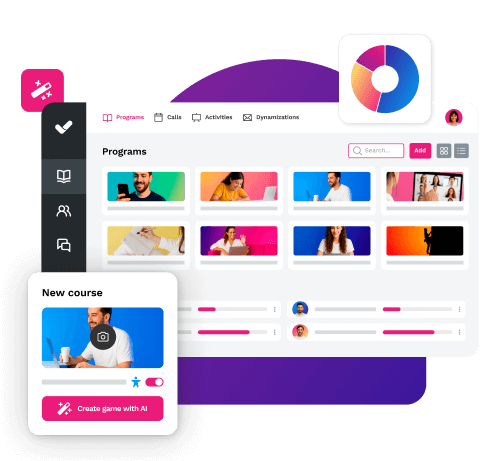
A Learning Management System (LMS) is the core tool for managing a corporate training plan. It allows you to organize learning paths, assign courses by group, monitor execution, and provide real visibility into progress.
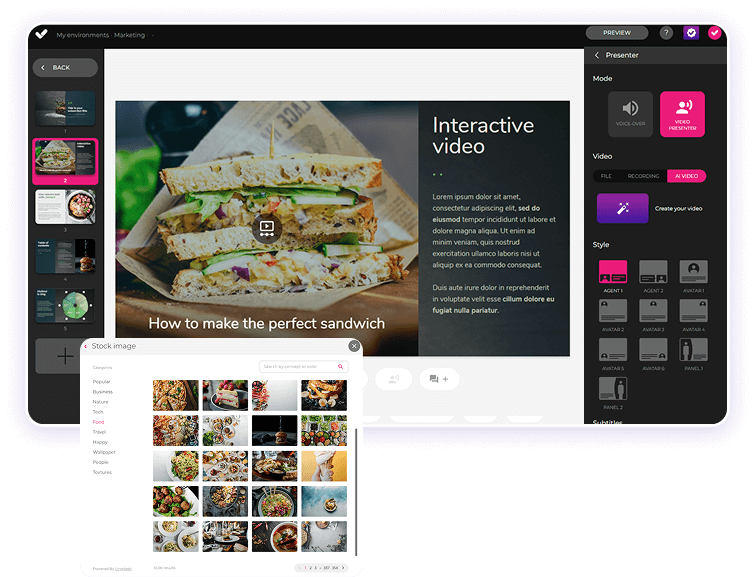
In addition to delivering training, many companies need to create their own content: internal processes, policies, onboarding, product knowledge, tools, and more. E-learning authoring tools make it possible to generate interactive courses without depending on external suppliers.
In modern training plans, the combination of “LMS + authoring tool” is what makes the plan truly sustainable over time.
A common challenge when implementing a training plan is that the organization has the strategy in place but the content is not yet ready. That is why many organizations incorporate a corporate course catalog (especially for soft skills, compliance, and digital skills).

The most efficient way to manage a training plan today is to have a single environment where you can create, manage, and measure all your training. This simplifies operations, improves the employee experience, and allows you to scale learning without multiplying tools or processes.
Pepco, the retail chain with a presence in more than 20 European countries, used isEazy to manage the training of tens of thousands of store employees from a centralized platform. Their challenge was to ensure consistent training across multiple languages and locations, while maintaining high completion rates. Discover how they did it →
That is why you should discover isEazy LMS, the all-in-one AI-powered learning management platform that lets you manage all your training end to end, choose from hundreds of expert-created courses, and create your own content faster than ever. Designed to cover all your workforce’s needs: onboarding, compliance, corporate training programs, key skills, and more. Request a demo today.
The timeline depends on several factors, including the size of the organization, the scope of the plan, and the resources available. A basic training plan can be developed in a few weeks, while more comprehensive plans may require months of planning and implementation.
It is not mandatory, but a training plan is highly recommended for any organization looking to improve talent retention, adapt to market changes, and keep employees up to date and engaged.
Metrics such as employee satisfaction, achievement of specific learning objectives, skills improvement, productivity gains, and retention of key talent can all be used to measure success. Tools like the Kirkpatrick Model provide a structured framework for evaluating training impact at four levels: reaction, learning, behavior, and results.
Continuous training focuses on the ongoing, progressive development of employee skills over time, whereas other types — such as onboarding or compliance training — tend to be one-time initiatives designed to address immediate needs. A well-rounded training plan typically includes both.
Yes, many governments and organizations offer subsidies or incentives to encourage continuous training in companies. It is advisable to check the options available in your country or region, as eligibility criteria and funding amounts vary.
Solutions like isEazy offer end-to-end tools for designing, implementing, and tracking training plans — including customization options and analytics to optimize effectiveness. An LMS (Learning Management System) is the core platform for managing assignments, tracking progress, and measuring ROI in real time.
It is essential to communicate the benefits of training clearly, align learning with employees’ personal and professional goals, and offer incentives that foster engagement and commitment. Formats such as microlearning, gamification, and social learning significantly improve participation and completion rates.

Streamline your training management
Experience the power of AI in an LMS that has it all


Automate processes, access 600+ ready-to-use courses, or create your own content with the help of AI.
Request a demoContact us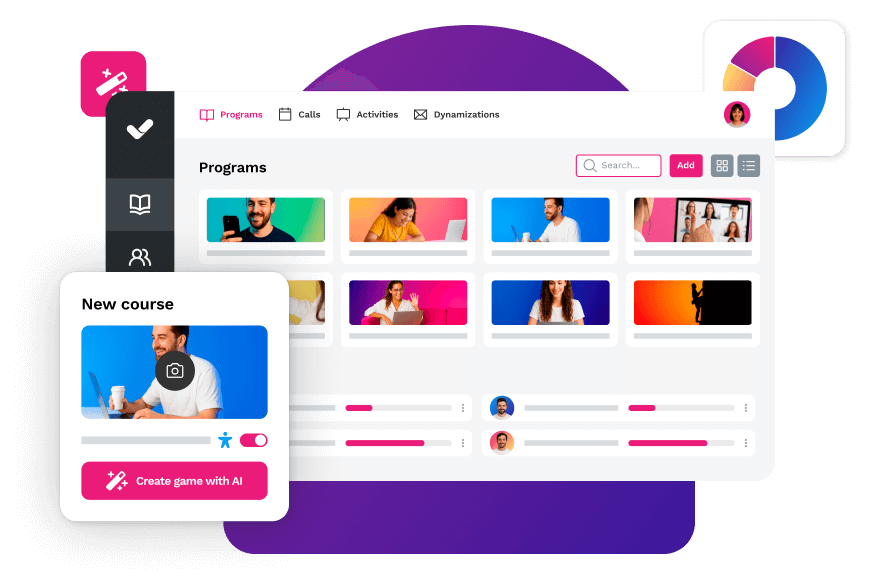
Streamline your training management
Experience the power of AI in an LMS that has it all