CASE STUDY
Learn how we helped AKRON Group promote upskilling and reskilling of their workforce

Brain
The first AI trained to teach

Author
The #1 AI-powered authoring tool on the market

Factory
Custom e-learning content factory

Skills
Comprehensive power skills course catalog

LMS
All-in-one LMS platform with AI

Engage
App for managing frontline teams
Product

What is Brain?
Everything you need to know about the first AI trained to teach.

How does it work?
Adaptive, conversational, and contextual. That’s learning with Brain.

Security
Why your company’s knowledge never leaves your environment or trains other models.

Comparison
Discover what sets isEazy Brain apart from other AI solutions.

Frequently Asked Questions
Want to learn more? Find answers to all your questions about isEazy Brain here.
FEATURES

AINew
Unlock your full potential and speed up course creation with artificial intelligence.

Accessibility
Automatically meet accessibility guidelines—without sacrificing interactivity!

Interactivity
Boost engagement with interactive, ready-to-use activities that make learning fun.

Course Creation
Reduce the time it takes to create your e-learning courses with our authoring tool.

Distribution
We offer you different distribution options, so that nothing can stop you.

SCORM
Publish your course in SCORM format and share it on any LMS.
SERVICES

Instrucional Design
Surprise your students with multimedia and interactive content.

Custom Courses
We create e-learning courses for you—tailored to your needs and hassle-free!

Virtual Reality
Turn learning into an immersive experience.

Custom Avatars
Give your courses and videos a unique touch with personalized avatars.

Audiovisual FactoryNew
Turn training into something dynamic and visual with engaging videos.
CATALOG

Course catalog
Over 600 skills and competency courses to help you adapt to your team's needs.
Microsoft Copilot AcademyNew
Your professionals will learn how to apply Copilot AI to key processes within your organization.

Artificial Intelligence Academy
Train your teams in the practical use of AI to boost productivity and innovation in your company.

Cybersecurity Academy
Capacita a tu empresa con el catálogo más completo en seguridad digital corporativa.
FEATURES

Learning platform
Manage all your training from one place

Analitycs
Measure the impact of your training

Learning Experience
Offer a unique learning experience to your team
Content Library
Choose from hundreds of expert-created courses
Authoring Tool
Create your own content—faster than ever

Use cases
Choose the solution that best fits your needs

Industries
Solutions for all types of industries
USE CASES

Onboarding
Facilitate the onboarding process, productivity and engagement of your new employees.

Upskilling
Boost your team's skills and prepare them for the challenges of the future with upskilling.

Microlearning
Discover all the advantages of microlearning and boost your training results.

Gamification
Enjoy addictive training that will get your professionals hooked.

Internal Communication
Improve communication in your company and enjoy an aligned and committed team.

Mobile learning
Agile, flexible, and interactive learning—built for today’s digital-first workforce.
INDUSTRIES

Banking and financial services
Training in compliance, cybersecurity, customer service, and key skills development.

Pharmaceuticals and healthcare
Digital onboarding, regulatory updates, and ongoing training for healthcare staff.

Retail and consumer
Agile and scalable training for in-store, operational, and customer service teams.

Industry and manufacturing
Training in processes, safety, and corporate culture for distributed teams.

Education and training
Digital solutions for training centers, internal academies, and corporate universities.

Technology and telecommunications
Development of technical talent, digital skills, and upskilling and reskilling programs.
CLIENTS

MAPFRE
How MAPFRE turn e-learning into sales with isEazy

Pepco
A personalised learning experience for a growing team.

BBVA
Digitisation and creation of high quality e-learning content.

Shiseido
We increase the engagement of the training with a social and gamified app.

Telefónica
Large-scale reskilling for the company's digital transformation.

Vodafone
A personalised learning experience for a growing team.
More than 1,000 companies already rely on isEazy.





MEET ISEAZY

Events
Discover our upcoming events and connect with the future of e-learning.

News
Find out the latest news about isEazy: press releases, partnerships, updates...

Contact
Leave us your personal details and we will contact you as soon as possible.
About isEazyNew
Find out more about our company.

Careers
We are looking for the best talent, join our team!

Partners
Become our partner and grow your business.
INTERESTING RESOURCES

Blog
The best content on e-learning: trends, tools and key strategies.

Whitepapers
Gain valuable insights and stay ahead of industry trends.

Product releases
The latest news and releases of our e-learning products and solutions.

Glossary
Definitions of the most commonly used terms and key industry concepts.

Guides
Discover the best step-by-step tips and tricks to optimize your L&D strategy.

Webinars
Video sessions on our products, trends and more

Comparatives
Compare e-learning solutions available on the market and choose the most suitable one.


WEBINAR
Master AI in isEazy Author in under an hour.




GUIDE
Prepare your organization to comply with the new AI regulations

Stay up to date with all our latest news
 Subscribe to our newsletter
 Stay up to date with all our latest news

May 25, 2026

CONTENT CREATED BY:

Table of contents
Are your most valuable employees leaving even though you’re paying them well? Emotional compensation is the answer many organizations are still not taking advantage of. And within it, corporate training is its most powerful lever: the one that turns work into a real opportunity for growth.
Emotional compensation encompasses everything an organization offers its employees beyond salary: from flexible working hours and recognition to development opportunities and career plans. Unlike emotional salary, a term often used as a synonym but one that focuses on the employee’s subjective perception, emotional compensation is a broader concept that includes concrete, measurable actions by the company.
In the context of HR and L&D departments, emotional compensation has gone from being an “extra” to a strategic priority. According to PwC’s Global Workforce Hopes and Fears Survey 2024, 28% of employees planning to change jobs in the next year cite lack of development opportunities as the main reason, ahead of even economic compensation.
This places training managers at the center of retention strategy: a company’s training offering is no longer a peripheral benefit but part of the emotional contract with its employees.
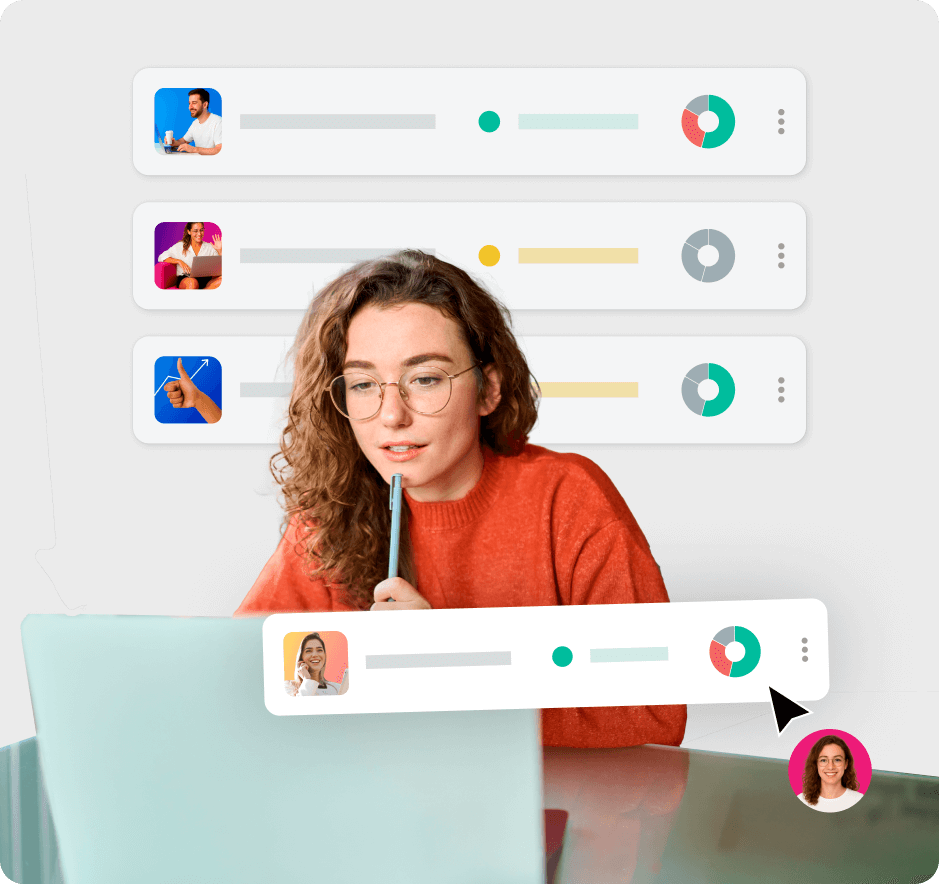
Of all the elements that make up emotional compensation—work-life balance, recognition, workplace climate, social benefits—training is the only one that directly impacts three dimensions simultaneously: employee motivation, their employability, and the organization’s business results.
The most cited statistic in the industry comes from LinkedIn Learning’s Workplace Learning Report 2024: 94% of employees say they would stay longer at their company if it invested in their professional development. This is not a minor figure: it means that almost the entire workforce is willing to make a long-term commitment if they perceive that the organization is invested in their growth.
Self-determination theory (Deci and Ryan, 1985) explains the psychological mechanism behind this phenomenon: people have three fundamental needs — competence, autonomy, and relatedness. Well-designed training directly addresses all three: it makes employees feel more capable, gives them control over their development, and connects them to a shared organizational purpose.
The business data reinforces this:
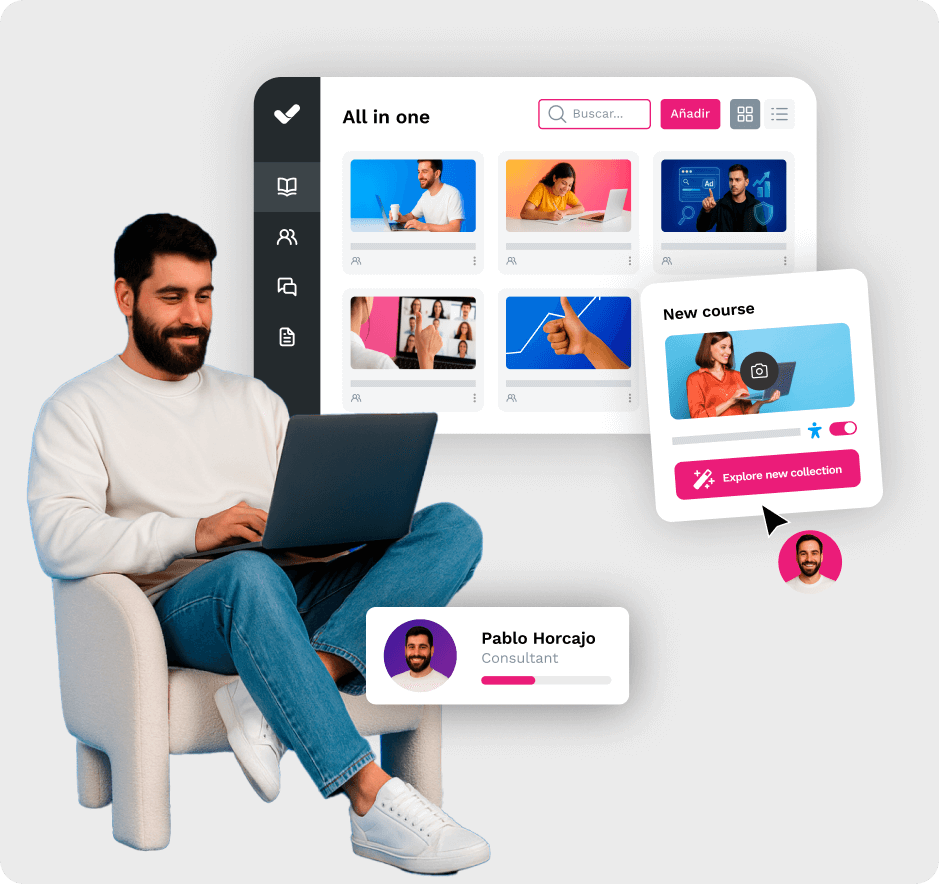
Not all training has the same impact as a tool for emotional compensation. The key is designing an offering that connects with employees’ real development needs. These are the formats with the greatest retention power:
Equipping employees with new skills in their current area (upskilling) or preparing them to take on different roles (reskilling) is the type of training with the greatest impact on employees’ perception of value. It sends an unambiguous message: the company is investing in them for the long term.
Short-form learning, accessible anytime and from any device, reduces the friction of learning without interrupting the workday. Microlearning well integrated into the workflow increases completion rates and reinforces the perception that the company respects the employee’s time.
Generic training is perceived as an obligation. A learning path designed around the individual employee’s role, level, and career objectives transforms training into a genuine personal development asset. This is the modality with the highest positive impact on eNPS and voluntary turnover.
Mentoring programs—whether formal or informal—strengthen the employee’s sense of belonging and create lasting ties with the organization beyond their immediate role. Peer learning reinforces the sense of belonging and commitment to the organizational culture.
Offering training in cross-functional competencies—leadership, communication, time management, mindfulness—signals that the company cares about the person’s holistic development, not just their job performance.
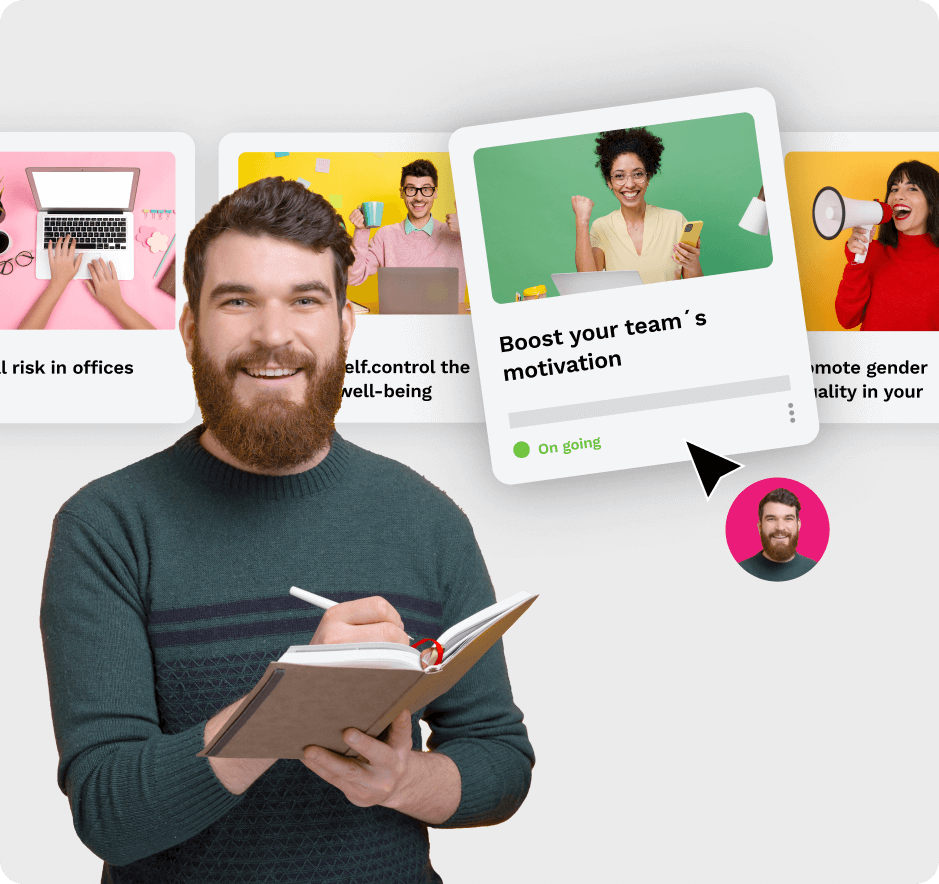
An effective emotional compensation strategy is not improvised: it requires a structured process that connects employees’ needs with business objectives. These are the four key steps:
Before designing any program, it is essential to understand what employees really need and what competencies will be critical for the organization over the next two or three years. Useful tools include: engagement surveys, development interviews, skills gap analysis, and performance data.
Generic training has little impact as emotional compensation. The key is designing personalized—or at least role-, level-, and career-stage-segmented—learning paths that the employee perceives as relevant and valuable. A catalog of courses that nobody finishes does not generate commitment; a targeted path that unlocks a promotion does.
For training to function as emotional compensation, it must be communicated as such. Integrating it into the EVP, making it visible from onboarding, and celebrating achievements publicly transforms training from an internal process into a cultural differentiator. Concrete formats: personalized learning paths, real-project mentoring, certifications tied to career milestones.
Without metrics, the emotional compensation strategy remains in the realm of good intentions. It is essential to link training indicators (completion rate, training NPS, learning hours per capita) with retention indicators (turnover rate, eNPS, average tenure).
A training-based emotional compensation strategy is only sustainable if it is measured. These are the key indicators that L&D and HR teams must monitor together:
This table summarizes the main training-based emotional compensation actions and their expected impact on retention indicators:
| Training action | Impact on retention | Key indicator |
|---|---|---|
| Upskilling / reskilling program | High — reduces obsolescence and builds confidence | Internal promotion rate |
| Personalized learning path | High — increases perception of individual investment | eNPS + completion rate |
| Microlearning integrated into workflow | Medium-high — reduces friction and boosts engagement | Completion rate + training NPS |
| Internal mentoring program | High — reinforces belonging and culture transfer | Voluntary turnover rate |
| Certifications and formal recognition | Medium-high — links learning to career progression | Internal promotion rate |
| Soft skills training | Medium — improves workplace climate and team trust | eNPS + absenteeism |
AKRON Group is a reference point for how an organization can use training as a strategic lever of emotional compensation. With a constantly evolving workforce, the group needed to offer its employees real development opportunities that went beyond mandatory training: an accessible, up-to-date catalog aligned with their career plans. Thanks to isEazy Skills, AKRON implemented an upskilling and reskilling strategy that made training a central element of its employee value proposition. Discover how they did it →
CASE STUDY
Learn how we helped AKRON Group promote upskilling and reskilling of their workforce


A training-based emotional compensation strategy needs technological support. The course catalog available to employees is, in many cases, the most visible showcase of the company’s training commitment: its breadth, quality, and relevance largely determine how the employee perceives the organization’s dedication to their development.
Below, a comparison of the leading corporate training catalog platforms and their differentiating features:

Features
Benefits
Ratings
Specialized Schools
Features
Benefits
Ratings
Specialized Schools

Features
Advantages
Ratings
Features
Advantages
Ratings

Features
Advantages
Ratings
Features
Advantages
Ratings
Emotional compensation is not a passing trend or a secondary benefit: it is the new frontier of the employee value proposition. And within it, corporate training holds a privileged position because it is the only element that, when well designed, simultaneously satisfies the needs of the employee (to grow, advance, feel valued) and those of the organization (to reduce turnover, increase productivity, build culture).
Companies that understand this do not manage training as a cost or a legal obligation: they integrate it as part of their employer identity and measure it with the same indicators as any other strategic investment. The result is a more engaged, more productive workforce that, above all, is far harder to lose to a competitor’s higher salary offer.
If you are designing or reviewing your organization’s training strategy, the starting point is not the course catalog: it is the question of what your team needs to grow. The tools to answer that at scale—such as isEazy Skills or isEazy LMS—already exist. What makes the difference is the strategic will to use them.
Although the two terms are often used interchangeably, there is an important distinction. Emotional salary focuses on the employee’s subjective perception: how they value the non-monetary benefits they receive. Emotional compensation is a broader, more strategic concept that refers to the set of concrete actions a company implements to meet its employees’ emotional, social, and developmental needs. In practice, emotional compensation is what the company designs and manages; emotional salary is what the employee experiences.
Because it addresses the employee’s deepest psychological needs: competence (feeling capable and growing), autonomy (having control over their development), and connection (belonging to an organization that invests in them). Other benefits like remote work or health insurance improve comfort or security, but they don’t generate the same level of long-term emotional commitment. Moreover, training has a very powerful signaling effect: when a company invests in an employee’s development, it is implicitly telling them that it is counting on them for the future.
The ROI of training-based emotional compensation is measured by cross-referencing training indicators (completion rate, training NPS, learning hours per capita) with retention and performance indicators (voluntary turnover rate, eNPS, internal promotion rate, productivity per employee). The key is to establish a baseline before launching the strategy and measure changes over a 12- to 24-month horizon. It is also useful to compare the turnover rate between employees who actively participate in training programs and those who do not: the difference is usually significant.
Any organization, regardless of size, can and should work on emotional compensation through training. In small companies, it can start with a few targeted development conversations and access to online learning platforms. In medium and large organizations, the strategy requires more structure: personalized learning paths, internal mentoring, certifications tied to career milestones. The key is not the budget, but the intentionality: demonstrating to each employee that the organization is committed to their growth.

GUIDE
Prepare your organization to comply with the new AI Regulations
Download guide


Your team’s talent is your greatest asset. Grow it with isEazy Skills
Develop soft skills and key competencies with a comprehensive course catalog designed to accelerate your team’s growth.

Your team’s talent is your greatest asset. Grow it with isEazy Skills
Develop soft skills and key competencies with a comprehensive course catalog designed to accelerate your team’s growth.