CASE STUDY
How Telefónica trained its employees in new skills with a large-scale reskilling plan

Brain
The first AI trained to teach

Author
The #1 AI-powered authoring tool on the market

Factory
Custom e-learning content factory

Skills
Comprehensive power skills course catalog

LMS
All-in-one LMS platform with AI

Engage
App for managing frontline teams
Product

What is Brain?
Everything you need to know about the first AI trained to teach.

Learning agent: CompanionNew
Supports learners and answers their questions right inside the course, without breaking the audit trail.

How does it work?
Adaptive, conversational, and contextual. That’s learning with Brain.
FEATURES

AINew
Unlock your full potential and speed up course creation with artificial intelligence.

Accessibility
Automatically meet accessibility guidelines—without sacrificing interactivity!

Interactivity
Boost engagement with interactive, ready-to-use activities that make learning fun.

Course Creation
Reduce the time it takes to create your e-learning courses with our authoring tool.

Distribution
We offer you different distribution options, so that nothing can stop you.

SCORM
Publish your course in SCORM format and share it on any LMS.
SERVICES

Instrucional Design
Surprise your students with multimedia and interactive content.

Custom Courses
We create e-learning courses for you—tailored to your needs and hassle-free!

Virtual Reality
Turn learning into an immersive experience.

Custom Avatars
Give your courses and videos a unique touch with personalized avatars.

Audiovisual FactoryNew
Turn training into something dynamic and visual with engaging videos.
CATALOG

Course catalog
Over 600 skills and competency courses to help you adapt to your team's needs.
Microsoft Copilot AcademyNew
Your professionals will learn how to apply Copilot AI to key processes within your organization.

Artificial Intelligence Academy
Train your teams in the practical use of AI to boost productivity and innovation in your company.

Cybersecurity Academy
Capacita a tu empresa con el catálogo más completo en seguridad digital corporativa.

Use cases
Choose the solution that best fits your needs

Industries
Solutions for all types of industries
USE CASES

Onboarding
Facilitate the onboarding process, productivity and engagement of your new employees.

Upskilling
Boost your team's skills and prepare them for the challenges of the future with upskilling.

Microlearning
Discover all the advantages of microlearning and boost your training results.

Gamification
Enjoy addictive training that will get your professionals hooked.

Internal Communication
Improve communication in your company and enjoy an aligned and committed team.

Mobile learning
Agile, flexible, and interactive learning—built for today’s digital-first workforce.
INDUSTRIES

Banking and financial services
Training in compliance, cybersecurity, customer service, and key skills development.

Pharmaceuticals and healthcare
Digital onboarding, regulatory updates, and ongoing training for healthcare staff.

Retail and consumer
Agile and scalable training for in-store, operational, and customer service teams.

Industry and manufacturing
Training in processes, safety, and corporate culture for distributed teams.

Education and training
Digital solutions for training centers, internal academies, and corporate universities.

Technology and telecommunications
Development of technical talent, digital skills, and upskilling and reskilling programs.
CLIENTS

MAPFRE
How MAPFRE turn e-learning into sales with isEazy

Pepco
A personalised learning experience for a growing team.

BBVA
Digitisation and creation of high quality e-learning content.

Shiseido
We increase the engagement of the training with a social and gamified app.

Telefónica
Large-scale reskilling for the company's digital transformation.

Vodafone
A personalised learning experience for a growing team.
More than 1,000 companies already rely on isEazy.





MEET ISEAZY

Events
Discover our upcoming events and connect with the future of e-learning.

News
Find out the latest news about isEazy: press releases, partnerships, updates...

Contact
Leave us your personal details and we will contact you as soon as possible.
About isEazyNew
Find out more about our company.

Careers
We are looking for the best talent, join our team!

Partners
Become our partner and grow your business.
INTERESTING RESOURCES

Blog
The best content on e-learning: trends, tools and key strategies.

Whitepapers
Gain valuable insights and stay ahead of industry trends.

Product releases
The latest news and releases of our e-learning products and solutions.

Glossary
Definitions of the most commonly used terms and key industry concepts.

Guides
Discover the best step-by-step tips and tricks to optimize your L&D strategy.

Webinars
Video sessions on our products, trends and more

Comparatives
Compare e-learning solutions available on the market and choose the most suitable one.


WEBINAR
Master AI in isEazy Author in under an hour.




GUIDE
Prepare your organization to comply with the new AI regulations

Stay up to date with all our latest news
 Subscribe to our newsletter
 Stay up to date with all our latest news

August 24, 2026

CONTENT CREATED BY:

Table of contents
Persuasive communication is the ability to influence people’s opinions, attitudes, or behaviors through solid arguments, emotional appeals, and perceived credibility. It is one of the most in-demand soft skills in the professional environment: we use it in meetings, presentations, negotiations, emails, and everyday conversations.
In the HR and L&D field, mastering this skill makes the difference between a message that drives action and one that gets forgotten. According to LinkedIn Learning’s Workplace Learning Report 2024, communication skills rank among the five most sought-after skills by organizations for team development in 2024 and 2025.
More than 2,000 years ago, Aristotle identified the three elements that determine whether a message is convincing or not. They remain the most solid reference framework for any professional who wants to communicate with impact.
Ethos is the authority and trust projected by the speaker. An L&D manager who justifies a training change with impact data generates more buy-in than one who relies solely on intuition. Credibility is built through consistency, transparency, and demonstrating results.
Pathos connects the message with what matters to the receiver: their fears, aspirations, or values. In internal communications, appealing to the team’s sense of purpose or the impact of learning on professional development activates pathos in an authentic way.
Logos supports the argument with data, evidence, and coherent reasoning. A training plan that is well-justified with business metrics is far more persuasive than a proposal based on good intentions alone. The three pillars work together: without ethos, logos goes unheard; without pathos, it is not remembered; without logos, it does not convince.
Truly persuasive communication is not limited to choosing the right words. It means activating all available resources: the ability to observe, listen, intuit, adapt the message, and deliver it with the right tone. Here is how the five senses become a practical guide to communicating more effectively.
According to experts in neurolinguistic programming, a significant share of people process information primarily in a visual way. This has two implications: first, your message must enter through the eyes — with concrete examples, visual resources, and language that generates mental images; and second, you must be a good observer of context. If your interlocutor’s emotional state is not right, sight allows you to detect it and, if necessary, postpone the conversation to a more favorable moment.
Persuasive communication is not a monologue. Having hearing means truly listening — without interrupting or prejudging — asking sincere questions and understanding the other person’s point of view before making your case. Many professionals talk about their own agenda without caring about what the other party actually needs. That attitude creates disconnection and misunderstandings. Active listening, on the other hand, allows you to build arguments that genuinely resonate. It is directly related to emotional intelligence at work.
Smell in communication is equivalent to intuition: the ability to interpret subtle signals and detect the right moment to launch a message, even without having all the information available. A good persuasive communicator knows when to push and when to wait. It is also about prudence: not all situations are the same, and adapting your approach to the context is a skill that can be trained.
The correct version of the golden rule in communication is: “communicate with people the way they would like to be communicated with.” Taste is the ability to identify what style, tone, and level of detail each interlocutor needs for the message to truly land. Persuading without adapting the message is like cooking only for yourself.
Touch is the finest sense in persuasive communication. It relates to kindness, assertiveness, and empathy. Saying things in the right way — even when the message is difficult — is a skill that makes the difference between someone who builds trust and someone who raises resistance. Touch is what allows a tough piece of feedback to be received as an opportunity for growth, not as an attack.
Beyond the five senses, there are concrete techniques that allow persuasive messages to be structured systematically. These are the most relevant for the professional and training environment:
Telling stories is the oldest and most effective persuasive technique. A well-constructed narrative — with context, challenge, action, and result — activates both pathos and logos. In internal communications, sharing real stories of transformation or learning connects emotionally with the team far more than data alone.
People tend to give back when they feel they have received something of value. A training manager who shares useful resources before asking for commitment to a programme creates a positive predisposition. The principle of reciprocity, identified by Robert Cialdini in Influence: The Psychology of Persuasion (1984), is one of the six pillars of social influence.
Showing that others have done the same — and with good results — reduces resistance to change. In corporate training, this translates into sharing satisfaction rates, participant testimonials, or results from previous programmes. Social proof turns an individual proposal into a collective trend.
People remain consistent with their prior commitments. An effective strategy is to ask for small initial commitments — such as attending a presentation session — before proposing larger ones. This approach is especially useful in internal communications for the adoption of new initiatives.
Anticipating and addressing objections before they are raised is an advanced persuasion technique. Openly acknowledging the limitations of a proposal builds credibility and defuses resistance. Rather than avoiding the uncomfortable, the persuasive communicator incorporates it as part of the argument.
Each sense we activate when communicating is backed by a set of professional competencies that can be trained. The table below summarises the key connections and provides a practical guide for identifying what to work on depending on the area for improvement. It is useful both for individual self-diagnosis and for designing development plans within teams.
| Sense | Associated skills and competencies | How to train it in L&D |
|---|---|---|
| Sight | Contextual adaptation, strategic thinking, observation | Role-play exercises, visual feedback, presentation simulations |
| Hearing | Active listening, emotional intelligence, mindfulness, asking questions | Listening dynamics, non-violent communication courses, coaching sessions |
| Smell | Prudence, decision-making, analytical thinking | Case studies, situational analysis, situational leadership programmes |
| Taste | Persuasion, impact and influence, message adaptation | Storytelling workshops, DISC profile training, person-to-person communication exercises |
| Touch | Assertiveness, empathy, kindness | Feedback practice, emotional management workshops, conflict resolution |
Identifying that someone needs to improve their persuasive communication is the first step. The second — and most important in L&D — is designing a development plan that is scalable, measurable, and connected to business objectives. Here are the four key steps:
Before intervening, it helps to know where the gap lies. Is the problem one of listening (hearing)? Of adapting the message (taste)? Of perceived credibility (ethos)? Competency assessments, 360° feedback, and observations in real situations are useful tools for this diagnosis. A communication skills test can also help.
Persuasive communication does not improve with theory alone. The development plan must combine learning content (concepts, frameworks, techniques) with deliberate practice: simulations, role-plays, real case analyses, and structured feedback sessions. Training in customer service skills or leadership are natural contexts for integrating this work.
Telefónica is a great example of how a global-scale company can address the development of communication skills through digital training. With isEazy Skills, their teams access up-to-date content on soft skills — including communication, leadership, and emotional intelligence — in a flexible and measurable way. Discover how they did it →
CASE STUDY
How Telefónica trained its employees in new skills with a large-scale reskilling plan


A persuasive communication development plan must be measurable. Indicators can be quantitative — completion rates, assessment results, improvements in internal NPS — or qualitative — manager perception, observations in real-world contexts. What matters is closing the loop: diagnosis → training → practice → measurement → new diagnosis.

Persuasive communication is not a gift you are born with — it is a competency developed through practice, self-awareness, and the right training. In a corporate environment where many challenges are resolved through conversations, presentations, negotiations, and feedback processes, knowing how to communicate clearly and influence ethically becomes a strategic advantage.
The five senses we have explored — sight, hearing, smell, taste, and touch — provide a practical framework for identifying areas for improvement. Combined with the principles of ethos, pathos, and logos, and techniques such as storytelling, active listening, and objection handling, they allow for the building of messages that are more credible, relevant, and action-oriented.
If you are looking for a catalogue of ready-to-use content to work on these competencies with your team, the isEazy Skills catalogue includes specific courses on business skills, leadership, and emotional intelligence to address each dimension of persuasive communication in a structured way. You can also request an isEazy Skills demo to see how it adapts to your organisation’s needs.
Persuasive communication is the ability to influence people’s opinions, attitudes, or behaviors through compelling arguments, emotional appeals, and credibility. Unlike informative communication, its goal is not simply to share information, but to drive a change: to get the receiver to think, decide, or act in a specific way. In the workplace, it is an essential soft skill for leaders, trainers, and team managers.
Persuasion seeks to influence others through honest arguments, respecting their autonomy and benefiting both parties. Manipulation, on the other hand, conceals information, distorts reality, or exploits emotional weaknesses to achieve an outcome that only benefits the sender. The line between them lies in transparency and intent: a persuasive communicator offers real reasons; a manipulator offers apparent ones.
Improving persuasive communication requires working on several competencies in parallel: active listening, empathy, assertiveness, and emotional intelligence. In practice, it helps to practise the ethos-pathos-logos structure in internal presentations, receive feedback on message impact, and train techniques such as storytelling and objection handling. In a corporate setting, soft skills training programmes — such as those in the isEazy Skills catalogue — allow these competencies to be developed in a scalable and measurable way.
In the business environment, persuasive communication appears constantly: a manager justifying a process change to their team, a trainer motivating employees to complete a learning programme, an executive presenting the annual strategy to generate commitment, or a sales professional adapting their pitch to the client’s needs. In all these cases, success depends not only on the content of the message, but on how it is delivered: with well-balanced credibility, emotion, and logic.

WHITEPAPER
Discover the power skills that will transform your company
Download whitepaper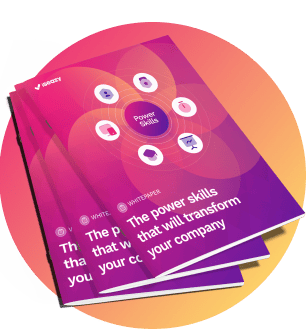

Enhance your team's skills with isEazy Skills
Discover how isEazy Skills can transform your team’s skills with high-impact courses

Enhance your team's skills with isEazy Skills
Discover how isEazy Skills can transform your team’s skills with high-impact courses