WHITEPAPER
Discover the power skills that will transform your company

Brain
The first AI trained to teach

Author
The #1 AI-powered authoring tool on the market

Factory
Custom e-learning content factory

Skills
Comprehensive power skills course catalog

LMS
All-in-one LMS platform with AI

Engage
App for managing frontline teams
FEATURES

AINew
Unlock your full potential and speed up course creation with artificial intelligence.

Accessibility
Automatically meet accessibility guidelines—without sacrificing interactivity!

Interactivity
Boost engagement with interactive, ready-to-use activities that make learning fun.

Course Creation
Reduce the time it takes to create your e-learning courses with our authoring tool.

Distribution
We offer you different distribution options, so that nothing can stop you.

SCORM
Publish your course in SCORM format and share it on any LMS.
SERVICES

Instrucional Design
Surprise your students with multimedia and interactive content.

Custom Courses
We create e-learning courses for you—tailored to your needs and hassle-free!

Virtual Reality
Turn learning into an immersive experience.

Custom Avatars
Give your courses and videos a unique touch with personalized avatars.

Audiovisual FactoryNew
Turn training into something dynamic and visual with engaging videos.
CATALOG

Course catalog
Over 600 skills and competency courses to help you adapt to your team's needs.
Microsoft Copilot AcademyNew
Your professionals will learn how to apply Copilot AI to key processes within your organization.

Artificial Intelligence Academy
Train your teams in the practical use of AI to boost productivity and innovation in your company.

Cybersecurity Academy
Capacita a tu empresa con el catálogo más completo en seguridad digital corporativa.

Use cases
Choose the solution that best fits your needs

Industries
Solutions for all types of industries
USE CASES

Onboarding
Facilitate the onboarding process, productivity and engagement of your new employees.

Upskilling
Boost your team's skills and prepare them for the challenges of the future with upskilling.

Microlearning
Discover all the advantages of microlearning and boost your training results.

Gamification
Enjoy addictive training that will get your professionals hooked.

Internal Communication
Improve communication in your company and enjoy an aligned and committed team.

Mobile learning
Agile, flexible, and interactive learning—built for today’s digital-first workforce.
INDUSTRIES

Banking and financial services
Training in compliance, cybersecurity, customer service, and key skills development.

Pharmaceuticals and healthcare
Digital onboarding, regulatory updates, and ongoing training for healthcare staff.

Retail and consumer
Agile and scalable training for in-store, operational, and customer service teams.

Industry and manufacturing
Training in processes, safety, and corporate culture for distributed teams.

Education and training
Digital solutions for training centers, internal academies, and corporate universities.

Technology and telecommunications
Development of technical talent, digital skills, and upskilling and reskilling programs.
CLIENTS

MAPFRE
How MAPFRE turn e-learning into sales with isEazy

Pepco
A personalised learning experience for a growing team.

BBVA
Digitisation and creation of high quality e-learning content.

Shiseido
We increase the engagement of the training with a social and gamified app.

Telefónica
Large-scale reskilling for the company's digital transformation.

Vodafone
A personalised learning experience for a growing team.
More than 1,000 companies already rely on isEazy.





MEET ISEAZY

Events
Discover our upcoming events and connect with the future of e-learning.

News
Find out the latest news about isEazy: press releases, partnerships, updates...

Contact
Leave us your personal details and we will contact you as soon as possible.
About isEazyNew
Find out more about our company.

Careers
We are looking for the best talent, join our team!

Partners
Become our partner and grow your business.
INTERESTING RESOURCES

Blog
The best content on e-learning: trends, tools and key strategies.

Whitepapers
Gain valuable insights and stay ahead of industry trends.

Product releases
The latest news and releases of our e-learning products and solutions.

Glossary
Definitions of the most commonly used terms and key industry concepts.

Guides
Discover the best step-by-step tips and tricks to optimize your L&D strategy.

Webinars
Video sessions on our products, trends and more

Comparatives
Compare e-learning solutions available on the market and choose the most suitable one.


WEBINAR
Master AI in isEazy Author in under an hour.




GUIDE
Prepare your organization to comply with the new AI regulations

Stay up to date with all our latest news
 Subscribe to our newsletter
 Stay up to date with all our latest news

July 6, 2026

CONTENT CREATED BY:

Table of contents
Middle manager training is the set of development programs and actions designed to equip mid-level leaders with the competencies needed to translate organizational strategy into team results. Unlike generic executive training, it specifically focuses on the friction zone where corporate strategy either becomes — or fails to become — real execution.
In many organizations, middle managers are the most pressured link in the chain of command: they face pressure from above to meet objectives and from below to support and motivate their teams. According to a Gartner report (2023), 72% of middle managers say they feel caught between the demands of leadership and the needs of their teams, which directly impacts their performance and that of the organization as a whole. Specific training for this profile is not a luxury — it is a strategic investment with measurable returns in productivity, talent retention, and goal achievement.
Understanding what is expected of a middle manager is the starting point for designing effective training. Middle managers are neither pure strategic executives nor pure operational executors — they are translators. Their primary function is to turn directives from leadership into concrete, understandable, and motivating actions for their teams.
This means operating simultaneously on three levels:
This triple function means that middle manager training cannot rely solely on generic leadership skills. It needs to be contextualized, practical, and applied to the real environment of the organization.

There is no single middle manager profile, but there is a set of cross-functional competencies that all development programs for this group must address. These are the six most critical ones, based on leadership development research and L&D practice:
A McKinsey study (2022) found that 75% of leadership programs fail to produce sustained behavioral change because they address competencies in isolation, without connecting them to the real challenges of the role. The key lies in designing training where each competency is practiced in context, not in the abstract.
| Phase | Objective | Recommended tools |
|---|---|---|
| Diagnosis | Identify gaps and profiles | 360° assessment, climate surveys, team KPI analysis |
| Design | Build the learning path | E-learning authoring tool, competency map, sector benchmarking |
| Implementation | Deploy for maximum transfer | LMS, microlearning, gamification, peer practice groups |
| Measurement | Verify business impact | Kirkpatrick model, team KPIs, LMS tracking dashboards |
Most intermediate leadership programs fail not due to lack of investment, but because of design errors that repeat themselves. These are the most frequent:
There is no single optimal format for middle manager training. The right choice depends on the participants’ profiles, the organization’s culture, available resources, and program objectives. Here are the main options and when each makes sense:
| Format | Flexibility | Scalability |
|---|---|---|
| In-person | Low | Low |
| Asynchronous e-learning | High | High |
| Blended | Medium | Medium |
| Microlearning | Very high | Very high |
Measurement is the weak point of most leadership programs. The most solid model for evaluating them is the Kirkpatrick model, applied at four levels:
Levels 3 and 4 are the most difficult to measure but the most relevant for demonstrating the ROI of training investment. An LMS with KPI tracking capabilities and team dashboards makes this measurement significantly easier, especially when the program includes evaluable practical activities.

STF Group is a great example of how a well-designed leadership program can transform organizational performance. With isEazy Skills, STF Group achieved an 87% completion rate in its middle manager leadership program, combining structured learning paths with gamified content that maintained engagement throughout the entire program. Discover how they did it →
CASE STUDY
We helped STF Group achieve an 87% completion rate in its leadership program


Designing and deploying a middle manager training program requires tools that adapt to busy, geographically distributed profiles with high performance expectations. isEazy Skills offers a ready-to-use leadership and team management content catalog, combined with the flexibility to customize learning paths based on the real profile and needs of each organization.
With isEazy Skills, L&D managers can:
Explore the full isEazy Skills catalog to discover all available learning paths for leadership and people management.

Middle managers are the silent engine of any organization. They are the ones who turn strategic decisions into tangible results, who retain or lose team talent, and who largely determine the actual culture that the company lives day to day — far beyond the values proclaimed in corporate documents.
Investing in their training is not a wellbeing initiative — it is a business decision with measurable returns. A well-designed training program — contextualized, multimodal, with follow-up and impact measurement — can reduce team turnover, accelerate project execution, and sustainably improve organizational climate.
The key is not to treat middle managers as miniature executives or promoted technicians. They are a profile in their own right, with their own challenges, who deserve training designed specifically for them. Designing that training well is the responsibility of the L&D function, and today’s digital tools make that work more scalable and measurable than ever. Request a demo now and start training your team!
The duration varies depending on the depth of the program and the participants’ profiles. Intensive leadership development programs typically last between 3 and 6 months, with periodic training sessions and applied practice. If a microlearning or flexible e-learning format is chosen, the same content can be distributed in 10–20 minute modules over several weeks, adapting to managers’ schedules without disrupting daily operations. The most effective approach combines formal training with real-world projects and ongoing follow-up support.
Executive training typically focuses on high-level strategic competencies: business vision, P&L management, and corporate decision-making. Middle manager training, on the other hand, addresses the interface between strategy and execution: how to translate corporate objectives into team actions, how to manage people with diverse profiles, and how to communicate decisions that were not always made from the bottom up. Middle managers need both leadership and operational management skills, which makes their training more complex and specific.
Yes, and with strong results when the instructional design is right. The key is ensuring that online formats are not purely theoretical: the most effective programs combine e-learning content (concepts, frameworks, case studies) with asynchronous practical activities (simulations, team challenges, leadership journals) and occasional synchronous sessions for peer exchange. Platforms like isEazy Skills allow L&D teams to design personalized learning paths for middle managers, with leadership content, progress tracking, and built-in assessment tools.
The main obstacle is rarely motivation — it’s time and perceived relevance. To increase engagement: (1) co-design the program with middle managers or a representative sample, incorporating the real challenges they face; (2) explicitly connect each module to day-to-day situations, not abstract theory; (3) use agile formats that respect their available time (microlearning, learning in the flow of work); and (4) recognize progress with internal visibility. When managers see that training helps them solve concrete problems, engagement follows naturally.

WHITEPAPER
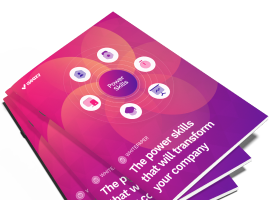
Discover the power skills that will transform your company in 2025
Download whitepaper

Develop Leadership Skills Across Your Team
Empower your team with the most comprehensive leadership training catalog available

Develop Leadership Skills Across Your Team
Empower your team with the most comprehensive leadership training catalog available